
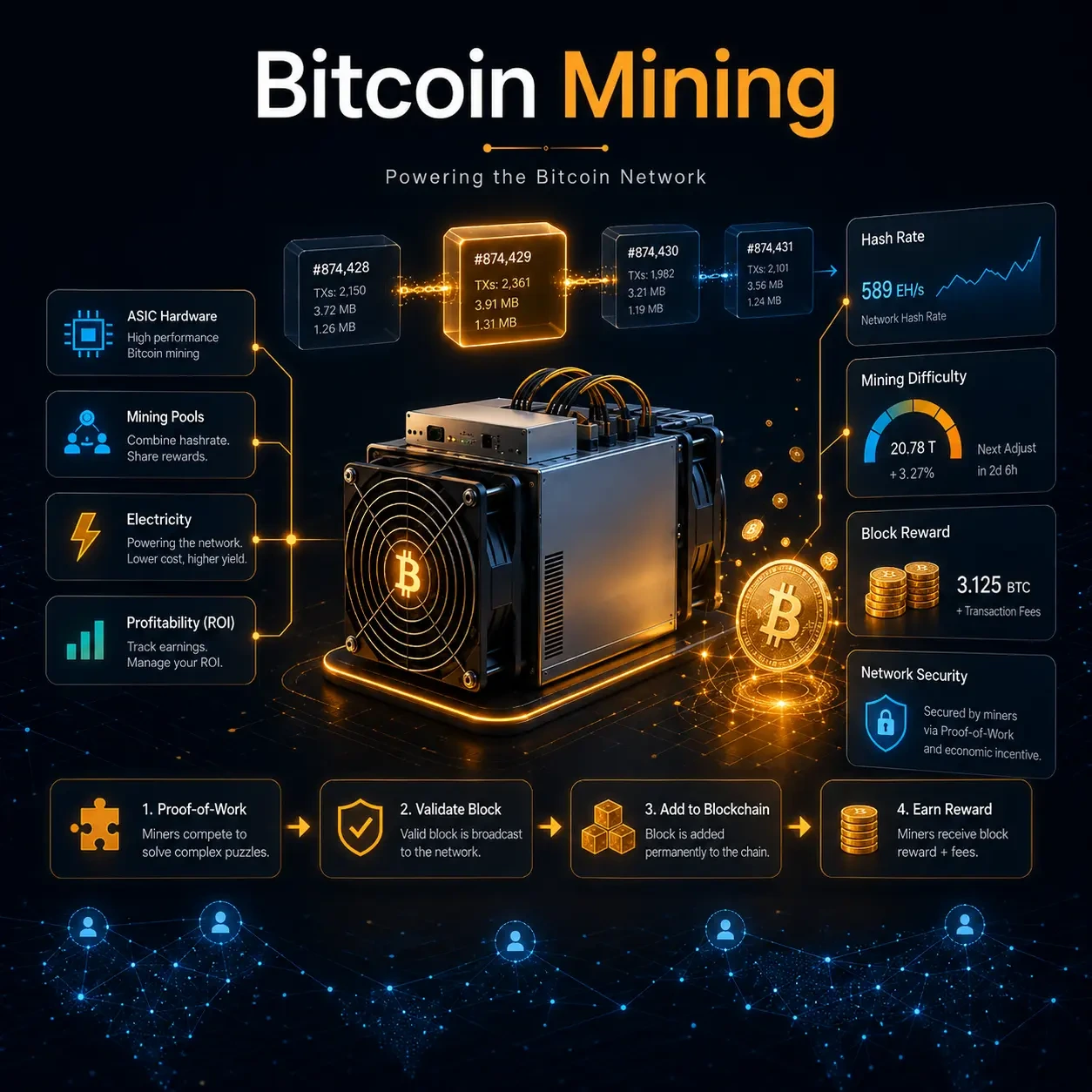
Transactions are collected
Miners select valid transactions and prepare them for inclusion in a candidate block.
Bitcoin mining is the foundation of the Bitcoin network and the starting point for the ECOS Academy learning path. This hub explains how miners validate blocks through Proof-of-Work, why hashrate matters, how mining difficulty keeps block production stable, and how block rewards connect network security with miner incentives.
Use this page as the parent section for beginner and intermediate mining education. It links upward to the Academy, sideways to hardware, pools and profitability, and downward into focused fundamentals such as what Bitcoin mining is, how ASIC miners work, how pools distribute rewards, and how electricity and ROI shape real mining decisions.
Mining validates transactions, adds blocks to the blockchain and creates a security cost for attacking the network.
FundamentalProof-of-Work requires miners to perform costly hashing before a block can be accepted by the network.
FundamentalHashrate measures mining power and helps compare ASIC machines, pools and expected output.
FundamentalDifficulty adjusts to total network hashrate so Bitcoin blocks stay close to the expected schedule.
FundamentalBlock rewards and transaction fees are the main economic incentives that miners compete for.
FundamentalPools combine hashrate from many miners and distribute rewards according to pool rules.

Miners select valid transactions and prepare them for inclusion in a candidate block.
ASIC machines repeatedly calculate SHA-256 hashes until one meets the current target.
The valid block is broadcast to the network, checked by nodes and added to the blockchain.
Every 2016 blocks, difficulty adjusts based on network hashrate to keep blocks near a 10-minute cadence.
Higher hashrate improves expected block reward share, but it must be compared with power draw.
J/TH shows how much energy a miner spends to produce hashrate.
Electricity often defines whether gross mining revenue remains profitable after operating costs.
ROI connects hardware cost, expected revenue, operating expenses and payback period.
Learn the definition, Proof-of-Work, blocks and rewards first.
02Compare miner models, efficiency, firmware, cooling and setup requirements.
03See how pools reduce payout variance and distribute rewards.
04Use calculators to connect mining theory with electricity, ROI and payback scenarios.