BTC
BTC KAS
KAS KDA
KDA LTC
LTC DOGE
DOGE ALPH
ALPH ERG
ERG ETHW
ETHWPoW
ASIC / GPUProof-of-Work Coins
PoW coins use mining to secure the network and create new blocks. Some are ASIC-dominated, while others remain accessible to GPUs.
Cryptocurrencies differ by consensus model, mining algorithm, hardware requirements and economic design. Some coins are mined with specialized ASIC devices, others remain practical for GPU mining, and many major networks no longer support mining at all because they use Proof-of-Stake or related models.
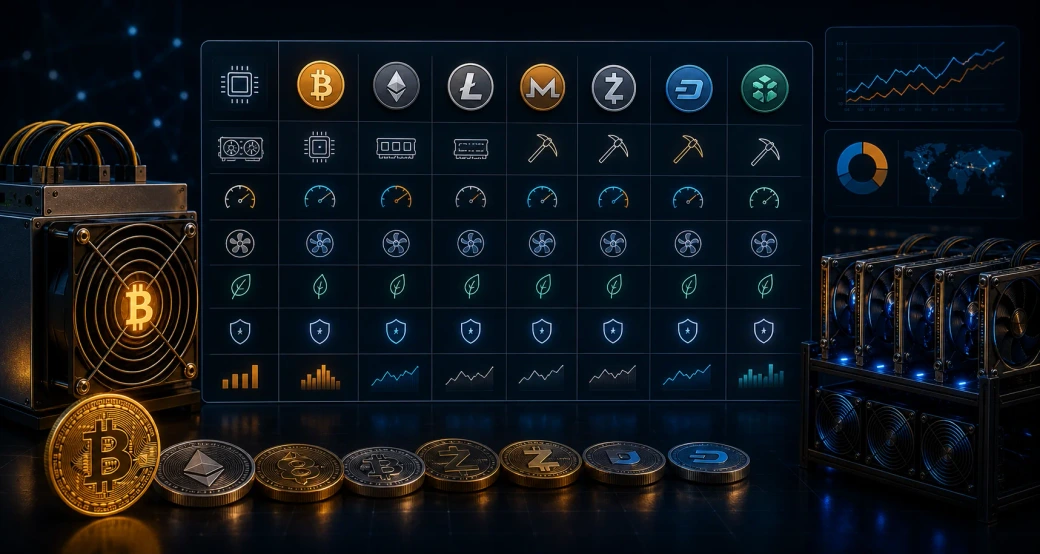
This ECOS Academy hub helps compare coins that matter to miners: Bitcoin, Litecoin, Dogecoin, Kaspa, Kadena, Alephium, Ergo, ETHW and other networks. Use it as a starting point for understanding which coins are mineable, what equipment they require, how algorithms affect profitability, and where coin research connects with mining hardware, pools and calculators.
PoW coins use mining to secure the network and create new blocks. Some are ASIC-dominated, while others remain accessible to GPUs.
Hybrid networks combine PoW, PoS or custom governance models. They may be mineable, but profitability and participation rules differ from classic PoW.
Non-mineable networks rely on staking, validators or delegated consensus. They are relevant to crypto markets but not to mining hardware selection.

Bitcoin is the benchmark SHA-256 network and the largest market for ASIC mining. It defines the standard for industrial hashrate, mining pools and halving cycles.

Kaspa uses KHeavyHash and has moved from GPU mining toward specialized ASIC competition as network hashrate increased.

Kadena uses the Blake2S algorithm and is mined with dedicated ASIC hardware on a multi-chain Proof-of-Work architecture.

Litecoin uses Scrypt and is commonly mined with ASICs. It is also connected to Dogecoin through merged mining.

Dogecoin is mined through Scrypt merged mining with Litecoin, making its economics tightly connected to LTC mining activity.
EthereumPoW preserves a Proof-of-Work version of Ethereum-style mining and is mainly relevant for GPU miners.
Kaspa started as a major GPU mining target before ASIC competition changed its hardware profile.

Alephium uses Blake3 and attracts GPU miners looking for efficient Proof-of-Work alternatives.

Ergo uses Autolykos and is known for GPU mining, smart-contract features and an active mining community.

Ravencoin uses KawPow, a GPU-friendly algorithm designed to resist ASIC dominance.

Neoxa uses KawPow and combines Proof-of-Work mining with gaming-oriented network ideas.

Dynex uses DynexSolve and appeals to GPU miners evaluating niche algorithms and alternative compute demand.
The algorithm determines whether a coin fits SHA-256 ASICs, Scrypt ASICs, GPUs or specialized hardware.
Hardware availability, efficiency and resale market affect mining risk as much as the coin itself.
Difficulty and hashrate growth show how competitive block rewards are becoming over time.
Halvings, tail emission and reward schedules shape long-term miner revenue.
Exchange depth matters because mined coins usually need to be sold, held or converted.
Profit depends on price, rewards, electricity cost, pool fees, uptime and hardware efficiency.
| Coin | Algorithm | Equipment | Emission | Notes |
|---|---|---|---|---|
 Bitcoin Bitcoin | SHA-256 | ASIC | Halving every 210,000 blocks | Most liquid PoW asset and strongest ASIC competition. |
 Litecoin Litecoin | Scrypt | ASIC | Halving cycle with Scrypt rewards | Often evaluated together with Dogecoin merged mining. |
 Dogecoin Dogecoin | Scrypt | ASIC | Ongoing block rewards | Economics depend heavily on merged Scrypt mining. |
 Kaspa Kaspa | KHeavyHash | ASIC / GPU | Declining emission schedule | Fast network with evolving ASIC competition. |
 Kadena Kadena | Blake2S | ASIC | Long-term PoW emission | Specialized Blake2S ASIC market. |
 Alephium Alephium | Blake3 | GPU | Programmatic emission curve | GPU-oriented coin with distinctive architecture. |
Compare ASIC models, manufacturers and algorithms before choosing a mineable coin.
CalculatorsEstimate revenue and operating costs before switching to another coin or algorithm.
PoolsPool fees, payout models and supported coins affect miner results.
EducationReview Proof-of-Work basics before comparing PoW, PoS and hybrid networks.