
Bitcoin Improvement Proposal (BIP)
A Bitcoin Improvement Proposal (BIP) is a formal technical document used to propose changes, upgrades, standards, or informational guidelines for the Bitcoin network. BIPs provide a structured process for developers and the Bitcoin community to discuss and implement protocol improvements. They are the primary mechanism through which Bitcoin evolves over time while maintaining decentralization and community consensus.
Bitcoin Improvement Proposal (BIP) Explained in Simple Terms
A BIP is essentially a proposal for changing or improving Bitcoin.
Developers create BIPs to suggest:
new features
technical upgrades
security improvements
wallet standards
consensus rule changes
The Bitcoin community then reviews, debates, tests, and decides whether to adopt the proposal.
You can think of a BIP as:
a blueprint for modifying Bitcoin’s software rules
How Bitcoin Improvement Proposal (BIP) Works
Step 1: Proposal Creation
A developer writes a detailed document describing:
the problem
the proposed solution
technical specifications
compatibility considerations
Step 2: Community Discussion
The proposal is reviewed by:
developers
miners
node operators
exchanges
wallet providers
users
Step 3: Testing and Review
The proposal may undergo:
code testing
simulations
security analysis
public review
Step 4: Consensus and Activation
If enough community support exists:
developers implement the changes
nodes and miners upgrade software
the proposal activates through consensus rules
Example of Bitcoin Improvement Proposal (BIP) in Practice
A typical BIP includes:
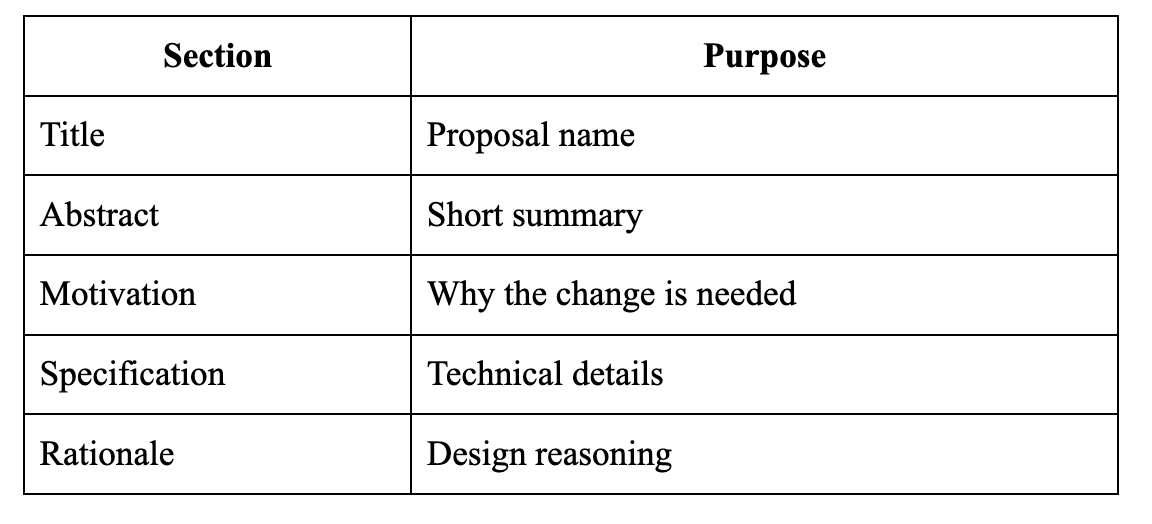
Impact on existing systems
Types of BIPs
1. Standards Track BIPs
These modify Bitcoin protocol behavior or technical standards.
Examples:
transaction formats
consensus changes
networking rules
2. Informational BIPs
These provide guidelines or educational information without changing protocol rules.
3. Process BIPs
These define governance or workflow procedures related to Bitcoin development.
Famous Bitcoin Improvement Proposals
BIP 32 — Hierarchical Deterministic Wallets
Introduced HD wallets allowing multiple addresses from a single seed phrase.
BIP 39 — Mnemonic Seed Phrases
Created the popular 12-word and 24-word wallet recovery phrases.
BIP 141 — Segregated Witness (SegWit)
Implemented SegWit to:
improve scalability
reduce transaction malleability
lower fees
BIP 340 — Schnorr Signatures
Part of the Taproot upgrade improving:
privacy
efficiency
smart contract flexibility
BIPs and Consensus Changes
Some BIPs change Bitcoin consensus rules.
These upgrades may activate through:
soft forks
miner signaling
node adoption
Consensus upgrades often require broad agreement to avoid network splits.
Example of a BIP Lifecycle
Imagine developers identify a Bitcoin scalability issue.
Step 1: Developer Creates Proposal
A BIP describes:
larger transaction efficiency improvements
technical implementation details
Step 2: Community Reviews Proposal
The Bitcoin ecosystem debates:
security
decentralization impact
scalability tradeoffs
Step 3: Software Updated
Bitcoin node software includes the new rules.
Step 4: Activation
If enough miners and nodes upgrade:
the BIP activates
the network adopts the improvement
Why BIPs Matter
1. Structured Bitcoin Development
BIPs create organized documentation for changes.
2. Transparency
All proposals are public and open for discussion.
3. Decentralized Governance
No central authority controls Bitcoin upgrades.
4. Technical Standardization
BIPs help wallet providers, exchanges, and developers remain compatible.
5. Long-Term Stability
The process encourages careful review before activation.
BIP Numbering System
Each proposal receives a unique identifier.
Examples:
BIP 32
BIP 39
BIP 141
The numbering helps organize Bitcoin’s development history.