
Chain Reorganization
A chain reorganization is a situation where a blockchain network replaces part of its current blockchain history with a different valid chain that has more accumulated work or stronger consensus support. In Bitcoin, chain reorganizations usually happen when two miners produce blocks at nearly the same time, temporarily creating competing versions of the blockchain.
Chain Reorganization Explained in Simple Terms
Chain Reorganization Explained in Simple Terms
A chain reorganization happens when the blockchain briefly splits into two possible versions and the network later decides which version becomes the official chain.
In Bitcoin:
miners may sometimes find blocks simultaneously
different nodes may temporarily see different chains
eventually one chain becomes longer
the network switches to the longer valid chain
Blocks removed from the rejected chain become orphaned or stale blocks.
How Chain Reorganization Works
How Chain Reorganization Works
Chain reorganizations are part of normal blockchain behavior in Proof of Work systems.
Here’s how it works:
Two Blocks Are Found
Two miners discover valid blocks at almost the same time.Temporary Blockchain Split
Some nodes accept Block A first, while others accept Block B first.Competing Chains Exist
Two versions of the blockchain temporarily exist.Next Block Is Mined
One chain receives another valid block before the other.Longest Chain Wins
Nodes switch to the chain with the most accumulated Proof of Work.
Bitcoin follows this rule:
Valid Chain=Chain With Most Accumulated
Old Chain Is Replaced
Transactions from removed blocks return to the mempool if not included elsewhere.
Why Chain Reorganizations Happen
Chain reorganizations occur because blockchain networks are decentralized and block propagation takes time.
Common causes include:
simultaneous block discovery
network latency
mining competition
temporary node desynchronization
Small reorganizations of 1–2 blocks are relatively normal in Proof of Work networks.
Example of Chain Reorganization in Practice
Example of a Chain Reorganization
Imagine:
Miner A finds Block 800001
Miner B also finds Block 800001 at nearly the same moment
Some nodes receive Miner A’s block first.
Other nodes receive Miner B’s block first.
Now two chains temporarily exist.
Later:
another miner builds on Miner B’s chain
Miner B’s chain becomes longer
The network reorganizes:
nodes switch to Miner B’s chain
Miner A’s block becomes stale
Chain Reorganization and Confirmations
Transaction confirmations help protect against reorganization risk.
A transaction with:
1 confirmation → small reorg risk
6 confirmations → much lower reorg risk
As additional blocks are added:
reorganizing the chain becomes exponentially more difficult
Deep Chain Reorganizations
Most reorganizations are small.
A deep reorganization affects many blocks and may indicate:
network attacks
severe consensus failures
51% attacks
Deep reorganizations are rare in large networks like Bitcoin.
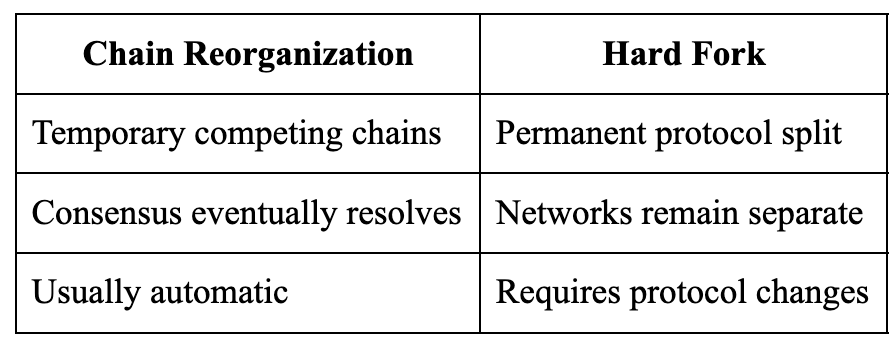
Chain Reorganization vs Hard Fork
How Chain Reorganizations Affect Miners
When a miner’s block becomes stale:
the block reward is lost
mining work becomes wasted
This is why miners try to propagate new blocks quickly across the network.
Chain Reorganization and Double Spending
Attackers may attempt to exploit reorganizations for double-spending attacks.
A malicious miner with significant hashrate could:
spend coins on one chain
secretly mine another chain
release the alternative chain later
If the malicious chain becomes longer:
the original transaction may disappear
This is one reason exchanges often wait for multiple confirmations.