
Mining Node
A mining node is a specialized blockchain node that participates directly in cryptocurrency mining by validating transactions, building candidate blocks, and performing Proof of Work (PoW) calculations to add new blocks to the blockchain. In networks like Bitcoin, mining nodes play a critical role in maintaining network security, decentralization, and transaction verification.
Mining Node Explained in Simple Terms
A mining node is a computer connected to the blockchain network that does two main jobs:
verifies transactions
mines new blocks
Unlike a regular node that only checks and relays blockchain data, a mining node also competes to solve cryptographic puzzles using computational power.
If the mining node successfully solves the puzzle first:
it adds a new block to the blockchain
it receives the block reward and transaction fees
How Mining Node Works
Step 1: Receive Transactions
The mining node receives pending transactions from the network mempool.
Step 2: Verify Transactions
The node checks:
digital signatures
wallet balances
protocol rules
transaction validity
Step 3: Build Candidate Block
Valid transactions are grouped into a block template.
The block includes:
transaction list
previous block hash
timestamp
Merkle Root
nonce field
Step 4: Perform Mining
The mining node repeatedly hashes the block header using SHA-256.
Bitcoin mining condition:

Example of Mining Node in Practice
Imagine a mining operation running:
10 ASIC miners
Bitcoin Core node software
connected to the Bitcoin network
Process
node downloads blockchain
transactions enter mempool
node builds candidate block
ASICs perform trillions of hashes per second
valid block discovered
node broadcasts new block
If accepted:
miner receives:
block subsidy
transaction fees
Mining Node and Hashrate
Mining node performance depends heavily on hashrate.
Hashrate measures computational power:
Mining Probability∝Hashrate
Higher hashrate increases the probability of finding valid blocks.
Challenges of Running a Mining Node
High Electricity Consumption
Mining hardware consumes large amounts of power.
Hardware Costs
ASIC miners and infrastructure are expensive.
Cooling Requirements
Mining nodes generate significant heat.
Increasing Difficulty
Bitcoin mining becomes more competitive over time.
Network Connectivity
Reliable internet is necessary for rapid block propagation.
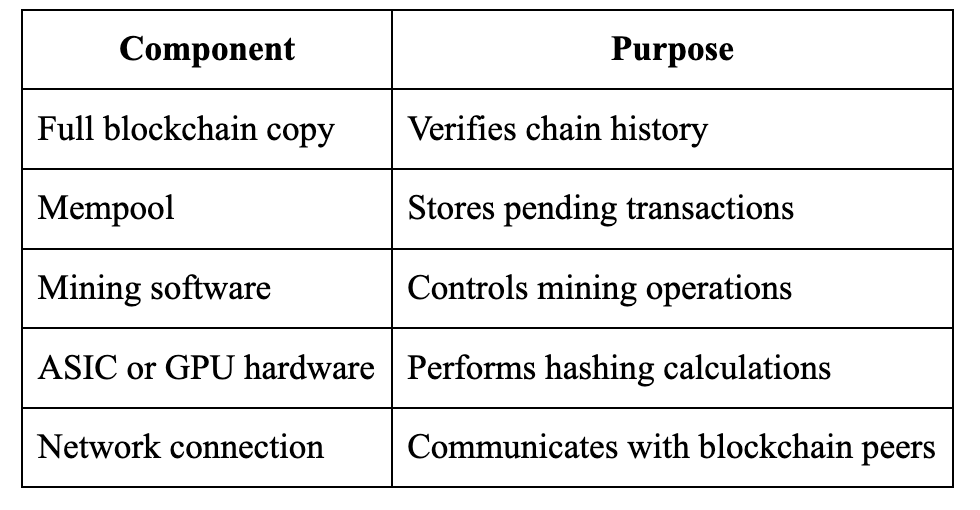
Components of a Mining Node
Mining Node vs Full Node
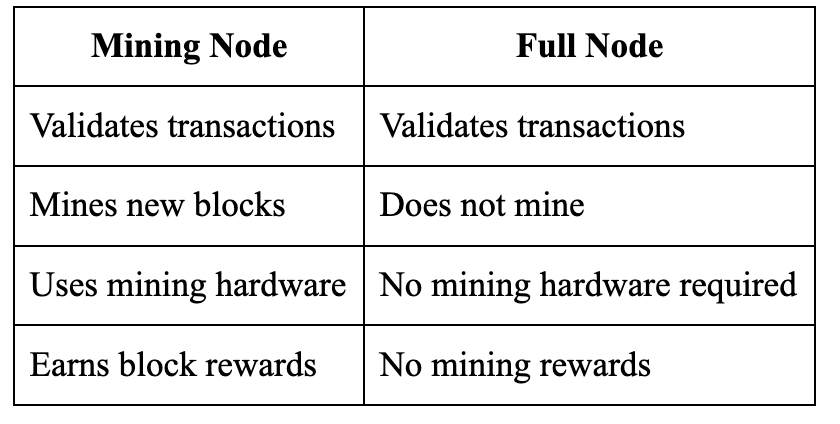
Every mining node is usually also a full node, but not every full node performs mining.
Types of Mining Nodes
Solo Mining Node
Operates independently and receives the full block reward if successful.
Advantages:
full rewards
full control
Disadvantages:
extremely low probability of finding blocks alone
Pool Mining Node
Connects to a mining pool and contributes hashrate collectively.
Advantages:
stable payouts
lower reward variance
Disadvantages:
shared rewards
pool dependency
Why Mining Nodes Matter
1. Blockchain Security
Mining nodes secure the network against attacks and double-spending.
2. Transaction Verification
They ensure only valid transactions enter the blockchain.
3. Decentralization
Independent mining nodes distribute blockchain control globally.
4. Block Production
Without mining nodes, new blocks cannot be created in PoW systems.
5. Consensus Enforcement
Mining nodes follow consensus rules and reject invalid blocks.