
Uniswap Explained: What It Is, How It Works, and How to Use the UNI DEX
Introduction
Decentralization and decentralized platforms that have emerged in recent years have completely changed the way people interact with finance. Users now have the ability to choose between decentralized and centralized platforms. Websites where users do not need to hand over control of their assets to third parties (such as transferring funds to an exchange) have become especially appealing, and among these platforms Uniswap holds a special place as one of the most well-known projects in the DeFi ecosystem.
Uniswap has become a symbol of a new trading model where there are no intermediaries, and transactions take place directly between users through smart contracts. For many, Uniswap crypto and the protocol itself became their first introduction to the concepts of DEX and automated market makers. Today, Uniswap exchange is among the largest platforms in terms of trading volume and active users. Interest in Uniswap is driven not only by its popularity, but also by its ease of use. Unlike traditional trading platforms, there is no need to create an account or go through KYC – it is enough to connect a wallet, and the user gains access to all functionality directly via a browser or mobile device.
In this article, we will take a detailed look at what is Uniswap used for, how the protocol works, how it differs from other exchanges, what opportunities it offers, and – most importantly – why this platform in particular, and DEXs in general, have become so popular.
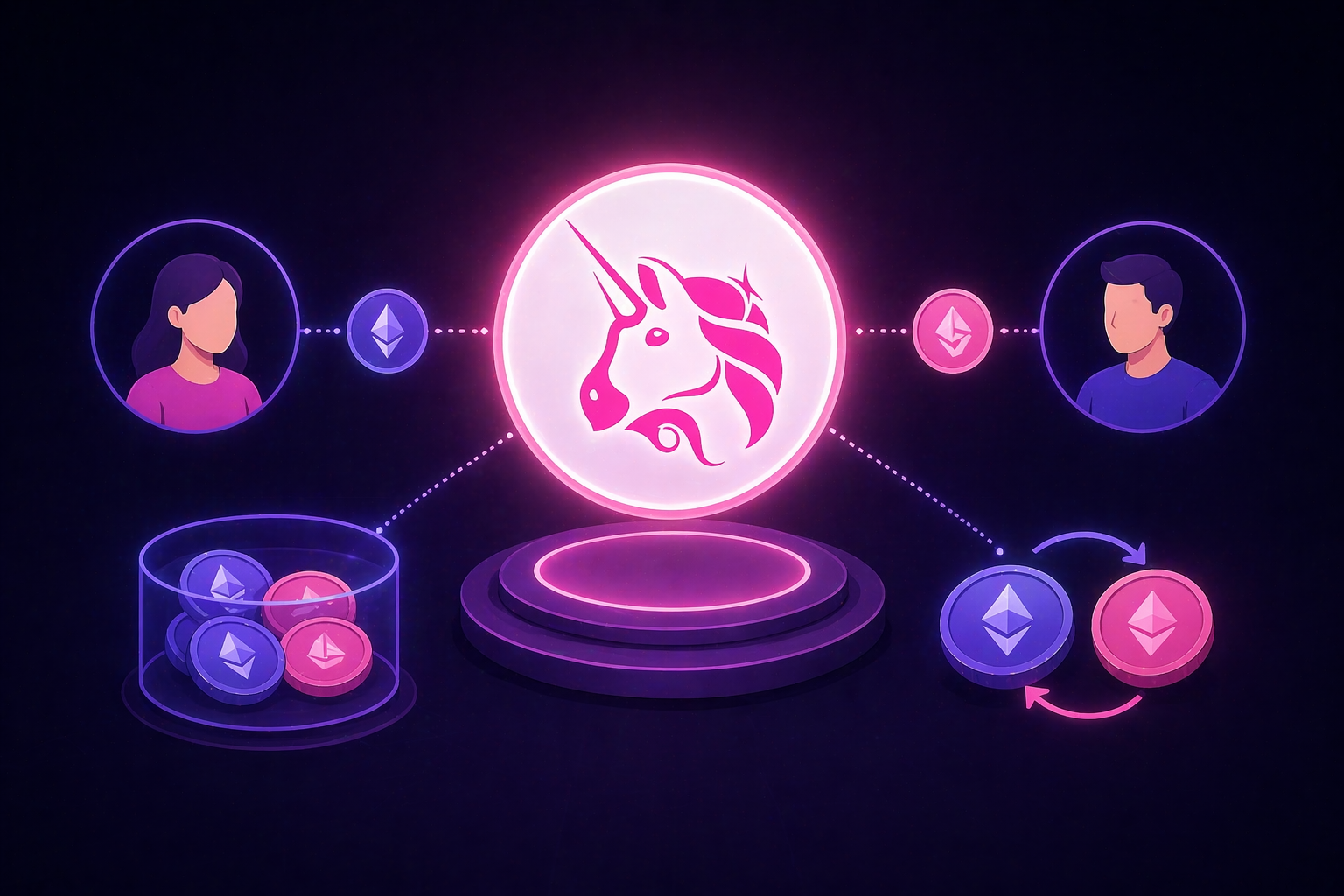
Uniswap is a decentralized crypto exchange (DEX). It works primarily with ERC-20 tokens. Unlike centralized platforms, the Uniswap exchange does not store user funds. It is not controlled by a single company. All operations are executed via smart contracts. Full control over assets always remains with the wallet owner.
The project launched in 2018. It quickly became a core element of DeFi infrastructure. Today, Uniswap crypto represents a unique financial model. Users provide liquidity and earn fees themselves. This approach shows how an automated market operates without intermediaries.
The Uniswap dex is not a traditional trading terminal. It does not use order books or classic buy and sell orders. Prices are formed algorithmically based on liquidity pools. This mechanism makes the platform accessible to everyone. Even users with no trading experience can use it easily.
The UNI token is also very important. It plays a key role in protocol governance. UNI holders vote on upgrades and fee changes. This answers the question: what is Uniswap used for? It is used for token swaps and participating in governance.
Accessing the platform is simple. There is no traditional Uniswap login or registration. Users just connect a Web3 wallet to start. This approach lowers entry barriers significantly. It makes Uniswap a popular solution in the DeFi space. The platform is now a benchmark for decentralized trading. It proves that financial markets can function without centralized control or custodial risks.
How Does Uniswap Work?
To understand how does Uniswap work (как работает Uniswap), it is important to immediately discard the familiar exchange model with order books: on Uniswap, there are no buyers and sellers placing orders for each other. Instead, the platform uses mathematical algorithms and smart contracts that automatically determine asset prices and enable token swaps at any moment.
At the core of the Uniswap protocol lies the concept of automated market makers – meaning users do not trade directly with one another, but with a liquidity pool funded by participants of the ecosystem. This is exactly what distinguishes uniswap dex from centralized exchanges and makes it fully autonomous.
Automated Market Makers (AMMs) Explained
An automated market maker, or AMM, is an algorithm that replaces the traditional order book. When there is no order book, the price of an asset is determined by a formula rather than by real-time supply and demand balance. The most well-known Uniswap formula looks like x × y = k, where x and y represent the reserves of two tokens in a pool, and k is a constant value. When a user executes a trade, they change the ratio of tokens in the pool, and the price is recalculated automatically. Thanks to this mechanism, uni swap can provide liquidity even for rare tokens that would be impossible to trade on classical exchanges due to a lack of orders.
As a result, the platform enables instant asset swaps without waiting for a matching counter-order. This is especially important for DeFi applications, arbitrage strategies, and users for whom execution speed is critical.
Liquidity Pools and LP Tokens
Liquidity pools are special token reserves that make it possible to exchange tokens between users without intermediaries. They are digital “pools” containing two or more cryptocurrencies (for example, ETH and USDT). These funds are used for swaps, and in return liquidity providers earn a fee from every transaction. In this way, Uniswap turns ordinary users into participants of the market infrastructure.
When adding funds to a pool, a user receives LP tokens. These tokens confirm the share of participation in the pool and give the right to receive a portion of the fees. It is important to understand that LP tokens are not just a receipt, but a full-fledged asset that can be used in other DeFi protocols.
It is precisely through liquidity pools that the essence of uniswap crypto is revealed: the platform does not need centralized market makers, because this role is performed by the community. However, along with potential returns come risks, including so-called impermanent loss, which depends on fluctuations in asset prices.
Price Calculation and Slippage
The price on Uniswap is formed automatically based on the balance of tokens in a liquidity pool. The larger a trade is relative to the size of the pool, the more the price changes after it is executed. This phenomenon is called slippage and is an inherent part of how AMMs work. For users, this means that with low liquidity or large swap volumes, the final price may differ from the expected one. That is why when exploring how to use Uniswap (how to use Uniswap), it is important to learn how to set an acceptable slippage tolerance before confirming a transaction – this protects against sharp price changes, but if the settings are too strict, the transaction may simply fail.
Slippage also plays an important role in arbitrage. Professional traders use price discrepancies between Uniswap and other exchanges to balance the market. As a result, prices on Uniswap exchange (Uniswap exchange) often remain close to the market average, despite the absence of centralized control.
Taken together, AMMs, liquidity pools, and algorithmic pricing form the unique architecture of Uniswap. This model is exactly what answers the question what is uniswap (what is Uniswap) and presents the platform not just as an exchange, but as a self-regulating financial system within Web3.
Uniswap as a DEX (Decentralized Exchange)
Uniswap dex (decentralized exchange Uniswap) is an excellent example of how a decentralized platform operates. There is no single operator, no custodial wallets, and no mandatory registration – the user always remains the owner of their funds and interacts directly with smart contracts. The main difference between uniswap exchange (Uniswap exchange) and traditional CEX platforms lies in the absence of intermediaries. The platform does not store assets, does not manage accounts, and does not control access to funds. All operations are executed through the blockchain, which makes Uniswap part of the open and transparent financial infrastructure of Web3.
This approach explains why the question is Uniswap safe (how safe is Uniswap) is often framed differently than in the case of centralized exchanges. Here, risks shift away from trusting a company toward the quality of smart contracts and the user’s personal responsibility for wallet security and private keys.
Within DeFi, Uniswap performs several roles at once. It serves as an entry point for token swaps, a source of base liquidity for other protocols, and an infrastructural layer for many dApps. Numerous services use the uniswap protocol (Uniswap protocol) “under the hood,” even if users never visit the exchange’s website directly.
Another key feature of Uniswap as a DEX is its global accessibility. Users can connect to the platform from anywhere in the world, without restrictions related to citizenship or banking systems. At the same time, decentralization also imposes certain limitations: for example, there is no customer support, no transaction reversals, and no account recovery. Users fully control their assets – but they also bear full responsibility for their actions.
The DEX model has allowed Uniswap to become a new industry standard. Over the years, the platform has proven that decentralized exchange can be scalable, liquid, and convenient for millions of users.
How to Use Uniswap
The platform was designed with everyday DeFi users in mind, so basic operations are performed directly through the interface and do not require complex preparation. At the same time, there is also the uniswap app (Uniswap app), which is not a separate mobile application in the traditional sense. It is a web interface that runs in a browser and connects to the user’s crypto wallet. All actions – token swaps, adding liquidity, and transaction confirmations – are carried out through smart contracts.
Below, we’ll go through the key steps that every user encounters.
Connecting a Wallet (MetaMask, WalletConnect, etc.)
The first step is connecting a crypto wallet. Without it, working with uniswap exchange (Uniswap exchange) is impossible, as the platform does not support logins, passwords, or custody of funds. Uniswap supports most popular Web3 wallets, including MetaMask, WalletConnect, Coinbase Wallet, and several others. Connection is done in a single click via the “Connect Wallet” button in the interface. The process looks like this: the user selects a wallet, confirms the connection in the extension or app, and gains access to the platform’s functionality. It’s important to note that uniswap login (Uniswap login) is not authorization in the traditional sense, but merely permission for the wallet to interact with smart contracts.
When connecting, Uniswap does not gain access to private keys or funds. The user retains full control over their assets, and all operations require separate confirmation in the wallet.
To operate, the wallet must be connected to the Ethereum network, as uniswap ethereum (Uniswap on Ethereum) remains the main environment for the protocol, despite support for additional networks.
How to Swap Tokens on Uniswap
Token swapping is the most popular function of the platform, and it essentially answers the question, what is Uniswap used for (what is Uniswap used for). It’s straightforward: the user selects the token they want to exchange and the asset they want to receive. The interface automatically shows the current rate, the estimated fee, and potential slippage. Unlike centralized exchanges, uni swap (Uniswap swap) does not require working with order books; as mentioned, the price is determined algorithmically based on the liquidity in the pool, and the trade executes instantly upon confirmation in the wallet.
After confirmation, the transaction is sent to the Ethereum network. Once it is included in a block, the tokens are automatically credited to the user’s wallet without the involvement of third parties.
Adding Liquidity and Earning Fees
In addition to token swapping, Uniswap allows users to earn by providing liquidity. This is one of the key functions of the uniswap protocol (Uniswap protocol) and the foundation of its economic model. By adding liquidity, a user receives LP tokens, which confirm their share. These tokens entitle the holder to a portion of the fees paid by traders on each swap.
Earnings depend on trading volume, the user’s share in the pool, and market conditions. It is also important to consider the risk of impermanent loss – a temporary loss in value due to token price changes. That’s why providing liquidity is suitable for those who already understand the mechanics of uniswap crypto (Uniswap crypto ecosystem) and are ready to manage the risks.
The Uniswap interface makes the liquidity provision process transparent: the user can see proportions, potential fees, and can withdraw funds at any time. As a result, Uniswap serves not only as a trading platform but also as a tool for passive income within DeFi.
Uniswap App and User Experience
One of the secrets behind the popularity of uniswap exchange (Uniswap exchange) is the platform’s and app’s ease of use. Despite the complex internal mechanics of DeFi, the platform is intuitive even for beginners. The developers focused on minimalism, data transparency, and avoiding unnecessary elements – and it paid off. In addition to the web version, users have access to the uniswap app (Uniswap app) – it also does not store user data and does not require registration.
Interface Overview and Uniswap Login Process
The workflow and uniswap login (Uniswap login) are fundamentally different from what users are accustomed to on centralized exchanges: as mentioned, there are no accounts, email addresses, or passwords. The user simply connects their wallet and can start working with crypto.
Once the wallet is connected, the interface automatically adapts to the user: the screen displays token balances, available pools, and interaction history with the platform. At the same time, Uniswap does not store transaction history – all information is pulled directly from the blockchain.
For many users, the absence of traditional authorization is a key reason to choose uniswap dex (decentralized Uniswap exchange).
Mobile and Web App Features
Uniswap was originally created as a web platform. However, many users prefer to work with crypto on mobile devices. To meet this need, the platform’s creators developed a dedicated app. Functionally, the mobile version is almost on par with the desktop version. Users can swap tokens, buy, and sell assets with ease. They can also manage liquidity and monitor pool data in real-time. Thanks to this approach, uniswap crypto becomes accessible to a global audience. It can be used without being tied to a specific device or operating system.
Uniswap Info and Analytics Tools
The exchange offers its users a dedicated service, Uniswap info (Uniswap analytics), which allows tracking analytical and statistical data in real time. Uniswap Info is actively used by traders and liquidity providers for decision-making, as it shows which trading pairs are the most popular, where the main volumes are concentrated, and how market conditions are changing. The analytics are based on blockchain data and update in real time. This increases transparency and strengthens trust in the Uniswap protocol (Uniswap protocol) as an open financial system.
Overall, the intuitive interface makes Uniswap stand out. The absence of a traditional login process also simplifies the experience. Furthermore, users benefit from direct access to powerful analytics. Together, these features make Uniswap one of the most user-friendly DeFi platforms on the market.
Uniswap Protocol Evolution
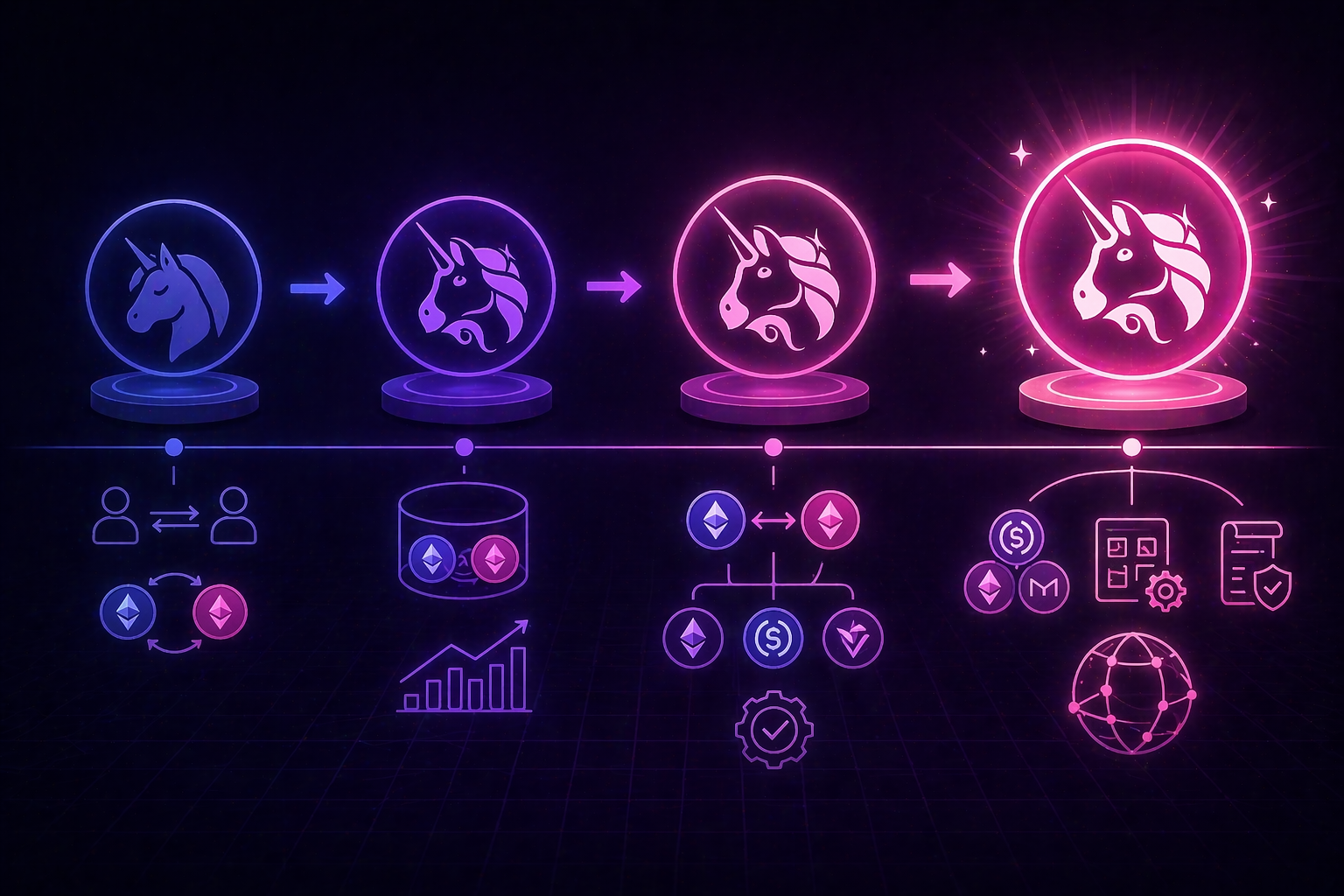
Over the years, the Uniswap protocol has gone through several key development stages. Each new version has become more efficient for the market. These updates also make the platform more user-friendly. Today, it is highly accessible for both traders and liquidity providers. The first version of the protocol laid the foundation for automated market makers. It demonstrated that token swaps were possible without a traditional order book. Subsequent updates then made this process faster. These improvements also made the entire experience more convenient for users.
Uniswap v2 expanded the platform’s functionality significantly. It introduced a wide range of new token trading pairs. The version also featured improved pricing logic. These changes increased overall liquidity on the platform. They also reduced the number of intermediate steps for trades. This directly enhanced the user experience on the Uniswap exchange.
With the release of Uniswap v3, the concept of concentrated liquidity was introduced. This feature allows providers to allocate capital within selected price ranges. It significantly improved capital efficiency for the protocol. Experienced participants also gained much greater control over their trading strategies.
Each version enhanced smart contract security and optimized fee management. This approach illustrates how uniswap ethereum (Uniswap on Ethereum) evolves alongside the blockchain ecosystem, adapting to new market demands.
Risks and Challenges
Of course, uniswap crypto (Uniswap as a crypto project) is not without risks. It is crucial to understand potential challenges before actively interacting with the protocol.
One key risk is volatility. When providing liquidity, users may encounter situations where earnings from fees do not compensate for changes in asset prices.
Network fees on Ethereum must be considered. During periods of high congestion, transaction costs can rise significantly. This can make small operations economically unprofitable. This is why the question of how Uniswap works is important. It is linked to the protocol’s logic. However, it also depends on the current state of the network.
Smart contract security is another important aspect. Although Uniswap’s code has undergone numerous audits, the risk of vulnerabilities cannot be completely eliminated. Users are solely responsible for safeguarding their funds, as there is no traditional customer support service.
Alternatives to Uniswap
Uniswap remains the market leader. However, the number of decentralized exchanges is actively growing. New alternatives offer different approaches to liquidity and fees. They also focus on unique user experiences. Some platforms provide lower fees or operate on other blockchains. Others offer more trading tools. There are also additional earning mechanisms for liquidity providers.
Nevertheless, Uniswap often serves as the entry point into DeFi for new users. Its reputation and scale are significant. The openness of the protocol makes Uniswap a benchmark. Other solutions are constantly compared against this standard.
Conclusion
Uniswap has become a key project in the decentralized finance market. It laid the foundation for future developments in this sector. Understanding what Uniswap is and how it works offers a new perspective. You can view the crypto market without intermediaries or registration. There is no control by centralized entities. The platform combines a simple interface with a powerful technological backbone. This gives users full control over their assets. All operations remain transparent and open.
Despite existing risks, Uniswap remains an important part of the Ethereum ecosystem. The protocol continues to evolve. For those who want to dive deeper into DeFi, Uniswap is a great starting point. It often becomes the first and most logical choice for working with decentralized exchanges.
Published Articles
Crypto Basics Explained: A Beginner’s Guide to Cryptocurrency and Trading
Introduction The world of finance is changing right before our eyes. Just...
WAGMI in Crypto Explained: Meaning, Origin, and the Rise of WAGMI Exchange
Introduction Over the past few years, the crypto community has developed its...

Services You Can Pay for with Bitcoin
Where Bitcoin Is Accepted Today Today, Bitcoin (BTC) can be used to...
 Popular
The Meme Economy: How Internet Humor Shapes Culture, Markets, and Crypto
Introduction Ten years ago, the idea that a picture of a dog...

What You Can Buy With Bitcoin in 2025
Introduction Over the years, Bitcoin has evolved from an experimental digital currency...
 Popular
Bitcoin & Crypto Options Trading: A Complete Guide for Beginners and Experts
Bitcoin options trading has grown rapidly in recent years as the cryptocurrency...