
The Meme Economy: How Internet Humor Shapes Culture, Markets, and Crypto
Introduction
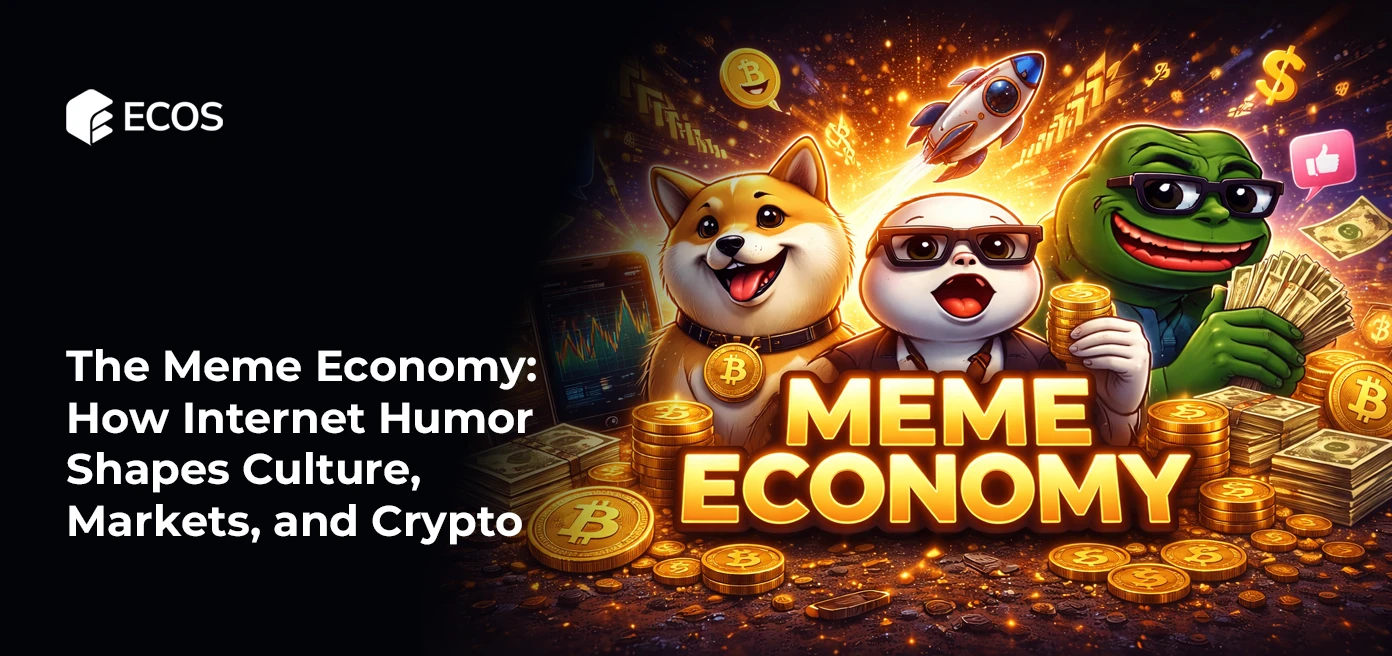
Ten years ago, the idea that a picture of a dog or a typo on a forum could be worth billions of dollars would have seemed absurd. Today, it is the reality we live in. Internet memes have ceased to be mere entertainment; they have transformed into a legitimate economic asset. Welcome to a world where attention is the new oil and humor is the hardest currency.
What Is the Meme Economy?
At its core, the meme economy is the economy of attention taken to its absolute extreme. While in classical economics the value of an asset (stock, commodity) depends on corporate profit or utility, in the meme economy, the value depends on how many people are talking about it right now and how emotionally invested they are.
The Architecture of the Meme Economy
Here are the three pillars it stands on:
1. Cultural Currency vs. Fiat In real life, we trade time for money. On the internet, we trade attention for influence. A meme is the perfect “container” for an idea.
-
Example: When Elon Musk posted a photo of his Shiba Inu puppy in 2021, it wasn’t just a cute picture. It was a signal. Within hours, the market capitalization of the Shiba Inu (SHIB) token grew by billions. People weren’t buying “technology”; they were buying participation in a global cultural moment.
2. Community as the Board of Directors In traditional business, executives make the decisions. In the meme economy, the “Board” is the crowd on Reddit, Discord, or Telegram.
-
Example with GameStop (GME): Retail investors decided that the company shouldn’t go bankrupt simply because it was part of their childhood. They turned buying stock into an act of protest. The price surged from $17 to $480 not because of the store chain’s financial success, but because of memes calling to “punish” hedge funds. Collective belief creates market reality.
3. “Casino” Infrastructure The meme economy is impossible without instant-buy tools. Cryptocurrencies and zero-commission trading apps (like Robinhood) turned investing into something akin to a computer game.
-
Example: The launch of the PEPE token in 2023. It literally had no function other than “being a frog.” But because anyone with a smartphone could buy it in 5 seconds, the token reached a $1 billion market cap in record time. This is “liquidity at your fingertips.”
The Formula for Economic Value
If you try to derive a formula, it looks like this:
Virality + Community + Accessibility of financial tools = Economic Value
This transforms the internet from a place where we simply watch content into a massive exchange where any joke can become your pension fund (or, as more often happens, a lesson in risk management).
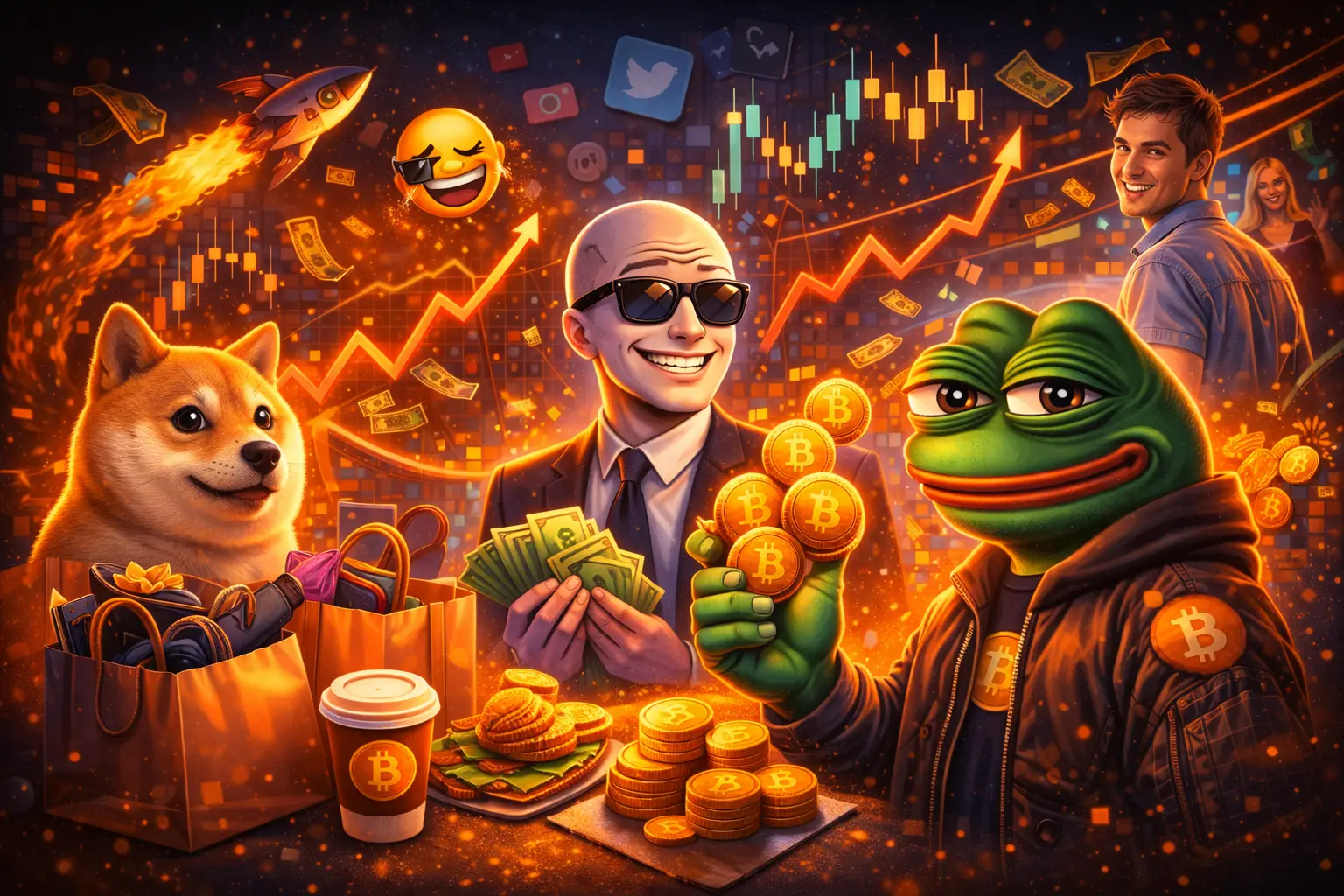
Economy Memes and Their Popularity
The logic of the meme economy is easiest to understand if you stop looking at memes as “pictures” and start seeing them as a way to transfer trust and attention. Previously, finance was a closed “white-collar” club with complex terminology. Memes hacked this door open, turning boring reports into something understandable and fun.
In the old economy, factories created value. In the new economy, communities create value.
Why Memes Drive the New Financial Reality
Translating Attention into Money Previously, for an asset to grow in value, a company had to build a business for years, hire employees, and pay dividends. In the meme economy, this path is shortened to one step. If 10 million people are looking at the same joke today, that represents a massive amount of “attention energy.” If you attach a token or a stock to this joke, that energy turns into market capitalization. A meme is simply the cheapest and fastest way to capture the attention of millions.
Social Glue (Synchronization) Imagine that thousands of strangers must simultaneously perform the same action—for example, buy shares in a dying retail chain. How do you make them do it? You can’t order them. But you can launch a meme and get them interested. A meme synchronizes the behavior of the crowd. It gives people a common goal and a sense of being part of something bigger (“us against the system,” “to the moon”). When thousands of people act as one, they become a force capable of breaking professional analysts’ forecasts.
Response to Systemic Injustice For many young people, the classical economy feels “broken”: housing is unaffordably expensive, inflation eats wages, and the barrier to entry for serious investment is too high. The meme economy is a kind of “back door” into the world of wealth. It is a gamble where the rules are dictated not by bankers, but by internet users. For participants, it’s a way to state: “If you don’t let us earn the traditional way, we will create our own economy out of pictures of frogs and get rich on that.” In an all-digital world, community belief is the hardest asset.
“In This Economy” Meme Explained
The “In This Economy” meme became a reaction to the reality of 2024–2025. Visually, it often looks like a tired Squidward or a social media screenshot: “Buy an apartment? In this economy?!”. This phenomenon represents a universal response to inflation and rising prices. Serving as a “social shield,” irony helps to acknowledge hardships without losing dignity when everything around becomes more expensive. Ultimately, it is a marker of a generation that understands: the old rules of success no longer work.
The Rise of Economy and Economics Memes
The history of economic memes is a chronicle of how serious people in suits lost control of information, and “digital hooligans” from forums turned exchange reports into counterculture. It all started not in banks, but in specific internet communities where financial literacy mixed with trolling.
Pre-crypto era: corporate satire (2000s)
The first seeds were demotivators and comics mocking office life and banker greed. After the 2008 crisis, images began to appear online highlighting the absurdity of what was happening. The famous character Wojak (the sad grey man) was not originally financial, but fit perfectly into the role of the “loser investor” watching his savings burn.
2013: The “Great Typo” and the first dog
This was the year economic memes gained their DNA.
- HODL: On the Bitcointalk forum, a trader under the nickname GameKyuubi posted a drunken message: “I AM HODLING.” He admitted he was a bad trader and couldn’t time the market, so he was just “holding.” The typo instantly became a manifesto. It was the first time a mistake became a strategy.
- Dogecoin: In December 2013, programmers Billy Markus and Jackson Palmer decided to troll the altcoin boom and created a coin featuring a Shiba Inu dog. They wanted to show how silly it was to invest in random tokens, but the effect was the opposite: people loved the joke so much they started buying it for real.
The “Printing Press” Era (2020)
The pandemic was the catalyst. When governments began injecting trillions of dollars into the economy, the “Money Printer Go Brrr” meme appeared. Why it matters: It explained complex monetary policy through a simple visual: an old man from the Fed (Jerome Powell) cranks the handle of a machine, while a young angry zoomer screams that this devalues money. The meme turned macroeconomics into a political statement understandable to any teenager.
The Reddit and WallStreetBets Revolution (2021)
This is where economic memes became weapons. Reddit users realized that if a million people simultaneously believed in a meme, they could dictate terms to the market. They began using memes (rockets, diamonds, apes) to coordinate actions against professional investors. Memes stopped just “describing” the market—they started moving it.
Economic Memes and Market Commentary
Economic memes today are not just pictures; they are informal analytics. While classical experts write multi-page reports with charts, the internet community delivers the “base” in a single image. Essentially, it is satirical commentary that often proves more accurate than official forecasts because it reflects real sentiments and fears rather than just numbers.
Memes have become self-fulfilling prophecies. If a stream of “It’s over” memes appears under news of a stock drop, it can trigger real panic and even greater sell-offs. Conversely, memes of support can keep an asset from crashing.
How Economic Memes Reflect Real-World Trends
Memes are the voice of the “street.” They make market analysis alive and honest. In a world where financial reports can be manipulated, the collective humor of millions remains the most sincere indicator of where everything is headed.
- Memes as a “Risk Thermometer” When the market is calm, memes are usually ironic and lazy. But as soon as retail investors start mass-posting images of rockets or “greedy” characters, it’s a signal of the euphoria phase. Real trend: In 2024–2025, the capitalization of meme coins (like DOGE or PEPE) became an indicator of “risk appetite.” If meme coins are growing, it means people have plenty of spare cash and are ready to risk it. If memes shift to “In This Economy,” the market is going into hibernation.
- Reflecting “Real” Inflation Official inflation figures often seem low to the public. Memes fill this gap, reflecting perceived inflation. 2025 Example: Memes about “Trump eggs” (mocking food price hikes after his tariff initiatives) or ironic comparisons of “dinner at a restaurant” to “buying a plane wing.” Trend: Memes record the dissatisfaction of the middle class, for whom small life pleasures are becoming luxury items. This is the “voice of the street” that politicians often ignore.
Satire on Inflation, Recession, and Crypto Prices
When a global disruption occurs (a container ship stuck in the Suez Canal or a shortage of graphics cards), memes instantly turn the problem into absurdity. Memes allow people to survive scarcity through laughter. In 2025, this touched the “chip wars” and AI capacity shortages. Images of “farmers growing graphics cards” reflect the real lack of infrastructure for technology.
Memes as a form of “New Analysis” (AI Sentiment Scrapers) This is the most modern trend. In 2025, large investment funds use AI tools to scan Reddit, X, and Telegram. They look not for keywords, but for the emotional tone of memes. If the number of memes with a negative tone (Doom-scrolling, Wojak in despair) grows, funds start preparing for a correction. Memes have become data that can be digitized and turned into a trading signal.
Best Economic Memes of the Decade
To compile a list of the decade’s best economic memes, one must look at images that didn’t just “make people laugh,” but changed market behavior and people’s attitudes toward money. Here is the “gold fund” of 2015–2025:
- Stonks (2017 – Present): Perhaps the most recognizable symbol of the decade. A surreal 3D mannequin in a suit against a rising chart. Originally mocked amateurish business ideas, it became the official face of “retail madness.”
- Money Printer Go Brrr (2020): Born during the pandemic, it became the main tool for criticizing inflation. It explained the basics of monetary policy better than any textbook.
- HODL (2013 – 2020s Legend): A typo turned into a financial religion. It is a call to never sell an asset, no matter how much it drops. It created the “diamond hands” culture.
- Distracted Boyfriend (Economic Version): A classic stock photo used to describe the psychology of FOMO—when an investor gazes at a “hot” new asset while their stable portfolio looks on in shock.
- This is Fine: A dog sitting in a burning room. The personification of calm (or denial) amidst economic chaos. The main meme of every market crash of the decade.
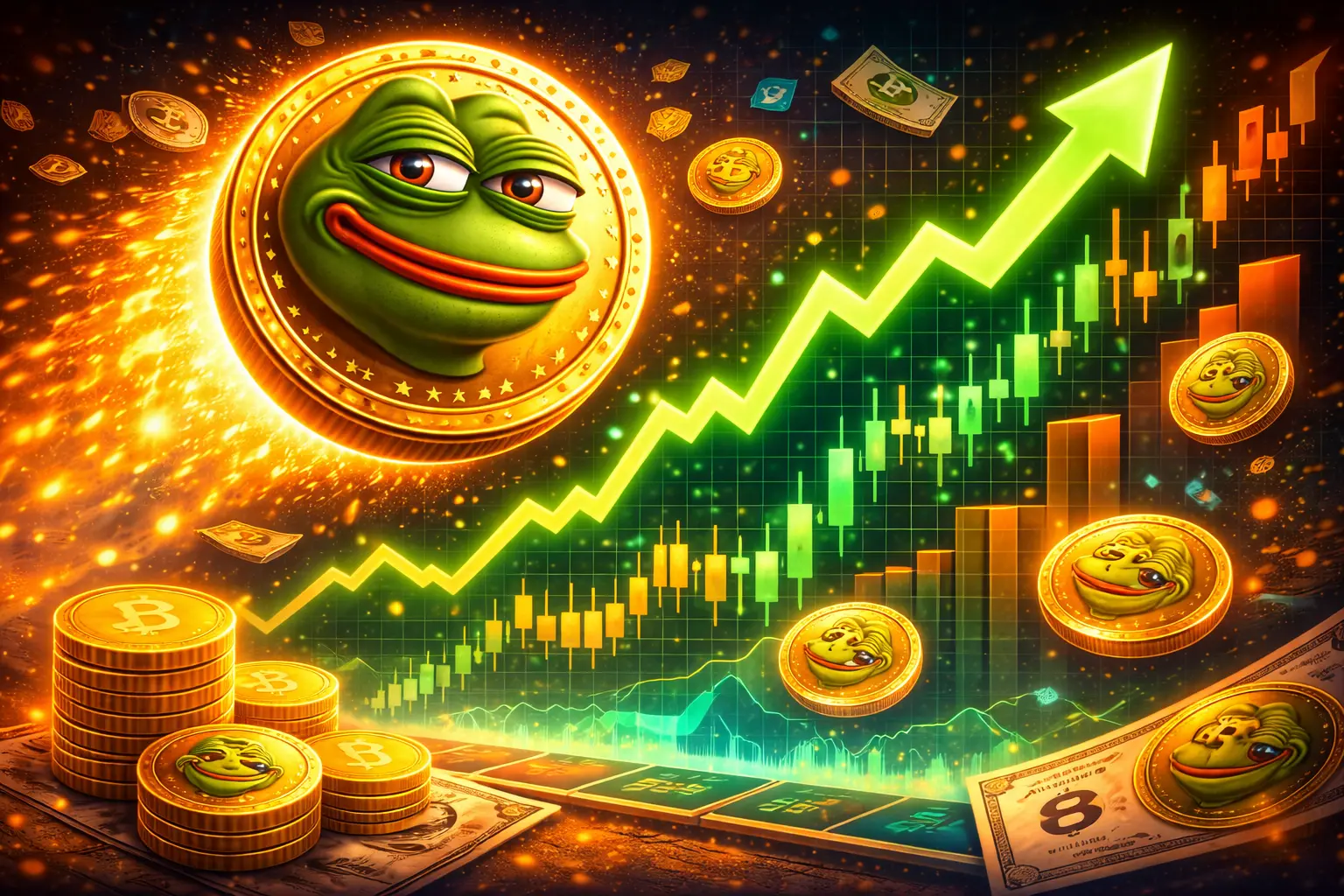
- Pepe the Frog: A symbol of internet culture that became the face of one of the largest meme coins. It proved that a cultural symbol could have a market cap of billions without any “useful” product.
Cryptography and Crypto Memes
Crypto memes are a layer of internet folklore that has turned into a real financial tool. In crypto, a meme is often a coin ticker backed by millions of dollars. Here are the categories defining 2025:
Legendary “Mammoths” (Culture Foundation)
- HODL: Now an acronym for Hold On for Dear Life. A prayer for those refusing to panic-sell.
- Where Lambo?: The ironic embodiment of the dream of quick riches during a price surge.
- To the Moon!: Accompanying any “pump” (sharp growth).
Crypto Characters (Market Faces)
- Wojak and Pepe: Pink Wojak represents the furious trader staring at a red crash chart. Pepe is the symbol of “crypto-anarchy” and luck.
- Dogecoin and family: The Shiba Inu dog spawned an entire industry of “dog coins” (SHIB, FLOKI, BONK), serving as indicators of retail risk appetite.
Slang as a Meme
- Copium: A fictional gas inhaled by traders to cope with their coin’s collapse while believing it will rise tomorrow.
- Paper Hands vs. Diamond Hands: “Paper hands” sell at the first drop; “Diamond hands” hold until the end.
- GM (Good Morning): A meme of unity. Saying “GM” shows you are part of the market community.
Cryptography Memes in the Tech Community
In the tech environment, memes serve as fundamental cognitive models helping people master complex concepts. For developers, memes are a way to discuss digital freedom.
Legendary characters Alice, Bob, and Eve have served for decades to explain encryption protocols, shaping an understanding among engineers that privacy is a natural human right. The principle “Don’t Trust, Verify” evolved from a dry technical requirement into a cultural code that filters out fraudulent projects and elevates code transparency to an absolute value.
How Crypto Humor Shaped the Blockchain Movement
Humor became the “soft power” that allowed blockchain to emerge from the shadows. Without memes, cryptography would have remained a narrow hobby for mathematicians. Jokes about “magic internet money” and dreams of “Lambo” made the technology human, lowered the barrier of fear, and united people from different countries into a global digital community. Humor here acts as social glue, holding the community together even during prolonged market crashes.
From Bitcoin Jokes to “Based Economy” Memes
We have traveled the path from the defensive satire of the early 2010s to the creation of complex infrastructure. The modern concept of the Based Economy symbolizes the maturation of the industry. In this paradigm, a project is considered successful if its values are “based” on transparency, sincerity, and the absence of intermediaries. Memes no longer just mock the old system—they serve as the trust interface for a new economy built directly “on-chain.”
The Role of Memes in the Crypto Market
In the crypto market, memes act as the primary driver of liquidity. They function as an attention funnel: a viral image attracts new users, who create wallets and start trading, filling the ecosystem with capital. In 2025, meme coins have become a sort of “cultural stock,” where the asset’s price directly depends on the creative energy and cohesion of the community. It is a market where “being understandable and funny” is often more profitable than being “serious and complex.”
Memes as Economic Indicators
In the hands of a professional analyst, memes turn into powerful forecasting tools. The frequency of certain images allows for measuring “risk appetite” or the level of panic among retail investors. Memes about inflation reflect real public expectations far more accurately than delayed central bank reports. Thus, internet folklore has become an informal form of reporting that cannot be forged or hidden.
The Future of the Meme Economy
In the coming decade, we will see the merger of human creativity and AI algorithms. The main players will be AI agents capable of autonomously creating meanings and instantly turning them into financial assets. The meme economy will integrate into the real world through asset tokenization (RWA), where humor becomes the packaging for investments in real estate or industry. In a world oversaturated with content, the most valuable currency will be genuine human sincerity—those very “based” ideas that cannot be generated by a simple algorithm.
Conclusion
The meme economy is the triumph of the human factor over the faceless accounting of the old world. It proved that the emotion, attention, and belief of a group of people could be a more solid foundation for capital than material reserves. We are no longer just joking about money—we are creating a new financial reality out of humor and reposts.
Published Articles
 Popular
Bitcoin Pizza Guy: The Story Behind the First Real Bitcoin Purchase
Introduction The history of Bitcoin is full of dramatic ups and downs,...
 Popular
What is the Omniverse? Exploring the Ultimate Multiversal Concept
Introduction Do you know what the omniverse is? Is this concept real?...
Bitcoin Taproot Explained: What the Upgrade Means for BTC
Introduction Unfortunately, the most popular cryptocurrency today – Bitcoin – was not...
Crypto On-Ramps and Off-Ramps Explained: How Fiat and Crypto Move In and Out
Entering the world of digital assets often feels like trying to cross...
Crypto Basics Explained: A Beginner’s Guide to Cryptocurrency and Trading
Introduction The world of finance is changing right before our eyes. Just...
 Popular
Uniswap Explained: What It Is, How It Works, and How to Use the UNI DEX
Introduction Decentralization and decentralized platforms that have emerged in recent years have...