
Lightweight Node
A lightweight node is a blockchain client that connects to full nodes to access and verify blockchain data without downloading the entire blockchain history. Lightweight nodes use significantly less storage, bandwidth, and processing power than full nodes, making them ideal for mobile wallets and low-resource devices. In Bitcoin, lightweight nodes commonly use Simplified Payment Verification (SPV) to confirm transactions efficiently.
Lightweight Node Explained in Simple Terms
Lightweight Node Explained in Simple Terms
A lightweight node allows users to interact with a blockchain without storing the entire blockchain locally.
Instead of downloading every block and transaction:
it downloads only essential information
it relies on full nodes for detailed blockchain data
it verifies transactions more efficiently with fewer resources
You can think of a lightweight node like using cloud storage instead of storing everything directly on your computer.
How Lightweight Node Works
How a Lightweight Node Works
Step 1: Connect to Full Nodes
The lightweight node communicates with one or more blockchain full nodes.
Step 2: Download Block Headers
Instead of downloading full blocks, it downloads only block headers.
Bitcoin block headers contain:
previous block hash
Merkle Root
timestamp
difficulty target
nonce
Step 3: Verify Transaction Inclusion
Using Merkle proofs, the node checks whether a transaction exists inside a block.
Step 4: Trust Network Consensus
The lightweight node assumes the majority of network miners and full nodes follow valid consensus rules.
Example of Lightweight Node in Practice
Example of a Lightweight Node
Imagine a user installs a Bitcoin wallet app on a smartphone.
Instead of:
downloading the entire blockchain
The wallet:
downloads block headers
requests transaction data from full nodes
verifies transactions using Merkle proofs
This allows fast setup while still providing reasonable transaction verification.
Merkle Proofs in Lightweight Nodes
Merkle proofs allow lightweight nodes to confirm transaction inclusion efficiently.
The process:
full node provides transaction hash
neighboring hashes are provided
lightweight node reconstructs the Merkle Root
compares result with block header
If the values match:
the transaction is verified
Lightweight Node Security Assumption
Lightweight nodes assume:
most miners are honest
longest chain represents valid consensus
This assumption is generally secure in large decentralized networks like Bitcoin but less robust than full independent verification.
Lightweight Node vs Custodial Wallet
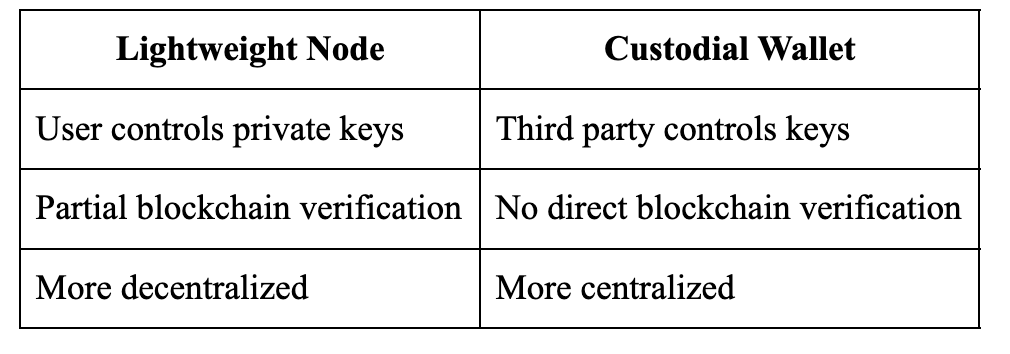
Lightweight nodes still provide significantly more control than custodial services.
Simplified Payment Verification (SPV)
Bitcoin lightweight nodes commonly use SPV.
SPV verification works like this:
Transaction Verification=Block Header+Merkle Proof\text{Transaction Verification} = \text{Block Header} + \text{Merkle Proof}Transaction Verification=Block Header+Merkle Proof
This allows transaction verification without downloading the full blockchain.
Lightweight Node vs Full Node
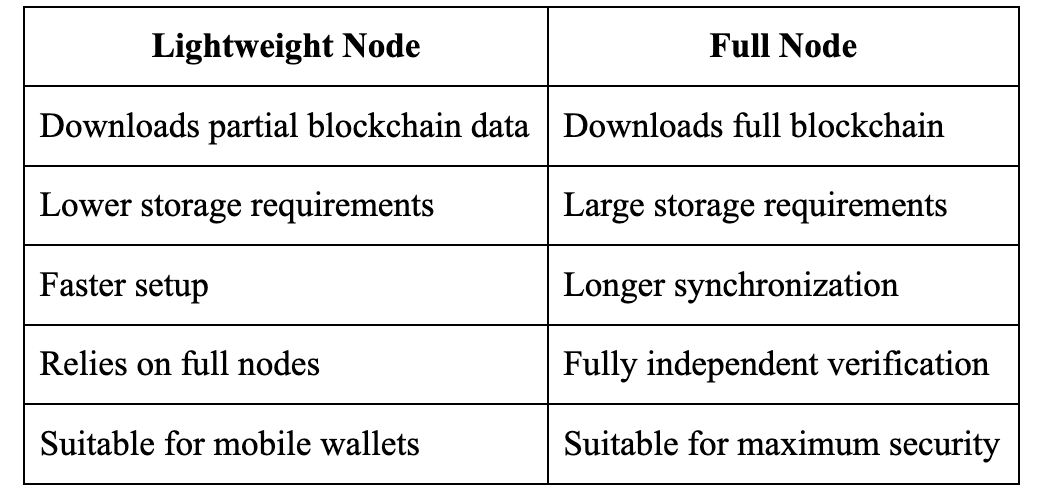
Advantages of Lightweight Nodes
1. Low Storage Usage
No need to store hundreds of gigabytes of blockchain data.
2. Faster Synchronization
Lightweight nodes can become operational quickly.
3. Mobile Compatibility
Ideal for smartphones, tablets, and low-power devices.
4. Lower Bandwidth Consumption
Only essential blockchain data is downloaded.
5. User Convenience
Easy setup for everyday cryptocurrency use.
Disadvantages of Lightweight Nodes
1. Reduced Security
Lightweight nodes trust full nodes for some blockchain data.
2. Less Privacy
Full nodes may observe wallet queries and addresses.
3. Limited Validation
They do not independently verify every blockchain rule.
4. Dependency on Full Nodes
Without accessible full nodes, lightweight nodes cannot operate effectively.
Lightweight Nodes in Bitcoin
Many popular Bitcoin wallets operate as lightweight nodes.
Examples include:
mobile wallets
browser wallets
hardware wallet companion apps
These wallets typically:
connect to external servers
use SPV verification
avoid downloading the entire blockchain