
secp256k1
secp256k1 is the elliptic curve cryptography (ECC) standard used by Bitcoin to generate private keys, derive public keys, and create digital signatures. It serves as the mathematical foundation of Bitcoin's security model and enables users to prove ownership of funds without revealing their private keys.
secp256k1 Explained in Simple Terms
secp256k1 Explained in Simple Terms
When someone creates a Bitcoin wallet, the wallet must generate:
a private key
a public key
a Bitcoin address
These components are not created randomly without structure. Instead, they are generated using a specific mathematical framework called secp256k1.
Think of secp256k1 as the set of cryptographic rules that determines how Bitcoin keys are created and how ownership is verified.
Whenever a user:
creates a wallet
signs a transaction
verifies ownership
secp256k1 is working behind the scenes.
Although most users never interact with it directly, every Bitcoin transaction depends on this mathematical system.
How secp256k1 Works
How secp256k1 Works
Bitcoin uses secp256k1 to transform a private key into a public key through elliptic curve multiplication.
The process works as follows:
Private Key Generated A wallet creates a random 256-bit private key.
Elliptic Curve Calculation Performed The private key is multiplied by a predefined generator point on the curve.
Public Key Produced The result becomes the wallet's public key.
Address Created The public key is hashed to generate a Bitcoin address.
Digital Signatures Created Transactions are signed using the private key and verified using the public key.
The core relationship can be represented as:
Where:
d represents the private key
G is the generator point defined by secp256k1
Q is the resulting public key
This operation is easy to perform but extraordinarily difficult to reverse.
The secp256k1 Curve Equation
The elliptic curve used by Bitcoin follows the equation:
While this equation appears simple, the cryptographic security comes from performing calculations over a very large finite field.
The combination of elliptic curve mathematics and enormous numerical ranges creates the security properties required for Bitcoin.
Example of secp256k1 in Practice
Example of secp256k1 in Bitcoin
Suppose a wallet generates a private key.
Using secp256k1:
a public key is derived
a Bitcoin address is created
transactions can later be signed
When the owner spends BTC:
the wallet creates a digital signature using the private key
Bitcoin nodes verify the signature using the public key
The network confirms ownership without ever seeing the private key itself.
This process occurs millions of times every day across the Bitcoin network.
Why Bitcoin Uses secp256k1
When Bitcoin was designed, several elliptic curves already existed.
Bitcoin's creator, Satoshi Nakamoto, selected secp256k1 because it offers:
strong cryptographic security
efficient computation
relatively small key sizes
fast signature verification
lower computational overhead
These characteristics make it particularly suitable for a decentralized system where every node must verify transactions independently.
Security of secp256k1
The security of secp256k1 relies on the Elliptic Curve Discrete Logarithm Problem (ECDLP).
The basic principle is:
deriving a public key from a private key is straightforward
deriving a private key from a public key is computationally infeasible
Because of this asymmetry, users can safely share public keys while keeping ownership protected.
The total number of possible private keys is so large that brute-force attacks are considered practically impossible with modern computing technology.
secp256k1 and Bitcoin Signatures
Bitcoin originally used the Elliptic Curve Digital Signature Algorithm (ECDSA), which is built on secp256k1.
Today, Bitcoin also supports:
Schnorr signatures
Taproot enhancements
However, these upgrades still rely on the secp256k1 elliptic curve.
As a result, secp256k1 remains at the core of Bitcoin's security architecture even as the protocol evolves.
secp256k1 vs RSA
Before ECC became widely adopted, many systems relied on RSA cryptography.
Compared with RSA, secp256k1 provides:
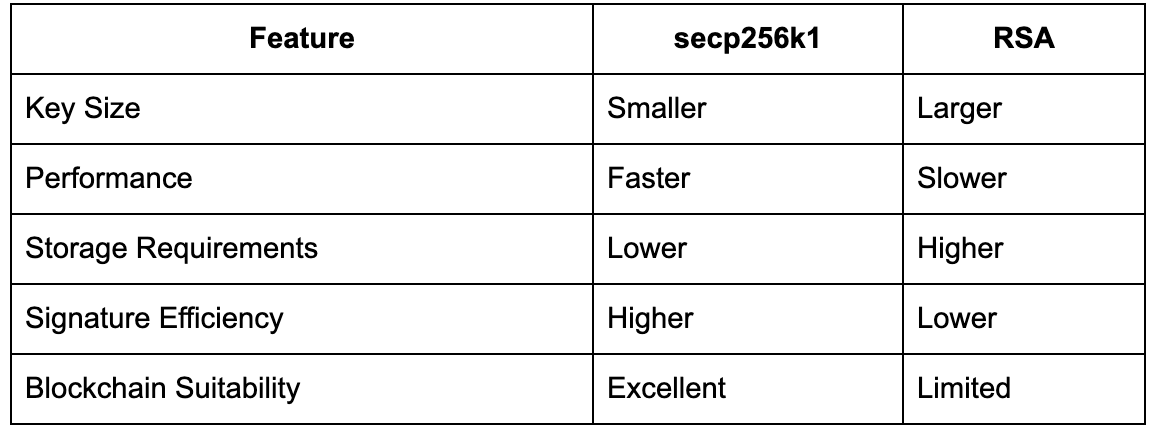
These advantages help reduce transaction verification costs across the Bitcoin network.
Future Considerations
Researchers continue studying the long-term security of elliptic curve cryptography.
Potential future developments include:
quantum-resistant cryptography
post-quantum signature systems
upgraded blockchain security models
At present, secp256k1 remains one of the most trusted and widely used elliptic curves in cryptocurrency.
Related Bitcoin Terms
Elliptic Curve Cryptography (ECC)
Private Key
Public Key
Digital Signature
ECDSA