
Automated Market Makers Explained: What AMMs Are and How They Work
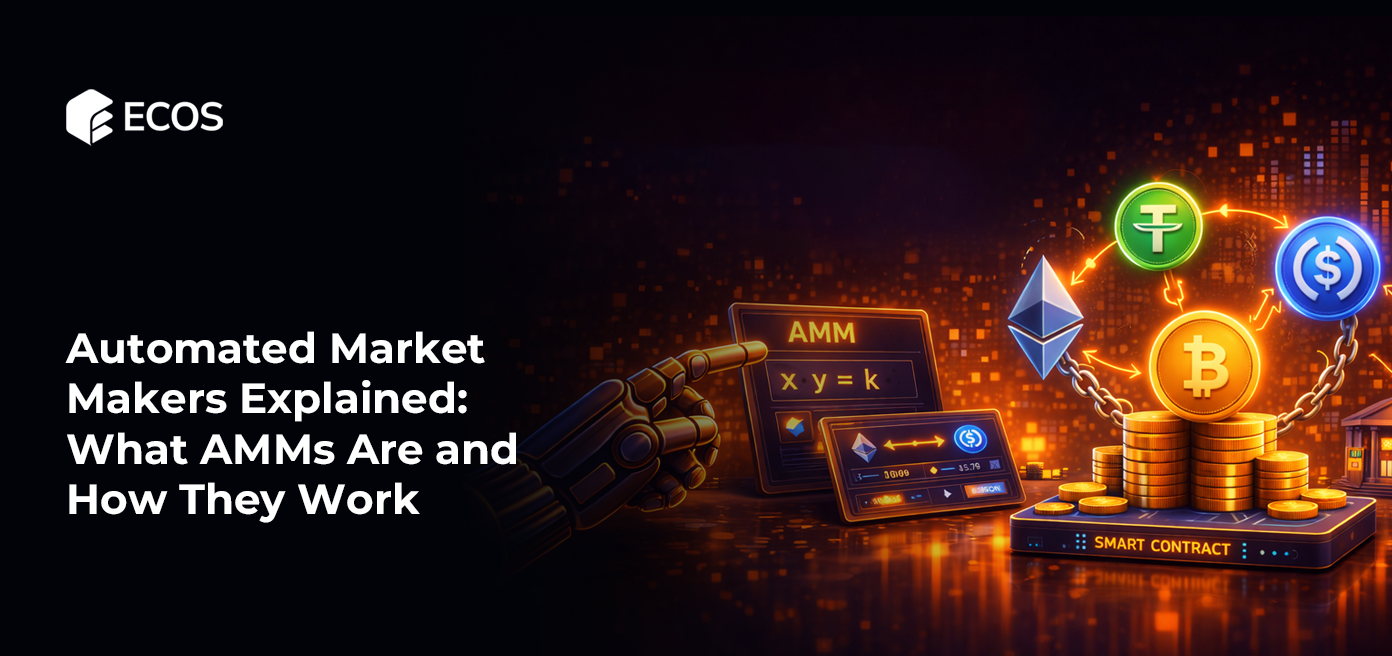

Before decentralized exchanges existed, trading crypto meant using a centralized platform where buyers and sellers found each other. An order book matched your buy order to someone else’s sell order. Simple enough — but it required both parties to be present, prices to align, and a company in the middle maintaining the infrastructure and taking custody of your funds. Automated market makers changed that equation entirely. An automated market maker is a type of smart contract protocol that provides liquidity for trading without requiring any counterparty. You swap a token against a pool of reserves; the pool prices the swap automatically based on a mathematical formula. No order book, matching engine and no counterparty needed.
This is what made DeFi trading possible at scale. Understanding what automated market makers are and how they work is foundational to understanding how decentralized finance functions in 2026.
What Is an Automated Market Maker (AMM)?
AMM Definition
An automated market maker is a decentralized exchange protocol that uses liquidity pools and algorithmic pricing formulas to enable token swaps without traditional order books. Instead of matching buyers with sellers, an AMM lets users trade against a smart contract that holds reserves of two or more tokens.
The protocol prices every trade automatically. When you swap ETH for USDC on Uniswap, you’re not buying from another user who happens to be selling USDC at that moment. You’re buying from the liquidity pool — a smart contract holding both ETH and USDC reserves — and the price you receive is calculated by the AMM’s pricing formula based on the current ratio of reserves.
Liquidity providers (LPs) fund these pools by depositing equal values of both tokens. In return, they receive LP tokens representing their share of the pool, and they earn a portion of the trading fees generated by every swap.
How AMMs Replace Traditional Order Books
In a traditional exchange, market makers are firms or individuals who post bid and ask orders continuously, earning the spread between buy and sell prices. This requires capital, sophistication, and active management. On most centralized crypto exchanges, market-making is handled by professional firms.
AMMs democratize market-making. Anyone with tokens can become a liquidity provider and earn fees proportional to their pool share. The smart contract automatically handles pricing — no human needs to quote prices or manage inventory. A liquidity pool on Uniswap keeps working at 3 AM on a Sunday with zero active participants, because the formula runs continuously on the blockchain.
The tradeoff is that AMM pricing is mechanical, not adaptive. A professional market maker will widen spreads during volatility; an AMM doesn’t. This creates arbitrage opportunities — and arbitrageurs play a crucial role in keeping AMM prices aligned with broader market prices.
Role in DeFi Ecosystem
AMMs are the foundation of decentralized trading. Without them, DeFi would have no mechanism for users to exchange tokens without centralized intermediaries. They enable: token swaps without accounts or KYC, yield generation for liquidity providers, price discovery for new tokens before centralized listings, and composability — other DeFi protocols can build on top of AMM pools, using them as price oracles or liquidity sources.
By 2026, AMM protocols collectively process billions of dollars in daily trading volume across Ethereum and multiple Layer-2 networks, making automated market makers one of the most used primitives in all of crypto.
How Automated Market Makers Work
The mechanics of an AMM come down to three components: liquidity pools, a pricing formula, and arbitrage.
Liquidity pools are smart contracts holding reserves of two tokens. To create a pool or add liquidity, providers deposit equal values of both tokens. The pool issues LP tokens tracking each provider’s share. When traders execute swaps, they send one token in and receive the other — the pool’s reserves change, and the price adjusts accordingly.
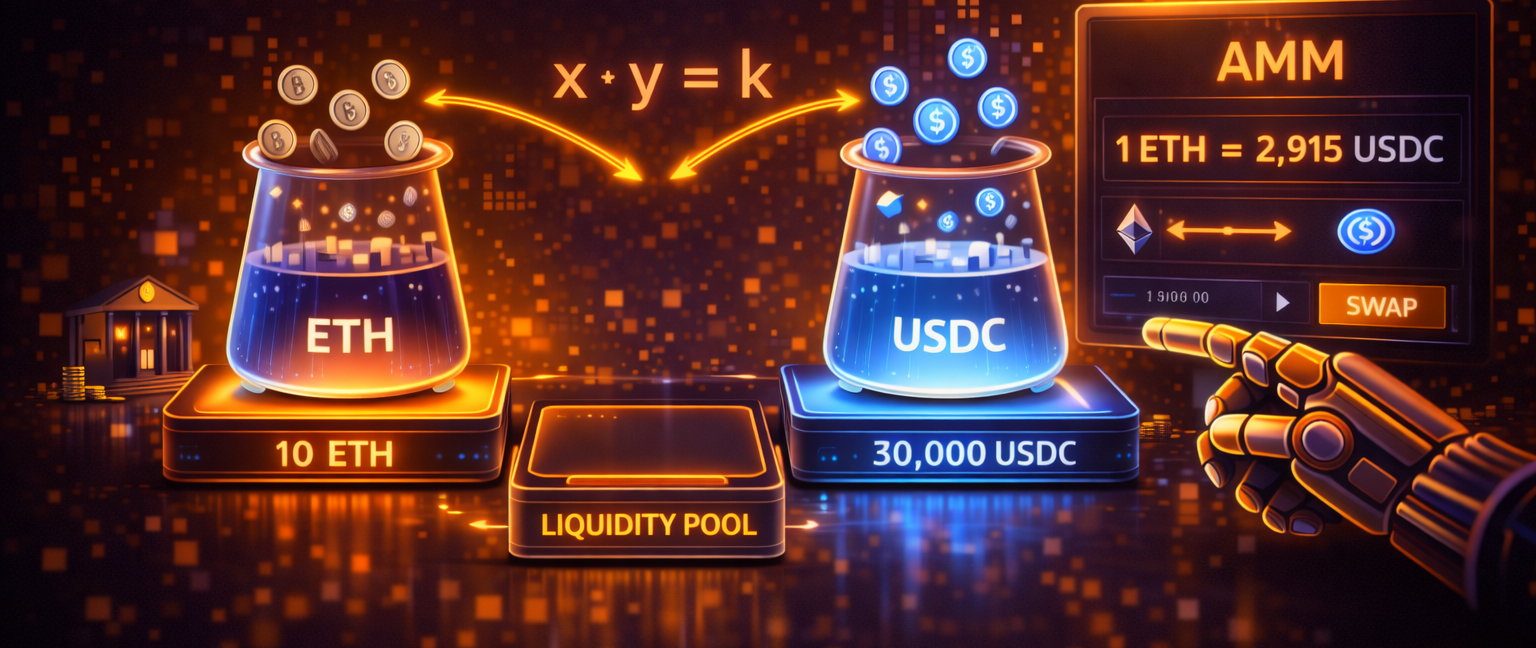
The pricing formula is the algorithm that determines swap rates based on reserve ratios. The most common is the constant product formula used by Uniswap: x * y = k, where x and y are the reserve quantities of two tokens and k is a constant. Every trade must preserve k — which means as the supply of one token in the pool decreases, its price increases automatically.
Arbitrage keeps AMM prices honest. If ETH is priced at $3,000 on Coinbase but $2,980 in a Uniswap pool, arbitrageurs buy ETH from Uniswap and sell on Coinbase, capturing the difference. This buying pressure pushes the pool’s ETH price up until it matches the market. Arbitrageurs don’t act charitably — they profit from the imbalance — but their activity is what keeps AMM prices roughly aligned with market reality.
AMM Pricing Formula Explained
The constant product formula x * y = k is the original and most widely used AMM pricing model, introduced by Uniswap in 2018. It guarantees that the product of reserve quantities stays constant, which produces a characteristic hyperbolic price curve.
Here’s how it works in practice. Suppose a pool holds 100 ETH and 200,000 USDC, giving k = 100 * 200,000 = 20,000,000. A trader wants to swap 1 ETH for USDC. After the swap, the pool holds 101 ETH. To keep k constant: 101 * y = 20,000,000, so y ≈ 198,020 USDC. The pool must hold 198,020 USDC after the trade, meaning the trader receives 200,000 – 198,020 = 1,980 USDC for their 1 ETH. The implied price is $1,980 per ETH — lower than the spot price of $2,000 because the large relative trade moved the curve.
This price impact is called slippage. Small trades relative to pool size experience minimal slippage; large trades cause significant price movement. A $10,000 swap in a $1 million pool will move price much less than in a $100,000 pool.
Later AMM designs introduced variations. Curve Finance uses a stableswap invariant optimized for assets that trade near the same price (like USDC and USDT), dramatically reducing slippage for stablecoin swaps. Uniswap v3 introduced concentrated liquidity, letting LPs allocate capital within specific price ranges rather than across the full curve — improving capital efficiency but requiring more active management.
What Is AMM in Crypto Trading?
Swapping Tokens on DEXs
From a user’s perspective, swapping tokens on an AMM-based DEX is straightforward. Connect a Web3 wallet (MetaMask, Phantom, Coinbase Wallet), select the tokens you want to swap, enter the amount, review the estimated output and price impact, and confirm the transaction. The smart contract executes atomically — either the full swap completes or nothing changes.
The user interface abstracts the underlying mechanics. When you see a price quote on Uniswap, you’re seeing the output calculated from the pool’s current reserve ratio and the constant product formula, minus the trading fee (typically 0.05%, 0.3%, or 1% depending on the pool).
No Counterparty Needed
One of the most significant properties of AMM trading in crypto is the absence of counterparty risk in the traditional sense. You’re not waiting for someone to fill your order. You’re not depending on a market maker to quote you a fair price. The smart contract is the counterparty — and its behavior is deterministic, publicly auditable, and not subject to human discretion.
This matters particularly for tokens with low trading volumes. A small-cap token might have a single Uniswap pool with $500,000 in liquidity. On a centralized exchange, such a token might have no market makers willing to quote it at all. The AMM ensures a price is always available, even if that price worsens significantly for larger trades.
24/7 Liquidity
Traditional exchanges operate during market hours. AMMs operate continuously on blockchains that never stop. A swap can execute at 2 AM on Christmas Day with the same mechanics as during peak trading hours on a weekday. The only constraint is blockchain congestion — network fees may be higher during busy periods, but liquidity is always present.
This 24/7 availability is particularly valuable for international users in time zones where traditional market hours are inconvenient, and for automated strategies that execute at any time based on on-chain conditions.
Popular AMM Platforms in DeFi
Uniswap
Uniswap is the largest and most influential AMM by trading volume. Launched on Ethereum in 2018 with the constant product formula, it pioneered the AMM model for the broader DeFi ecosystem. Uniswap v3 (launched 2021) introduced concentrated liquidity, and v4 (launched 2024) added hooks — customizable code that can execute logic before and after swaps, enabling novel pool types without requiring new core contracts. Uniswap operates on Ethereum mainnet and multiple Layer-2 networks including Arbitrum, Optimism, Base, and Polygon.
Curve Finance
Curve Finance specializes in stablecoin and like-asset swaps. Its stableswap algorithm maintains much lower slippage than constant product for assets that trade near parity, making it the preferred venue for USDC/USDT, stETH/ETH, and similar pairs. Curve’s deep stablecoin liquidity makes it a key component of the DeFi ecosystem — many protocols route large stablecoin trades through Curve to minimize slippage.
PancakeSwap
PancakeSwap is the dominant AMM on BNB Chain (formerly Binance Smart Chain), functioning as Uniswap’s equivalent in that ecosystem. It has expanded to multiple chains and offers additional features including lottery products and yield farming. For users transacting on BNB Chain, PancakeSwap provides the primary DEX liquidity.
Advantages of Automated Market Makers
- Permissionless access — anyone with a crypto wallet can trade or provide liquidity. No account registration, no KYC, no approval from the platform.
- Continuous liquidity — pools are always available to trade against. Price impact varies but there’s always a price.
- Open liquidity provision — anyone can become a liquidity provider and earn trading fees. Market-making is no longer exclusive to professional firms.
- Composability — AMM pools expose standard interfaces that other smart contracts can call. Lending protocols, yield optimizers, and arbitrage bots all integrate with AMM liquidity programmatically.
- Token listing without gatekeepers — a new project can create a Uniswap pool and begin trading without applying to an exchange or paying listing fees. This enabled the DeFi token proliferation that defined 2020–2021.
- Transparent pricing — the pricing formula is public, verifiable, and deterministic. Users can calculate exactly what price they’ll receive before confirming a transaction.
Risks of AMMs
Impermanent loss is the most significant risk for liquidity providers. When the price ratio between a pool’s two tokens changes, LPs end up holding a different ratio than they deposited — and if the price change is large, their position is worth less than if they had simply held the tokens. The loss is “impermanent” because it reverses if prices return to the original ratio, but if a provider withdraws during a large price divergence, the loss is realized. For stable pairs (USDC/USDT), impermanent loss is negligible. For volatile pairs (ETH/altcoin), it can be substantial.
Smart contract risk is inherent to all AMM protocols. A bug in the pool contract could allow an attacker to drain reserves. The history of DeFi includes multiple AMM exploits, including flash loan attacks that manipulate pool prices within a single transaction to profit at the expense of LP funds.
Price impact and slippage affect larger trades significantly. A $1 million swap in a $2 million pool will cause substantial price movement, and the executed price may be far worse than the quoted market price. Users must carefully review price impact warnings before confirming large trades.
Oracle manipulation is a risk for protocols that use AMM pools as price oracles. An attacker with sufficient capital can temporarily move an AMM price within a single block, trick a downstream protocol into using that false price, and profit before the price reverts — all within one atomic transaction.
Role of Liquidity Providers in AMMs
Liquidity providers are the backbone of the AMM ecosystem. Without LP capital in pools, AMMs would have no liquidity to trade against. In exchange for depositing tokens, LPs earn a share of the trading fees generated by every swap in their pool — typically split proportionally to pool share.
Fee revenue compensates LPs for the opportunity cost of holding tokens in the pool and the risk of impermanent loss. On high-volume pools with stable price ratios (like USDC/ETH on Uniswap), fee income can comfortably exceed impermanent loss. On low-volume volatile pairs, the economics are less favorable.
In Uniswap v3, liquidity provision became more complex. LPs can concentrate their capital within specific price ranges, dramatically improving capital efficiency when prices stay within that range — but earning zero fees when prices move outside. This shift made LP management more active and created a market for specialized automated LP management protocols.
Many LPs use yield optimizers like Yearn Finance or Beefy Finance to automate liquidity management and compound fee earnings, abstracting the complexity of active range management.
Future of Automated Market Makers
AMM design continues evolving rapidly. Several trajectories are clear in 2026:
Intent-based trading is emerging as a complement to AMMs. Rather than executing a swap directly against a pool, users sign an “intent” — a statement of what they want (e.g., at least 1,980 USDC for 1 ETH) — and solvers compete to fulfill it, potentially routing through multiple pools, centralized exchanges, or private liquidity. Protocols like CoW Protocol and UniswapX operate on this model. The result is often better prices than naive AMM swaps, particularly for large trades.
Cross-chain AMMs are addressing the fragmentation of liquidity across many blockchains. With significant TVL distributed across Ethereum mainnet, Arbitrum, Optimism, Base, Polygon, Solana, and other chains, efficient cross-chain swapping is a major user need. Protocols like Across and Stargate provide cross-chain liquidity; integrated cross-chain AMMs are an active development area.
Dynamic fee AMMs are adjusting trading fees based on market volatility. When volatility is high, impermanent loss risk for LPs increases — so some newer AMM designs automatically raise fees during volatile periods to better compensate LPs for that risk.
AMMs are also increasingly integrated into institutional workflows. Regulated entities can now access AMM liquidity through compliant interfaces that add KYC layers without modifying the underlying permissionless protocols.
Conclusion
Automated market makers solved a fundamental problem in decentralized finance. They enabled trading tokens without a counterparty or a central intermediary. The constant product formula, introduced by Uniswap in 2018, powered a trading revolution. It processed hundreds of billions in volume and spawned an entire ecosystem of derivative protocols.
The core insight is that a mathematical formula and a pool of reserves can replace a market maker. This concept turned out to be both technically sound and practically transformative. AMMs made DeFi trading accessible to anyone with a wallet. They allowed new projects to list tokens without approval and enabled composable financial applications.
The risks are real and shouldn’t be understated. Impermanent loss, smart contract vulnerabilities, and slippage on large trades all affect users and LPs. But the model has proven durable through multiple market cycles. Ongoing development continues to address its limitations. For anyone participating in DeFi, understanding automated market makers isn’t optional. It is the foundation.
FAQ
What is an automated market maker?
An automated market maker (AMM) is a type of decentralized exchange protocol that uses liquidity pools and mathematical pricing formulas to enable token swaps without requiring buyers and sellers to match with each other. Instead of an order book, AMMs use smart contracts holding token reserves; the price of each swap is calculated algorithmically based on the current ratio of reserves. AMMs are the foundational trading mechanism of decentralized finance.
What is AMM in crypto?
In crypto, AMM refers to the automated market maker protocol that powers most decentralized exchange (DEX) trading. When you swap tokens on a DEX like Uniswap or Curve, you’re trading against an AMM pool — a smart contract holding reserves of two tokens — rather than buying from another user. AMMs enable permissionless trading, continuous liquidity, and open liquidity provision, making them central to how DeFi operates.
What are AMMs in DeFi?
AMMs in DeFi are the smart contract protocols that provide decentralized trading infrastructure. DeFi relies on AMMs because they operate permissionlessly on blockchains — no company needs to run them, no accounts are required, and liquidity is always available. Uniswap, Curve Finance, PancakeSwap, and Balancer are among the most prominent AMM platforms. Collectively, they process billions in daily trading volume and provide the price discovery and liquidity that the broader DeFi ecosystem depends on.
What is automated market making?
Automated market making is the process by which an AMM protocol continuously provides buy and sell prices for token pairs based on a mathematical formula and the current state of a liquidity pool. Unlike traditional market making (where firms actively manage order books), automated market making is algorithmic and runs continuously on the blockchain without human intervention. Any price change updates automatically as trades occur and reserve ratios shift.
What is impermanent loss in AMMs?
Impermanent loss is the difference between holding tokens in an AMM liquidity pool versus holding them in a wallet, when the price ratio between the two tokens changes. When prices diverge from the ratio at which you deposited, the constant product formula rebalances the pool in a way that gives you a less favorable mix of tokens than your original deposit. The loss is called “impermanent” because it reverses if prices return to the original ratio — but becomes realized if you withdraw at a divergent price.
Published Articles

Crypto Basics Explained: A Beginner’s Guide to Cryptocurrency and Trading
Introduction The world of finance is changing right before our eyes. Just...
 Popular
Uniswap Explained: What It Is, How It Works, and How to Use the UNI DEX
Introduction Decentralization and decentralized platforms that have emerged in recent years have...
WAGMI in Crypto Explained: Meaning, Origin, and the Rise of WAGMI Exchange
Introduction Over the past few years, the crypto community has developed its...

Services You Can Pay for with Bitcoin
Where Bitcoin Is Accepted Today Today, Bitcoin (BTC) can be used to...
 Popular
The Meme Economy: How Internet Humor Shapes Culture, Markets, and Crypto
Introduction Ten years ago, the idea that a picture of a dog...

What You Can Buy With Bitcoin in 2025
Introduction Over the years, Bitcoin has evolved from an experimental digital currency...