
Bitcoin Pizza Guy: The Story Behind the First Real Bitcoin Purchase
Introduction
The history of Bitcoin is full of dramatic ups and downs, but no single event has anchored itself in popular culture as firmly as the act of the man now known as the bitcoin pizza guy. Back when cryptocurrency was merely an experiment for a small circle of cryptographers and programmers, no one could have imagined that digital coins would one day be worth tens of thousands of dollars. For most ordinary people, these weren’t even “play money,” but just numbers on a screen with zero real-world value. However, this specific case proved to the world that Bitcoin could move beyond computer simulations and become a legitimate means of payment in the real world.
This pizza bitcoin story didn’t start with financial analysis or an investment strategy. Instead, it began with a simple human desire to have lunch without spending cash. Laszlo Hanyecz, the protagonist of this story, wanted to test a simple idea. He wondered if exchanging virtual coins for something tangible would actually work. What seemed like a fun experiment back then eventually led to a massive result. It created an unofficial holiday celebrated annually by the entire crypto community. Today, we see this episode as a vital starting point. It marked the triumphant march of blockchain technology into the global economy.
Who Is the Bitcoin Pizza Guy?
The man who went down in history as the bitcoin pizza guy is Laszlo Hanyecz, a talented programmer from Florida. In 2010, he was an active member of the early community and one of the first miners helping to support the Bitcoin network in its infancy. Laszlo wasn’t a professional investor; he was an enthusiast who believed in the technical potential of open-source code. At that time, mining Bitcoin was much simpler than it is today: coins could be mined using a standard home computer’s CPU, and Laszlo managed to accumulate a significant amount of digital assets that were practically worthless at the time.
Many remember Laszlo today only in the context of “lost gains.” This is due to the current astronomical value of those coins. However, Laszlo himself has never expressed public regret over his actions. He entered history as a pioneer, not a loser. His contribution to the industry’s development is hard to overstate. He was the first to move Bitcoin from abstract digits to a real purchasing tool.
Thanks to his initiative, the world learned a vital lesson. Decentralized currency is not just a theory from a whitepaper. It is a working mechanism capable of paying for mundane items like pizza. If Laszlo had kept his coins, they might be worth nothing today. Without his transaction, Bitcoin’s growth could have stalled entirely.

The Legacy of the Bitcoin Pizza Guy
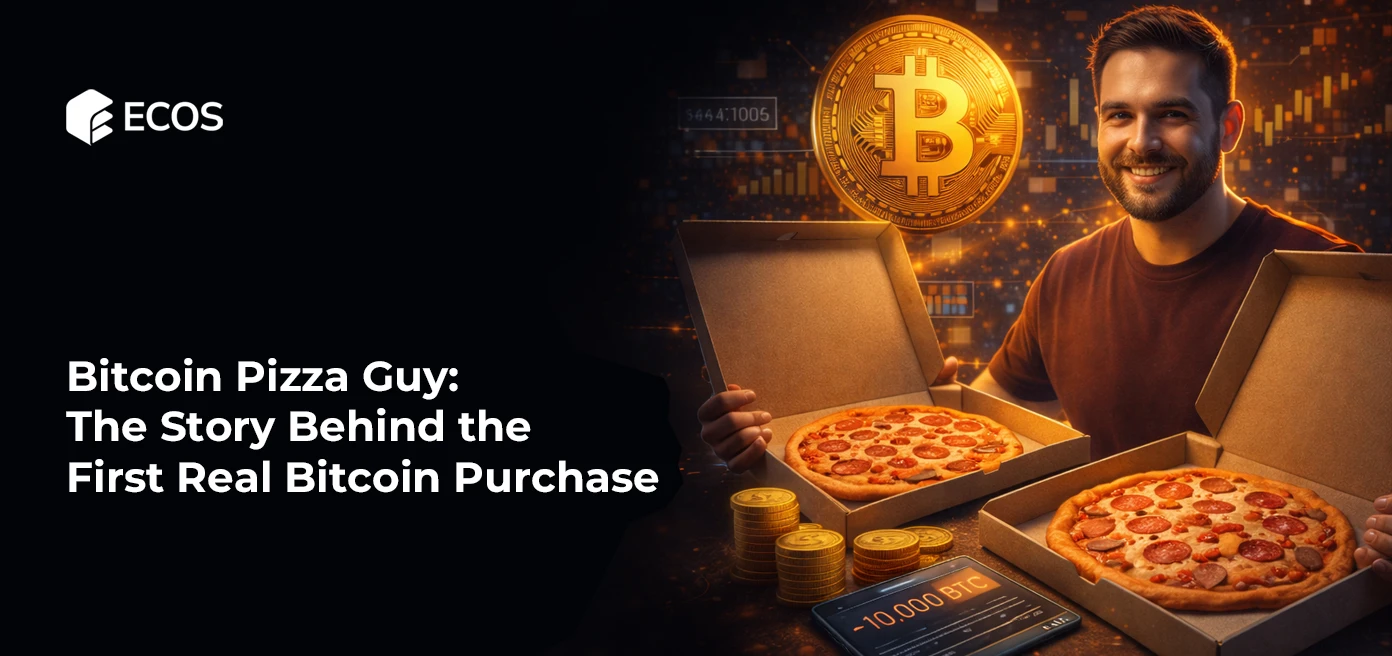
The events that formed the basis of the pizza bitcoin story unfolded in May 2010. On May 18, Laszlo Hanyecz posted a message on the Bitcointalk.org forum titled “Pizza for bitcoins?”. His offer was remarkably simple: he was willing to pay 10,000 BTC to anyone who would order and deliver two large pizzas to him. Laszlo even specified his preferences, mentioning he liked onions, peppers, sausage, and mushrooms, but the main condition was the fact of the exchange itself. He wanted it to feel like ordering food at a hotel – you bring me the food, and I give you the payment, only in this case, the payment was digital.
How the Pizza Was Bought With Bitcoin
At that moment, Bitcoins were worth nothing because it wouldn’t have occurred to anyone to buy them with real money. The offer to buy a pizza bought with bitcoin sat on the forum for a few days without a response; users discussed the feasibility, the meaning, and the very possibility of such a deal. Finally, on May 22, a volunteer emerged – a 19-year-old student from the UK named Jeremy Sturdivant (known by the nickname jercos). He was the first person to agree to accept Bitcoin as payment for a tangible material good.
The Exact Bitcoin-for-Pizza Transaction
This transaction became the first documented case of using Bitcoin to purchase a physical product, creating a precedent that proved Bitcoin has exchange value. Jeremy, being on the other side of the world, found a Papa John’s pizzeria in the US and, using his credit card, ordered two pizzas to be delivered to Laszlo’s address in Florida.
The transaction itself was conducted manually and built entirely on trust. In 2010, there were no payment gateways, QR codes, or crypto wallets on mobile phones. Laszlo Hanyecz sent 10,000 BTC to Jeremy Sturdivant’s address after the latter confirmed the pizza order through the delivery service. At that time, confirming a transaction on the blockchain could take a significant amount of time, and the participants chatted in real-time via IRC and the forum, waiting for the coins to change hands. Essentially, it was a barter: one person paid for food with fiat money, and the other compensated for those costs with a digital asset. From a technical standpoint, this transaction is recorded in the Bitcoin blockchain forever – a 10,000 BTC transfer that serves as a digital monument.
Why This Moment Changed Crypto History
The event centered around the bitcoin pizza guy wasn’t just a fun trivia fact; it was a fundamental shift in the perception of digital assets. Before May 22, 2010, Bitcoin existed primarily as a theoretical concept for cryptographers and “digital anarchists.” Laszlo’s deal brought Bitcoin out of the realm of abstract code into the real economy. It proved in practice that a decentralized network, without the support of banks or governments, is capable of fulfilling the primary function of money: being a medium of exchange.
This moment changed crypto history by launching the mechanism of market price formation. Before the pizza purchase, Bitcoin effectively had no exchange rate; it wasn’t traded on exchanges and had no clear dollar equivalent. As soon as Laszlo traded 10,000 BTC for goods worth about $25–30, Bitcoin received its first “fair” price. This provided the spark of confidence: if you can buy food with coins, you can buy anything else. Furthermore, the pizza bitcoin story created a powerful cultural narrative and became a cornerstone of Bitcoin mythology, attracting millions of people to the industry. Without this simple step, the first real payment might have happened years later, significantly slowing down the adoption of cryptocurrencies.
Bitcoin Pizza Day
When and Why Bitcoin Pizza Day Is Celebrated
Every May 22, the global crypto community unites to celebrate Bitcoin Pizza Day. This event has long since outgrown its status as a local meme to become an official symbol of the industry. On this day, it’s customary not only to order pizza (preferably with crypto) but also to reflect on the progress of blockchain technology.
How the Community Marks the Event
For companies, this holiday has become a fantastic marketing opportunity: major exchanges like Binance or Coinbase host themed events, giveaways, and even release limited-edition merch dedicated to Laszlo Hanyecz’s legendary purchase. The popularity of Bitcoin Pizza Day is explained by the deep meaning it holds for every market participant. For industry veterans, it’s a day of nostalgia for the early, “small” community days. For newcomers, it’s a vivid lesson in the importance of believing in technology in its early stages. The holiday reminds us that Bitcoin is, above all, the freedom to manage your own funds.
Bitcoin Pizza Day Meaning for Crypto Users
Bitcoin Pizza Day has become a vital tool for popularizing the idea of “mass adoption.” Every year, media outlets around the world retell Laszlo’s story, drawing a new audience to the topic of crypto. It creates a cycle of interest: people come for the story of the “most expensive pizza” and stay to learn about decentralized finance. Often, it’s not just the technology that interests them, but the hope that they, too, might buy something for twenty dollars that eventually turns into a billion. Many new tokens are bought specifically with a nod to Bitcoin Pizza Day – the hope that currently worthless tokens might one day skyrocket in value. Ultimately, May 22 is a victory of an idea over skepticism, proving that even a seemingly insignificant experiment can change financial history.
How Much Was the Pizza Worth in Bitcoin?
To understand the price of that purchase, one must understand the context of 2010. Laszlo Hanyecz paid exactly 10,000 BTC for two large pizzas. At that time, Bitcoin had virtually no market value because no one was buying or selling it. There was nowhere to buy it; you could only mine it. Technically, the transaction included another 1 BTC as a miner’s fee, so a total of 10,001 BTC left Laszlo’s wallet. At the time, it seemed like a great deal: a programmer got a free dinner by spending coins he mined on his home computer in just a few days.
If we calculate the value of those Bitcoins at today’s exchange rate, the figures are astronomical. Today, with Bitcoin’s price exceeding $90,000, those two pizzas are worth over $900 million. This deal is rightfully considered the most expensive food purchase in human history. To put it in perspective: with that money, you could buy not just a few restaurants, but an entire international pizza chain with all its assets and real estate. This colossal gap between “then” and “now” turned a simple lunch order into a legend. Laszlo chose 10,000 BTC because, back then, they were viewed as experimental “tokens.” Miners received 50 BTC per block, so accumulating thousands of coins was just a few hours of work. For Laszlo, getting real pizza for the fruits of his hobby was simply an “incredibly cool thing.”
Why Someone Bought Pizza With Bitcoin
To modern investors, it seems irrational to spend assets that could be worth hundreds of millions on fast food. However, the answer to why someone bought pizza with Bitcoin lies in the very essence of Satoshi Nakamoto’s ideology. In 2010, Laszlo and others didn’t see Bitcoin as “digital gold” or a wealth-building tool. It was a decentralized payment system. And any payment system is useless if it doesn’t allow you to buy anything. Laszlo wanted to prove that Bitcoin was a functional alternative to fiat money (or perhaps he was just looking for someone to buy him real pizza in exchange for “meaningless” digits).
But why did Jeremy Sturdivant want 10,000 “tokens”? In 2010, it didn’t look like a profitable trade. Jeremy spent about $25–30 of real money to receive an asset he couldn’t spend anywhere. His motivation was purely exploratory and ideological. Like Laszlo, Jeremy was a tech enthusiast. For him, it was a quest: could he successfully act as an “exchange point” between traditional finance and the crypto world? He took on the risk of being the “first market maker.” Jeremy later admitted he didn’t “hold” the coins; as the price rose slightly, he spent them on a trip with his girlfriend and computer upgrades. He has no regrets, as his role was to provide liquidity where none existed, helping Bitcoin take its first step toward global recognition.
Cultural Impact of the Bitcoin Pizza Purchase
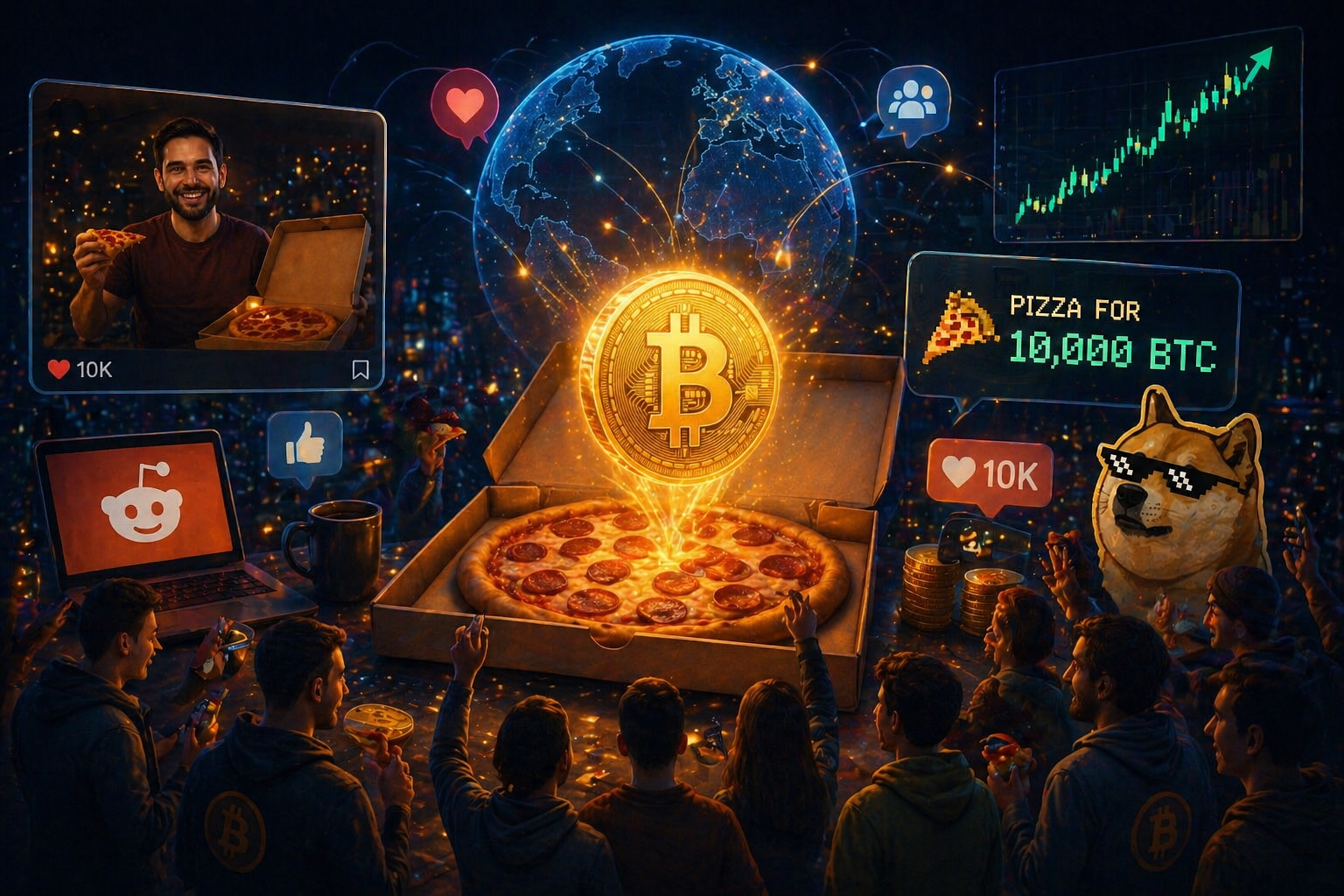
The Cultural Impact of the Bitcoin Pizza Purchase cannot be overstated – it has become part of global digital folklore. This story is a universal metaphor for missed opportunities, used by financial advisors, bloggers, and even Hollywood writers. For the mass audience, the “pizza guy” is the personification of how technology can radically revalue ordinary things. This case firmly established jokes about the “world’s most expensive dinner” in the investor’s lexicon.
Furthermore, it spawned an entire industry of souvenirs and digital art. Today, you can find NFT collections dedicated to those two pizzas and themed restaurants using this story in their branding. The cultural footprint of the deal acts as an “entry point” for beginners. While technical terms like “hashing” might be intimidating, the pizza story is relatable to everyone. It makes cryptocurrency human, adding an element of personal drama and irony that is crucial for mass adoption. It demonstrates a healthy atmosphere in the industry: acknowledging past mistakes and respecting those who stood at the beginning.
Lessons From the Bitcoin Pizza Story
The story is a life lesson for the modern investor. The main lesson we can draw from the pizza bitcoin story is that an asset’s value is often non-obvious in its early stages. Many critics in 2010 called Bitcoin garbage, but Laszlo’s act showed that value is created by community belief and a willingness to use the tool. Another important lesson concerns the nature of money: currency must circulate to have value. If everyone only hoarded coins, there would be no market price or ecosystem. Laszlo didn’t “lose” – he invested his 10,000 BTC into Bitcoin’s global recognition.
Finally, this story teaches us to treat our financial decisions with a bit of irony. This is especially true when compared to other stories of success and failure. Take the story of the Victoria’s Secret founder for example. Roy Raymond borrowed $80,000 to create the company. In 1982, he sold it to Leslie Wexner for just $1 million. Raymond became a millionaire through the deal. However, the company soon turned into a multi-billion dollar empire. Watching this growth led Roy into a deep depression. He eventually took his own life in 1993.
Both stories illustrate the “price of an early exit.” Laszlo became a legend who treats his story with humor. In contrast, Roy Raymond became a symbol of a missed opportunity that led to tragedy. Laszlo often says he doesn’t regret his choice. He got two tasty pizzas and a permanent place in history.
Bitcoin Pizza Story vs Modern Crypto Payments
Comparing Laszlo’s case to the modern industry (Bitcoin Pizza Story vs Modern Crypto Payments) shows a massive technical evolution. In 2010, buying something required a forum post, a volunteer, and a manual coordination that could take ages. Today, paying with crypto is a matter of seconds. With technologies like the Lightning Network, Bitcoin has become a fast tool for micro-payments, allowing you to buy coffee or pizza instantly.
However, a psychological gap remains. In 2010, Laszlo spent Bitcoin because it was new and exciting. Today, many view it strictly as a “Store of Value,” leading to a reluctance to spend. We have the technology for mass payments, but volatility makes people want to “HODL.” Modern systems solve this with stablecoins, allowing for blockchain convenience without the fear of becoming the next “pizza guy” whose dinner became worth millions. The pizza story was the “Wild West” of crypto; modern payments are a mature industry.
Conclusion
The bitcoin pizza guy story is the “Big Bang” that turned Bitcoin from abstract code into real currency. By exchanging 10,000 BTC for two pizzas, Laszlo Hanyecz sacrificed a potential fortune to prove the viability of decentralized money. Today, Bitcoin Pizza Day reminds us that every great technology starts with simple, sometimes curious steps. Laszlo didn’t lose – he became a pioneer whose courage allowed Bitcoin to find its price and the recognition of millions. This story teaches us to value progress and to remember that real-world impact determines the value of innovation through how it changes our daily lives.
Published Articles
How Bitcoin ATMs Work: A Complete Guide to Using Crypto ATMs
Introduction Millions of people around the world use cryptocurrencies today – at...

Best Bitcoin Mining Software of 2025 – Top 7 Tools for Maximum Profitability
Bitcoin mining has long since moved beyond being a hobby for enthusiasts...

Services You Can Pay for with Bitcoin
Where Bitcoin Is Accepted Today Today, Bitcoin (BTC) can be used to...

What You Can Buy With Bitcoin in 2025
Introduction Over the years, Bitcoin has evolved from an experimental digital currency...
 Popular
Bitcoin & Crypto Options Trading: A Complete Guide for Beginners and Experts
Bitcoin options trading has grown rapidly in recent years as the cryptocurrency...
Bitcoin Taproot Explained: What the Upgrade Means for BTC
Introduction Unfortunately, the most popular cryptocurrency today – Bitcoin – was not...