
NFT Marketing: A Complete Guide to Promoting Non-Fungible Tokens
Introduction
Today, the NFT market has evolved from a niche experiment into a full-scale digital industry. However, as the number of collections and projects has grown, one thing has become clear: simply creating an NFT is not enough. Without a thoughtful approach to promotion, even the highest-quality product will go unnoticed. But how do you market collections when traditional crypto marketing tactics do not work the same way here?
Unlike traditional digital marketing, value in NFTs is not built through ad budgets, but through engagement, narrative, and a sense of belonging. That is why NFT marketing and promotion are built around communication, transparency, and long-term interaction with an audience. For collection creators, the key challenge is not reach, but engagement. Collectors, traders, digital art fans, and users interested in utility NFTs respond to different messages and channels. Without a clear understanding of your audience, even the most creative campaign loses effectiveness.
This article is a practical guide to NFT marketing. We explain what is NFT marketing as a distinct direction within Web3, break down what an NFT marketing strategy looks like, how to build an NFT marketing plan, which channels work best, how to promote your NFT before, during, and after launch, and which mistakes most often prevent projects from achieving results.
What Is NFT Marketing?
To begin, let’s clarify what is NFT marketing. It is a set of strategies and tools designed to attract attention to an NFT project, build trust, and generate sustained community interest. The focus is not only on selling tokens, but on building long-term value.
NFT marketing operates at the intersection of digital marketing, branding, and Web3 culture. Metrics like reach and clicks matter less than reputation and community activity. That is why an NFT marketing strategy rarely comes down to one channel or a short-term campaign.
H3 What Is NFT Marketing and Promotion
NFT marketing and promotion cover the full project lifecycle – from early concept and launch preparation to maintaining momentum after mint. In the early stage, this often includes setting expectations, building allowlists, and clearly communicating the project’s value.
During launch, visibility becomes the priority: social media posts, influencer participation, and activity across community platforms. After the sale, marketing does not end – in fact, post-launch activity often determines whether a project becomes long-term or quickly loses attention.
How NFT Marketing Differs from Traditional Digital Marketing
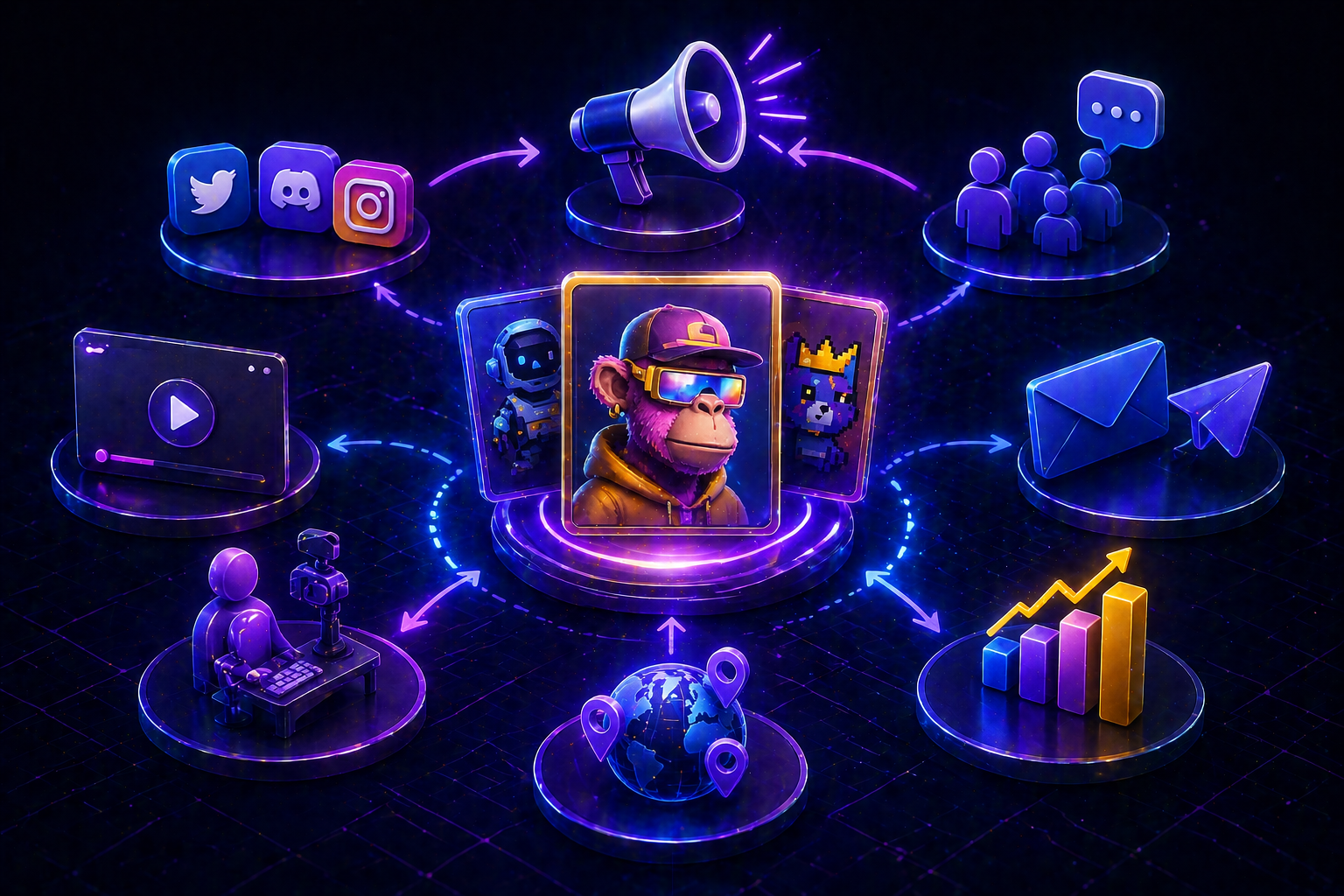
A key difference between NFT marketing and other marketing approaches is that a project’s community often plays the central role. In NFTs, the buyer becomes a participant – and sometimes a co-creator or ambassador.
NFT marketing also depends heavily on trust. Lack of transparency, anonymous teams, or promises that do not match reality can undermine reputation quickly. Unlike classic ad campaigns, weak fundamentals cannot be fixed with larger budgets – Web3 audiences are highly sensitive to insincerity and react fast when projects make mistakes.
Why NFT Marketing Matters in Web3
As the NFT market matures, competition for attention becomes more difficult. Many collections rely on similar standards and marketplaces, so marketing increasingly determines who gains liquidity and who remains invisible. In this context, an NFT marketing strategy becomes a real foundation for success.
In Web3, value is not created centrally – it is shaped by the community. If a project cannot sustain interest and communicate its value, the market will do it instead, often negatively. That is why strong strategy and positioning directly affect trust, secondary-market performance, and long-term viability.
Market Saturation and Competition
The NFT market is saturated. Even now, after the hype has cooled, hundreds of new collections launch daily, competing for the same users. In this environment, simply being an NFT project is no longer enough.
A well-structured NFT marketing plan helps:
- stand out among similar collections;
- communicate what makes the idea unique;
- set expectations before launch.
Without a clear strategy, even a technically strong project can get lost in the market noise.
Community-Driven Value in NFTs
It is important to recognize that in NFTs, value is often created after purchase. In some projects, token holders gain access to private communities, events, content, or future updates. That is why NFT marketing must focus not only on acquisition, but also on retention.
In these projects, the community serves multiple functions: it spreads information better than any influencer, supports secondary-market liquidity, and shapes brand reputation. When marketing is executed well, a project’s social channels start to promote your NFT organically, becoming a durable growth engine. In Web3, this is one of the most valuable outcomes of promotion.
Defining Your NFT Target Audience
One of the most common mistakes in NFT projects is trying to speak to everyone. In practice, an effective NFT marketing strategy always starts with a clear understanding of the NFT target audience. Without defining your audience, you cannot choose the right channels, messaging tone, or content format.
Different user groups perceive NFT value differently. Collectors, traders, gamers, and DAO participants may share platforms, but respond to very different narratives. Audience definition is not a formality – it is the foundation of any NFT marketing plan.
Identifying NFT Buyers and Collectors
The first step is answering a basic question: who is most likely to buy your NFT? For some projects, it is investors focused on resale and liquidity. For others, it is collectors who value visual identity, narrative, and uniqueness.
When defining collection buyers, you should clarify:
- purchase motivation (investment, status, participation);
- Web3 experience level (beginner vs experienced);
- preferred platforms and communities;
- price sensitivity and mint conditions.
The more precise the buyer profile, the easier it becomes to build NFT marketing and promotion without wasted spending or diluted messaging.
Understanding Utility vs Art NFT Audiences
Art NFTs and utility NFTs are fundamentally different asset types, and their audiences respond to different triggers.
For digital art projects, the key factors are visual identity, artist reputation, and cultural context – marketing is built around narrative, aesthetics, and uniqueness. Utility NFTs, by contrast, sell access and functionality. These may include participation rights, in-game assets, subscriptions, or ecosystem features. In these cases, an NFT marketing strategy focuses on communicating utility, roadmap clarity, and long-term value.
Understanding the difference helps avoid expectation mismatches that often destroy trust immediately after launch.
Building an NFT Marketing Strategy
A successful NFT project almost never starts with mint – it starts with a plan. An NFT marketing strategy guides the entire project: positioning, content tone, channel selection, and how the team communicates with its audience. Without a strategy, promotion becomes a collection of disconnected actions that are difficult to scale or evaluate.
In Web3, strategy must reflect market specifics: high competition, strong sensitivity to authenticity, and short attention cycles. That is why an NFT marketing plan is built around project value, not just sales.
Setting Goals for an NFT Marketing Plan
The first step is defining what you expect marketing to achieve. Goals depend on project stage and NFT type. Typical goals within an NFT marketing plan include:
- building brand awareness before launch;
- growing an active community;
- achieving a successful mint;
- supporting secondary-market liquidity;
- maintaining long-term holder engagement.
Clear goals make performance measurable and allow strategy adjustments during the campaign.
Branding, Storytelling, and Value Proposition
In a saturated market, narrative often separates one NFT project from another. Users rarely buy tokens “just because” – they buy an idea, an emotion, or membership in a community. Many recent successful collections gained traction through storytelling and engagement.
A strong value proposition answers a simple question: why should this NFT exist? Within an NFT marketing strategy, that is expressed through visual identity, consistent storytelling, a clear mission, and transparent communication.
Without those elements, no matter how aggressively you try to promote your NFT, results will be limited.
NFT Marketing and Promotion Channels
Channel selection is a critical step. Effective NFT marketing and promotion almost always relies on multiple platforms rather than a single traffic source.
Social Media and Community Platforms
Social media remains the foundation for most NFT projects. It is where audiences first discover a project, expectations are built, and ongoing dialogue is maintained. However, unlike traditional marketing, NFT projects rarely rely only on posting content.
Community platforms become the ecosystem center. That is where participants discuss updates, gain early access, and develop a sense of belonging. Within an NFT marketing strategy, these spaces are not purely promotional – they turn an audience into active participants.
Influencer and Creator Collaborations
Influencer collaborations play an important role in NFT promotion, but they require careful execution. Web3 audiences quickly identify superficial paid integrations, so partner selection must be deliberate.
Effective collaborations are based on trust and relevance. When an influencer genuinely shares the project’s values, recommendations feel natural. In that case, how to promote an NFT becomes less like advertising and more like a trusted endorsement.
Email Marketing and Allowlists
Despite the growth of social platforms, email marketing remains useful, especially during launch preparation. Early-access lists and allowlists enable direct communication with the most interested audience.
Within an NFT marketing plan, allowlists serve two functions: they create a sense of exclusivity and help predict demand. Used well, this channel strengthens other activities and improves mint-stage conversion.
How to Promote an NFT Collection
Promoting an NFT collection is a process that starts long before mint and continues afterward. A common mistake is focusing only on launch day. In practice, successful NFT marketing and promotion is built in stages and accounts for the full lifecycle of a collection.
Pre-Launch NFT Marketing Strategies
The pre-launch phase is the most important. This is when first impressions are formed, a community core is built, and trust is established. At this stage, the NFT marketing strategy should focus on explaining value, not selling.
Key pre-launch elements include gradual concept and visual reveals, introducing the team and project idea, building allowlists, and engaging the audience through discussions and activities.
Strong preparation ensures that launch begins with an interested audience rather than a last-minute attempt to capture attention.
Launch-Day Promotion Tactics
On mint day, the goal is visibility, transparency, and fast communication. That includes synchronized announcements across platforms, an active team presence in community channels with rapid answers to questions, and support from influencers and partners.
The launch-day objective is not only to sell NFTs, but to preserve trust in a high-pressure environment.
Post-Launch Engagement and Retention
After mint, marketing does not end – it shifts focus. The priority becomes maintaining holder interest and proving the project is active. This is where long-term collection value is built.
Within an NFT marketing plan, post-launch actions may include regular updates, exclusive holder content, roadmap progress communications, and new partnerships and collaborations. Without this, even a successful launch can remain a one-time event rather than the start of a sustainable project.
NFT Ads and Paid Promotion
Most projects would prefer free promotion, and in NFTs, organic and semi-organic tactics often produce the strongest results. Still, paid promotion can be justified as part of a strategy. When used correctly, NFT ads can amplify existing momentum and support key launch phases.
When NFT Ads Make Sense
Paid promotion works best when combined with organic interest. If a project is already being discussed and has clear value, ads can expand reach and attract new audiences.
An NFT marketing strategy may include paid tools for:
- supporting a major launch or partnership;
- reaching new audiences beyond the existing community;
- retargeting users who have already interacted with the project.
In these scenarios, ads amplify impact rather than replacing trust and product value.
Risks and Limitations of Paid NFT Advertising
The main risk of paid promotion is expectation mismatch. Web3 audiences are highly sensitive to aggressive advertising and quickly identify projects without real value. In such cases, NFT marketing through ads may generate short-term traffic but damage reputation.
That is why paid promotion should be part of a deliberate plan, not an attempt to compensate for a weak concept. In NFT markets, ads work only when there is genuine interest and an active community behind them.
Using Data and NFT Search Trends
As the market matures, intuition is not enough. An effective NFT marketing strategy increasingly relies on data: audience behavior, interest dynamics, and reactions to different content formats. Analytics helps evaluate what has worked and adjust promotion in real time.
Tracking NFT Search Trends
NFT search trends show which themes and directions are attracting attention at a given moment. Rising or falling search interest can signal a market shift before it becomes visible in sales.
For marketing, this means choosing better timing for launches and avoiding outdated or overheated narratives. Trends do not replace strategy, but they help align NFT marketing and promotion with current demand.
Analytics, Feedback, and Optimization
In NFT marketing, data is not only numbers but also community feedback. Activity in community spaces, user questions, and discussions can be more informative than standard metrics.
Within an NFT marketing plan, it is important to regularly analyze engagement, track post-mint user behavior, and adjust content and communication channels.
Continuous optimization helps a project remain relevant and sustain interest even after overall market hype declines.
Common Mistakes in NFT Marketing
Even with a strong idea, NFT projects often struggle due to repeated marketing mistakes. These issues are usually not technical – they stem from misunderstanding the audience and Web3 dynamics. Recognizing these risks supports a more resilient NFT marketing strategy.
One of the most common mistakes is focusing exclusively on mint. Many teams concentrate on how to promote your NFT before and on launch day, while ignoring the post-sale period. As a result, interest fades quickly and secondary-market liquidity drops.
Another issue is a vague value proposition. If a project cannot clearly explain why the NFT exists and what value it provides, NFT marketing and promotion becomes a set of abstract promises. In a competitive market, such projects are quickly overshadowed by clearer, more transparent initiatives.
Many teams also overestimate the power of advertising. Trying to compensate for a weak concept with NFT ads usually produces a short-term traffic spike without long-term impact. Web3 audiences identify value gaps quickly and respond negatively to aggressive promotion.
Finally, ignoring community feedback is a serious mistake. NFT projects exist in continuous dialogue with users, and lack of communication erodes trust faster than any market downturn. A strong NFT marketing plan always includes strategy adjustments based on audience response.
Is NFT Marketing Still Effective?
As the market cools, many ask whether NFT marketing is still effective. The answer depends less on market conditions and more on execution quality. The era of quick hype-driven sales is over, but that does not mean NFT promotion no longer works.
Effectiveness has shifted from mass noise to targeted engagement. An NFT marketing strategy focused on community, utility, and long-term development remains viable even when overall market interest declines. Projects that maintain dialogue and consistently deliver on promises continue to find demand.
The market is also more mature. Users better understand what is NFT marketing and expect transparency, a real product, and a clear development logic. In this environment, marketing becomes less about manipulation and more about communicating value.
NFT marketing remains effective, but it works differently. It requires more time, discipline, and strategic thinking than during the hype cycle.
Conclusion
NFT marketing is not a set of tactics or a short-term ad campaign. It is a structured process of building trust and value in Web3. Understanding what is NFT marketing helps projects move beyond a single mint and build a durable market presence.
An effective NFT marketing strategy starts with a clear audience definition, is built on a strong value proposition, and develops through consistent communication. NFT marketing and promotion work best when they amplify a real product rather than trying to replace it.
In a highly competitive environment, projects win when they treat NFTs as a long-term commitment to their community rather than a quick monetization tool. This approach makes it possible not only to promote your NFT, but to build trust, liquidity, and a sustainable reputation within the Web3 ecosystem.
Published Articles
Crypto Basics Explained: A Beginner’s Guide to Cryptocurrency and Trading
Introduction The world of finance is changing right before our eyes. Just...
 Popular
Uniswap Explained: What It Is, How It Works, and How to Use the UNI DEX
Introduction Decentralization and decentralized platforms that have emerged in recent years have...
WAGMI in Crypto Explained: Meaning, Origin, and the Rise of WAGMI Exchange
Introduction Over the past few years, the crypto community has developed its...
Services You Can Pay for with Bitcoin
Where Bitcoin Is Accepted Today Today, Bitcoin (BTC) can be used to...
 Popular
The Meme Economy: How Internet Humor Shapes Culture, Markets, and Crypto
Introduction Ten years ago, the idea that a picture of a dog...
What You Can Buy With Bitcoin in 2025
Introduction Over the years, Bitcoin has evolved from an experimental digital currency...