
What Are the Best Cryptocurrencies to Invest in? A Comprehensive Guide
Introduction
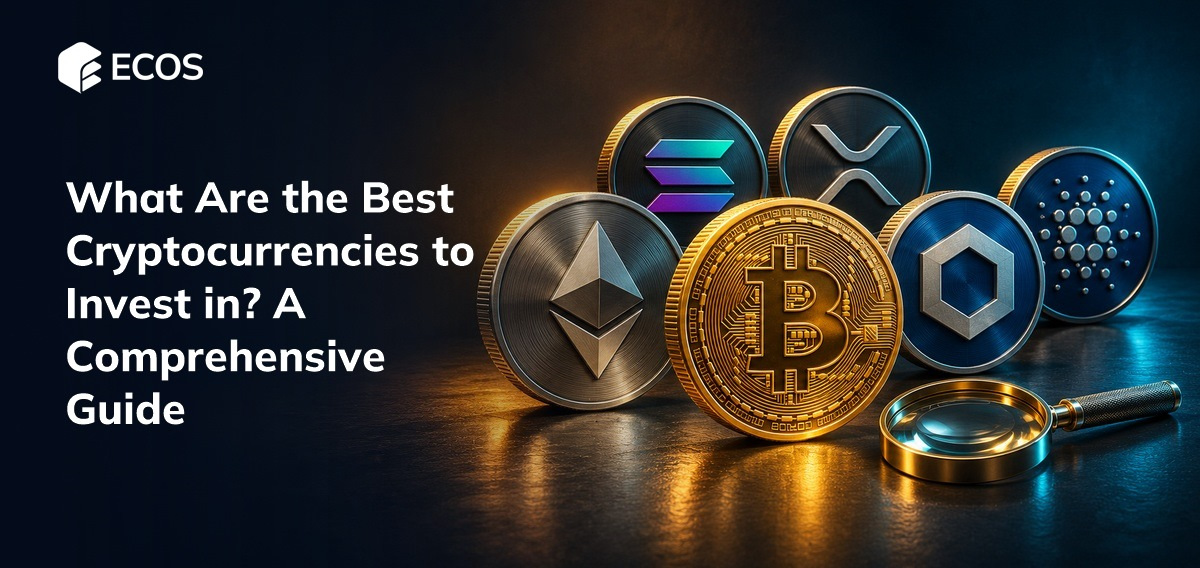
Bitcoin and Ether are useful starting points for research because their monetary rules, network roles and trading markets are extensively documented. Solana, XRP, Chainlink and Cardano offer other exposures, with different reasons for holding their tokens. None comes with a dependable return. A suitable choice depends on your time horizon, ability to absorb losses and willingness to manage custody.
The search for “what are the best cryptocurrencies to invest in” often begins with a price chart. A more revealing starting point is the token itself: who needs it, how new units reach the market, and what could make existing holders sell. This guide compares those mechanics rather than yesterday's winners.
What are the best cryptocurrencies to invest in?
A cryptocurrency investment is ownership of units of a digital asset whose market value can change. Depending on the network, those units may pay transaction fees, support validation or purchase a service. Holding a token generally does not give you ownership of the company developing its ecosystem, or a contractual claim on that company's profits.
In practical terms, “what are the best cryptocurrencies to invest in” asks which assets deserve closer examination for a particular purpose. Someone researching scarce digital money has a different starting point from someone evaluating demand for blockchain applications. Their acceptable holding periods may differ too.
An asset can pass an initial research screen and still be too expensive at its current valuation. Even a well-used network can have a token whose supply is expanding faster than demand. That distinction matters before you allocate any money.
How this shortlist was selected
The six assets below were selected for established operating histories, accessible supply information, identifiable token functions and trading availability on established exchanges. Together they cover monetary assets, application platforms, payments and oracle infrastructure. The order follows those functions; it is not a forecast of returns or a ranking by recent price gains.
To answer “what are the best cryptocurrencies to invest in” with something usable, compare each candidate against the same questions:
- What does the token allow its holder to do, and who must obtain it?
- How much supply exists, and what can enter circulation during your holding period?
- Can your intended trade be executed on an accessible venue without excessive price impact?
- What evidence would weaken the investment case enough to reconsider it?
This is an editorial research list. It does not establish that any asset is undervalued. Live prices, market caps and liquidity rankings are deliberately excluded; update those figures for the venue and date of your own decision.

Six cryptocurrencies to research
Bitcoin (BTC)
Bitcoin provides a transferable digital monetary asset secured through proof-of-work. Its supply rules limit issuance to approximately 21 million BTC, with new coins distributed through mining. The case for studying it rests on that predictable issuance schedule and a long operating history, alongside demand for holding and transferring the asset.
BTC has broad trading availability, making it a practical reference when comparing other crypto markets. For your own order, examine the spread and available depth rather than assuming every exchange offers the same execution. Owning a small fraction is possible; the price of one whole bitcoin need not determine your budget.
The supply cap does not prevent a sharp fall in demand or price. Custody failures, changes in access and concentrated selling remain relevant. Bitcoin also pays no contractual income to an ordinary holder, so an expected return depends on future market pricing rather than a promised cash distribution.
Ether (ETH)
ETH pays for computation on Ethereum and helps secure its proof-of-stake network. Applications such as lending protocols and stablecoin transfers create reasons to use Ethereum, although using an application does not necessarily require holding a large ETH balance. The question for investors is how activity translates into sustained token demand.
Supply changes through validator issuance and fee burning. ETH has no Bitcoin-style fixed maximum, and net supply can rise or fall as those forces change. Treat claims that it is permanently deflationary with care. Its established trading markets make comparison easier, but the actual pair and order size still determine execution quality.
Staking introduces another layer of decisions. Rewards depend on participation and service terms; validator penalties or an intermediary's failure can affect results. Smart-contract exposure arises when you use applications or staking products. Simply holding ETH does not expose you to every application's code, though your wallet still needs protection.
Solana (SOL)
Solana is an application blockchain whose native SOL pays transaction fees and can be staked to support validation. Its investment case involves demand for activity on that network. Low fees can make frequent transactions practical, while also limiting how much fee demand any individual transaction creates for the token.
SOL has ongoing inflationary issuance under its staking economics. Staking rewards therefore need to be considered alongside growth in supply, validator commission and operating performance. Trading is available on established venues, but liquidity should be checked for your specific pair rather than inferred from a network's transaction count.
Research technical reliability, validator concentration and competition for users. Activity driven by temporary trading incentives may be less durable than it first appears. A high transaction count can include automated activity; it does not establish either a large paying user base or an attractive purchase valuation.
XRP (XRP)
XRP is the native asset of the XRP Ledger, used for transaction costs and available as a bridge asset in payments. The original supply of 100 billion XRP was created at the outset. Transaction fees are destroyed, while escrow arrangements influence when previously created units become available.
Its established trading presence makes it accessible for comparison, although regional availability and market depth vary. A payments thesis should identify actual demand for XRP. A business using Ripple's technology or transferring another asset on the ledger does not, by itself, demonstrate sustained purchases of XRP.
Large holdings and escrow releases deserve particular attention. An unlock is not automatically a sale, but it changes what can potentially reach the market. XRP also represents no equity claim on Ripple. Assess the token's own utility and supply separately from expectations about the company's commercial success.
Chainlink (LINK)
Chainlink supplies oracle and interoperability services that connect blockchains with data and other systems. LINK supports service payments and staking arrangements. Its maximum supply is one billion tokens; units outside circulation can still enter the market. The relevant scarcity question includes that future distribution, not just the cap.
LINK trades on established exchanges, but research the order book you can actually access. The reason to investigate this asset is its infrastructure role across multiple ecosystems. Chainlink's Payment Abstraction converts supported service payments into LINK, providing a mechanism through which usage can generate token demand.
That mechanism needs economic scrutiny. More integrations do not specify how much LINK will be purchased, retained or sold by recipients. Service reliability, competing infrastructure and the release of non-circulating tokens affect the case. Holding LINK is also different from owning shares in a business providing oracle software.
Cardano (ADA)
Cardano is a proof-of-stake application blockchain. ADA pays transaction fees and supports staking and governance participation. Its maximum supply is 45 billion ADA. Staking distributions draw on transaction fees and reserve releases, so a quoted reward should be read alongside the changing reserve and circulation figures.
ADA has established exchange markets and public information about network activity. It offers another application-platform case to compare with ETH and SOL. Focus on what users are doing, what they pay and whether activity persists beyond a particular promotion or development announcement.
Development plans still need to become useful products. Competition, governance concentration and limited demand for applications can weaken the case even when the technology functions as designed. Delegation rewards do not guarantee a positive return in your spending currency if ADA's market price falls during the holding period.
Comparing the assets by function
- BTC combines a capped issuance schedule with demand for a monetary asset; its price remains exposed to changes in that demand.
- ETH links application use and network security to a supply balance between issuance and burning.
- SOL combines low-cost application transactions with staking and ongoing inflation; activity quality matters.
- XRP offers a payments-related case with an already-created supply and continuing questions about distribution and token demand.
- LINK connects infrastructure services with payment and staking mechanisms; service adoption needs to translate into meaningful token demand.
- ADA combines application use, governance and staking within a capped supply whose reserves continue entering circulation.
Several of these positions can respond to the same market shock. Buying three application-platform tokens does not provide the same diversification as adding investments outside crypto. Count overlapping exposure before counting the number of ticker symbols.

How is cryptocurrency valued?
The price of one coin tells you remarkably little about whether it is cheap. A project can issue a billion units instead of a million without creating a better investment. Unit count changes the appearance of the price. Begin with the whole supply and the economic role of the asset.
Price, market cap and fully diluted valuation
Market capitalization equals the current reference price multiplied by circulating supply. It is a valuation at that price, not the amount of cash invested or the money available for everyone to withdraw. Selling a large position can move the price that was used to calculate the headline figure.
Fully diluted valuation, or FDV, applies the current price to a broader supply figure, commonly total or maximum supply. Providers differ, so read the definition. For an asset without a fixed maximum, a finite FDV figure should not be mistaken for the value of every unit that could ever be issued.
Consider an invented token at $2 with 100 million units circulating and 500 million maximum supply. Its market cap is $200 million; using that maximum, FDV is $1 billion. If circulation doubles and price stays at $2, circulating market cap must also double. The example makes no prediction that demand will grow enough to support that price.
Supply releases and demand for the token
Before returning to “what are the best cryptocurrencies to invest in,” examine the next scheduled releases. Team vesting, reserve distributions and validator rewards can expand tradable supply through different mechanisms. Ask who receives the units and whether those recipients have expenses or incentives that may lead them to sell.
Network growth needs similar care. An application can attract users while collecting tiny fees, paying incentives or allowing customers to hold very little native currency. Trace the path from a customer's payment to token purchases, burning, staking or distribution. Stop where the evidence stops; an integration announcement is not a valuation calculation.
Liquidity and risks that change the decision
Liquidity is specific to the market where you trade. An exchange's advertised daily volume does not reveal how many buyers sit near your intended sale price. Look at the bid-ask spread and order-book depth. A large market order can consume several price levels, producing a worse average execution than the screen quote.
Storage changes the risks you take. An exchange account exposes you to the operator and withdrawal availability. Self-custody puts responsibility for keys, backups and approvals on you. A hardware wallet helps protect signing keys, but approving a malicious transaction can still cause a loss. Practice with an amount small enough to make mistakes tolerable.
Concentration deserves a separate investigation. Large balances may belong to an exchange holding customer assets, so a rich list alone does not establish common ownership. Where ownership is identifiable, investigate founders, treasuries and validator control. Contract upgrade powers and administrative keys can create dependencies that are invisible in a price chart.
Finally, ask whether a loss would force a sale at an inconvenient time. Money needed for near-term obligations cannot rely on a recovery arriving on schedule. Before deciding “what are the best cryptocurrencies to invest in,” establish a maximum loss you can absorb and a reason to exit that goes beyond an arbitrary price target. Choosing no position remains an available outcome.
Buying, mining and staking are different commitments
Buying on a spot market gives you the asset at an agreed execution price, subject to fees. Mining involves providing proof-of-work computation and competing for block rewards and transaction fees. Bitcoin miners typically use specialized ASIC hardware, with electricity and equipment costs continuing even when the coin's price disappoints.
For readers asking “how does cryptocurrency mining work,” that operating business is the essential distinction. Ethereum, Solana and Cardano use proof-of-stake, so their native assets are not mined through Bitcoin-style computation. XRP and LINK do not offer that mining route either. Learning how to mine for cryptocurrency starts with identifying a genuinely mineable network.
Staking commits eligible assets under a network's rules, directly or through a service. Rewards can be offset by dilution, fees or price losses; restrictions and penalties depend on the arrangement. Compare buying, mining and staking only after accounting for their separate costs and dependencies. A higher token balance is not automatically a higher portfolio value.
Expert insight on token utility
Chainlink's economics documentation describes LINK as “used to pay for services, enhance network security, and incentivize reliable performance.” That gives investors a concrete mechanism to investigate. The next step is to establish the scale of payments and how the tokens move afterward. The documentation explains a function; it does not promise that buying LINK at any price will produce a return.
Conclusion
An answer to “what are the best cryptocurrencies to invest in” starts with a shortlist and ends with your own valuation and loss limits. Compare token demand with supply changes, then test liquidity and custody. The six assets here provide different research cases. None removes the need to decide what could go wrong before committing money.
FAQ
- Which cryptocurrency should a beginner research first?
BTC and ETH offer extensive public documentation and established markets. Studying them helps build a comparison framework; neither guarantees a suitable investment or a positive return.
- Does a low coin price mean good value?
No. Compare circulating supply, market cap and future issuance. A low unit price can accompany a very large overall valuation.
- Is a fixed supply enough to support price growth?
No. Demand can fall even when issuance is capped. Distribution, liquidity and the price paid still matter.
- Does more network activity always benefit the token?
Examine who pays, which asset they need and where fees go. Usage can grow without creating proportionate demand for holding the token.
- How many cryptocurrencies provide diversification?
No fixed number does. Several tokens can share market and technology risks. Assess overlapping exposure and investments outside crypto.
Published Articles
What Does Pegging Mean in Crypto?
What supports a token's value? Learn the answer to “what does pegging mean in crypto” and see how reserves, redemption, and depegging work.
IBIT: What It Is and How BlackRock's Bitcoin ETF Works
Learn how the IBIT ETF works, its fees and risks, and how buying U.S. shares differs from investing in IBIT39 on Brazil's B3 exchange.
What Is Cryptocurrency Market Capitalization?
Understand crypto market cap, how to calculate it, and how circulating supply, FDV, trading volume, and liquidity affect cryptocurrency analysis.
Bitcoin Price Prediction for 2026: Bull, Bear, and Base Cases
Our bitcoin price prediction 2026 maps bull, bear, and base cases using current BTC price, ETF flows, Fed policy, and clear invalidation signals.
Will Crypto Go Back Up? Bitcoin and Cryptocurrency Market Recoveries
Introduction November 2022. Bitcoin sat at $16,000. Celsius, Voyager, Three Arrows Capital, and FTX had all collapsed within months of each other. Every major news outlet ran some version of the same headline: "Is cry...
Will Bitcoin Crash Again? Understanding BTC Price Cycles, Risks, and Growth Potential
Introduction In November 2021, Bitcoin reached $69,000. A year later, in November 2022, it traded below $16,000. A 77% decline in twelve months. Many declared cryptocurrency dead — again. By March 2024, Bitcoin exceed...