
Bitcoin Cash (BCH): Overview of Advantages and Use Cases
Introduction
Bitcoin Cash started as a disagreement about throughput. In August 2017, a segment of the Bitcoin community forked the protocol over a single parameter: block size. One side believed Bitcoin should scale on-chain by increasing block capacity. The other believed the base layer should stay conservative, with scaling handled above it.
The result was BCH — a separate chain with larger blocks, lower fees, and a deliberate focus on everyday payments. Six years later, BCH trades on every major exchange, processes millions of transactions per year, and remains one of the more divisive projects in crypto. Understanding what BCH coin is, how it works, and where it actually gets used requires setting aside the debate and looking at the mechanics.
What Is Bitcoin Cash (BCH)?
Bitcoin Cash is a proof-of-work blockchain that forked from Bitcoin at block 478,558. It shares Bitcoin’s transaction history up to that point but has diverged significantly since. The ticker is BCH; the native unit is the bitcoin cash, sometimes abbreviated as BCH.
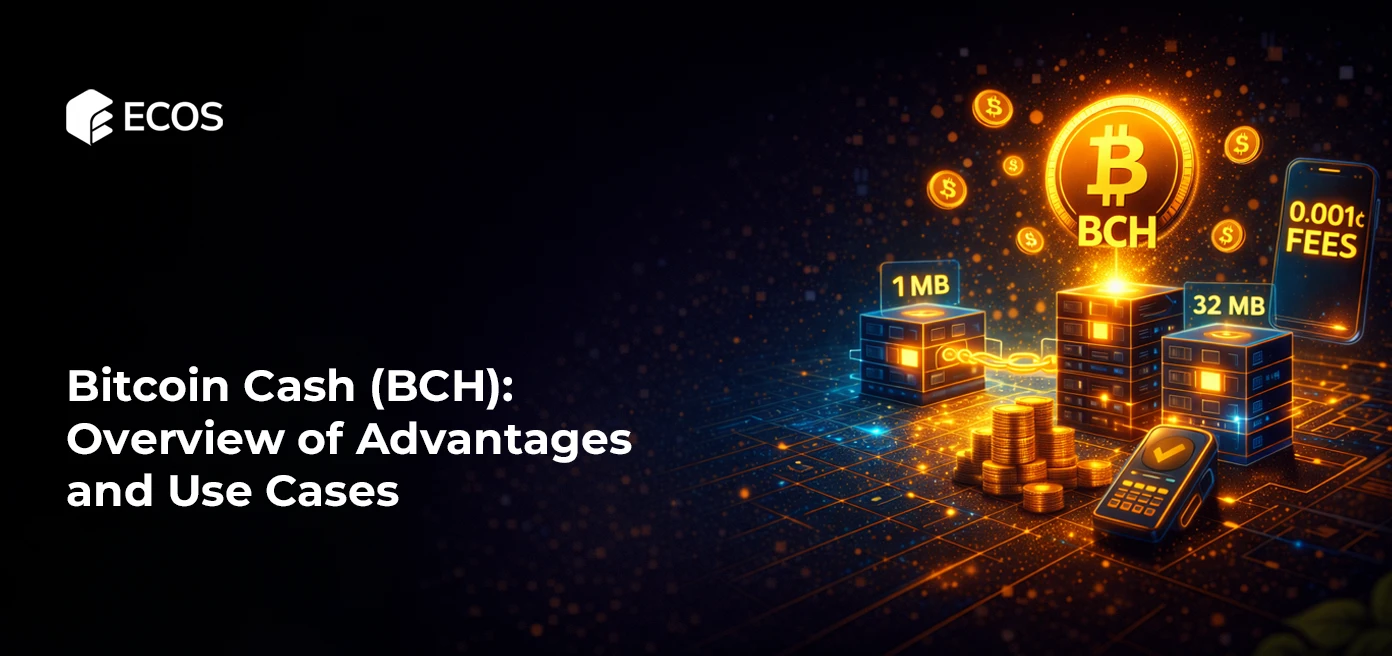
The core premise of BCH is peer-to-peer electronic cash — the phrase from Satoshi Nakamoto’s original whitepaper. According to its proponents, Bitcoin moved away from its original use case as fees rose and block space became scarce. To remain faithful to that vision, BCH was built with fast confirmations, sub-cent fees, and enough throughput to handle global payment volumes. From a technical standpoint, the meaning of this fork comes down to a few key parameters that differ from Bitcoin: larger blocks (32 MB vs 1 MB), a different difficulty adjustment algorithm, and the absence of SegWit. These aren’t cosmetic differences — they determine the transaction capacity, fee structure, and decentralization tradeoffs of the two networks.
Bitcoin Cash vs Bitcoin
Block Size Differences
Bitcoin’s block size is capped at approximately 1 MB of transaction data (with SegWit allowing more in some cases). Bitcoin Cash raised this to 32 MB. The practical effect: BCH can process significantly more transactions per block.
A Bitcoin block at full capacity handles around 2,000–3,000 transactions. A BCH block at full capacity handles over 100,000. In practice, BCH blocks are rarely full — the network’s lower transaction volume means most blocks use a fraction of their capacity. But the headroom is there, and BCH advocates argue it’s essential for any chain that wants to serve global payment volumes.
The tradeoff is node economics. Larger blocks require more storage, more bandwidth, and more processing to validate. Critics argue this pushes the full node requirement out of reach for ordinary users, concentrating network participation among well-resourced operators.
Transaction Speed and Fees
Both chains produce a block every 10 minutes on average. Confirmation speed is therefore similar for a single confirmation. The difference is in fee pressure. When Bitcoin’s mempool fills up, fees spike because users compete for limited block space. BCH’s larger blocks reduce this pressure substantially.
A few concrete numbers from 2026 conditions:
- Bitcoin average fee — typically $1–5 for standard transactions, spiking to $10–50+ during congestion periods.
- BCH average fee — consistently below $0.01, often fractions of a cent.
- Confirmation time — similar for both (one block = ~10 minutes), though BCH’s lower mempool congestion means fewer delays.
For someone sending $5 worth of value, a $3 Bitcoin fee is prohibitive. A $0.001 BCH fee is not. This arithmetic drives BCH’s focus on micropayments and everyday transactions.
Community and Development
The 2017 fork was contentious, and BCH has since experienced its own split. In 2018, a dispute over protocol changes led to another fork, producing Bitcoin SV (BSV). The BCH community that remained coalesced around a development approach focused on stability, merchant adoption, and gradual protocol improvements rather than radical changes.
Key development groups include Bitcoin Cash Node (BCHN) and Bitcoin Cash ABC, which maintain different client implementations. The community has historically debated funding mechanisms, protocol governance, and the pace of technical changes. These disagreements are lower-profile than BCH’s origin story but affect how the protocol evolves.

How Does Bitcoin Cash Work?
Blockchain Structure
BCH uses the same UTXO model as Bitcoin. Every transaction consumes unspent outputs from previous transactions and creates new outputs. This design makes transaction validation efficient and supports simple payment verification (SPV) without downloading the full chain.
Addresses come in several formats: legacy addresses (beginning with 1), CashAddr format (beginning with bitcoincash:q or simply q), and newer formats supported by specific wallets. CashAddr was introduced to prevent accidental sending between Bitcoin and Bitcoin Cash addresses — a practical problem that caused real fund losses in BCH’s early years.
Mining and Consensus Mechanism
BCH uses SHA-256 proof-of-work, the same algorithm as Bitcoin. Miners can point their hardware at either chain, which creates a direct competition for hashrate. When BCH’s relative profitability rises, some miners shift over from Bitcoin; when it falls, they shift back.
BCH implemented a different difficulty adjustment algorithm (DAA) specifically to handle this hashrate volatility. Bitcoin’s difficulty adjusts every 2,016 blocks (roughly two weeks). BCH’s DAA adjusts every block, responding to hashrate changes much faster. This prevents the chain from grinding to a halt when miners leave, but it also means BCH blocks can come faster or slower than 10 minutes depending on miner behavior.
Network Security
BCH’s security budget depends on block rewards and transaction fees paid to miners. At current BCH prices and network hashrate, the chain is significantly less secure than Bitcoin on a pure cost-to-attack basis — controlling 51% of BCH’s hashrate costs less than 51% of Bitcoin’s, because Bitcoin has more total hashrate and a higher coin price.
This is a genuine vulnerability. BCH has experienced hashrate-based attacks in the past, though not a successful 51% attack on the main chain. The risk is mitigated by the fact that a successful attack would likely destroy BCH’s value — making the attack expensive relative to potential profit. But it remains a structural difference from Bitcoin’s security model.
Bitcoin Cash Transactions Explained
A BCH transaction works like a Bitcoin transaction in its basic structure: inputs, outputs, a signature, and a fee. The sender specifies one or more inputs (UTXOs they control), one or more outputs (addresses receiving funds), and a fee that goes to the miner who includes the transaction in a block.
What makes BCH transactions practically different is the cost and speed of confirmation. Because the mempool rarely fills up, most BCH transactions confirm in the next block without requiring elevated fees. This makes BCH payments more predictable than Bitcoin payments during busy periods.
BCH also supports a few features built on top of the base transaction layer:
- OP_RETURN data — BCH allows up to 220 bytes of arbitrary data per transaction using the OP_RETURN opcode. This supports timestamping, token issuance, and basic smart contract applications.
- SLP tokens — the Simple Ledger Protocol lets anyone issue tokens on the BCH blockchain. These are similar in concept to ERC-20 tokens on Ethereum but use BCH’s UTXO model.
- CashFusion — a privacy protocol that joins multiple BCH transactions together to obscure the link between senders and recipients, similar in concept to CoinJoin on Bitcoin.

Advantages of Bitcoin Cash
BCH’s case rests on a few concrete properties that distinguish it from other payment-focused cryptocurrencies.
- Low fees — sub-cent fees make BCH practical for small transactions that are uneconomical on Bitcoin. Sending $1 worth of BCH costs less than $0.001 in fees.
- High throughput — 32 MB blocks support transaction volumes that Bitcoin’s 1 MB blocks can’t. Whether current BCH volumes need this capacity is a separate question from whether the architecture supports it.
- Established infrastructure — BCH has been live since 2017. It’s listed on every major exchange, supported by major wallets (Coinbase Wallet, Trust Wallet, Exodus), and accepted by merchants through BitPay and other payment processors.
- Simple payment verification — the BCH network’s support for SPV means lightweight wallets can verify payments without downloading the full blockchain, making mobile payment apps practical.
- On-chain data capacity — the larger block size and expanded OP_RETURN allowance support more on-chain data storage than Bitcoin, useful for timestamping and certain token applications.
Limitations and Criticism of BCH
BCH has real weaknesses that its proponents sometimes understate.
- Lower hashrate than Bitcoin — BCH shares Bitcoin’s mining algorithm, which means its security competes directly with Bitcoin’s. Bitcoin’s hashrate is orders of magnitude higher, making BCH comparatively less expensive to attack.
- Centralization concerns — larger blocks concentrate full node operation among well-resourced participants. Critics argue this undermines the permissionless ethos of Bitcoin.
- Limited developer ecosystem — most crypto developer activity flows toward Ethereum, Solana, and Bitcoin. BCH’s development community is smaller, which slows protocol improvements and application building.
- Brand confusion and reputation damage — multiple forks and public disputes (the 2018 BSV split, the 2020 infrastructure funding controversy) have damaged BCH’s reputation and created confusion about which chain is the “real” Bitcoin Cash.
- Thin DeFi ecosystem — BCH lacks the smart contract capabilities of Ethereum or Solana. Applications built on SLP tokens are simpler and less composable than EVM-based DeFi.
How to Use Bitcoin Cash
BCH is available through most paths that lead to crypto ownership.
To buy BCH: any major exchange — Coinbase, Binance, Kraken, OKX — lists it against USD, USDT, and BTC pairs. The purchase process is standard: fund an account, place a buy order, receive BCH in your exchange wallet.
To store BCH: exchange wallets work for traders who plan to sell. For long-term holding or active use, dedicated wallets give more control. Options worth considering:
- Electron Cash — the recommended desktop wallet for BCH, maintained by the Bitcoin Cash community. Supports CashAddr, SLP tokens, and hardware wallet integration.
- com Wallet — a mobile app focused on BCH with a clean interface, built-in exchange, and merchant payment features.
- Coinbase Wallet / Trust Wallet / Exodus — mainstream wallets that support BCH alongside other assets.
- Ledger / Trezor — hardware wallets that support BCH, recommended for any significant holdings.
To spend BCH: merchant adoption varies by region. In some markets — particularly Venezuela, South Sudan, and parts of Southeast Asia — BCH has meaningful merchant networks built around platforms like Prompt.Cash and BCH Argentina. In most Western markets, accepting BCH requires a merchant to set it up specifically, typically through BitPay.
For BCH payments online, the process is straightforward: the merchant displays a QR code or BCH address, the buyer scans or copies it and sends the specified amount. Confirmations typically arrive within 10 minutes; some merchants accept zero-confirmation transactions for small amounts, treating the broadcast transaction as payment.
Conclusion
BCH prioritizes low fees and high throughput over conservative block limits. It targets micropayments and remittances with mature infrastructure, though it faces smaller developer support and lower security than Bitcoin. It is a Bitcoin fork built for payments, with the tradeoffs that implies.
More Questions
A 2017 Bitcoin fork using the same proof-of-work but with 32 MB blocks. It targets sub-cent fees for daily payments.
The ticker for Bitcoin Cash. It prioritizes cash-like utility over store-of-value.
Miners add blocks every 10 minutes. Larger blocks handle more transactions, while a unique adjustment algorithm stabilizes mining times.
Low-fee ($0.01) transfers using Bitcoin’s UTXO model. Supports privacy via CashFusion and custom tokens.
Bitcoin has 1 MB blocks and higher fees; BCH has 32 MB blocks and sub-cent fees. Bitcoin is for savings; BCH is for payments.
Accepted via BitPay and Prompt.Cash. Used globally for merchant transactions, notably in Venezuela and Southeast Asia.
Published Articles
 Popular
Bitcoin Pizza Guy: The Story Behind the First Real Bitcoin Purchase
Introduction The history of Bitcoin is full of dramatic ups and downs,...
How Bitcoin ATMs Work: A Complete Guide to Using Crypto ATMs
Introduction Millions of people around the world use cryptocurrencies today – at...

Best Bitcoin Mining Software of 2025 – Top 7 Tools for Maximum Profitability
Bitcoin mining has long since moved beyond being a hobby for enthusiasts...

Services You Can Pay for with Bitcoin
Where Bitcoin Is Accepted Today Today, Bitcoin (BTC) can be used to...

What You Can Buy With Bitcoin in 2025
Introduction Over the years, Bitcoin has evolved from an experimental digital currency...
 Popular
Bitcoin & Crypto Options Trading: A Complete Guide for Beginners and Experts
Bitcoin options trading has grown rapidly in recent years as the cryptocurrency...