
Bitcoin History: Key Milestones and Market Impact

Introduction
On October 31, 2008, a person using the pseudonym Satoshi Nakamoto published a nine-page document. A purely technical text with no images, no marketing, no press release. Just equations and an idea: digital money that works without banks. Nobody expected this to become the starting point of one of the largest wealth redistribution processes in history. Today Bitcoin costs more than gold, and it is held by central banks, hedge funds, and governments. The journey from nine pages on the internet to $100,000 per coin took less than twenty years.
When Did Cryptocurrency Start?
The official history of cryptocurrency began on January 3, 2009. That day Satoshi Nakamoto mined the first Bitcoin block — the genesis block. He embedded a line from The Times newspaper of that day: “Chancellor on brink of second bailout for banks” — the UK government was bailing out banks again. This was not a random detail. It was a manifesto.
But the roots go deeper. The idea of digital money did not emerge in 2009. In 1983, cryptographer David Chaum published a scheme for anonymous electronic payments. Wei Dai described “b-money” — a system with a distributed transaction ledger — back in 1998. In 2004, Hal Finney developed RPOW — a reusable proof-of-work mechanism. Nakamoto studied all of this, took the best parts, and assembled them into a working system.
When did cryptocurrency start as a phenomenon? Technically — in 2009. As an idea — twenty years earlier.
How Did Bitcoin Start?
The history of Bitcoin is first and foremost a history of anonymity. The identity of Satoshi Nakamoto is unknown to this day. It could be one person or a group. The Japanese name is most likely just a pseudonym. Over fifteen years, several people claimed to be Bitcoin’s founder — none could prove it.
What is known for certain is that in 2007–2008 Nakamoto wrote the code and the paper. In August 2008 he registered the domain bitcoin.org. That October saw the publication of the whitepaper. By January 2009, the network was live, and he had already sent the first transaction of ten bitcoins to Hal Finney.
After that, Satoshi Nakamoto communicated with developers by email and on forums for several years. In 2010 he handed control of the code to other contributors. In 2011 he disappeared. Nobody has heard from him since.
Bitcoin history is that rare case where a creator walked away from a project without taking anything material from it. One million bitcoins in wallets presumably belonging to Nakamoto have never moved.

The Story of Bitcoin
First Bitcoin Transactions
More than a year passed between the launch of the network and the first commercial transaction. The network ran, blocks were mined, coins accumulated with early miners. But Bitcoin had no price. Nobody was buying or selling it.
The first recorded market price appeared on October 5, 2009. The New Liberty Standard service set the rate based on the cost of electricity needed to mine one bitcoin: one US dollar equaled 1309.03 BTC. That is exactly how many bitcoins you could mine for one dollar. Bitcoin cost less than a tenth of a cent.
In May 2010, a US programmer named Laszlo Hanyecz asked on the Bitcointalk forum for someone to buy him pizza for bitcoins. Whoever ordered him pizza would receive 10,000 BTC. Jeremy Sturdivant from England responded. He ordered two Papa John’s pizzas for $25, paid with his bank card, and received the coins. This is the first known purchase of a real product with Bitcoin.
Bitcoin Pizza Day
May 22, 2010 — Bitcoin Pizza Day. A date the crypto community celebrates every year, with a little nostalgia and a little bitterness: the 10,000 BTC once spent on two pizzas are worth around a billion dollars today.
But viewing this deal as a mistake is wrong. Hanyecz did not “lose” a billion. He paid the fair market price of 2010 for a real product. What matters is something else: this transaction proved that Bitcoin works as money. Not merely as a technical experiment, but as a genuine medium of exchange.
Without these early transactions, trust in Bitcoin would never have formed — or at least would have formed many years later.
Early Community Growth
In 2009–2010, Bitcoin existed within a small group of enthusiasts: programmers, cypherpunks, libertarians. The Bitcointalk forum was the main platform. People mined Bitcoin on ordinary processors — graphics cards were not yet used, ASIC miners existed only in theory, but the computing power of computers at the time was sufficient.
The first exchange, Mt. Gox, opened in July 2010. The site was originally intended for trading Magic: The Gathering cards — the name stands for Magic: The Gathering Online Exchange. A young man named Jed McCaleb repurposed the platform for Bitcoin trading. By 2013 Mt. Gox processed 70% of all global Bitcoin transactions.
What Was the First Price of Bitcoin?
Bitcoin’s Earliest Market Value
The first recorded price of Bitcoin — $0.0009 per coin, October 2009. This was a calculated value based on the electricity costs of mining, not a market quote in the modern sense.
The first exchange price appeared only after Mt. Gox began operations in 2010. In July 2010 Bitcoin traded at $0.08. By the end of the same year — already $0.30. This is a threefold increase in a few months. But trading volumes were still negligible.
First BTC Exchanges
Even from the very start, Mt. Gox was not alone. In 2011, TradeHill and Bitstamp appeared, claiming their share of the market. Bitstamp survived Mt. Gox and operates to this day. In 2012 Coinbase launched a service for buying Bitcoin by bank card — this made the process accessible to ordinary users.
The first exchanges operated in conditions of complete regulatory vacuum. Nobody checked user identities, demanded documents, or reported to authorities. This attracted both idealists seeking financial freedom and people with less lawful intentions.
Growth From Cents to Thousands
Bitcoin’s price dynamics over the first decade:
- 2009: $0.0009 (approximate calculated value)
- 2010: $0.08 first exchange trades
- 2011: first cycle, rapid rise to $31 and collapse to $2
- 2013: first reach of $1,000
- 2017: all-time high of $20,000
- 2021: new all-time high of $69,000
- 2024: first breach of $100,000
Each cycle looked the same: a sharp rise followed by a sharp fall, but the new low was already higher than the previous one, and each subsequent peak exceeded the one before.
Major Milestones in Bitcoin History
2009: Network Launch
On January 3, 2009, Nakamoto mined the very first block — the so-called genesis block. The reward — 50 BTC. The first network transaction took place on January 12: Nakamoto sent Hal Finney ten bitcoins.
2010: First Real Price
The opening of Mt. Gox gave Bitcoin a market price. By the end of 2010, the combined value of all Bitcoin in circulation exceeded one million dollars. By the standards of that market, this was a great deal.
2011: First Major Cycle
In April 2011, Time magazine published an article about Bitcoin. The price rose from $1 to $31 in a few months. Then fell to $2. Most new participants lost money and left. Those who stayed became long-term holders.
That same year Silk Road launched — an anonymous marketplace on the Tor network that accepted only Bitcoin. This gave Bitcoin the reputation of a criminal currency, which it fought against for many years.
2012: First Halving
On November 28, 2012, the first Bitcoin halving occurred: miner rewards were cut from 50 to 25 BTC per block. The market responded with growth — the following year the price exceeded $1,000.
2013: First Thousand Dollars
In November 2013, Bitcoin first reached $1,000. This event made global news. A new wave of interest, a massive influx of new users, and as a result a new bubble — by year end the price had reached $1,200, then collapsed to $200 over the next two years.
2014: Mt. Gox Collapse
In February 2014, Mt. Gox declared bankruptcy. 850,000 Bitcoin (around $450 million at the time) simply disappeared. Investigation established that the exchange had been concealing thefts for years. Bitcoin’s price fell below $400.
Mt. Gox became a lesson the crypto market learned slowly: don’t store the main volume of coins on exchanges, only what is needed for trading. The lesson was not learned the first time. FTX repeated this story in 2022.
2016: Second Halving and DAO
In July 2016, Bitcoin’s second halving took place and miner rewards per block fell to 12.5 BTC. Around the same time, Ethereum suffered the DAO hack — a third of its funds were stolen. Ethereum developers rolled back the blockchain to recover the stolen money, violating the principle of immutability. Part of the community refused to accept the rollback and continued on the original chain — this is how Ethereum Classic was born.
Bitcoin during this period stayed clear of scandals, which reinforced its reputation as the most reliable blockchain.
2017: ICO Boom and $20,000
2017 was the first mass crypto boom. Thousands of projects conducted ICOs — initial coin offerings. Most turned out to be fraud or failures. But before that they attracted billions of dollars from ordinary investors.
Bitcoin reached $20,000 in December 2017. Then collapsed to $3,000 by end of 2018.
2020: Third Halving and Institutional Investors
The May 2020 halving coincided with the pandemic. Governments worldwide were printing money at unprecedented scale. MicroStrategy bought Bitcoin as a defensive asset to protect against inflation. Tesla announced a $1.5 billion Bitcoin purchase. Grayscale Bitcoin Trust attracted billions from institutional investors.
For the first time, major public companies voluntarily put Bitcoin on their balance sheets.
2021: $69,000 and Crypto Winter
In November 2021, Bitcoin reached $69,000. Then crypto winter arrived: the algorithmic stablecoin Terra/Luna collapsed, Celsius and Three Arrows Capital went bankrupt, and in November 2022 — FTX. Bitcoin fell to $16,000.
2024: ETFs and $100,000
In January 2024, the SEC approved spot Bitcoin ETFs. BlackRock, Fidelity, and other asset managers gained the ability to hold Bitcoin within regulated funds. In their first year, the ETFs attracted over $100 billion.
In December 2024, Bitcoin first broke through $100,000.
Evolution of Cryptocurrency After Bitcoin
Bitcoin showed that a decentralized digital currency works. This opened the door to thousands of other projects.
In 2011, Charlie Lee, a former Google engineer, created Litecoin — “silver” to complement Bitcoin’s “gold.” Transactions faster, blocks mined more frequently. Lower cost.
In 2013, Vitalik Buterin published the Ethereum whitepaper. The idea: a blockchain not just for money but for programmable contracts. In 2015, Ethereum launched. This radically transformed the crypto industry.
Thousands of cryptocurrencies exist today. Most are useless or dead. Several dozen are actively used and solve real problems. Bitcoin occupies a distinct place among them: not as the most technologically complex or convenient, but as the first and most decentralized crypto asset.
Why Bitcoin Became Popular
Bitcoin attracted attention for different reasons at different times.
The early enthusiasts of 2009–2012 were drawn to the idea: money without the state, without banks, without the possibility of confiscation. This was pure idea and philosophy, not investment.
After 2013, speculators joined them. Growth from $200 to $1,000 in a year attracted people who simply wanted to make money. This pattern repeated in every cycle.
After 2020, institutional investors arrived with a different thesis: Bitcoin as protection against inflation. When central banks print money, Bitcoin’s fixed supply of 21 million coins becomes a compelling argument.
After 2024, with the arrival of ETFs, pension funds and ordinary brokers gained access to Bitcoin. This is yet another level of institutionalization.
None of these narratives displaced the previous ones — they layered on top of each other, each time expanding the holder base.
Challenges in Bitcoin’s History
The history of Bitcoin is not a story of uninterrupted success. It is full of crises.
Reputational damage from Silk Road. Before 2013, the word “bitcoin” in the media almost always appeared next to “drug trafficking” and “money laundering.” The FBI shut down Silk Road in 2013 and arrested Ross Ulbricht. But the label of criminal currency stuck to Bitcoin firmly.
Mt. Gox showed that trust in infrastructure is critically important. A good idea does not protect against poor implementation and the human factor.
Volatility. Bitcoin lost 80% of its value three times — in 2011, 2015, and 2018. Each time it was declared dead. The search query “bitcoin is dead” returns hundreds of articles written in each of those cycles. Most authors later preferred to forget about them. After each collapse, Bitcoin grew to new all-time highs.
Regulatory pressure. China banned Bitcoin several times, the last time in 2021 — completely. Miners relocated to Kazakhstan, the US, Russia. The global decentralized network proved more resilient than national bans.
Environmental accusations. Bitcoin uses a lot of electricity. That is a fact. How critical this is depends on the energy source. According to the Bitcoin Mining Council for 2024, more than 50% of mining uses renewable energy. The debate continues.
Scalability. The Bitcoin network processes around 7 transactions per second. Visa handles thousands. The Lightning Network solution offers payment channels outside the main chain, but mass adoption has not yet arrived.
Future of Bitcoin and Cryptocurrency
The fourth halving took place in April 2024. Miner rewards were cut to 3.125 BTC per block. Historically, every halving has launched a new bull cycle within 12–18 months.
The fifth halving is expected around 2028. The reward will fall to 1.5625 BTC. By that point, around 97% of all Bitcoin from the 21 million supply will have been mined.
Institutional adoption continues. Several US states are discussing the creation of government Bitcoin reserves. El Salvador made Bitcoin official legal tender in 2021.
Regulation is tightening worldwide, but in different directions: the US created regulatory frameworks for ETFs, the EU adopted MiCA, Asia is charting its own course. This somewhat limits crypto’s wild west, but also legitimizes Bitcoin in the eyes of traditional financiers.
The Lightning Network is growing slowly. El Salvador uses it for retail payments. Several major payment services have integrated Lightning.
The question is not whether Bitcoin will survive. It will — it is not going anywhere. For 15 years the network ran without a single serious outage. The question is what its place in the financial system will be in twenty years.
Bitcoin and Traditional Finance: Changing Relationships
For the first ten years, Bitcoin and traditional finance coexisted in parallel, barely intersecting. Banks ignored the crypto market or viewed it as a threat. Regulators did not know how to approach it. Most financial advisors strongly discouraged clients from Bitcoin.
By 2020, something had changed. Paul Tudor Jones, one of the largest hedge fund managers, publicly called Bitcoin “the best asset for protecting against inflation” and bought it. Stanley Druckenmiller followed. Goldman Sachs resumed crypto investment after several years’ pause.
The turning point came when major institutional players solved the problem that had prevented them from entering the market: custodial storage. Fidelity Digital Assets offered Bitcoin custody for institutional clients from 2019. Bank of New York Mellon announced crypto custody in 2021. Regulated storage removed the main operational barrier for pension funds and insurance companies.
The approval of spot ETFs in January 2024 completed the integration process. BlackRock — the world’s largest fund managing $10 trillion in assets — now offers its clients Bitcoin. This is not a break from traditional finance. It is the inclusion of Bitcoin within its structure.
Bitcoin’s Role in the Global Economy
Bitcoin did not remain an American or Western phenomenon. Its adoption in different parts of the world reflects different economic realities.
In countries with high inflation — Turkey, Argentina, Nigeria — Bitcoin became one of the main tools for preserving savings. When the local currency loses 50% per year, even volatile Bitcoin looks attractive. Nigeria’s P2P Bitcoin trading volume is one of the largest in the world.
El Salvador in 2021 became the first country to adopt Bitcoin as legal tender. The experiment is mixed: the level of Bitcoin use for everyday payments remained low, but tourist interest grew, and the government’s Bitcoin portfolio delivered solid returns.
For part of the world’s population without bank accounts, Bitcoin provides access to financial services through a smartphone.
Bitcoin Mining: How the Industry Changed
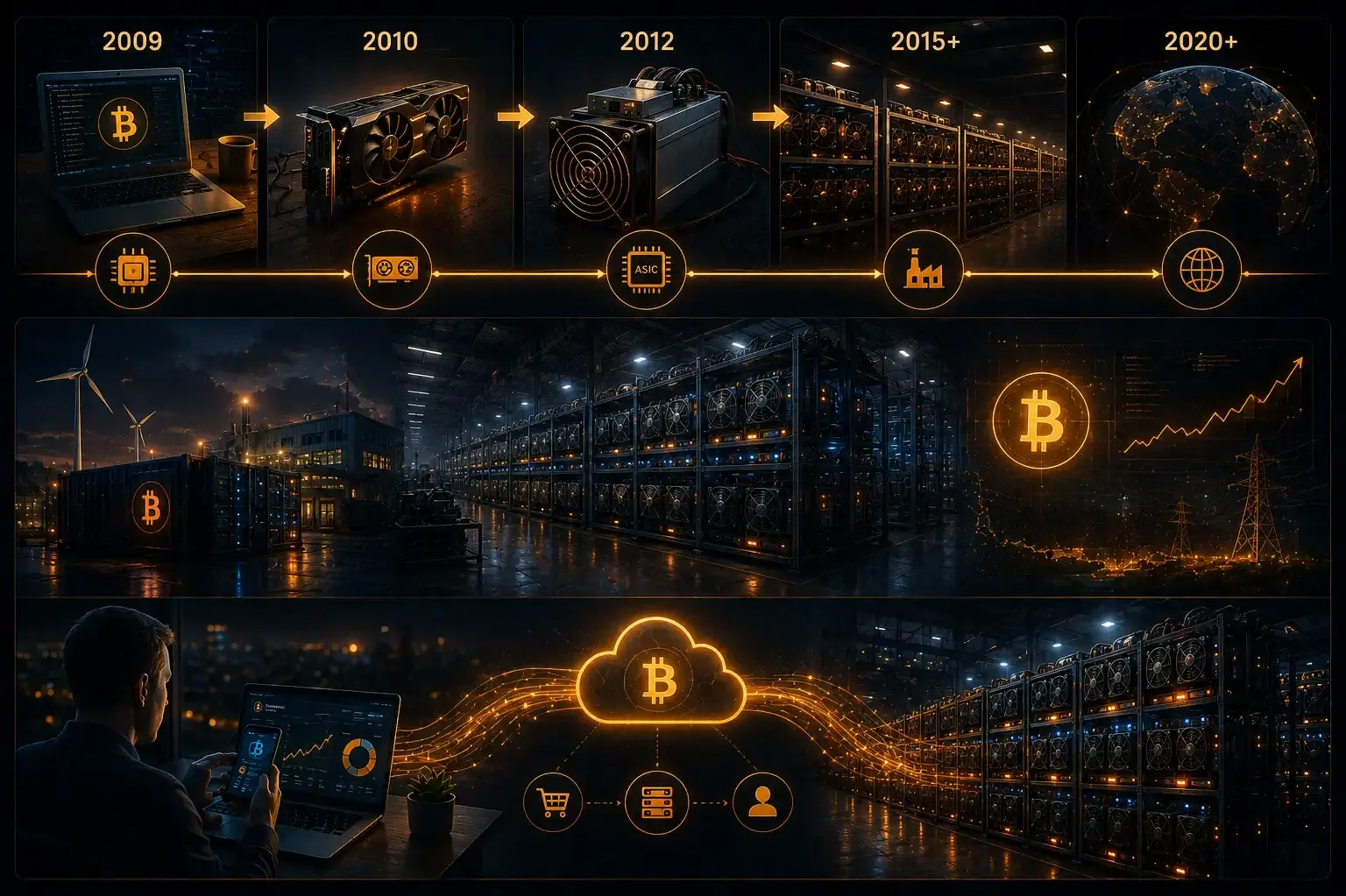
In 2009, Nakamoto mined Bitcoin on an ordinary laptop processor. Network difficulty was minimal. Any participant with a computer could mine coins.
In 2010, someone discovered that graphics cards (GPUs) mine Bitcoin 50–100 times more efficiently than processors. This triggered the first arms race.
In 2012, the first ASICs appeared — specialized chips designed exclusively for Bitcoin mining. GPUs became unprofitable almost instantly.
Today Bitcoin mining is an industrial sector. The largest mining companies — Marathon Digital, Riot Platforms, CleanSpark — trade on stock exchanges. Mining farms consume as much electricity as small countries.
Cloud mining allows private individuals to participate in Bitcoin mining without purchasing equipment. Services like ECOS provide computing power for rent — the user receives rewards proportional to their share of the pool’s total hashrate.
Key Takeaways
- Bitcoin history began on January 3, 2009, with the genesis block. Satoshi Nakamoto mined the first block and embedded a newspaper headline about the banking crisis — a declaration of independence from traditional finance.
- The first market price of Bitcoin was $0.0009 in October 2009. The first commercial transaction — 10,000 BTC for two pizzas in May 2010.
- Halvings every four years cut new Bitcoin issuance in half. Historically, every halving preceded a new price high within 12–18 months.
- Every major crisis in Bitcoin history — Mt. Gox, the 2018 crypto winter, FTX 2022 — dropped the price 70–80% and each time was declared “the death of Bitcoin.” The network kept running.
- Bitcoin traveled from a philosophical project for cypherpunks to an institutional asset. The approval of spot ETFs in the US in 2024 opened access to pension funds and the broad retail audience.
- The history of cryptocurrency is not Bitcoin’s story alone. Ethereum, DeFi, NFTs, stablecoins — each of these phenomena grew from the idea that Bitcoin made possible in 2009.
Expert Insight
Ledger Academy, in its Bitcoin history section, describes the significance of the genesis block this way: “By embedding The Times headline in the first block, Satoshi Nakamoto clearly articulated the project’s motivation — to create an alternative to a financial system that once again needed a government bailout. This is not merely a technical artifact but a political statement.”
This distinction matters today. Many view Bitcoin purely as an investment instrument — and that is a legitimate use. But the original intent was different: to create money that no single person, bank, or government controls. Both interpretations coexist and continue to attract different categories of market participants.
Conclusion
Bitcoin traveled from a nine-page whitepaper to an asset with a market capitalization of over two trillion dollars. The path was not straight: hacks, bans, scandals, bubbles. But the network kept running.
More Questions
Cryptocurrency as a working system began on January 3, 2009, when Satoshi Nakamoto mined the first Bitcoin block. Conceptually, the ideas underlying Bitcoin were being developed from the 1980s.
The first calculated price of Bitcoin was $0.0009 per coin in October 2009. The first exchange price after Mt. Gox opened in 2010 was $0.08 per BTC.
Bitcoin was created by a person or group of people under the pseudonym Satoshi Nakamoto. The creator’s identity is unknown to this day. In 2011, Nakamoto stopped communicating.
Bitcoin Pizza Day is celebrated on May 22. On that day in 2010, Laszlo Hanyecz paid 10,000 BTC for two pizzas. The first known purchase of a real product with Bitcoin.
Bitcoin passed through several phases: technical experiment for enthusiasts (2009–2012), speculative asset (2013–2019), inflation hedge (2020–2023), institutional asset with ETFs (2024 to present). The price rose from fractions of a cent to $100,000+.
Published Articles
 Popular
Bitcoin Pizza Guy: The Story Behind the First Real Bitcoin Purchase
Introduction The history of Bitcoin is full of dramatic ups and downs,...
How Bitcoin ATMs Work: A Complete Guide to Using Crypto ATMs
Introduction Millions of people around the world use cryptocurrencies today – at...

Best Bitcoin Mining Software of 2025 – Top 7 Tools for Maximum Profitability
Bitcoin mining has long since moved beyond being a hobby for enthusiasts...

Services You Can Pay for with Bitcoin
Where Bitcoin Is Accepted Today Today, Bitcoin (BTC) can be used to...

What You Can Buy With Bitcoin in 2025
Introduction Over the years, Bitcoin has evolved from an experimental digital currency...
 Popular
Bitcoin & Crypto Options Trading: A Complete Guide for Beginners and Experts
Bitcoin options trading has grown rapidly in recent years as the cryptocurrency...