
Bitcoin vs XRP Explained: Technology, Speed, and Investment Comparison
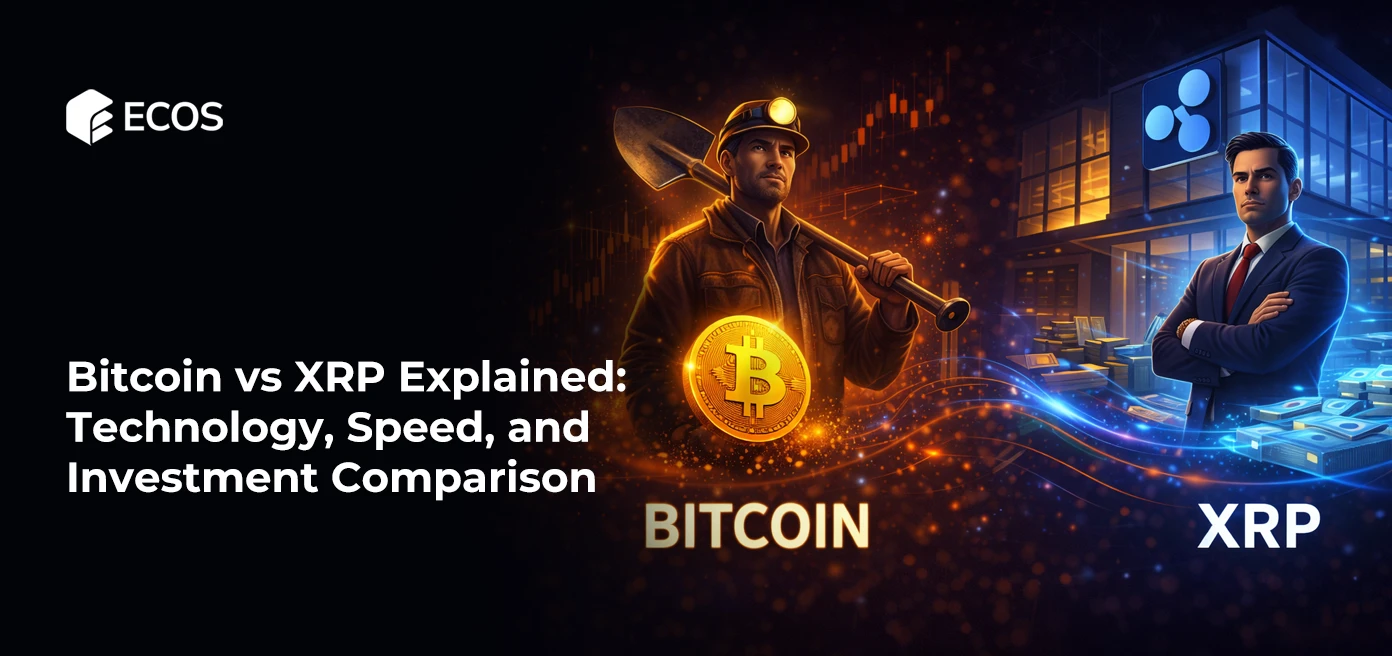
Bitcoin and XRP both appear on the same exchange screens, get covered in the same news cycles, and attract roughly the same category of investor. The similarity mostly ends there. Bitcoin emerged from a cypherpunk vision of money that no government could control. XRP came from a fintech company trying to fix international wire transfers. Those origins produce two assets with genuinely different architectures, governance models, and investment profiles.
This piece goes through each of those differences directly.
What Is Bitcoin?
Bitcoin launched in January 2009, created by the pseudonymous Satoshi Nakamoto with a stated goal of peer-to-peer electronic cash. Rising fees and 10-minute confirmation times gradually made it impractical for everyday purchases, and the community stopped treating it that way. What developed instead was a savings asset thesis: fixed supply, no issuer, no central authority.
The 21 million coin cap is hardcoded into the protocol. Approximately 19.9 million BTC had been mined by early 2025 — over 94% of the total — with the remainder releasing through a fixed halving schedule that cuts block rewards in half every four years. April 2024 was the most recent halving, bringing the per-block reward to 3.125 BTC.
Spot Bitcoin ETFs received SEC approval in January 2024. By early 2025, Bitcoin’s market capitalization sat at approximately $2.3 trillion — roughly 55–60% of total crypto market value, a dominance level that hadn’t existed since Bitcoin was the only serious digital asset.
What Is XRP?
Ripple Labs created XRP in 2012. A San Francisco fintech company, not a pseudonymous developer with an ideological agenda, founded the project to modernize cross-border payments. Ripple controls much of the default validator infrastructure. They also hold a large portion of total supply in escrow and drive the protocol’s development roadmap. That corporate structure is also why the SEC treated XRP differently from Bitcoin when it filed suit in 2020. The agency framed Ripple’s token distribution as an unregistered securities offering.
International wire transfers through SWIFT and correspondent banking tie up capital in pre-funded accounts at each destination bank. This money sits idle while transfers clear over 3–5 business days. RippleNet was built around eliminating that lag. Financial institutions using XRP as a bridge asset can settle the same transfer in 3–5 seconds. They convert currencies on demand rather than relying on pre-positioned liquidity pools at every destination.
All 100 billion XRP tokens were minted at launch. Unlike Bitcoin, there is no mining and no gradual supply release tied to network activity. Ripple Labs retained 80 billion at the outset. They placed 55 billion into escrow with a release schedule of up to 1 billion tokens per month. By early 2025, around 60 billion were circulating. The remainder was still under Ripple’s control.
The SEC sued Ripple in December 2020, claiming XRP was an unregistered security. Multiple US exchanges delisted the token preemptively. Its price stagnated for years while the case wound through court. A partial ruling in July 2023 found that retail-sold XRP was not a security. This lifted enough of the pressure to restart price momentum. The case eventually settled for $50 million in May 2025. By which point XRP had already hit a seven-year price high.
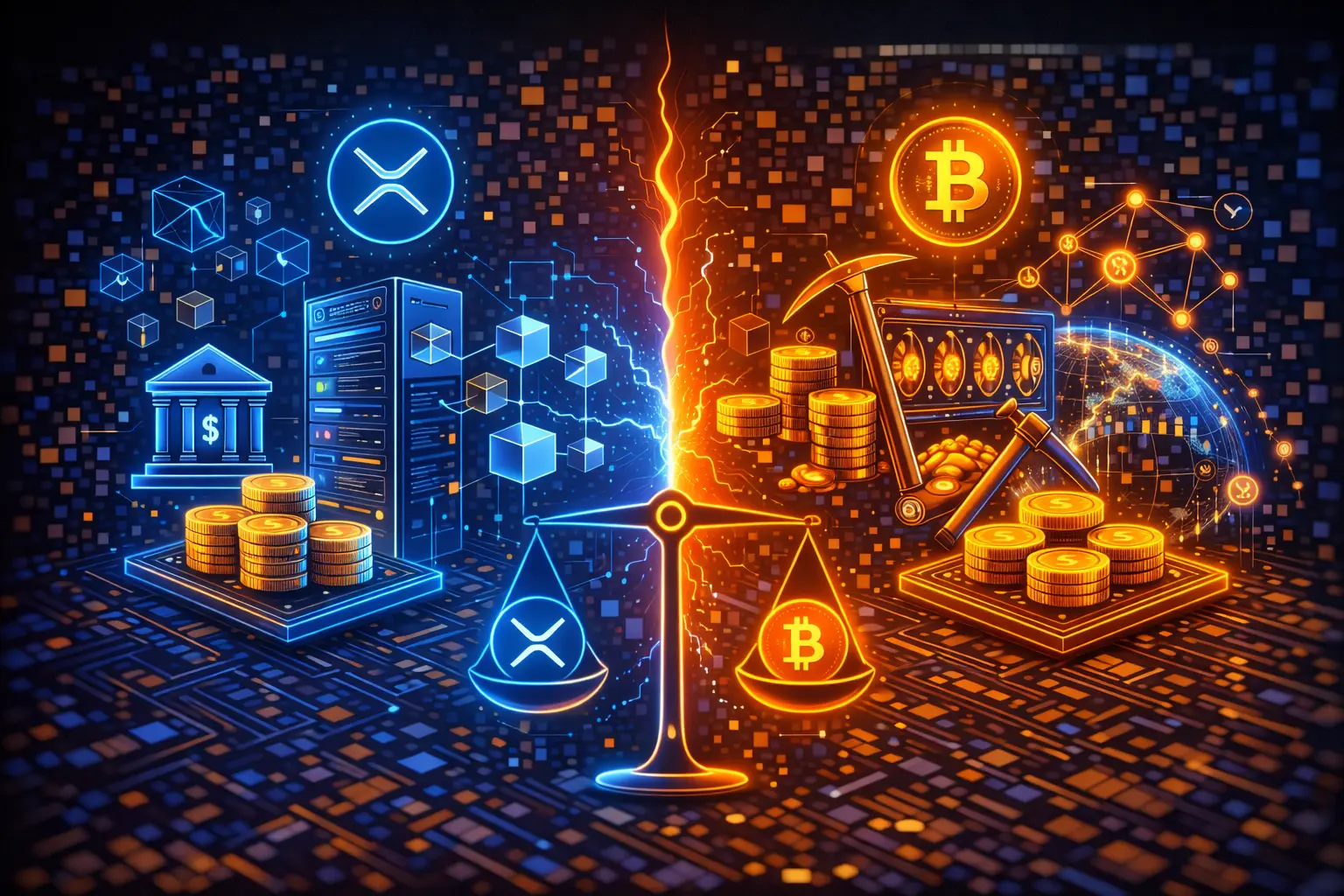
XRP vs Bitcoin: Core Differences
Consensus Algorithm
Bitcoin’s security model is based on proof-of-work mining. Miners worldwide run specialized hardware competing to solve cryptographic puzzles. Whoever solves the current one first adds the next block and earns the block reward. Rewriting Bitcoin’s transaction history would require controlling more than 50% of global hash rate. This is an economically prohibitive attack given the scale of current mining infrastructure. That energy consumption is intentional. Computational cost is precisely what raises the price of attacking the ledger.
The XRP Ledger reaches consensus through a Unique Node List (UNL). Each participant maintains a list of trusted validators. When 80% of that list agrees on the ledger’s current state, the round closes and transactions confirm. Validators reach agreement by voting rather than competing through computation. The round closes in 3–5 seconds once 80% of the trusted set agrees. This consumes a fraction of the electricity that proof-of-work requires at near-zero cost.
The trade-off is structural. Bitcoin’s security comes from decentralized economic competition among thousands of independent miners. XRP’s speed comes from a much smaller trusted validator set. Ripple Labs historically controlled a significant portion of the default UNL. However, the company has been reducing its footprint among validators over time.
Transaction Speed and Fees
XRP settles in 3–5 seconds with fees of roughly $0.00003 per transaction. Bitcoin confirms in approximately 10 minutes under normal conditions, with fees that fluctuate based on network congestion — ranging from under $1 to over $30 during peak periods, and occasionally higher during exceptional network activity.
For payments — especially cross-border remittances where a few dollars in fees on a $200 transfer represents a meaningful percentage — XRP’s architecture is simply more practical. For a long-term holder moving large amounts infrequently, Bitcoin’s fee structure is a non-issue.
The Lightning Network provides an important caveat for Bitcoin’s payment limitations. This Layer 2 protocol enables near-instant, near-zero-fee Bitcoin transactions by routing payments through payment channels settled on the base layer. Lightning adoption has grown steadily, though it remains more complex to use than direct XRP transactions.
Supply Structure
Bitcoin’s supply is designed around scarcity and predictability. The emission schedule is fixed in code, halvings reduce issuance mechanically every four years, and the terminal supply cap is mathematically guaranteed. Current circulation is over 94% of the final total.
XRP’s supply structure operates differently.
The original text contains several passive constructions (is fixed, not used, being permanently burned). Here is a version using active voice:
The 100 billion token cap remains fixed, but the distribution mechanism introduces variables missing from Bitcoin’s model. Monthly escrow releases grant Ripple Labs ongoing influence over circulating supply. Ripple returns any unused XRP from these releases to escrow rather than permanently burning the tokens — meaning the release schedule can extend indefinitely. The circulating supply of roughly 60 billion XRP also implies that full dilution could roughly double current supply, a factor that investors should consider when modeling price targets.
Decentralization: Bitcoin vs XRP
Mining vs Validator Model
Bitcoin’s decentralization is rooted in its mining architecture. Any participant with hardware and electricity can join the network as a miner, and the protocol doesn’t discriminate between them based on identity or trust relationships. The hash rate is distributed across mining pools and individual miners across dozens of countries. No single miner or pool has sustained 51% of global hash rate for any meaningful period.
XRP validators operate on a different basis. Each full node maintains its own UNL — a list of validators it trusts for consensus. The XRP Ledger Foundation publishes a default UNL that most participants use, and historically this list skewed toward validators run by or affiliated with Ripple Labs. The practical question isn’t whether XRP is “truly decentralized” in an ideological sense — it’s whether the validator set is distributed enough to prevent coordinated manipulation. Ripple has reduced its share of the default UNL, but the concentration remains higher than Bitcoin’s mining distribution.
Governance Differences
Changes to Bitcoin’s protocol require broad consensus among developers, miners, and node operators — a slow and contested process by design. The block size debate of 2015–2017 took years to resolve and ultimately resulted in a hard fork (Bitcoin Cash) rather than a unified protocol change. This conservatism frustrates some developers but protects the network’s monetary properties from capture by any faction.
Ripple Labs exercises considerably more direct influence over the XRP Ledger’s development direction. The company’s engineering team controls the reference implementation and drives feature prioritization. This enables faster protocol iteration — useful for a payment network that needs to respond to enterprise requirements — but concentrates governance in a way that Bitcoin’s design explicitly avoids.
Community and Network Control
Bitcoin has no company behind it. Satoshi Nakamoto’s anonymity and disappearance from the project removed any single point of authority over the protocol. The developer community is distributed, the node operators are independent, and no entity can compel changes to the consensus rules.
XRP has Ripple Labs. That relationship is simultaneously a strength and a vulnerability. The company’s banking relationships and sales infrastructure accelerate adoption in the financial services sector — something a truly leaderless project would struggle to achieve. At the same time, Ripple’s large XRP holdings create an ongoing perception question about whether the company’s interests and token holders’ interests are fully aligned.
Use Cases: Ripple vs Bitcoin
By 2025, Bitcoin’s dominant use is as a long-duration savings asset. Corporate treasuries — MicroStrategy being the most visible — and sovereign wealth discussions pull from the same thesis. Retail holders treating it as inflation protection also value its fixed supply, no issuer, and censorship resistance. Transaction speed barely enters into it for this use case. What matters is that the code locks in the monetary policy and prevents political pressure.
RippleNet connects banks, money transfer operators, and payment service providers. These institutions currently move money internationally through correspondent banking chains that take days. These chains also tie up capital in pre-funded accounts. For a large bank processing hundreds of millions in daily volume, the difference between days and seconds is critical. It translates directly into freed-up working capital and lower per-transaction cost. XRP provides the on-demand liquidity that makes that settlement model work.
Beyond payments, the XRP Ledger has expanded into decentralized exchange features, asset tokenization, and stablecoin issuance. How far this ecosystem develops will depend on regulatory clarity and enterprise adoption. Both factors got meaningfully better after the SEC settlement cleared the biggest legal overhang.
Bitcoin’s direct payment use has shrunk relative to its savings-asset role. However, its Lightning Network keeps growing in specific markets. This is particularly true in regions with underdeveloped banking infrastructure where censorship-resistant transfers have practical daily demand.
XRP vs BTC Performance History
Both assets hit all-time highs in 2025, arriving from very different directions.
Bitcoin’s appreciation unfolded in stages over fifteen years. The 2020–2021 cycle pushed it from roughly $10,000 to $69,000; a steep correction in 2022 gave way to a steady recovery through 2023; spot ETF approval in late 2024 opened the asset to another wave of institutional allocation. Each phase added a different investor type to the base — retail, then corporate treasuries, then ETF buyers.
XRP’s five-year gain through early 2025 was roughly comparable to Bitcoin in magnitude — approximately 10x — but almost entirely delivered in a matter of months. For most of 2021–2024, the token traded well below its January 2018 high, pinned by the SEC lawsuit and exchange delistings. The late 2024 rally, once legal clarity arrived and ETF speculation took hold, compressed years of potential appreciation into a single burst.
Bitcoin’s price responds to macro adoption cycles that develop over years: halving dynamics, institutional inflow waves, long-horizon allocation decisions by treasuries and funds. XRP moves faster and on different triggers — a court ruling, a Ripple partnership announcement, or a regulatory signal can shift it sharply within days. An investor holding both is running two very different risk books at the same time.
Conclusion
Bitcoin and XRP solve different problems. Bitcoin’s logic rests on fixed supply and institutional adoption (ETFs, corporate treasuries) as a decentralized store of value. It thrives on the hard-money narrative. XRP’s logic depends on Ripple’s commercial success in cross-border payments. With legal hurdles and ETF speculation cleared by 2025, XRP faces execution risk: Ripple must close deals with global financial institutions at scale. Most investors hold both to hedge different theses—one macro, one commercial.
More Questions
Bitcoin is a decentralized, proof-of-work store of value with a 21 million cap and no central authority. XRP is a payment settlement asset created by Ripple Labs, using a consensus model designed for speed and institutional use.
XRP settles in 3–5 seconds for negligible fees. Bitcoin’s base layer takes 10 minutes per confirmation. While the Lightning Network speeds up Bitcoin, XRP remains natively faster and cheaper for simple transfers.
Yes. Ripple Labs holds significant supply and historically influenced the validator list. Bitcoin has no corporate structure; development and mining are distributed and permissionless.
Bitcoin follows macro adoption, ETF inflows, and halving cycles. XRP reacts to binary events: legal rulings, partnership news, and regulatory signals. Its 2025 rally was driven largely by legal resolutions.
Unlikely, due to supply differences. With 60 billion XRP versus 19.9 million BTC, XRP hitting Bitcoin’s price would require a market cap exceeding all global assets. Focus on market cap, not unit price.
Bitcoin offers deeper institutional trust and a proven track record. XRP provides high-volatility exposure to payment tech. The “better” choice depends on your risk appetite for macro vs. corporate-linked assets.
Published Articles
 Popular
Bitcoin Pizza Guy: The Story Behind the First Real Bitcoin Purchase
Introduction The history of Bitcoin is full of dramatic ups and downs,...
How Bitcoin ATMs Work: A Complete Guide to Using Crypto ATMs
Introduction Millions of people around the world use cryptocurrencies today – at...

Best Bitcoin Mining Software of 2025 – Top 7 Tools for Maximum Profitability
Bitcoin mining has long since moved beyond being a hobby for enthusiasts...

Services You Can Pay for with Bitcoin
Where Bitcoin Is Accepted Today Today, Bitcoin (BTC) can be used to...

What You Can Buy With Bitcoin in 2025
Introduction Over the years, Bitcoin has evolved from an experimental digital currency...
 Popular
Bitcoin & Crypto Options Trading: A Complete Guide for Beginners and Experts
Bitcoin options trading has grown rapidly in recent years as the cryptocurrency...