
How long to mine 1 bitcoin: factors impacting mining efficiency
As of February 11, 2026, Bitcoin is trading around $66,725.69. This figure is enough to keep interest in mining high, even though the rules of the game have become much tougher. I often hear questions about whether it is still realistic to mine one full Bitcoin today. To answer this, we need to stop looking at price charts and dive into the technical side: hashrate, difficulty, and economics after the 2024 halving. The block reward is now 3.125 BTC, and the competition for these coins has reached an all-time high.
How bitcoin mining works
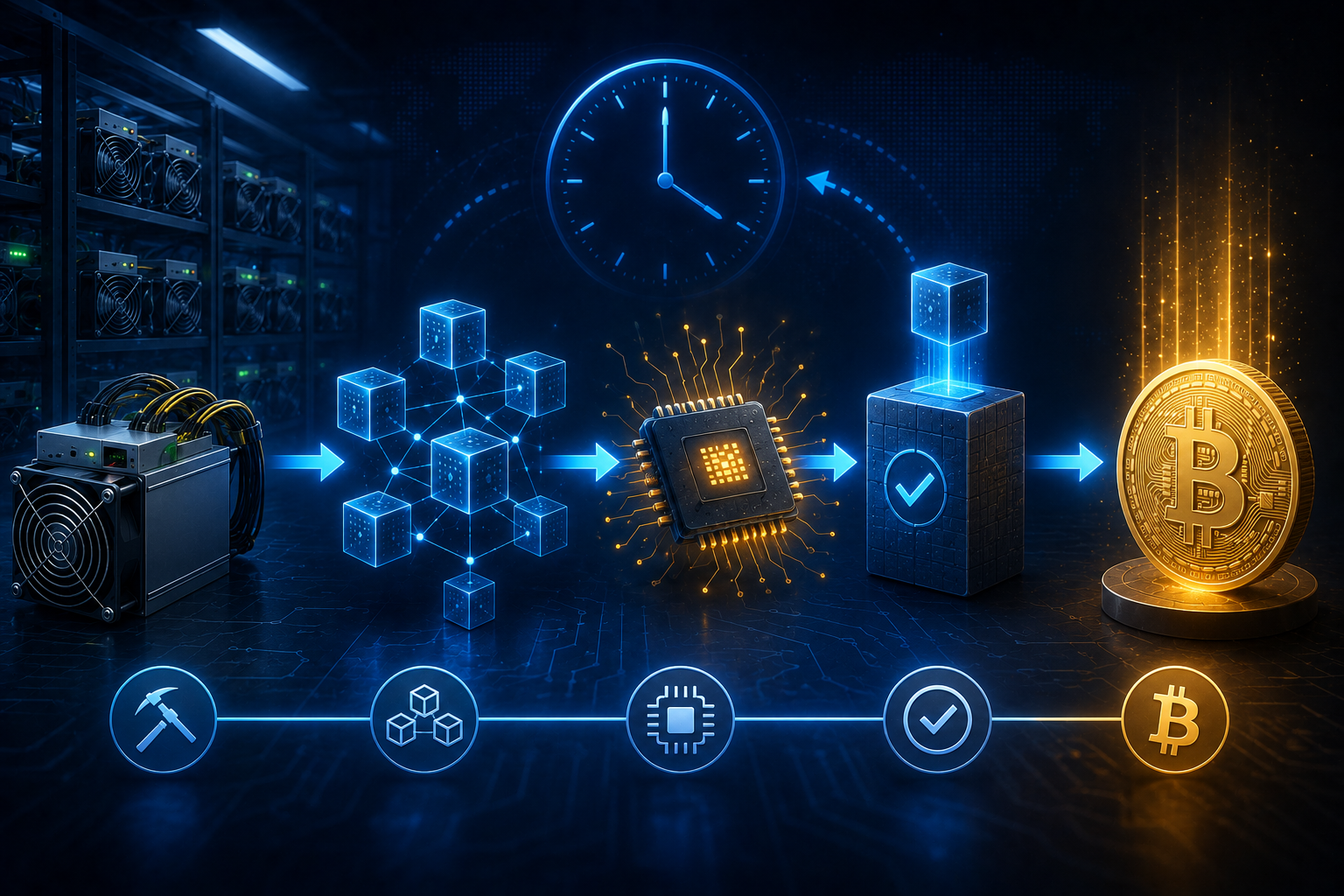
Mining is the process of securing the network and validating transactions. Miners use computational power to solve cryptographic puzzles and add new blocks to the blockchain. This can be compared to a global lottery where a drawing happens every 10 minutes. Participants worldwide cycle through billions of “nonce” values, trying to find the one that fits the network’s criteria. The winner earns the right to close the block and claim the reward, which currently stands at 3.125 BTC plus transaction fees.
What is hashrate and why is it important
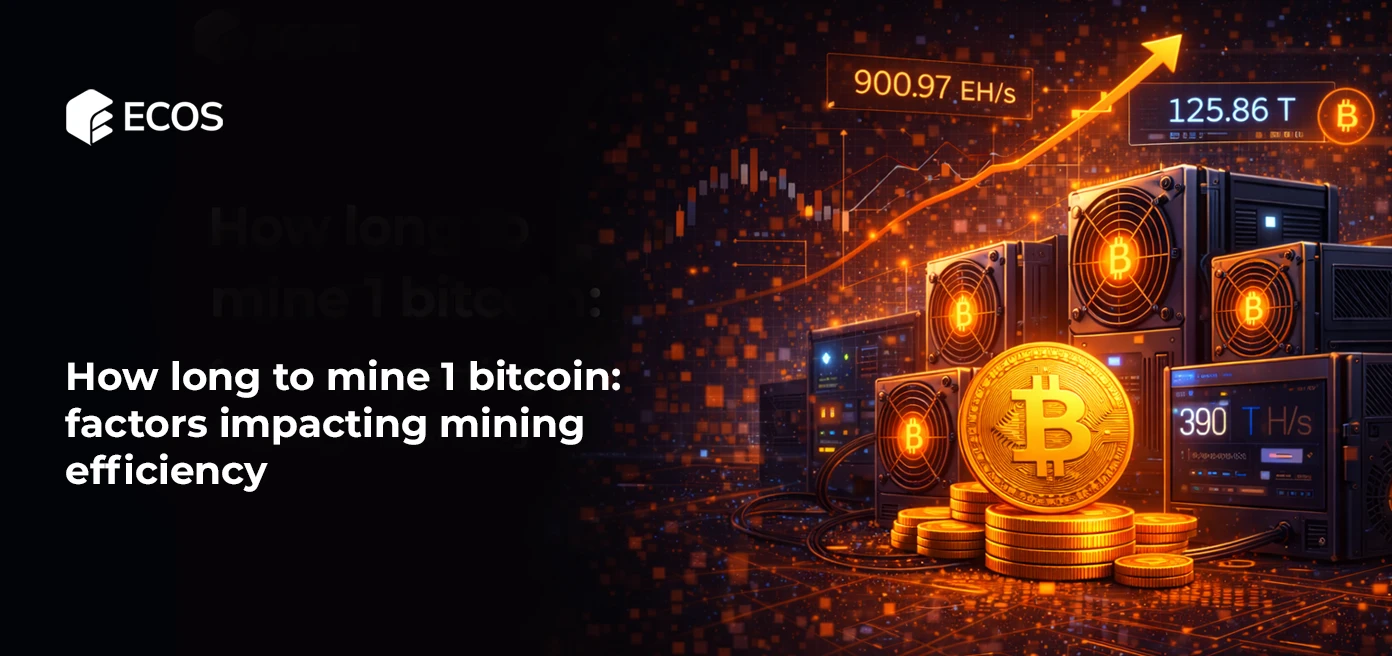
Hashrate is the total computing power of your hardware, or simply the number of attempts to guess the block code per second. The higher your personal hashrate, the more “lottery tickets” you hold in each ten-minute round. In February 2026, the total Bitcoin network hashrate is an impressive 900.97 EH/s. If you use one modern ASIC, such as the MicroBT Whatsminer M63S Hydro with a capacity of 390 TH/s, your share of the total network will be miniscule. This is why individual miners today almost always work through pools, joining forces with other players.
How does network difficulty affect bitcoin mining?
Network difficulty is the mechanism that ensures new Bitcoins are not mined too quickly. It adjusts approximately every two weeks (every 2,016 blocks) to keep the average block time at 10 minutes. If many new powerful machines join the network, the difficulty increases. Currently, this figure is around 125.86 T. This means that even if you buy ten times more equipment, the network will adjust to that power, and mining one Bitcoin will not become proportionally easier.
Impact of difficulty and halvings on mining profitability
Mining profitability depends directly on the balance between difficulty and the block reward. After the halving in April 2024, the reward dropped to 3.125 BTC. When difficulty rises while the reward stays the same or decreases, miners have to spend more electricity for the same amount of income. In 2026, only those using the most efficient hardware, such as the Antminer S21 Hydro or Sealminer A3, and having access to cheap electricity (ideally $0.05 per kWh or lower) survive. This turns mining from a technical hobby into a strict economic calculation where every cent of cost matters.
How long does it take to mine 1 bitcoin?
Mining one full Bitcoin on a single device now takes years. For a powerful MicroBT Whatsminer M63S Hydro (390 TH/s) at current difficulty, the estimated time is 5,133.8 days. This is roughly 14 years of operation, not accounting for future difficulty increases or halvings. Using a higher-performance Sealminer A2 Pro Hydro (500 TH/s) reduces this period to 4,082 days, or about 11.2 years. If 100 Sealminer A2 Pro Hydro machines are run simultaneously, one Bitcoin can be mined in approximately 41 days. These figures illustrate why solo mining on a single device is statistically nearly impossible.
How many BTC can be mined in a day?
The Bitcoin network generates an average of 144 new blocks every 24 hours. With the current block reward of 3.125 BTC, the total daily issuance is about 450 BTC. A single modern Whatsminer M63S Hydro (390 TH/s) mines approximately 0.00019479 BTC per day. This generates about $13 in revenue, with $8.66 spent on electricity at a rate of $0.05 per kWh. Consequently, the net profit is around $4.34 per day. Most participants receive these rewards through mining pools, as the chances of finding a full block independently are extremely low.
How mining time for bitcoin has changed over the years?
Over the past 15 years, the time and effort required to mine Bitcoin have changed drastically. In 2010, the network difficulty was 1, and blocks could be found on a standard home computer in a few minutes. By 2015, the difficulty rose to 1,000, and by 2020, it reached 15 million. In early 2026, this metric hit 125.86 T (trillion). Despite the massive increase in computing power, the average block time remains stable at about 10 minutes. The system automatically adjusts the difficulty every two weeks to account for any amount of hardware in the network.
Factors influencing mining speed
The speed of mining Bitcoin depends on the total computing power of the hardware. Modern ASIC miners are built for a single task: solving SHA-256 hashes as quickly as possible. A device like the MicroBT Whatsminer M63S Hydro produces 390 TH/s. In comparison, older models like the Antminer S9 produced only 14 TH/s. This massive gap shows that hardware choice is the primary factor in determining how fast you can accumulate Bitcoin. High-performance machines simply buy you more “lottery tickets” in each ten-minute network cycle.
Electricity costs often become a hidden factor in mining speed. If power is too expensive, a miner might have to shut down equipment during peak hours, which drops their effective speed to zero. Efficient machines, such as the Bitmain Antminer S21 Hydro, consume 5,360 Watts for 335 TH/s, which is about 16 J/TH. At a cost of $0.05 per kWh, mining remains profitable, allowing the hardware to run 24/7 without interruption. Continuous operation is vital because any downtime increases the total time needed to reach that 1 BTC milestone.
The role of pooling and hardware stability
Choosing between solo mining and joining a pool is a choice between speed and stability. In a pool, you combine your hashrate with thousands of other participants to solve blocks collectively. This does not change the block time in the network, but it ensures you receive small fractions of Bitcoin regularly. For most, this is the only realistic way to “speed up” the receipt of rewards. The reliability of the pool and your internet connection also matter; high latency can lead to the loss of part of the hardware’s work, which effectively slows down the process.
Operating temperature directly affects how long and how fast a miner runs. ASIC miners generate a lot of heat and can reduce performance or shut down when overheating. Modern setups often use liquid cooling, such as in the Sealminer A2 Pro Hydro, to maintain optimal temperature even under maximum loads. Quality cooling allows chips to operate at peak frequency, preventing hashrate drops that occur when the hardware gets too hot.

The economic side of mining 1 bitcoin
Mining one Bitcoin is primarily about financial planning. Buying hardware is only the first step. In February 2026, specialized ASIC devices remain the largest initial expense. A flagship miner like the MicroBT Whatsminer M63S Hydro (390 TH/s) costs approximately $13,699. More affordable models, such as the Antminer S21, are priced around $5,449, but they offer lower performance. Hardware depreciates quickly; newer, more energy-efficient models constantly enter the market, which lowers the resale value of older units.
Electricity is the main variable in the profitability equation. At an energy cost of $0.05 per kWh, running a Whatsminer M63S Hydro costs $8.66 per day. This represents over 60% of the daily revenue of $13.00. In regions with expensive electricity, mining often becomes unprofitable because the cost to power the machines exceeds the value of the coins produced. For this reason, large-scale farms are frequently located near sources of cheap renewable energy.
ROI calculations and maintenance costs
Return on Investment (ROI) calculations help illustrate the real prospects of the business. With a single 390 TH/s device, the estimated ROI period is about 3,156.9 days. This is over 8 years, which exceeds the typical lifespan of most ASICs. The situation changes with scaling: running hundreds of machines allows for faster capital accumulation but requires massive investments in infrastructure, cooling, and maintenance.
Additional costs include cooling and repairs. Powerful setups consume thousands of watts and generate a significant amount of heat. For stable operation, the Whatsminer M63S Hydro requires 7,215 Watts. Without high-quality ventilation or liquid cooling systems, chips fail quickly, leading to expensive downtime. Professional miners budget for technicians and periodic component replacements to keep the hashrate at a consistent level.
More questions
Mining profitability in 2026 remains a reality for those with access to cheap energy and modern ASICs. At a rate of $0.05 per kWh, flagship devices generate about $4.34 in net profit daily after expenses. The market situation changes almost every day due to fluctuations in price and network difficulty. Stable income is now primarily achieved by pool participants, where payouts occur regularly and do not depend on the luck of a single miner.
To date, over 19.9 million coins have been mined, leaving approximately 1.1 million BTC for miners. The issuance process will conclude around the year 2140. Every four years, the reward is cut in half, making new coins increasingly rare. This mechanism is built into the Bitcoin code to protect it from inflation by strictly limiting the total supply to 21 million units.
When the last coin is mined, miners will shift to earning exclusively from transaction fees. The network will continue to function, but participant income will depend entirely on user activity and transfer volume. This could change the market structure, forcing smaller players to exit or merge with larger companies to survive.
Using standard laptops or smartphones to mine Bitcoin in 2026 is pointless. Computational difficulty has increased so much that ordinary processors cannot handle network tasks. Specialized ASIC chips are required, as they are thousands of times more efficient at solving cryptographic puzzles. Attempting to mine on a home PC will only result in hardware overheating and massive electricity bills without any profit.
Published Articles
 Popular
Bitcoin Pizza Guy: The Story Behind the First Real Bitcoin Purchase
Introduction The history of Bitcoin is full of dramatic ups and downs,...
How Bitcoin ATMs Work: A Complete Guide to Using Crypto ATMs
Introduction Millions of people around the world use cryptocurrencies today – at...

Best Bitcoin Mining Software of 2025 – Top 7 Tools for Maximum Profitability
Bitcoin mining has long since moved beyond being a hobby for enthusiasts...

Services You Can Pay for with Bitcoin
Where Bitcoin Is Accepted Today Today, Bitcoin (BTC) can be used to...

What You Can Buy With Bitcoin in 2025
Introduction Over the years, Bitcoin has evolved from an experimental digital currency...
 Popular
Bitcoin & Crypto Options Trading: A Complete Guide for Beginners and Experts
Bitcoin options trading has grown rapidly in recent years as the cryptocurrency...