
Stablecoins Explained: List, Examples, and Safety Comparison
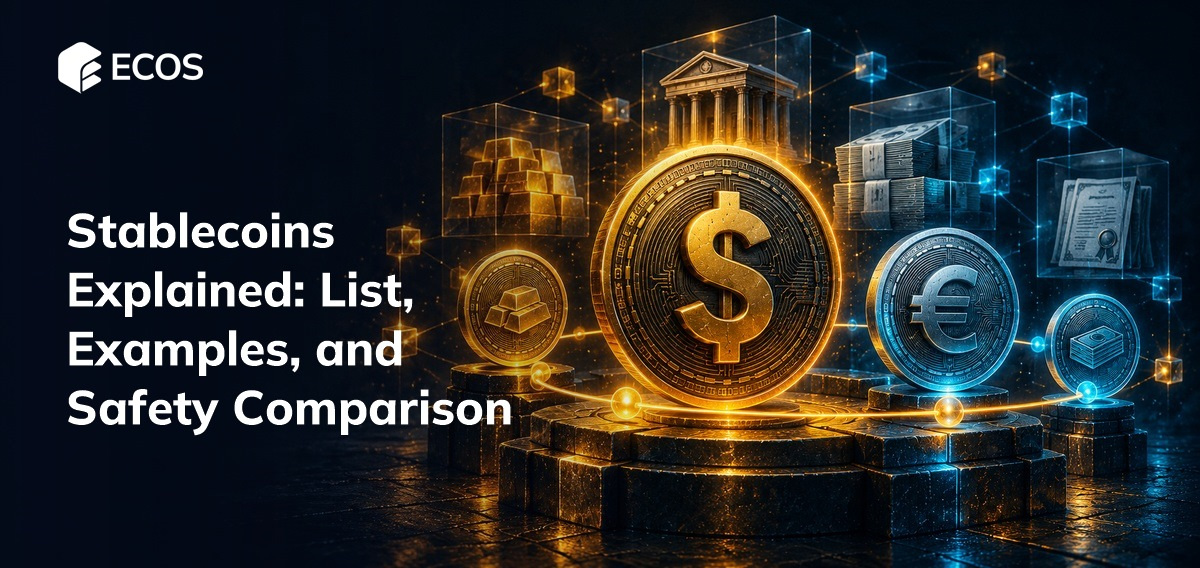
A list of stablecoins to compare
A stablecoin aims to track a reference price, usually one US dollar. USDT and USDC are familiar examples. The category also includes euro tokens, collateralized borrowing systems, and synthetic dollars whose stability depends on derivatives. A shared price target tells you surprisingly little about what happens when someone wants their money back.
This list of stablecoins covers 12 examples checked on October 17, 2026. It is an editorial selection across different designs, rather than a complete market directory or a safety ranking. Redemption below means the issuer or protocol route; selling on an exchange is a separate transaction at the available market price.
Tether USDT
USDT targets $1 and is issued by Tether International. Its reserves include Treasury-related holdings and other assets, so describing every token as a dollar sitting in a bank account would be misleading. Direct redemption requires an approved account. Tether's published minimum is $100,000, with a fee of the greater of $1,000 or 0.1%.
The main concern is dependence on the issuer and access to its reserves. Tether's terms also broadly restrict US persons, with a limited exception for approved Eligible Contract Participants. An exchange listing should never be treated as confirmation of eligibility.
USD Coin USDC
Circle issues USDC against dollar-denominated reserves, including cash and holdings in the Circle Reserve Fund. The target is $1. Direct dollar redemption requires an eligible Circle Mint account in good standing; holding the token in a personal wallet does not automatically provide that account.
USDC offers a relatively straightforward reserve structure, but users still depend on banks, custodians, and Circle's operations. Address blocking can prevent access to tokens. Its terms exclude FDIC and SIPC protection for token balances.
Sky Dollar USDS
USDS targets $1 within the Sky Protocol, which grew out of MakerDAO. Backing spans stablecoins, crypto lending, and exposure to real-world financial assets. It should therefore be assessed as a system with several counterparties and collateral arrangements.
Sky provides conversion routes between USDS and DAI, alongside supported stablecoin routes. Converting USDS does not mean receiving a bank wire from Sky. The principal risk is that problems in the collateral portfolio or connected protocols impair those routes or confidence in the peg.
Dai DAI
DAI remains a dollar-targeting token in the Sky ecosystem. It shares its issuance source with USDS, and the converter allows movement between them at parity. Existing DAI integrations explain why readers still encounter both names.
Collateral and governance dependencies overlap with USDS. DAI is neither backed exclusively by cryptocurrency nor independent of centralized stablecoin exposure. Holders can use supported protocol conversions or market sales, subject to the chosen route's conditions, rather than assume a universal cash-redemption promise.
PayPal USD PYUSD
PYUSD targets $1 and is issued by Paxos, rather than PayPal itself. Dollar deposits, US Treasuries, and cash equivalents support its reserves. Eligible users can access dollar conversion through supported PayPal services or redeem with Paxos under its terms.
Its practical appeal is payment integration. The main risk remains reliance on the issuer, reserve custody, and the service handling the balance. A familiar payment brand does not turn PYUSD into an insured deposit, and availability depends on location and account eligibility.
First Digital USD FDUSD
FDUSD is issued by FD121 (BVI) Limited and targets $1. First Digital Labs describes reserves consisting of cash and cash equivalents held through a custody structure. Its current disclosures identify First Digital Trust as the reserve custodian.
Direct redemption requires becoming a client and completing compliance checks. Retail holders commonly need a supported exchange or OTC provider instead. Custody and banking arrangements deserve close scrutiny, together with the depth of the market available when a holder wants to sell.
Ripple USD RLUSD
RLUSD targets $1. Ripple's issuer, Standard Custody & Trust Company, maintains segregated liquid reserves, with permitted holdings including cash deposits and short-term Treasury-related instruments. Approved customers can redeem at one dollar per token under the customer agreement.
Other holders may need an intermediary to reach dollars. Reserve segregation addresses one concern, while access restrictions and issuer operations remain relevant. Neither the Ripple name nor activity on the XRP Ledger guarantees that a particular retail account can redeem directly.
EURC
Circle's EURC tracks one euro and is backed by euro reserves. Its issuer redemption route is subject to the applicable Circle terms and eligibility; many holders will use a service that supports EURC trading or conversion.
The obvious difference appears on a dollar-denominated account statement. EURC can hold its euro peg while its dollar value falls as exchange rates move. It also carries issuer and banking risk. European regulatory treatment does not establish that a US customer can access every EURC service.
Ethena USDe
USDe is Ethena's synthetic dollar. Its design combines backing assets with offsetting derivatives positions to reduce exposure to price movements. This differs materially from keeping a cash reserve for each token, and the hedge requires functioning trading and custody arrangements.
Only approved Mint Users can redeem directly with Ethena. Other holders rely on secondary markets. Funding costs and failures involving trading counterparties can weaken the system even when the intended hedge appears balanced. Jurisdiction restrictions require checking before use.
Curve crvUSD
Curve's crvUSD targets $1 and is issued through collateralized borrowing arrangements. Its LLAMMA mechanism gradually trades collateral against crvUSD across price bands as markets move. Supporting liquidity and monetary mechanisms help manage the peg.
A holder normally exits through an available swap rather than requesting dollars from a corporate issuer. Contract errors, unreliable price inputs, and stressed collateral markets are central risks. Soft liquidation can reduce the abruptness of a borrower's liquidation while still causing losses.
Liquity LUSD
LUSD belongs to Liquity V1 and targets $1 against ETH collateral. The protocol permits redemption for a dollar's worth of ETH per LUSD before the redemption fee. What arrives is cryptocurrency, whose price can change immediately.
The design reduces reliance on a reserve bank, but leaves exposure to ETH, price feeds, and contract behavior. Holders should distinguish LUSD from the BOLD token associated with Liquity V2. Similar branding across protocol generations does not make their collateral rules interchangeable.
Frax USD frxUSD
Frax's frxUSD targets $1 using a reserve structure centered on tokenized Treasury funds and other supported backing assets. Minting and redemption pass through designated contracts or services. Available proceeds and eligibility depend on the route selected, which may involve stablecoins rather than a bank transfer.
This creates dependencies on fund issuers and custodians alongside the protocol contracts. The current design should be checked on its own terms. An old description of FRAX as a fractional-algorithmic experiment would not adequately explain frxUSD's backing.

What a list of stablecoins tells you
A stablecoin is a crypto asset designed to keep its market price close to a specified reference asset. The peg states the target. Backing describes the resources and arrangements intended to support it. Redemption determines how a holder can exchange tokens through the issuer or protocol, if eligible.
Chainlink's educational definition says stablecoins “aim to keep their price ‘pegged’ to the market value of an external asset.” The word “aim” matters. A token can trade below its target while its issuer still reports sufficient reserves, particularly when holders cannot access redemption quickly.
A list of stablecoins grouped by backing reveals shared dependencies that an alphabetical directory would hide. A euro peg may suit a euro obligation. ETH collateral may allow onchain redemption without delivering any dollars. Neither property establishes that a token is suitable for an unrelated purpose.
Consider an illustrative exchange quote of $0.98 for a dollar token. A buyer who can redeem at $1 may earn the difference after costs, encouraging purchases that support the market price. If redemption closes, or the buyer is ineligible, that trade may be impossible. A discount can then persist. The mechanism needs people able and willing to use it.
The backing mechanisms behind the price
Cash and short-term reserves
With a reserve-backed token, the issuer accepts eligible funds and creates tokens against them. Redemption removes tokens from circulation and returns the agreed proceeds. The reserve must be accessible when customers need payment. A solvent balance sheet alone cannot guarantee that every bank transfer will settle immediately.
Reserve composition changes the exposure. Short-term government securities generally behave differently from volatile crypto assets or loans to private counterparties. Read what the reserve actually holds, where it is held, and whether holders have enforceable rights if the issuer fails. “Fully backed” leaves all of those questions open.
Collateralized borrowing and governance
In a collateralized lending system, borrowers deposit assets to create stablecoin debt. If collateral values fall sufficiently, liquidation rules sell or redistribute collateral to protect the system. Price feeds, transaction execution, and buyers for the collateral must work during the same market stress.
Sky adds another layer: its ecosystem includes stablecoin holdings and real-world asset arrangements. Smart contracts execute programmed rules, while governance chooses important parameters and approved exposures. SKY now has a governance role. Explaining the system solely through MKR holders and automatically changing interest rates would miss the present structure.
Synthetic dollars and weakly backed designs
USDe illustrates a synthetic approach. A decline in the value of backing crypto can be offset by gains on a short derivatives position. Maintaining that relationship requires active operations. Prolonged unfavorable funding, execution problems, or counterparty failure can produce losses that a simple diagram of the hedge does not show.
Unbacked or weakly collateralized algorithmic designs rely more heavily on incentives and confidence to support their price. Calling a mechanism algorithmic says little about whether there are sufficient assets behind it. Inspect the actual collateral and redemption process before drawing comparisons with cash-backed tokens. The word stable offers no protection during a run.

How to assess the safest stablecoin for a particular use
Read assurance reports with the right question
An attestation examines specified statements, such as management's reserve assertions at stated dates. A financial-statement audit has a different scope, covering an entity's financial statements for a period. Either report needs to be read for its subject matter and exceptions. Neither provides continuous insurance against loss.
Circle publishes monthly reserve assurance reports and identifies Deloitte & Touche LLP as its independent auditor. Its support materials also identify Deloitte for monthly examinations of USDC reserve assertions. Older references to monthly Grant Thornton audits conflate the reporting type and the firm involved.
Tether announced on August 13, 2026 that KPMG US had completed an independent audit of Tether International's financial statements for the year ended December 31, 2025, with an unqualified opinion. This updates the old blanket claim that Tether had never completed such an audit. The announcement concerns that entity and reporting period. It cannot guarantee reserve liquidity throughout 2026.
When comparing two reports, check their dates before comparing their conclusions. A recent reserve statement and an older annual audit answer different questions. Also look for a gap between the token's issuing entity and the entity named in the document; group branding can conceal important legal boundaries.
Test the exit available to you
The same token can offer different practical protection to two holders. An institution with direct redemption access may exchange tokens for bank money. A retail holder may need to sell into a thin order book, pay a withdrawal charge, and wait for an intermediary to release the proceeds.
A decentralized exchange needs liquidity too. Imagine a pool holding a dollar token and USDC. If many users sell the first token for USDC, the pool's balances shift and later sellers can receive progressively worse prices. The displayed peg does not compel the pool to give everyone an equal dollar amount. Check the actual quote for the amount you intend to sell, including fees and slippage. A successful small swap proves that a route works at that size; it does not establish that a much larger balance can leave on the same terms.
Suppose a hypothetical $2,000 balance sells for $1,980 during a disruption, followed by $12 in trading and withdrawal costs. The holder receives $1,968. A future return to the peg would not reimburse that completed sale. This is why reserve quality and personal access to liquidity should be assessed together.
Keep additional dependencies visible
A native token and a bridged representation may have the same ticker on a wallet screen. The bridged version can depend on a separate bridge holding the original token. An exploit at that bridge can leave the representation impaired even if the original issuer's reserves remain intact.
Yield adds another layer. Lending a stablecoin exposes the holder to the borrower or lending protocol. Providing liquidity introduces pool and contract risks. A quoted return belongs to that arrangement; holding an ordinary dollar token does not automatically entitle its owner to the interest earned on reserve assets.
How many stablecoins are there
The answer depends on the catalogue and its inclusion rules. When checked on October 17, 2026, DefiLlama's directory advertised 427 tracked stablecoins. That is its unfiltered catalogue count across peg types, rather than a verified count of solvent, actively redeemable projects. It should not be presented as a census of every stablecoin ever launched.
For comparison work, count a tracked asset once and inspect its network deployments separately. USDC on several blockchains does not become several independent issuers. Conversely, two tokens from the same protocol may require separate entries because their contracts or redemption rules differ. This list of stablecoins keeps DAI and USDS separate while explicitly identifying their connection.
There is no reason to inflate that count with abandoned tokens to make the market sound larger. A useful directory records whether issuance continues, whether redemption works, and which markets remain available. Those checks tell a prospective holder more than an impressive total with no definition of “active.”
Before buying or transferring stablecoins
Start with the payment or transaction you need to complete. A token accepted by an overseas recipient may be unsupported by the exchange that will handle your withdrawal. Work through the entire route before sending money. Small test transfers can catch some operational mistakes, although they cannot establish reserve safety.
Check the official contract address and the network supported by both the sending and receiving services. Matching ticker symbols are insufficient.
Read the latest reserve disclosure and identify the actual issuer or protocol responsible for redemption.
Confirm eligibility, minimum amounts, fees, and what the redemption route pays out. A swap into another stablecoin leaves further conversion work.
Review the full transfer cost. Network fees, exchange spreads, currency conversion, and withdrawal charges can outweigh a low advertised transaction fee.
Keep enough of the network's required gas asset for later transactions, unless the chosen service explicitly handles fees another way.
US readers should check US eligibility directly. MiCA authorization in Europe does not supply US account access or extend European holder rights everywhere. Provider restrictions can also differ from the rules governing the token itself. Avoid assuming that permission to hold an asset means permission to use every related service.
Stablecoins are not a substitute for an insured bank deposit. Circle's USDC terms specifically exclude FDIC and SIPC protection for token balances. Losses can also arise from a compromised wallet or a failed exchange while the token itself stays near $1. Spreading assets across several tokens on that same exchange would leave the exchange dependency unchanged.
Conclusion
Use a list of stablecoins to narrow the field, then follow each candidate's exit route. Identify the reserve or collateral, check current reporting, and establish what you can receive when you redeem or sell. A familiar ticker helps with recognition. The terms and available liquidity determine what happens to the money.
FAQ
- What are examples of stablecoins?
USDT, USDC, PYUSD, and RLUSD target the US dollar. EURC targets the euro. Other dollar-targeting examples include DAI, USDS, LUSD, crvUSD, USDe, FDUSD, and frxUSD, with differing backing and redemption arrangements.
- Which is the safest stablecoin?
There is no universal winner. Compare reserve quality, legal rights, reporting, and the exit available to you. Custody and network choices can add risks independently of the token.
- Can stablecoins lose their peg?
Yes. Redemption problems, reserve losses, disrupted markets, or failures in a protocol can push the price away from its target. Recovery is not guaranteed.
- Is stablecoin yield guaranteed?
No. Lending, savings contracts, and promotional rewards have separate conditions and risks. A stable price target says nothing about the reliability of a yield offer.
- Are stablecoins FDIC-insured?
Holding a stablecoin does not make the balance an FDIC-insured deposit. Protection applying to a reserve bank account should never be assumed to protect the token holder in the same way.
Published Articles
What Does Pegging Mean in Crypto?
What supports a token's value? Learn the answer to “what does pegging mean in crypto” and see how reserves, redemption, and depegging work.

Best Crypto Wallets: Security, Features, and Expert Recommendations
Compare the most secure crypto wallets for mobile and hardware use. Review key protection, recovery, security audits, and risks before choosing a wallet.
What Is Aave (AAVE)? The Protocol and Token Explained
Learn what Aave coin means, how lending and borrowing work, the roles of AAVE, aTokens and GHO, and what to check before buying AAVE in Germany.
Bitcoin vs XRP Explained: Technology, Speed, and Investment Comparison
Compare XRP vs Bitcoin by technology, transaction speed, fees, supply, decentralization, and investment risks. Understand how Ripple differs from XRP.

Hardware Wallet Explained: How Cold Storage Protects Cryptocurrency
Learn how a hardware crypto wallet protects private keys, how to set one up, and what to check when backing it up, signing transactions, or recovering access.

How to Buy New Crypto Before Listing
Learn how to buy new crypto before listing through presales, launchpads, and DEXs. Understand token launches, US eligibility, vesting, and common risks.