
Who created Bitcoin: the story of three people
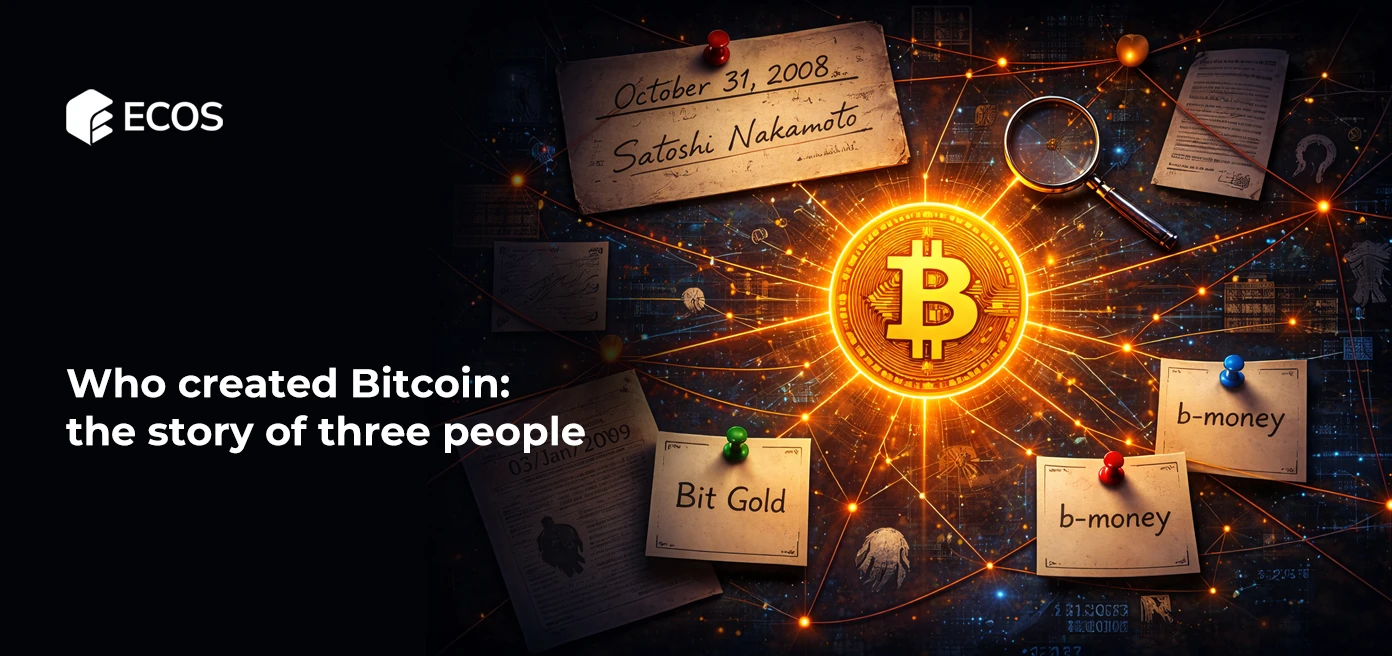
October 31, 2008. A nine-page document arrived in a cryptography mailing list under the name Satoshi Nakamoto. Most recipients ignored it. Hal Finney replied enthusiastically. Three months later, the first Bitcoin block was mined with a headline embedded in its code: “The Times 03/Jan/2009 Chancellor on brink of second bailout for banks.” Satoshi hung around for two more years — patching bugs, answering questions on forums, corresponding with developers — then sent a final email in April 2011 saying he’d moved on to other things.
Nobody has heard from him since.
Who is Satoshi Nakamoto?
The writing left clues. Satoshi spelled “colour” and “favour” the British way. He used “bloody hard” as an expression. He also posted at unusual sleeping hours for someone in Japan. The nine-page whitepaper was methodical and well-sourced. This suggests someone who spent years thinking about a problem. It does not look like a quickly drafted document.
The name itself has been picked apart. “Satoshi” means clear-thinking in Japanese. “Nakamoto” translates roughly to central origin. One theory holds that the pseudonym combines initials from four electronics companies. These are Samsung, Toshiba, Nakamichi, and Motorola. However, that particular theory has never gone anywhere.
What remains unexplained is the writing register. Whoever Satoshi was, they understood cryptographic protocol design deeply. They also mastered economic incentive structures at an elite level. Few people in the world could have managed this in 2008.
The genesis block message about bank bailouts wasn’t accidental. Bitcoin launched nine days after Lehman Brothers collapsed. The embedded headline was Satoshi’s timestamp and thesis statement. It serves as a permanent record of his vision. He clearly thought a bank-independent currency was worth building.
By late 2010, Satoshi had handed the repository to Gavin Andresen. He then stepped back from the project. The P2P Foundation account went quiet. The wallets connected to early mining have never moved. These contain around one million BTC. If Satoshi is alive today, he is incredibly wealthy. He has watched those coins reach billions in value without spending them.
Nick Szabo
Six months before Bitcoin’s whitepaper, Nick Szabo was seeking help to “code up” Bit Gold, a decentralized currency concept he had developed since 1998. The structural similarities are so profound that Bitcoin Magazine described Bit Gold as an “early draft of Bitcoin.” Szabo, a pioneer who coined “smart contracts” in 1994, possesses a rare multidisciplinary background in law, cryptography, and economics—a breadth reflected in Satoshi’s writing style.
Stylometric analyses by firms like Juola & Associates consistently rank Szabo’s prose as the most similar to the Bitcoin whitepaper. Furthermore, the mirror-image initials (NS and SN) have long fueled speculation, despite being circumstantial.
A historical puzzle remains: Satoshi initially cited Hashcash and b-money but ignored Bit Gold, only adding it to the Bitcoin website a year later. This omission suggests either a conscious effort to distance the project from parallel work or that Satoshi and Szabo were truly different individuals unaware of each other’s specific progress at the time.
While Szabo has consistently denied being Satoshi, he noted in 2011 that only he, Hal Finney, and Wei Dai were “seriously interested” in such projects during Bitcoin’s creation—a remarkably small circle of candidates.
Hal Finney
On January 12, 2009, Hal Finney received 10 BTC from Satoshi Nakamoto—the first Bitcoin transaction in history. As a brilliant cryptographer who created Reusable Proof of Work (RPOW) in 2004, Finney was one of the few people capable of writing Bitcoin’s complex code. He was an early technical collaborator, corresponding regularly with Satoshi and running the software when the network first launched.
Speculation about Finney being Satoshi intensified due to a localized coincidence: he lived just blocks away from a man named Dorian Satoshi Nakamoto in California. Furthermore, stylometric analysis by Juola & Associates found a remarkably high similarity between Finney’s writing and the Bitcoin whitepaper. Both he and Satoshi also uniquely utilized the German email provider GMX.
However, a strong alibi contradicts this theory: during a period when Satoshi was sending timestamped emails in January 2009, Finney was photographed competing in a ten-mile race. Despite being diagnosed with ALS that same year, Finney continued contributing to Bitcoin until his death in 2014. His final reflections described his early mining days and his belief that the project truly mattered to the world.
Dorian Nakamoto
In March 2014, Newsweek published a story identifying Dorian Prentice Satoshi Nakamoto — a retired Japanese American engineer living in Temple City, California — as Bitcoin’s creator. The journalist Leah McGrath Goodman pointed to his engineering background, his Japanese heritage, and a remark during their interview that she read as an admission of involvement. The story ran on the magazine’s cover.
It was wrong. Dorian Nakamoto said the question had been about a defense contract job he’d been told not to discuss, not Bitcoin. He’d misunderstood what she was asking. His engineering background was in defense and systems work, not cryptography. There’s no record of him on the cypherpunk mailing list, no technical publications relevant to Bitcoin’s design, no footprint in the forums and email threads where Bitcoin was actually developed. The real Satoshi — the dormant P2P Foundation account, silent for years — posted a brief message shortly after the story ran: “I am not Dorian Nakamoto.”
Press camped outside his house for weeks. The correction never travelled as far as the cover story. Dorian Nakamoto has spent years since doing interviews clarifying his situation, including attending Bitcoin conferences where the community has treated him with something between sympathy and awkward celebrity. He had the misfortune of a name.
Craig Wright
In 2015, two separate outlets — Wired and Gizmodo — published investigations suggesting that Craig Wright, an Australian computer scientist, might be Satoshi. Wright had apparently left a trail: blog posts mentioning cryptocurrency work, a PGP key linked to a known Satoshi email address, documents connecting him to early Bitcoin development. Later that year, Wright went public with the claim himself.
The cryptographic proofs he provided didn’t hold up. Researchers who examined the signatures found they were either recycled from known Satoshi transactions rather than newly generated — which any Satoshi impersonator could do — or technically constructed in ways that proved nothing. Ethereum’s Vitalik Buterin called him a fraud at a conference in 2019. The core Bitcoin development community reached the same conclusion faster.
Two courts have since ruled formally on the question. In May 2024, a UK High Court found that Wright was not Satoshi, had not authored the Bitcoin whitepaper, and had submitted forged documents as evidence. The judgment described his testimony as involving lies told “extensively and repeatedly.” That December, Wright received a one-year suspended prison sentence for contempt of court in a connected case — a £911 billion lawsuit he filed against companies including Block, Inc.
The decade of Wright’s claims produced real damage: legal threats to developers, patent filings through his company nChain, and competing blockchain projects marketed under “Bitcoin” branding. All of it traced back to a claim two courts found had no basis.
Why no one knows — and why it probably stays that way
Satoshi’s anonymity wasn’t accidental. Bitcoin was designed so that it doesn’t need its creator. There’s no company, no foundation with controlling authority, no update mechanism that requires Satoshi’s signature. The code runs on tens of thousands of nodes globally. Whoever Satoshi is, removing them from the picture was built into the design.
The wallets from early mining — the one million BTC that’s never moved — are the single most watched set of addresses in crypto. Every analyst tracking Satoshi’s known addresses would detect any transaction within minutes. The silence has lasted fifteen years. Some researchers interpret it as evidence of death or lost keys. Others think it’s deliberate restraint from someone who understood that spending would reveal information they don’t want revealed.
Nick Szabo remains the most credible candidate based on available evidence. The stylometric match, the Bit Gold parallel, his acknowledgment that essentially only he, Finney, and Wei Dai were interested in building this at the time — these details compound. Whether Szabo worked alone or with someone else is a separate question. The whitepaper uses “we” in several places, and no one has satisfactorily explained who “we” refers to if Satoshi was a single person.
Some researchers have proposed Wei Dai, Adam Back, and even Len Sassaman — a cryptographer who died by suicide in 2011, the same year Satoshi went silent. Each theory has supporters and holes. None has produced definitive evidence.
The answer may never come. Satoshi could be dead. The private keys could be gone with whoever held them. Or the person is alive, watching, and has simply decided that the work is the point — not the credit. Bitcoin was built to function without its creator. Sixteen years in, it’s doing exactly that.
Conclusion
The best Bitcoin wallet depends on your goals. For long-term savings, Ledger or Trezor are the standard. For frequent mobile use, BlueWallet or Exodus offers the best balance of convenience. Advanced users seeking maximum sovereignty should use the Coldcard and Sparrow ecosystem.
The choice of device is secondary to seed phrase security. More Bitcoin is lost through poor backup habits—like digital screenshots—than through technical exploits. Before moving significant funds, always verify your backup and perform a test restoration. Your wallet is the gatekeeper, but your backup is the ultimate safeguard.
More Questions
Satoshi Nakamoto published the whitepaper in 2008 and mined the first block in 2009. Their identity remains unknown. Nick Szabo is a strong candidate based on stylometric analysis. Craig Wright claimed to be Satoshi but was found by UK courts in 2024 to have lied and forged evidence.
Evidence often points toward Nick Szabo, whose writing and earlier “Bit Gold” proposal closely match Bitcoin’s structure. Szabo denies it. No candidate has provided the definitive test: signing a message with Satoshi’s original private keys.
Departure overlapped with intense government attention after WikiLeaks began accepting Bitcoin in 2010. Satoshi’s final messages in 2011 gave no explanation, and their anonymity has remained complete since.
Roughly one million BTC sits untouched in early mining addresses. It is unknown if these remain unspent by choice, lost keys, or death.
Satoshi’s holdings represent a massive market concentration; any movement would impact prices immediately. Additionally, the identity carries legal weight regarding copyrights, patents, and high-stakes court cases involving billions in claimed damages.
Published Articles
 Popular
Bitcoin Pizza Guy: The Story Behind the First Real Bitcoin Purchase
Introduction The history of Bitcoin is full of dramatic ups and downs,...
How Bitcoin ATMs Work: A Complete Guide to Using Crypto ATMs
Introduction Millions of people around the world use cryptocurrencies today – at...

Best Bitcoin Mining Software of 2025 – Top 7 Tools for Maximum Profitability
Bitcoin mining has long since moved beyond being a hobby for enthusiasts...

Services You Can Pay for with Bitcoin
Where Bitcoin Is Accepted Today Today, Bitcoin (BTC) can be used to...

What You Can Buy With Bitcoin in 2025
Introduction Over the years, Bitcoin has evolved from an experimental digital currency...
 Popular
Bitcoin & Crypto Options Trading: A Complete Guide for Beginners and Experts
Bitcoin options trading has grown rapidly in recent years as the cryptocurrency...