
BEP-20 Tokens: What They Are, How They Work, and How to Create Your Token
Introduction
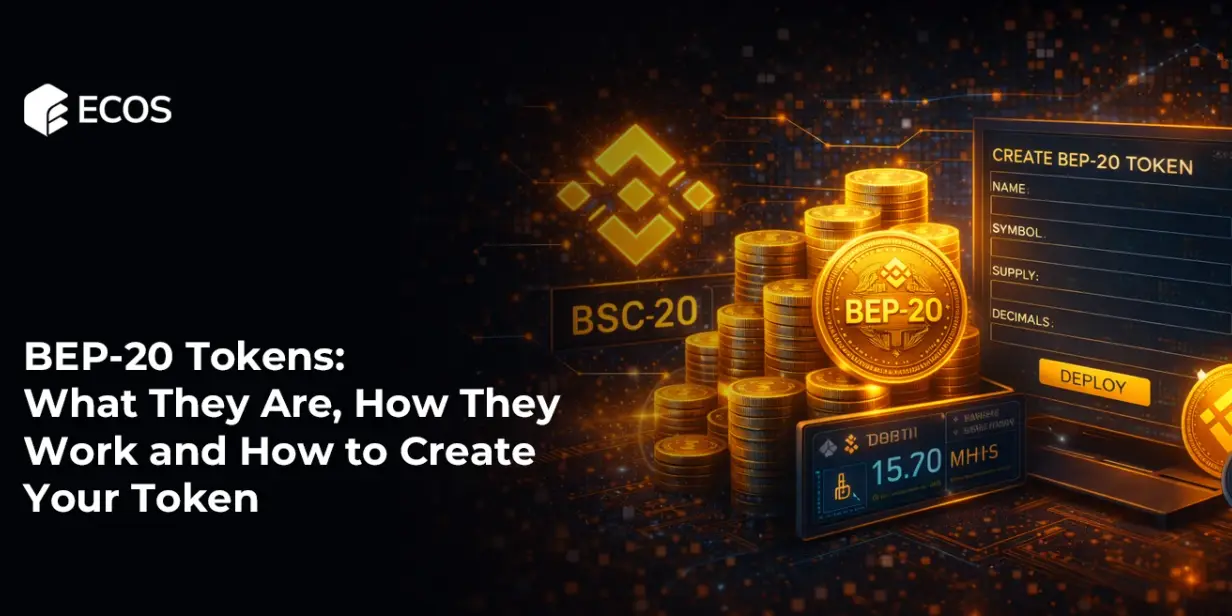
Developers create and use BEP-20 tokens on the Binance Smart Chain network. These assets have long since become an integral part of the modern crypto ecosystem. They offer faster transactions and lower fees compared to ERC20 tokens used on the Ethereum network. Today, more and more users are asking what is BEP20 network and how it differs from other popular token standards.
The emergence of BEP20 was a logical response to congestion on the ERC-20 network, offering a more affordable and faster alternative without losing compatibility with the smart-contract ecosystem. In this article, we will break down what network is BEP20, how tokens of this standard work, how they differ from ERC-20 and Bitcoin, and also answer the question of how to create your own token and what is the cost to create BEP20 token.
What Is the BEP-20 Network?
BEP20 tokens operate on the basis of smart contracts that automatically execute the rules embedded in their code. Thanks to the fact that BSC BEP20 is compatible with the Ethereum Virtual Machine, the logic of how these tokens function is almost identical to ERC-20 tokens, but with significantly lower fees and higher transaction processing speeds.

BEP-20 Definition and Origin
BEP-20 is a technical standard for creating and managing tokens on the Binance Smart Chain (BSC).
The team at Binance developed this standard as an extension of the ideas behind ERC-20. They specifically designed it with the unique features and architecture of BSC in mind. The main goal of the standard is to ensure simple and unified interaction between tokens, wallets, and decentralized applications within the Binance ecosystem.
The emergence of BEP-20 was a logical step in the development of the BSC network. Binance aimed to create a blockchain that would be compatible with the Ethereum Virtual Machine (EVM) while offering lower fees and higher throughput – and it succeeded. Unlike the outdated BEP-2 standard previously used on Binance Chain, BEP-20 supports smart contracts, DeFi protocols, and complex financial scenarios. This made it the foundation for the rapid growth of the BSC ecosystem.
How BEP-20 Tokens Function on Binance Smart Chain (BSC)
Tokens of the bsc BEP20 standard operate on smart contracts that define the rules for token issuance, transfer, and interaction. Each BEP20 token is created as a separate contract containing a set of mandatory functions, including balance checks, transaction approvals, and total supply management.
If we answer the question what network is BEP20, the answer is Binance Smart Chain, which operates in parallel with the main Binance Chain.
BSC uses the Proof of Staked Authority (PoSA) consensus mechanism. This allows the network to confirm transactions faster and at a lower cost than the classic Proof of Work model.
Thanks to EVM compatibility, popular wallets and DeFi protocols easily integrate BEP-20 tokens. Users store, send, and swap these tokens through all major wallets such as MetaMask and Trust Wallet. This compatibility also enables developers to migrate projects from Ethereum to Binance Smart Chain with ease.
Why BEP-20 Became Popular
The main reason behind the growing popularity of BEP20 lies in the successful combination of accessibility and functionality offered by tokens of this standard. At a time when transaction fees on Ethereum increased sharply, developers and users began looking for alternatives. BEP20 provided lower fees, faster transaction confirmations, and full support for smart contracts.
The growth in adoption was also driven by Binance itself, which invested heavily in the development of the BSC ecosystem by supporting DeFi projects, incentivizing users to launch tokens, and encouraging liquidity provision. This led to the emergence of hundreds of popular applications and established bsc BEP20 as the standard of choice for new projects targeting a mass audience. Finally, the simplicity of token creation and the transparent cost to create BEP20 token played a key role. Even small teams and startups gained the ability to launch their own tokens without significant technical or financial barriers.
How BEP-20 Tokens Work
BEP20 tokens operate on smart contracts and fully depend on the infrastructure of Binance Smart Chain. Each token is created as a separate contract that can interact with other applications within the ecosystem. Thanks to the high throughput of the network, bsc BEP20 is widely used in DeFi, GameFi, NFT projects, and payment solutions.
Technical Overview of BEP-20 Tokens
The logic of smart contracts written for BEP20 largely mirrors the architecture of ERC-20.
Each BEP-20 token supports a standard set of core functions. These smart contracts execute automatically without any human involvement or intermediaries.
Network validators handle all transaction processing. All fees are paid in the native BNB token. This makes the what is BEP20 network a significantly cheaper alternative to Ethereum, especially for high-volume transactions.
BEP-20 vs ERC-20: Key Differences
Comparing the BEP-20 and ERC-20 standards is one of the most common questions among developers and network users. Although both standards use a similar architecture, there are fundamental differences between them. The main distinction lies in the underlying network: BEP-20 operates on Binance Smart Chain, while ERC-20 runs on Ethereum. In most cases, BEP-20 transactions are cheaper and confirmed faster.
It is also important to consider that ERC-20 remains the standard for Ethereum-based applications. In contrast, Binance optimized bsc bep20 for scalability and mass adoption. This is why many projects migrate their tokens or launch them directly in the BEP-20 format.
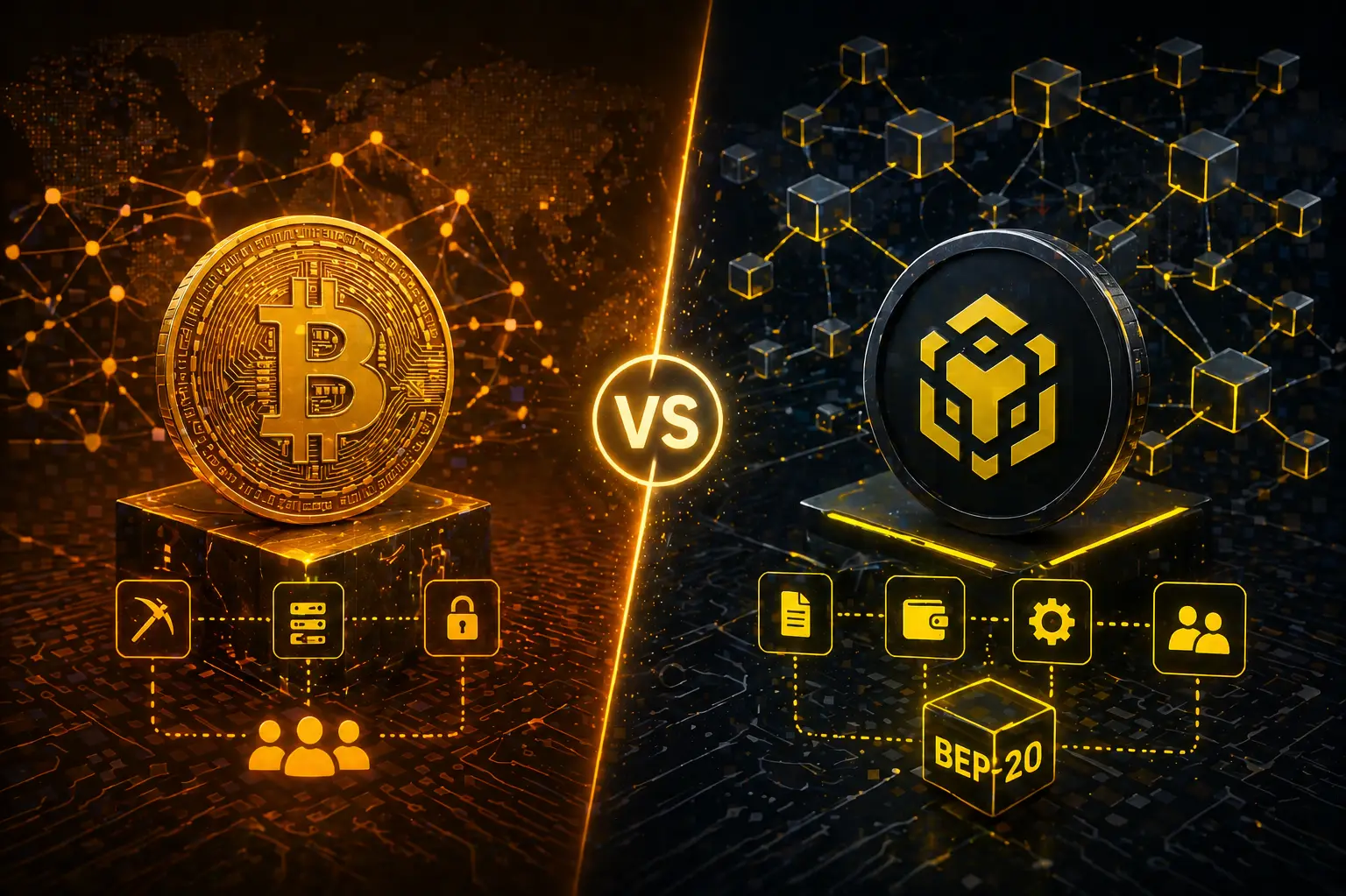
When comparing bitcoin vs bep20, the difference becomes even more obvious. Bitcoin does not use tokens or smart contracts in the conventional sense. Developers built BEP-20 from the ground up as a flexible standard for decentralized applications.
How to Create a BEP-20 Token
Creating your own BEP20 token does not require deep blockchain development expertise, but it does require an understanding of the basic principles of how smart contracts work. The process is largely similar to issuing an ERC-20 token, but it is cheaper and faster to implement.
Step-by-Step Guide to Creating Your BEP-20 Token
The token creation process usually includes several key stages. First, the project concept is defined – the token’s purpose, its role within the ecosystem, and the distribution model. Next, the parameters are selected: the name, ticker, total supply, and number of decimal places. Only after that is the smart contract created and deployed on the BEP-20 token network – Binance Smart Chain. The contract is then tested to ensure it works correctly, and finally the token is published and liquidity is added on an exchange if it is intended for trading.
Tools and Platforms for Token Creation (e.g., Remix, Binance Smart Chain)
To issue BEP20 tokens, developers most often use tools that are accessible to everyone. For example, Remix IDE allows users to write and compile smart contracts directly in the browser, while Binance Smart Chain provides the infrastructure needed to deploy them.
As a result, the modern market offers a wide range of solutions that make token creation possible even without specialized technical knowledge. Essentially, to interact with the network, a user only needs a crypto wallet that supports bsc BEP20. This approach makes the process accessible both for startups and for individual developers.
Coding Your BEP-20 Smart Contract
A smart contract is the foundation of any BEP-20 token.
The code defines the rules for token issuance, transfers, and additional functions such as burning or freezing funds. Most contracts are written in Solidity and rely on well-tested templates to reduce the risk of errors. It is important to remember that once a contract is deployed, it becomes immutable. Therefore, before launch, it is strongly recommended to conduct a code audit and thorough testing on a test network.
Costs to Create a BEP-20 Token
One of the key factors behind the popularity of BEP20 is the low entry barrier for developers. Unlike Ethereum, where fees can be unpredictably high, the BSC network offers more stable and affordable costs.
The basic cost to create BEP20 token includes paying gas fees for deploying a smart contract. In most cases, this amounts to just a few dollars in BNB equivalent, depending on the complexity of the code and current network load. For a simple token without additional features, expenses remain minimal.
Additional costs may arise when using third-party tools, ordering a security audit, or hiring developers. For commercial projects, audits and logic improvements often become the main expense item, while the technical token launch itself remains accessible even for small teams.
BEP-20 vs Bitcoin
One of the key factors behind the popularity of BEP20 is the low entry barrier for developers. Unlike Ethereum, where fees can be unpredictably high, the BSC network offers more stable and affordable costs.
The base cost to create BEP20 token includes paying gas fees for deploying a smart contract. In most cases, this amounts to just a few dollars in BNB, depending on the complexity of the code and current network load. For a simple token without additional features, the costs remain minimal.
Additional expenses may arise when using third-party tools, ordering a security audit, or hiring developers. For commercial projects, audits and custom logic development often become the main cost drivers, while the technical deployment of tokens itself remains accessible even for small teams.
Popular BEP-20 Tokens
Over several years, the Binance Smart Chain ecosystem has built its own set of flagship projects. Traders and DeFi developers actively use these projects in decentralized applications. Thanks to low fees and high network speed, developers often launch new projects in the BEP-20 format from the very start.
One well-known example is BNB, the native token of the Binance ecosystem. Users spend BNB to pay fees, participate in staking, and take part in protocol governance. Although BNB is not a classic user-issued token, it plays a key role in the operation of the bsc bep20 ecosystem.
But which tokens are popular within this ecosystem? PancakeSwap tokens are a major example, as they are used for protocol governance, farming, and staking. This case clearly demonstrates what is BEP20 network in practice: fast transactions, low operational costs, and active interaction with decentralized applications.
Stablecoins such as USDT and USDC are also issued in the BEP-20 standard, making the network convenient for transfers and trading. For users, this means access to familiar assets with significantly lower fees. The popularity of these projects confirms that the BEP-20 standard has become a full-fledged alternative to ERC-20 and has secured an important place in the modern crypto infrastructure.
Benefits of BEP-20 Tokens
The main advantage of BEP20 lies in its practicality and focus on mass adoption. This standard was originally designed as a more accessible alternative to ERC-20, which largely explains its widespread use.
One of the key benefits is low transaction costs. Within the bsc BEP20 ecosystem, fees remain stable even during periods of high network activity, making these tokens convenient for frequent transactions, micropayments, and DeFi protocols. This is especially important for projects that rely on active user interaction.
Another major advantage is high transaction speed. Operations involving BEP-20 tokens are confirmed faster than on most first-generation blockchains. This improves the overall user experience and reduces risks associated with delays and slippage during trading.
Compatibility with the Ethereum ecosystem is also worth highlighting. Thanks to EVM support, developers can relatively easily migrate existing projects, which strengthens what is BEP20 network as a universal platform for launching tokens and decentralized applications.
An additional benefit is the flexibility of the standard. BEP-20 tokens can be used for protocol governance, staking, farming, gaming mechanics, and payments. This versatility is what makes BEP-20 attractive both to startups and to large-scale projects.
Risks and Considerations of BEP-20 Tokens
Despite the obvious advantages, the use of BEP20 tokens is associated with a number of risks that are important for both investors and developers to consider.
One of the key factors is the level of network decentralization. Although bsc BEP20 offers high performance, the number of validators on the network is smaller compared to Ethereum or Bitcoin. This raises ongoing discussions about potential centralization and its impact on the long-term resilience of the network.
In addition, any mistake in token or protocol code can lead to vulnerabilities, exploits, or loss of funds. Since the BEP20 network is widely used for DeFi applications, smart contract audits become a critically important element of security.
It is also worth considering the large number of low-quality or fraudulent projects. The ease of token creation and the low cost to create BEP20 token have led to the rapid growth of speculative assets with no real underlying value. Users should independently evaluate projects, analyze tokenomics, and research the development team before interacting with such tokens.
Finally, there is the risk of compatibility issues and errors when transferring tokens between networks. Sending BEP-20 tokens to addresses that do not support this standard can result in permanent loss of funds. For this reason, understanding what network is BEP20 is essential for safe and responsible use.
The Future of BEP-20 and BSC
The future of BEP-20 tokens is directly tied to the development of the entire BSC ecosystem. Over the past few years, the network has established itself as one of the key platforms for DeFi, GameFi, and Web3 projects, with the BEP-20 standard serving as its foundation.
The Binance team continues to work on improving network throughput, reducing latency, and optimizing fees. This further strengthens the position of bsc BEP20 as a solution for mass adoption, especially for projects with a high volume of transactions.
Institutional interest is also expected to grow.
As infrastructure becomes more standardized, security requirements continue to increase. Because of this, bep20 is increasingly being considered as a base layer for corporate and payment solutions. This may lead to the emergence of new regulated products and higher-quality tokens within the ecosystem.
In the long term, more than just low transaction fees will define what is bep20 network. The ecosystem’s success will depend on the actual quality of its protocols and audited smart contracts.
Developers must also build sustainable business models to ensure growth. This shift toward maturity will determine the network’s lasting impact on the Web3 space.
The ecosystem’s success will depend on its ability to offer high-quality services and sustainable growth.
Real maturity comes from robust protocols and audited smart contracts. Additionally, projects must build sustainable business models to survive market shifts.
The maturity of the ecosystem will depend on robust protocols, audited smart contracts, and sustainable business models. These factors will ultimately shape trust among users and investors.
Conclusion
BEP20 tokens have become an important part of the modern crypto infrastructure. They offer developers a flexible and accessible tool for launching projects, while providing users with fast and low-cost transactions.
Understanding what is bep20 network and how these tokens work is essential. Knowing the costs to create them and the associated risks allows users to make more informed decisions.
BEP-20 does not replace Bitcoin or Ethereum. Instead, it successfully complements the market. It offers a great alternative for scalable decentralized applications.
As BSC continues to develop, the overall quality of projects will improve. The bep20 standard is likely to remain relevant. It will continue to be one of the key building blocks of the Web3 ecosystem.
Published Articles
 Popular
Bitcoin Pizza Guy: The Story Behind the First Real Bitcoin Purchase
Introduction The history of Bitcoin is full of dramatic ups and downs,...
 Popular
The Meme Economy: How Internet Humor Shapes Culture, Markets, and Crypto
Introduction Ten years ago, the idea that a picture of a dog...
 Popular
What is the Omniverse? Exploring the Ultimate Multiversal Concept
Introduction Do you know what the omniverse is? Is this concept real?...
Bitcoin Taproot Explained: What the Upgrade Means for BTC
Introduction Unfortunately, the most popular cryptocurrency today – Bitcoin – was not...

Crypto On-Ramps and Off-Ramps Explained: How Fiat and Crypto Move In and Out
Entering the world of digital assets often feels like trying to cross...
Crypto Basics Explained: A Beginner’s Guide to Cryptocurrency and Trading
Introduction The world of finance is changing right before our eyes. Just...