
Crypto On-Ramps and Off-Ramps Explained: How Fiat and Crypto Move In and Out
Entering the world of digital assets often feels like trying to cross a deep canyon. On one side, you have the familiar landscape of traditional finance: bank accounts, plastic cards, and government-issued cash. On the other side lies the vast, decentralized universe of blockchain, governed by smart contracts, cryptographic tokens, and immutable ledgers. For most people, moving between these two worlds is the most challenging part of their journey. To bridge this gap, users rely on specialized financial infrastructure known as on ramp off ramp crypto solutions.
Understanding these mechanisms is not just a technical necessity; it is a critical skill for any modern investor. Whether you are a newcomer buying your very first fraction of a Bitcoin or a seasoned institutional trader looking to lock in significant profits in dollars, you will inevitably interact with these gateways. The efficiency of these “ramps” determines how much you pay in fees, how quickly you can react to market volatility, and how securely your personal data is handled. In this comprehensive guide, we will break down the entire infrastructure of on and off ramp crypto, helping you choose the most efficient path for your capital.
Introduction
The global financial system is currently in the middle of a historic transformation. Traditional finance (TradFi) and decentralized finance (DeFi) have long existed as parallel ecosystems, each with its own advantages and barriers. While TradFi offers stability and legal protection, DeFi provides transparency, speed, and 24/7 accessibility. The main barrier to the mass adoption of blockchain technology has always been the “complexity of the first mile”—the difficulty of turning a regular paycheck into a digital asset without facing extreme technical hurdles or security risks.
This is precisely where fiat on ramp and off ramp crypto services play their vital role. They act as the primary gateways of the new economy, providing the liquidity and conversion layers necessary for these two systems to interact. Without a high-quality “on-ramp,” the crypto world remains an isolated playground for tech experts. Conversely, without a reliable “off-ramp,” digital assets would lack real-world utility, as users would be unable to convert their gains back into the currency they use to pay for housing, taxes, and daily essentials. These services are the essential plumbing of modern finance, and as they evolve, the line between “digital” and “traditional” money is becoming increasingly blurred.
What Is a Crypto On-Ramp?
In the simplest terms, a crypto on-ramp is an entry point. It is any service, platform, or piece of software that allows a user to exchange traditional, government-issued (fiat) money for digital assets. Think of it as an international currency exchange, but instead of swapping dollars for euros, you are swapping fiat for programmable value on a blockchain.
Fiat to Crypto On-Ramp Definition
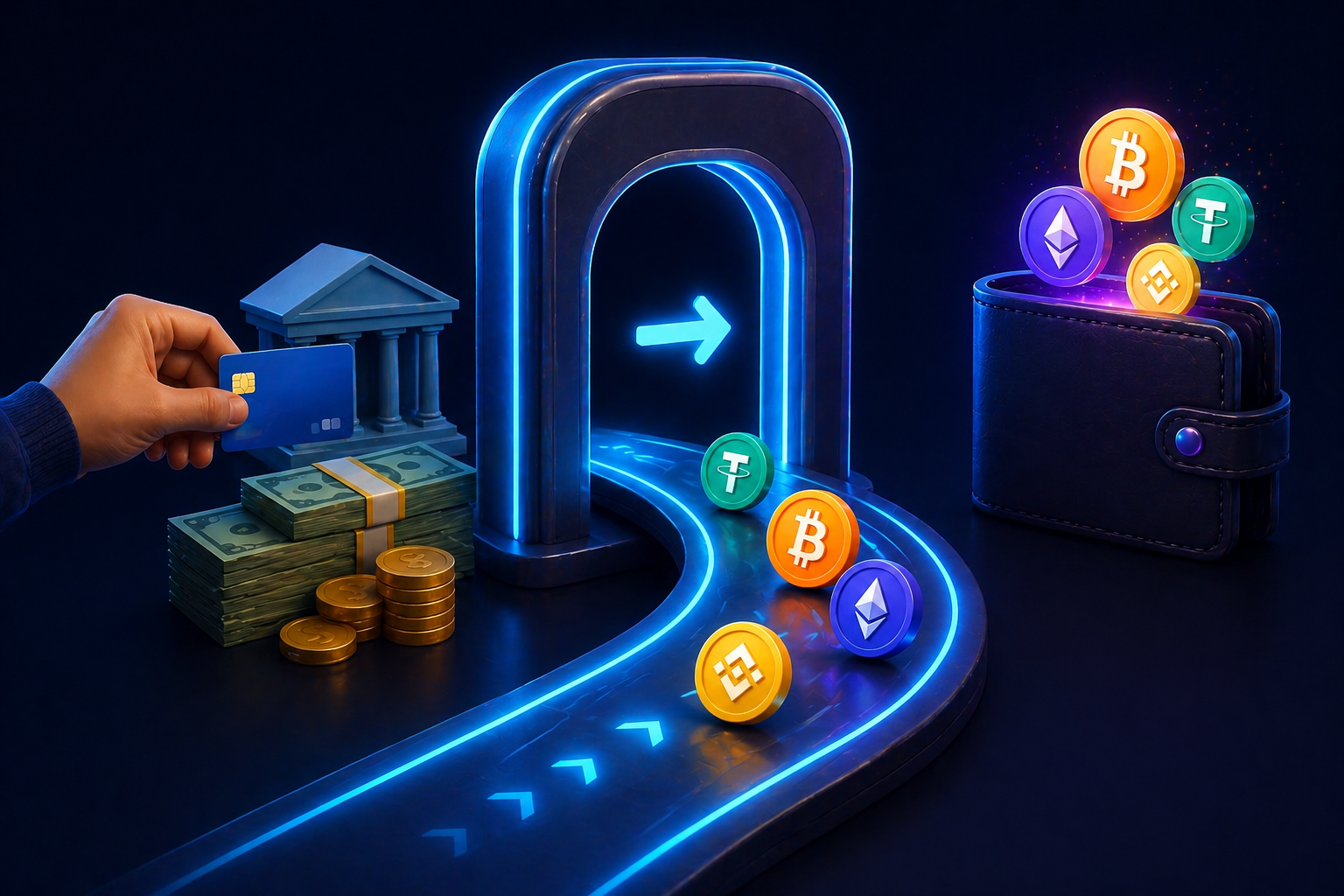
A fiat to crypto on ramp is a technological bridge that acts as a secure intermediary between the legacy banking system and the decentralized blockchain ecosystem. When you use your credit card to buy Solana, or transfer funds from your bank via a mobile app to purchase Ethereum, you are utilizing an entry ramp. This infrastructure is the foundation of the entire industry. The more seamless, regulated, and user-friendly these fiat onramp solutions become, the faster the global population can transition into the digital economy.
How Fiat On-Ramps Work
The process behind a fiat on ramp crypto solution involves a sophisticated coordination between traditional banking rails and blockchain protocols. While the user interface might look simple, the backend usually follows these critical stages:
- Initiation: The user selects the fiat currency they want to spend (e.g., USD, EUR, GBP) and the digital asset they wish to receive.
- Verification and Compliance (KYC): Because these services handle real-world money, they must comply with strict Anti-Money Laundering (AML) and Know Your Customer (KYC) regulations. This typically involves submitting a government ID and potentially a “liveness” check through a selfie.
- Payment Processing: The provider accepts the fiat funds through various channels, such as bank wires (ACH/SEPA), debit/credit cards, or digital wallets like Apple Pay.
- Execution: The provider secures the requested cryptocurrency from its own liquidity pools or an external exchange at the agreed-upon rate.
- Asset Delivery: Once the payment is confirmed, the provider broadcasts a transaction on the blockchain, sending the tokens directly to the user’s non-custodial wallet or their exchange account.
Examples of Popular Crypto On-Ramp Services
The on ramp crypto market is highly competitive, with providers constantly innovating to offer lower fees and faster processing times. Popular examples include:
- Centralized Exchanges (CEX): Giants like Coinbase, Kraken, and Binance serve as the most common entry points, offering high liquidity and support for a vast range of fiat currencies.
- Payment Widgets: Services like MoonPay, Banxa, and Transak are often integrated directly into wallets like MetaMask or Phantom. They allow users to fiat onramp without ever leaving their favorite dApp.
- P2P Marketplaces: Platforms like Paxful or local exchange desks allow users to buy crypto directly from other individuals, with the platform acting as a trusted escrow to ensure the safety of the trade.
What Is a Crypto Off-Ramp?
If the on-ramp is the front door to the world of digital finance, then the off-ramp crypto is your strategic exit. No matter how much a user believes in the future of blockchain, there will always be a need to move value back into the traditional system to meet real-world obligations.
Off-Ramp Crypto Definition
A crypto offramp is the process of converting digital assets back into fiat money. It is the bridge that allows you to take the wealth you have accumulated in a decentralized network and return it to the traditional banking system. This is crucial for maintaining the “circularity” of the economy—knowing you can easily “exit” into fiat gives users the confidence to “enter” in the first place.
How Crypto Off-Ramps Convert to Fiat
The crypto off-ramp process essentially mirrors the on-ramp experience in reverse. A user sends their cryptocurrency to a service provider’s address. The provider then liquidates that asset on the market and converts it into the user’s chosen fiat currency. After passing necessary fraud and security checks, the funds are sent to the user’s bank account or linked debit card. Modern fiat off ramp crypto solutions have become so fast that funds can often reach a bank account within minutes via instant payment rails like Visa Direct.
Where Crypto Off-Ramps Are Used
The need for a reliable crypto offramp arises in several essential scenarios:
- Realizing Investment Profits: When an asset’s price hits a target, traders use an off-ramp to secure their gains in stable fiat currency.
- Corporate Operations: Crypto-native companies often receive revenue in stablecoins but must use off-ramp crypto services to pay for legal fees, office rent, and employee salaries in local currency.
- Global Remittances: People sending money across borders often use crypto as a fast transport layer, utilizing an off-ramp at the destination to provide the recipient with local spendable cash.
On-Ramp vs Off-Ramp in Crypto
When analyzing on ramp vs off ramp, it is important to understand that while they share the same goal—interoperability—they face different challenges. On-ramps are the engines of growth, focusing on “onboarding” and user acquisition. They are often optimized for mobile experiences and instant card purchases to make the fiat to crypto on ramp as frictionless as possible.
In contrast, off-ramp crypto solutions are the engines of trust. They require deeper integration with the legacy banking system and often face more rigorous scrutiny from traditional banks. While an on-ramp focuses on getting your money *into* the blockchain, an off-ramp focuses on ensuring your money safely *returns* to your bank account without being flagged or blocked. Both are necessary to maintain the overall liquidity and health of the digital asset market.
Fiat On-Ramp Crypto Solutions
The industry for fiat on ramp crypto has matured significantly, moving away from “gray market” transactions to fully licensed financial services. Today, the choice of a solution depends on the balance between cost, speed, and privacy.
Bank Transfers, Cards, and Payment Apps
The most common methods for a fiat onramp offer different trade-offs:
- Debit and Credit Cards: This is the fastest method, offering near-instant delivery of assets. However, it often comes with higher fees (3-5%) and stricter limits from card issuers.
- Bank Transfers (ACH/SEPA/SWIFT): These are the best choice for moving large sums of money. While they may take 1-3 days to settle, the fees for this on ramp crypto method are often the lowest in the industry.
- Mobile Payment Apps: Integration with Apple Pay and Google Pay has revolutionized the fiat on ramp crypto experience, allowing users to authenticate purchases with biometrics in seconds.
Fiat Onramp Crypto Providers
Specialized fiat onramp crypto providers like Wyre or Simplex focus on the compliance and “middleman” layer. They allow wallets and dApps to offer crypto purchases without having to become a licensed money transmitter themselves. This modularity has led to a massive explosion in the number of places where users can start their crypto journey.
Fees, Limits, and Processing Times
Every fiat onramp crypto solution has a different fee structure. Users should look out for “hidden” costs, such as the spread—the difference between the market price and the price offered by the provider. Additionally, limits are usually determined by the user’s KYC level; the more information you provide, the higher your daily and monthly limits become. (Alt-tag: Fees, Limits, and Processing Times)
Fiat Off-Ramp Crypto Solutions
For many years, “cashing out” was the hardest part of being a crypto investor. Today, fiat off ramp crypto solutions have become as streamlined as any traditional fintech app.

Withdrawing Crypto to Bank Accounts
Modern crypto off-ramp platforms now utilize real-time payment networks. In the US, this means integration with the FedNow or RTP networks, while in Europe, SEPA Instant is the standard. This has reduced the time it takes to see your “crypto profits” in your bank account from days to seconds.
Fiat Off Ramp Crypto Platforms
Choosing the right fiat off ramp crypto platform is a matter of geography and supported currencies. Some platforms specialize in “crypto-to-card” services, where you sell your crypto and the balance is immediately available on a physical or virtual Visa card for spending.
Compliance, KYC, and Regulations
Regulatory compliance is the backbone of any fiat off ramp crypto service. Because the flow of funds moves from the “unregulated” blockchain to the “regulated” banking sector, providers must be extremely diligent. This transparency is actually a benefit for the user, as it ensures that the crypto offramp process remains legal and tax-compliant. (Alt-tag: Compliance, KYC, and Regulations)
Crypto On and Off Ramp Providers
The crypto on off ramp ecosystem is now a multibillion-dollar industry. We are seeing a trend toward “aggregators”—platforms that don’t provide the ramp themselves but instead connect to 10-20 different providers to find the user the absolute best exchange rate and lowest fee at that specific moment. When selecting a crypto on off ramp partner, always check their licensing in your specific jurisdiction to ensure your funds are protected by local laws.
Risks and Considerations
Despite the advancements, using on ramp off ramp crypto systems still involves risks that every user must manage:
- Slippage and Volatility: The price of crypto can change significantly in the minutes it takes for a bank transfer to clear.
- Security of Personal Data: Providing passports and IDs for KYC means you must trust the provider’s data security protocols.
- Irreversibility: Unlike a bank transfer, a blockchain transaction cannot be “undone.” If you provide the wrong address during an off-ramp crypto process, the funds may be lost forever.
On and Off Ramps in Web3 and DeFi
The most exciting development in the on and off ramp crypto space is its integration into Web3. In the past, the user journey was fragmented. Today, on ramp off ramp crypto solutions are becoming “invisible.” They are embedded directly into NFT marketplaces, decentralized exchanges (DEXs), and even blockchain games. A user can now mint an NFT using their credit card without ever knowing they are interacting with an on ramp crypto provider. This “abstraction” of the technical layer is what will ultimately lead to the next billion users entering the space.
Future of Crypto On-Ramps and Off-Ramps
Looking ahead, the fiat onramp crypto industry is moving toward even tighter integration with traditional banking. We expect to see the rise of Central Bank Digital Currencies (CBDCs), which may serve as a “native” fiat on-ramp that doesn’t require a middleman. Additionally, decentralized identity (DID) will allow users to pass KYC once and use that “identity token” across all on ramp off ramp crypto providers, eliminating the need to upload documents repeatedly. The “ramp” of the future won’t feel like a bridge; it will feel like a single, unified financial system.
Conclusion
The infrastructure of on ramp off ramp crypto is the foundation upon which the future of finance is being built. By understanding how these gateways function, you gain the ability to navigate the digital economy with confidence and efficiency.
You might be using a fiat on-ramp to build your portfolio or a crypto off-ramp to enjoy your gains. In either case, choosing the right partner is key to your success. A reliable partner ensures a successful and smooth experience. As these technologies continue to evolve, the transition between fiat and crypto will become seamless. We may eventually stop calling them “ramps” and simply call them “money.”
Published Articles
 Popular
Bitcoin Pizza Guy: The Story Behind the First Real Bitcoin Purchase
Introduction The history of Bitcoin is full of dramatic ups and downs,...
 Popular
The Meme Economy: How Internet Humor Shapes Culture, Markets, and Crypto
Introduction Ten years ago, the idea that a picture of a dog...
 Popular
What is the Omniverse? Exploring the Ultimate Multiversal Concept
Introduction Do you know what the omniverse is? Is this concept real?...
Bitcoin Taproot Explained: What the Upgrade Means for BTC
Introduction Unfortunately, the most popular cryptocurrency today – Bitcoin – was not...

Crypto Basics Explained: A Beginner’s Guide to Cryptocurrency and Trading
Introduction The world of finance is changing right before our eyes. Just...
 Popular
Uniswap Explained: What It Is, How It Works, and How to Use the UNI DEX
Introduction Decentralization and decentralized platforms that have emerged in recent years have...