
Bitcoin Lightning Network Explained: What It Is and How Bitcoin Lightning Works
Introduction
In the world of cryptocurrency, transaction speed and costs have always been a major bottleneck. If you have ever tried to send a small amount of BTC only to pay a $5–$10 fee while waiting 20 minutes for a confirmation, you understand the problem. This is exactly where the bitcoin lightning network enters the scene.
What Is the Bitcoin Lightning Network?
To put it simply, what is bitcoin lightning — it is a “Layer 2” technological solution built on top of the main Bitcoin blockchain. Its primary goal is to provide instant and nearly free payments without congesting the main network.
Imagine the main blockchain is a courtroom where every significant transaction is recorded. It is secure, but slow and expensive. In turn, bitcoin lightning is like a notepad where you record small expenses with a friend at a cafe over a month, and only bring the final balance to the “court” (the blockchain) at the end of the period.
When exploring what is the lightning network, it is crucial to understand that it does not replace Bitcoin; it extends its capabilities. It transforms BTC from “digital gold” sitting in a wallet into a real medium of exchange for buying coffee or paying for online subscriptions.
Why is this important right now?
Many beginners ask: how does bitcoin lightning work, and why do we need it if we already have credit cards? The answer lies in decentralization. Unlike Visa or Mastercard, there is no central authority that can block your payment. At the same time, the speed is comparable: transactions are settled in milliseconds.
Why Lightning instead of fast altcoins (e.g., TRON)?
Many ask: “Why complicate the system with a second layer if we can just use TRON (TRX), where transactions already cost less than a dollar and settle in seconds?” The answer lies in the so-called “Blockchain Trilemma,” which forces a choice between speed, security, and decentralization.
Security and Reliability:
The Lightning Network is not a separate coin; it is Bitcoin. When you use Lightning, your funds are protected by the hashing power of the entire Bitcoin network (Proof-of-Work), which is the most secure computer network in the world. TRON uses a Delegated Proof of Stake (DPoS) system where the network is managed by a limited number of validators. It is faster, but less resistant to censorship or attacks.
Decentralization:
Anyone can run a Bitcoin node on an old laptop or a Raspberry Pi. This ensures that no one can block your wallet. Fast networks like TRON require powerful server-grade hardware for nodes, which inevitably leads to centralization concerns — the network ends up being controlled by large corporations or pools that form near-cartels.
Liquidity and “Digital Gold” Status:
Bitcoin is the most recognized and liquid asset. For merchants (sellers), it is more profitable to accept payments in BTC, which has a capped supply of 21 million coins, than in altcoins with uncertain or high inflation. Lightning allows you to spend “gold” at the speed of “plastic” without swapping it for other, less reliable tokens. The 2026 crypto market crash showed that altcoins can lose 80% of their value in seconds, while Bitcoin dropped only 15-20% and quickly recovered.
Cost of Micro-payments:
Surprisingly, in 2026, Lightning is proving to be even cheaper than TRON. On TRON, a transaction costs about $1–$2 (depending on energy/bandwidth), which is too much for a cup of coffee. In Lightning, fees for micro-transactions often amount to fractions of a cent (a few satoshis), making it the only real solution for mass micro-payments.
How Bitcoin Lightning Works
To understand how bitcoin lightning works, one must grasp the concept of payment channels. The principle is somewhat counterintuitive, and even users familiar with crypto payments may not immediately understand the mechanics.
Imagine two people – let’s call them Alice and John – who frequently transfer money to each other. Instead of recording every single transfer on the main blockchain (which is slow and expensive), they open a payment channel between themselves. The process consists of several key steps:
Opening a Channel
They create a shared wallet on the main Bitcoin network and deposit a certain amount of funds into it. This transaction is recorded on the blockchain. It is as if the network says: “I don’t care how you move this specific amount between yourselves; I only care that the total amount of money in the main network remains exactly as intended.” Regardless of what happens inside the channel, the priority is that money cannot vanish from the global system, nor can new coins be created out of thin air.
Off-Chain Transactions
Once Alice and John have established their channel, they can exchange messages to transfer funds within that channel as many times as they like. These off-chain transactions occur instantly and do not require any miner fees.
Final Settlement on the Bitcoin Blockchain
When the two parties decide to settle their business, they close the channel. At this moment, only the final balance of all their transactions is recorded on the main blockchain.
To simplify it, off-chain transactions are like saying “put it on my tab” at a bar where you are a regular—or more accurately in our case, “deduct it from my tab.” It is as if you pre-funded your favorite bar with a couple of hundred dollars and then simply spent that deposit over time. In this scenario, you wouldn’t need to carry cash or a card every time, and you wouldn’t be bothered by a lack of change at the register or a broken card terminal.
You would also only pay a payment system fee once when transferring the deposit to the bartender. The next time you drop by for a pack of gum and a soda, you wouldn’t have to pay a fifty-cent fee on a one-dollar purchase. No matter how many times you visited the bar—ten times a day or twice a month—your bank would only see one final, consolidated transaction.
Scalability Through Nodes
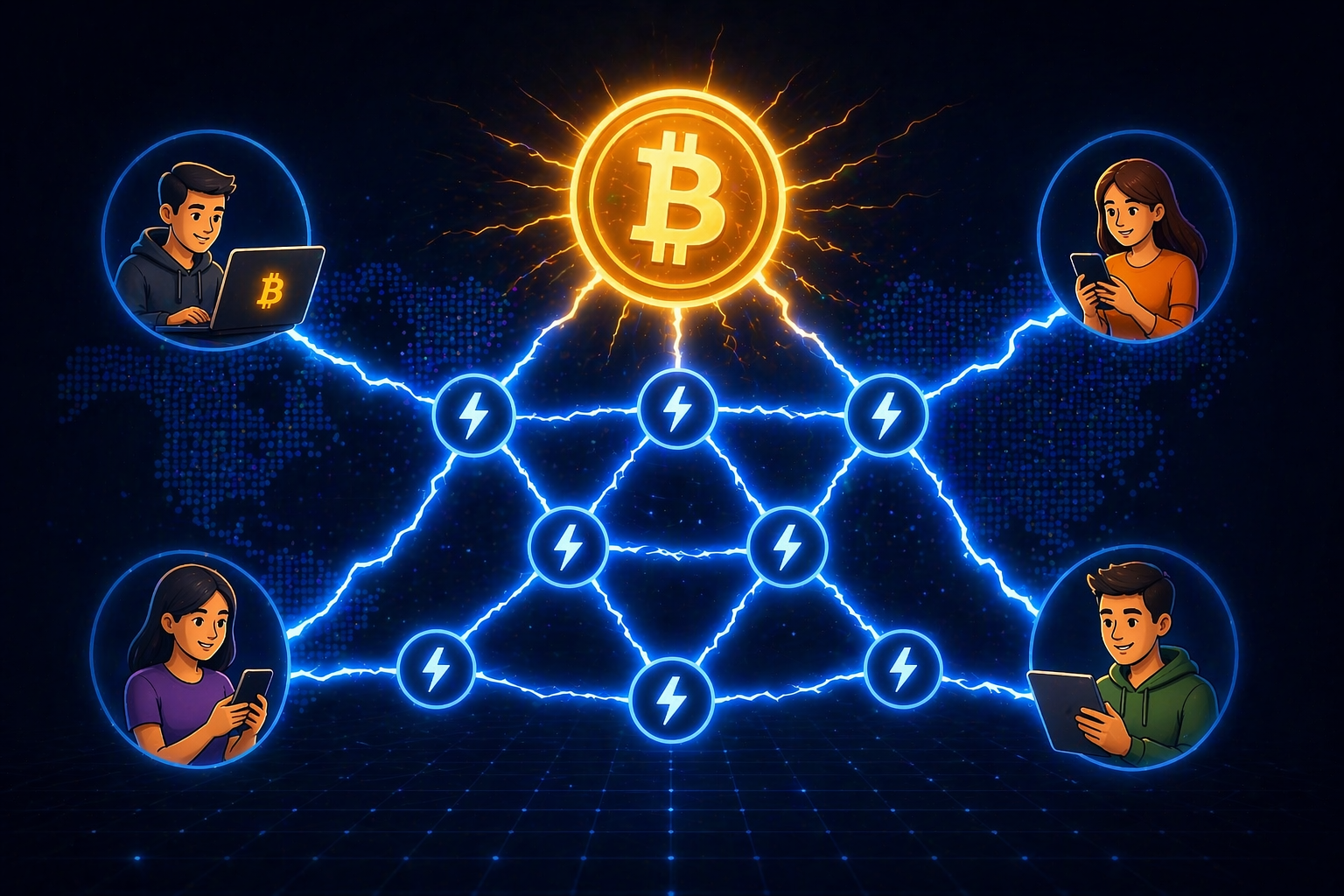
But what if Alice needs to pay a third party—let’s call him Charlie—with whom she has no direct channel? This is where the power of lightning network nodes comes into play. The system automatically finds a route through intermediaries (for example, through Bob, who has an open channel with Charlie). The funds move along the chain, but thanks to smart contracts, none of the intermediaries can steal the money.
This structure transforms Bitcoin into a global web. The more lightning network channels that appear, the more interconnected and faster the entire ecosystem becomes. This solves the core issue of bitcoin scalability, allowing the network to process millions of transactions per second, even surpassing traditional payment systems like Visa.
Benefits of the Lightning Network
The primary advantage provided by the bitcoin lightning network is the ability to conduct micro-transactions.
In the main Bitcoin network, it is practically impossible to send 10 cents because the transaction fee would be many times higher than the amount itself. In Lightning, fees are fractions of a cent, paving the way for a new economy: for instance, paying for each page of an article you read or for every minute of a video you watch.
Bitcoin Lightning Wallets
To start using the network, you will need a dedicated lightning wallet. These are generally divided into two types:
- Custodial: (e.g., Wallet of Satoshi) — These are as simple as a banking app, where the service provider manages the private keys for you.
- Non-custodial: (e.g., Phoenix or Muun) — These allow you to maintain full control over your funds and private keys.
Using these apps makes bitcoin payments as easy as scanning a QR code. The transaction is settled instantly, confirmed by a notification sound on your phone, much like using Apple Pay.
Real-World Use Cases of Bitcoin Lightning
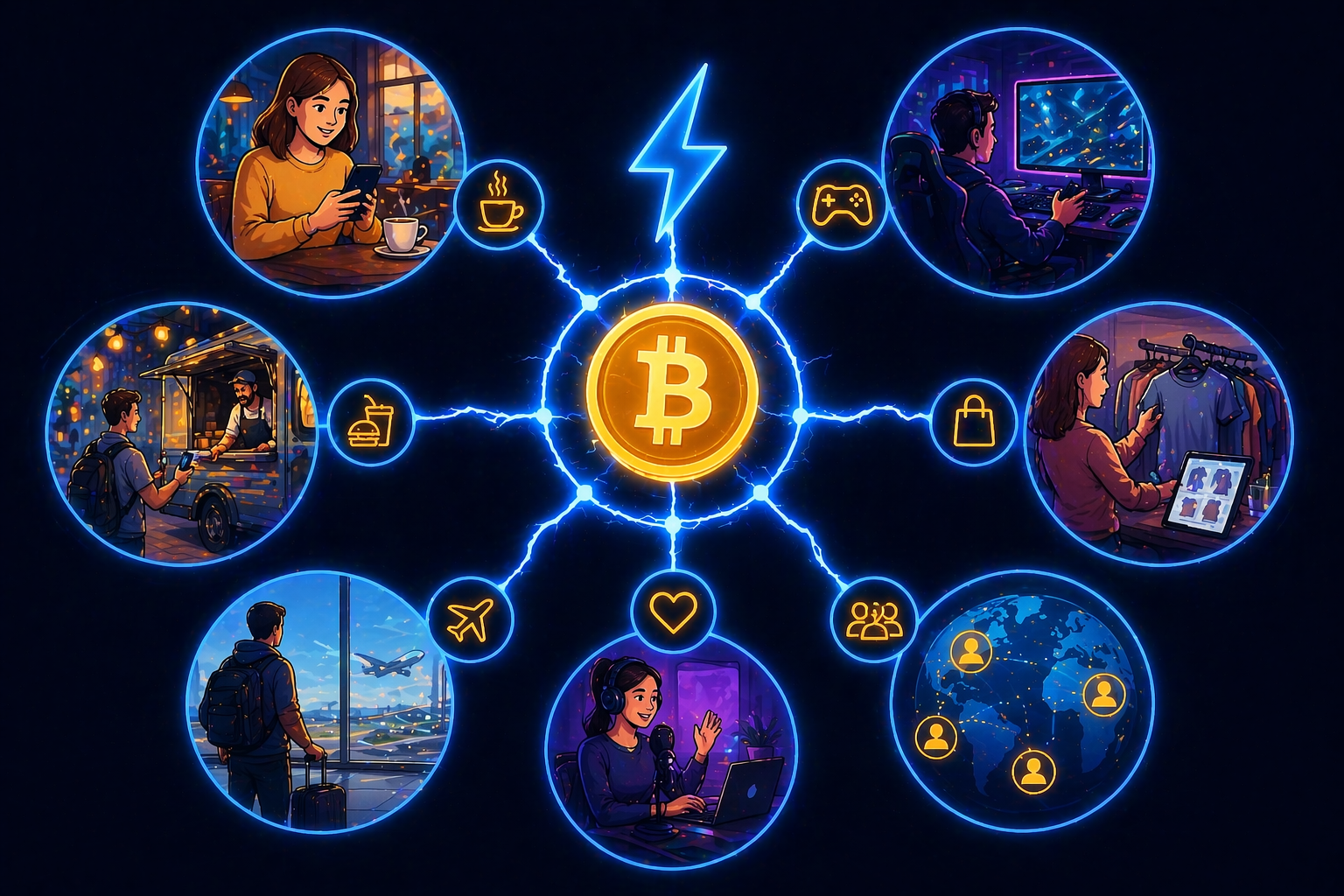
Today, lightning network adoption is in full swing. Regardless of one’s perspective, Bitcoin remains the premier and most reliable cryptocurrency. While the base layer may be cumbersome for daily tasks, the Lightning Network makes it significantly more practical and user-friendly. Currently, the technology is already being utilized across a wide range of sectors:
Offline Retail and the El Salvador Experience
El Salvador serves as one of the most vivid examples of theory meeting practice. In 2021, the country made history by officially recognizing Bitcoin as legal tender. However, using the main blockchain to purchase a cup of coffee or settle a supermarket bill would have been practically impossible due to high transaction fees and the lengthy wait times for block confirmations.
This is precisely why lightning network adoption became the cornerstone of this financial reform. In El Salvador, retail settlements occur instantaneously:
- For the Consumer: The process is as seamless as using Apple Pay. You scan a QR code at the checkout using your lightning wallet, and within a second, the payment is confirmed.
- For Business: Store owners—ranging from major global chains like McDonald’s and Starbucks to small local stalls on the coast of El Zonte—receive funds without the need to sacrifice 2–3% in commissions to payment processors. This makes bitcoin payments more economically advantageous than the traditional acceptance of credit cards.
The Salvadoran experience has proven that the lightning network is capable of handling the transaction load of an entire nation, facilitating millions of micro-transactions on a daily basis. This case study has become a global “sandbox,” demonstrating that Bitcoin can function not only as a store of value but as a functional, everyday currency in a common grocery store.
Microtransactions and Streaming Payments: The Attention Economy
The Lightning Network has sparked a genuine revolution in how content creators are rewarded by their audiences. Traditional payment systems—such as credit cards or PayPal—make it virtually impossible to send a creator 5 or 10 cents, as fixed transaction fees would swallow the lion’s share of the amount. With bitcoin lightning, this friction has vanished, making micro-payments a reality.
- Streaming Platforms and Twitch: Gamers and streamers are now integrating specialized extensions that allow viewers to send “satoshis” (the smallest units of Bitcoin) instantly during a live broadcast. This enables a unique micro-transactions mechanic where a viewer can tip a creator just a few cents for a clever joke or an impressive play in real-time.
- Podcasting 2.0 (Value4Value): A new wave of podcasting apps, such as Fountain or Breez, is emerging based on the “Value-for-Value” model. Listeners can configure an automatic stream of satoshis for every minute of audio consumed. If you enjoy the podcast, you pay; if you turn it off after five minutes, you have only paid for those five minutes.
- Donations Without Borders: Because the lightning network is decentralized, creators can receive financial support from anywhere in the world. This is a game-changer for authors in countries where traditional payment services are restricted or simply do not operate.
This approach is fundamentally reshaping internet marketing. Instead of relying on intrusive advertising, creators can depend directly on their audience’s support through lightning network channels, receiving micro-payments in real time.
A prime example of this is found in the decentralized social network Nostr (and through the Primal app), which features a function called “Zaps”:
- How it works: Under every post, instead of a traditional “like” button, there is a lightning bolt icon. By clicking it, you send the author 10, 50, or 100 satoshis (amounting to just a few cents).
- The Result: This has birthed a vibrant micro-economy for content. Authors earn real money for short notes or memes without the need for ads or the fear of censorship.
The system is very similar to “Telegram Stars,” where you can reward a post’s author with a single click using an internal currency. However, in this case, the creator doesn’t receive abstract “stars”—they receive actual Bitcoin, the world’s most pristine collateral.
Merchant Adoption and Global Payments
By 2026, lightning network adoption has transitioned from an experimental phase into a “must-have” tool for modern business. Investors no longer treat Bitcoin solely as ‘digital gold’ stashed in a vault. Instead, it has evolved into an active medium of exchange, standing shoulder-to-shoulder with stablecoins in the global marketplace.
Why Businesses Are Choosing bitcoin Lightning network
For merchants, switching to bitcoin payments via the Lightning Network offers three fundamental advantages over traditional credit card processing:
- Instant Settlement: Unlike bank transfers or card payments that can remain ‘pending’ for days, a Lightning transaction settles and finalizes in seconds.
- Drastic Fee Reduction: Traditional merchant services typically take a 2–3% cut of every sale. Utilizing the lightning network slashes these overhead costs to well below 1%, which is a game-changer for small businesses and high-volume retail.
- Elimination of Chargebacks: Bitcoin transactions are irreversible. This protects sellers from “friendly fraud” and unjustified chargeback claims, a persistent headache for merchants operating on the Visa or Mastercard networks.
Landmark Use Cases (2025–2026)
The real-world utility of this technology is now visible everywhere:
- Major Integrations: Block (formerly Square) has completed the full-scale rollout of Lightning support for its 4 million merchants. Today, a local coffee shop in Seattle or a barbershop in London can accept BTC as seamlessly as a swipe of a card.
- Stablecoins on Lightning: A massive breakthrough in 2025 was the ability to transfer USDT (Tether) over Lightning channels. This effectively solved the volatility problem—merchants can now enjoy the stability of the US Dollar combined with the lightning-fast speed and low cost of the Bitcoin network.
- Cross-Border Bridges: Platforms like Strike and Speed are processing billions of dollars annually, facilitating global remittances. For instance, the Steak ‘n Shake restaurant chain in the U.S. was among the first to integrate Lightning directly into their point-of-sale terminals, cutting their payment processing expenses by nearly 50%.
For the global economy, this represents the emergence of a new, parallel financial rail—global payments that operate independently of national borders, banking hours, or geopolitical sanctions.
Challenges and Limitations
Despite its revolutionary nature, there are certain lightning network problems that still hinder its universal adoption. However, it is important to recognize that the developer community has already found solutions to the majority of these hurdles.
Liquidity and Channel Management
To receive a payment, you must have available inbound capacity. This means someone must have previously opened a channel with you and “locked” their Bitcoins there. For the average user, this can be counterintuitive. However, modern wallets like Phoenix solve this automatically by opening “Just-In-Time” (JIT) channels on the fly.
Technical Complexity
Setting up and maintaining your own node still requires specific skills. The clear division between custodial and non-custodial solutions eliminates this technical complexity for the end user. The average user no longer needs to manage liquidity manually—the application handles the heavy lifting behind the scenes.
Security and Offline Protection
Lightning requires nodes to occasionally go online to monitor channel states. This creates a theoretical risk. A counterparty might attempt to close a channel at an unfair rate while you are offline. To safeguard funds, watchtower services monitor the network and prevent fraudulent channel closures. These are independent nodes that monitor your channels and automatically block any fraudulent attempts.
Operating with Limited Internet Access
A common question arises: What happens when governments block the internet or connections fail? As it happens, the Lightning Network demonstrates remarkable resilience under such conditions:
- SMS Transactions (Machankura): In several African countries, millions of users rely on the Machankura service. It allows users to send and receive Bitcoin payments using the USSD protocol. These standard text commands work even on basic feature phones without an internet connection.
- Satellite Data Transmission: Blockstream broadcasts Bitcoin blockchain data via a global satellite network. This allows nodes to stay synchronized even in areas where authorities shut down or heavily censor the internet. While broadcasting a transaction still requires a minimal communication link, the system drastically cuts its dependency on local ISPs.
- Radio Signals and Mesh Networks: In emergency scenarios, radio waves (using protocols like LoRaWAN) transmit transaction data, making the system virtually immune to state-level internet censorship. In local “Bitcoin circular economies,” users can exchange payments within their own mesh network, which only needs to sync with the global web occasionally.
- Offline Signing: Some modern lightning wallets allow users to prepare a transaction entirely offline. You only need to catch a signal for a split second to “push” the pre-signed data packet to the network.
Centralization Concerns
As a significant portion of liquidity becomes concentrated in large “hub” nodes, centralization concerns naturally arise. The network’s architecture is inherently permissionless. Anyone can become a hub. Furthermore, the routing technology automatically bypasses any nodes that attempt to impose censorship.
The Future of the bitcoin Lightning Network
While we have analyzed various lightning network problems, the trajectory of the technology remains undeniably upward. In 2026, the consistent lightning network growth indicates that this protocol is rapidly becoming a global financial standard.
The widespread adoption of instant Bitcoin payments across major exchanges has proven the network’s viability. Furthermore, the seamless integration of stablecoins has solidified the future of the entire ecosystem. We are entering a world where elegant user interfaces hide the complexity of channel management, bringing Bitcoin to the next billion users.
Conclusion
Bitcoin has broken free from the inherent limitations of its blockchain—it now moves at the speed of light. The Lightning Network has successfully transformed the world’s first cryptocurrency into a comprehensive, global payment system. It is now accessible to everyone—from tech-savvy developers in San Francisco to small-scale merchants in El Salvador.
Published Articles
Crypto On-Ramps and Off-Ramps Explained: How Fiat and Crypto Move In and Out
Entering the world of digital assets often feels like trying to cross...
 Popular
Bitcoin Pizza Guy: The Story Behind the First Real Bitcoin Purchase
Introduction The history of Bitcoin is full of dramatic ups and downs,...
Crypto Basics Explained: A Beginner’s Guide to Cryptocurrency and Trading
Introduction The world of finance is changing right before our eyes. Just...
 Popular
Uniswap Explained: What It Is, How It Works, and How to Use the UNI DEX
Introduction Decentralization and decentralized platforms that have emerged in recent years have...
How Bitcoin ATMs Work: A Complete Guide to Using Crypto ATMs
Introduction Millions of people around the world use cryptocurrencies today – at...
WAGMI in Crypto Explained: Meaning, Origin, and the Rise of WAGMI Exchange
Introduction Over the past few years, the crypto community has developed its...