
Blockchain Tokenization Explained: What It Is, How It Works, and Why It Matters
Introduction
Tokenization is a key direction for the blockchain industry. Its influence also extends far beyond that sector. Banks and investment funds are exploring this technology now. They use it to simplify asset access and increase transparency. This approach also helps them reduce costs.
What is tokenization? It is the process of representing asset rights in digital form. In blockchain, this involves more than just digital records. It focuses on programmable tokens instead. These tokens can be freely transferred and stored. They operate within decentralized systems. This is why crypto tokenization is seen as a bridge. It connects traditional finance directly to Web3.
Interest in tokenization crypto continues to grow. The market is searching for new ways to handle assets. Tokenization enables fractional ownership and faster settlement. It also provides global market access. Previously, this was only available to a limited group.
In this article, we look at tokenization in crypto. We explore how blockchain tokenization works. We also discuss which assets can be tokenized. Finally, we cover the benefits and risks involved. This explains why tokenization is a promising area for finance.
What Is Tokenization?
To understand this technology, we must start with a basic definition. Tokenization converts rights to an asset into a digital token. This token acts as a record. It confirms ownership, access, or a share in a specific asset.
In a digital environment, tokenization simplifies the transfer of rights. It also automates many complex processes. This is why tokenization crypto is a logical step for decentralized systems. In these networks, code enforces trust instead of intermediaries.
Tokenization Definition Explained Simply
Put simply, tokenization is the “digitization” of an asset. A physical or digital object receives a digital representation as a token. This token can be stored, transferred, and accounted for on a blockchain. This approach is at the core of tokenization blockchain. Smart contracts are used to record ownership rights and conditions in an immutable form. They replace traditional paper documents or centralized registries.
What Does “Tokenized” Mean
When an asset is tokenized, its value is represented by a token. Associated rights are also represented this way.
People often ask what tokenized means. This relates to how tokens link to real or virtual assets. A token can represent a share or access right. It can also act as a unit of account. The underlying asset may exist on-chain or off-chain.
Tokenization in cryptocurrencies and traditional finance
In traditional finance, tokenization most often refers to the digital representation of assets within closed systems–databases or registries controlled by centralized organizations. This approach simplifies recordkeeping but preserves the role of intermediaries.
What is tokenization in blockchain is a fundamentally different concept. Here, tokens exist in a decentralized environment, and the rules governing their circulation are defined by code. Blockchain tokenization reduces reliance on intermediaries, increases transparency, and makes assets accessible to a global audience.

What Is Tokenization in Blockchain?
Blockchain tokenization is the use of a distributed ledger to create, store, and manage digital tokens. Unlike traditional accounting systems, blockchain ensures immutability of records and full transparency of operations for all network participants.
Answering the question what is tokenization in blockchain, it’s important to note that this is not just about issuing tokens. It represents an entire infrastructure where ownership, transfer, and verification of rights occur without a centralized intermediary. This architecture makes blockchain tokenization especially attractive for financial and technological solutions, enabling trustless processes, automation through smart contracts, and global access to tokenized assets.
Blockchain Tokenization Explained
At the core of tokenization blockchain lies the idea of replacing traditional registries with smart contracts. Each token becomes a programmable object with clearly defined rules for issuance, transfer, and use. This approach makes it possible to create tokenized crypto assets that can freely circulate within decentralized networks. The blockchain acts as a single source of truth, eliminating data discrepancies between participants and ensuring transparency and trust across the entire system.
How Tokenization Works on Smart Contracts
Smart contracts play a central role in crypto tokenization. They define the total number of tokens issued. They also track who owns them. Finally, they set the conditions for every transfer.
The process works in a simple way. An asset is encoded into the smart contract logic. Then, a token linked to that asset is created. All operations involving the token are recorded on the blockchain. This happens automatically and permanently.
This mechanism changes the nature of crypto tokenization. This technology is no longer just a theoretical concept. Instead, it serves as a practical tool for managing assets. The system supports both digital and real-world holdings effectively. These systems operate effectively within decentralized networks.
Why Blockchain Is Used for Tokenization
Blockchain is used for tokenization because of its core properties: transparency, immutability, and decentralization. These characteristics help reduce operational risks and increase trust between participants.
In the context of what is tokenization blockchain, it is important to understand that blockchain does more than simply store data. It ensures the verifiability of ownership rights and transactions, allowing any participant to independently confirm their validity. Blockchain tokenization is a scalable solution for global markets. It also serves digital ecosystems well. In these spaces, trust must exist without centralized intermediaries.
Types of Tokenized Assets
One key advantage of blockchain tokenization is its versatility. Tokens can represent many different asset types. These range from purely digital assets to physical ones.
Blockchain infrastructure continues to evolve today. Therefore, the list of tokenized assets keeps expanding. This growth opens new possibilities for ownership. It also improves liquidity and global access across many markets.
Tokenized Crypto Assets
The most obvious and mature segment is tokenized crypto. This category includes tokens that represent other cryptocurrencies, shares in protocols, or synthetic versions of assets issued on a different blockchain. Such solutions are widely used in DeFi, where tokenization crypto enables the creation of liquid instruments that can be freely traded and utilized across decentralized protocols. In this case, the underlying asset is digital from the start, and tokenization primarily serves to expand its functionality and interoperability.
Tokenization of Real-World Assets (RWA)
Today, particular interest is focused on the tokenization of real-world assets. This includes real estate, stocks, and bonds. It also covers commodities and financial claims. In this model, a token represents a share of a physical asset. The blockchain acts as the official ownership registry.
Tokenization in the RWA segment helps lower entry barriers. It simplifies settlement processes for all users. It also provides global access to traditional markets. These markets were once limited to a narrow group of participants.
NFTs vs Fungible Tokenized Assets
Tokenization can take different forms depending on the nature of the asset. NFTs are used to represent unique objects such as digital art, collectibles, or licenses – each of these tokens is one of a kind.
Fungible tokens, on the other hand, represent simple divisible assets where each unit is interchangeable with another. Understanding the differences between these formats helps clarify what does tokenized mean in a specific context and allows projects to choose the most appropriate tokenization model for a given asset.
Crypto Tokenization Use Cases
The practical application of crypto tokenization is already moving beyond the experimental stage. Today, tokenization is used in corporate systems and Web3 applications, offering new models of ownership and interaction with assets.
One of the most common use cases is the tokenization of financial instruments. Tokenization blockchain makes it possible to issue digital versions of stocks, bonds, and funds with automated rights management and fast settlement. This reduces operational costs and simplifies access to investments.
In DeFi, tokenization sits at the core of lending and liquidity mechanisms. Tokenized crypto assets are used as collateral, traded on decentralized exchanges, and deployed in yield farming strategies. In this context, tokenization acts as a tool for improving capital efficiency.
Another important scenario is fractional ownership of real-world assets. What is tokenization of assets in this case? It is the ability to divide the value of real estate, art, or commodities into tokens, making traditionally illiquid markets more accessible to a broader audience.
Finally, corporate and Web3 projects use tokenization for access management, licensing, and rights control. Tokens can function as digital passes, proof of participation, or elements of a platform’s internal economy. Taken together, these examples show that tokenization crypto has already become a universal tool rather than a niche solution.
How Asset Tokenization Works Step by Step
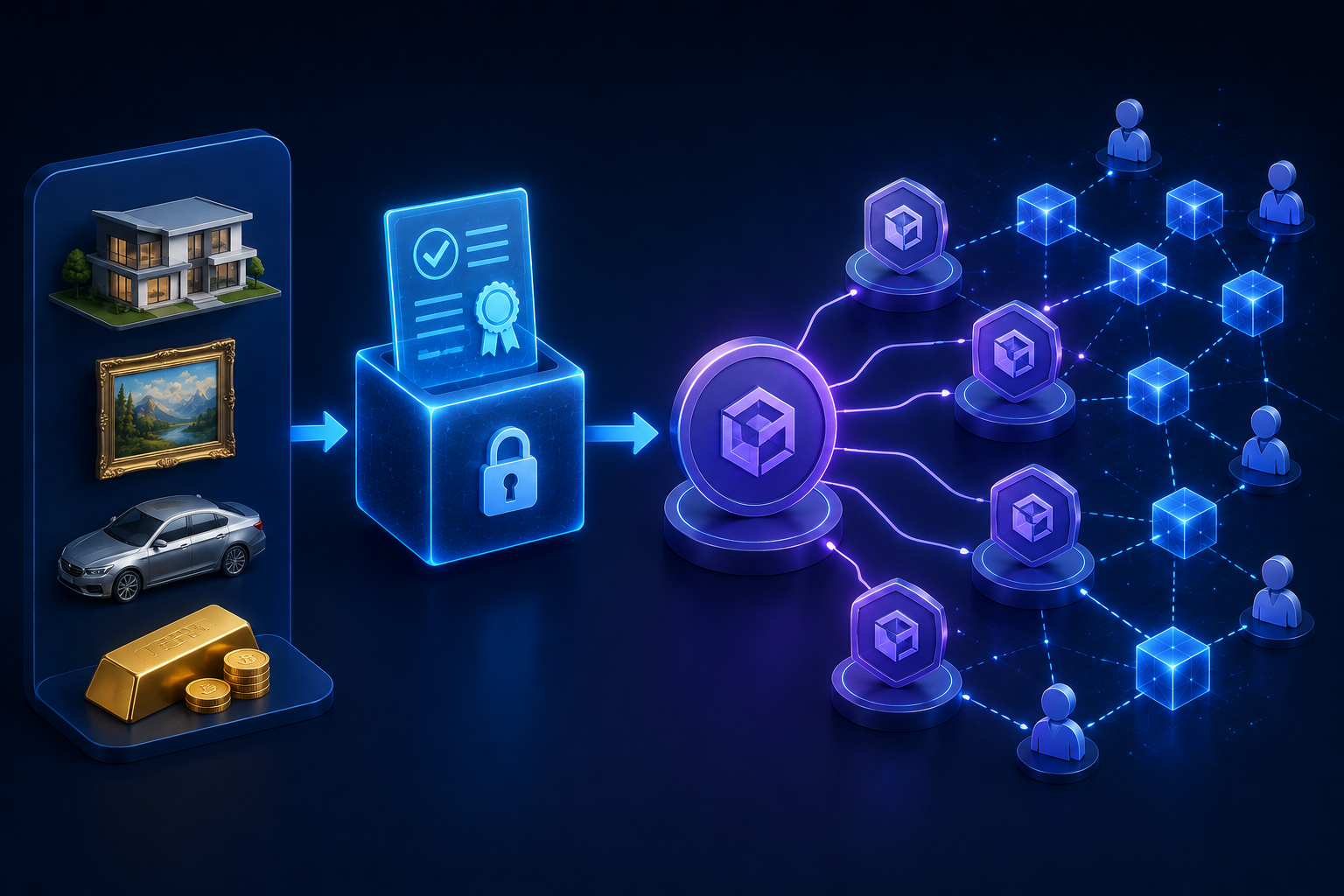
The blockchain tokenization process may seem complex at first glance, but in practice it consists of a series of structured steps. Each stage addresses the legal, technical, and operational aspects of a tokenized asset. Understanding these steps makes it easier to see how to tokenize an asset in real-world scenarios and how tokenization moves from concept to practical implementation.
Legal and Ownership Structure
The first and most critical stage is defining the legal status of the asset. Before launching tokenization blockchain, it is essential to clearly establish what rights the token will represent: ownership shares, claims, access rights, or economic benefits.
For real-world assets, an intermediary legal structure is often used. This might be a company or a trust. This entity formally holds the physical asset. In this case, tokens represent shares. They can also represent rights linked to that structure. This is how the legal meaning of asset tokenization is defined. It reflects how these systems work in practice.
Smart Contract Creation and Minting
At the next stage, a smart contract is developed to define how the tokens function. It specifies issuance parameters, transfer restrictions, and ownership logic. Once the contract is deployed, minting takes place, meaning the tokens are issued on the blockchain.
This step forms the technical foundation of crypto tokenization. Smart contracts enable automatic rule enforcement and remove the need for manual record-keeping. As a result, tokenized crypto assets become programmable and fully transparent.
Distribution, Trading, and Settlement
The final stage involves distributing tokens to participants. It also includes integrating them into trading infrastructure. Tokens may be allocated through private placements or public sales. Some are used internally within a specific platform.
Once issued, tokens can be freely transferred and traded. They can also be utilized in DeFi protocols. This depends entirely on their specific purpose. At this stage, the reality of crypto tokenization becomes fully evident. Settlements are fast. Ownership is verified directly on the blockchain. This process happens without the need for intermediaries.
How to Tokenize an Asset
The tokenization process begins with a clear understanding of the token’s purpose and structure. How to tokenize an asset is not purely a technical challenge but a combination of legal, financial, and infrastructure decisions.
The first step is selecting the asset and defining the rights the token will represent. It is important to determine in advance whether the token reflects ownership, revenue participation, or access to a service. This choice defines the structure of tokenization blockchain and the requirements for the smart contract.
Next, a blockchain platform is selected. Ethereum and compatible networks remain popular choices due to their mature ecosystems and established token standards. At this stage, the technical framework for crypto tokenization is established, including the token type and circulation model.
After that, the smart contract is developed and tested. It governs token issuance, transfers, and control mechanisms. Any error in the code can introduce significant risk. This is why audits and thorough testing are essential.
The final step is launching the token and integrating it into the broader infrastructure, including wallets, exchanges, or DeFi protocols. This is where tokenization in blockchain moves from theory to a fully operational solution.
Benefits of Blockchain Tokenization
Blockchain tokenization attracts growing attention from businesses and financial institutions for a reason. It addresses several structural issues of traditional markets related to access, liquidity, and transparency. The combination of these factors makes tokenization one of the most promising directions in the evolution of digital finance.
One of the key benefits is lower entry barriers. In practice, what is tokenization of assets means the ability to enable fractional ownership. Investors can purchase small shares of high-value assets such as real estate or securities without the need for significant capital.
Another major advantage is increased liquidity. tokenization blockchain simplifies the transfer of rights and accelerates settlement processes. Tokens can be traded around the clock. They also operate without geographic limitations. This makes markets more flexible and accessible for everyone.
Transparency and automation are also critical benefits. Smart contracts codify ownership and transfer rules, reducing the risk of errors and manipulation. In this context, tokenization in crypto directly addresses the issue of trust between market participants.
Finally, tokenization reduces costs. The removal of intermediaries lowers operational expenses. At the same time, automated processes make transaction execution much faster. These advantages make crypto tokenization attractive to both startups and large institutional players.
Risks and Challenges of Tokenization
Despite its advantages, blockchain tokenization faces several challenges. You must consider these before any launch or investment. Understanding these factors helps you assess the potential of tokenization crypto. It also helps you avoid common pitfalls.
One of the main challenges is regulation. Legally, tokenization in blockchain is interpreted differently across jurisdictions. Tokens may fall under securities regulation in many regions. This introduces strict requirements for issuance and disclosure. It also affects how tokens are traded. The lack of unified standards creates uncertainty. This affects both issuers and investors alike.
Another significant risk is technical in nature. Smart contracts are the foundation of crypto tokenization, and errors in code can lead to loss of funds or incorrect representation of rights. Even with audits, vulnerabilities may remain, especially in complex multi-layered systems.
The link between a token and the underlying real-world asset is also critical. In cases of what is tokenization of assets, elements such as custody, management, and legal enforcement remain outside the blockchain. If this linkage fails, the token may lose practical value even if it continues to exist correctly on-chain.
Finally, market adoption and liquidity remain open questions. Not all tokenized assets generate sufficient demand. Without an active ecosystem and clear use cases, tokenized crypto assets may remain illiquid, limiting their overall attractiveness.
Tokenization in DeFi and Web3
The DeFi ecosystem is a primary environment for tokenization. It has found many real-world applications there. In decentralized protocols, tokens transfer value easily. They also serve as tools for governance and collateral. Furthermore, they provide access to various financial services.
In DeFi, tokenized crypto assets can be used as lending collateral. They can also participate in liquidity pools. Some users deploy them in yield strategies. This demonstrates what tokenization is in crypto practice. Assets become programmable through this process. They can perform multiple functions within a single ecosystem.
In Web3, tokenization expands how users interact with digital services. Tokens are used for community governance, access rights, and participation in platform economies. Tokenization blockchain becomes the foundation for decentralized applications where users directly own digital assets and associated rights.
As a result, DeFi and Web3 do not merely adopt tokenization – they create new economic models in which tokens act as the core connective element.
The Future of Tokenization on Blockchain
The future of blockchain tokenization is linked to institutional adoption. It is increasingly integrated into traditional financial systems. Banks and investment funds are exploring tokenization today. They use it to modernize infrastructure. This helps them reduce operational costs effectively.
Growing interest is expected around the tokenization of assets. This trend covers both physical and digital holdings. It allows for fractional ownership of high-value items. Markets for real estate and fine art are leading this shift.
This trend is particularly visible in the real-world asset segment. This is true for assets like real estate and securities. As legal clarity improves, these assets will become common. They may soon be a familiar part of mainstream investment portfolios.
Interoperable tokenization is also likely to advance. Tokenization blockchain will move beyond single networks. This will enable compatibility across multiple ecosystems. Such developments are expected to improve liquidity. They will also expand practical use cases for many users.
In the long term, tokenization may not be a separate concept. It could become the standard method for representing rights. This would change how we transfer value within the digital economy.
Conclusion
Tokenization is becoming one of the most significant areas of development in the blockchain industry. Understanding what is tokenization and how crypto tokenization works helps explain why this approach attracts attention from both Web3 projects and traditional financial institutions.
Blockchain tokenization combines technological and economic advantages, including transparency, automation, and global accessibility. It introduces new models of asset ownership and reshapes financial markets by reducing reliance on intermediaries.
At the same time, tokenization remains an evolving field. Legal considerations, technical risks, and the need for broader market adoption continue to play an important role. A thoughtful approach to what is tokenization in crypto allows participants to leverage its potential without overlooking its limitations.
As a result, tokenization is already laying the foundation for a future digital economy in which assets become more accessible, flexible, and programmable.
Published Articles
 Popular
Bitcoin Pizza Guy: The Story Behind the First Real Bitcoin Purchase
Introduction The history of Bitcoin is full of dramatic ups and downs,...
 Popular
The Meme Economy: How Internet Humor Shapes Culture, Markets, and Crypto
Introduction Ten years ago, the idea that a picture of a dog...
 Popular
What is the Omniverse? Exploring the Ultimate Multiversal Concept
Introduction Do you know what the omniverse is? Is this concept real?...
Bitcoin Taproot Explained: What the Upgrade Means for BTC
Introduction Unfortunately, the most popular cryptocurrency today – Bitcoin – was not...
Crypto On-Ramps and Off-Ramps Explained: How Fiat and Crypto Move In and Out
Entering the world of digital assets often feels like trying to cross...
Crypto Basics Explained: A Beginner’s Guide to Cryptocurrency and Trading
Introduction The world of finance is changing right before our eyes. Just...