
Centralized, Decentralized, and Distributed Systems: Key Differences, Advantages, and Applications
Most people never stop to think about what happens behind the screen when they tap a button on their phone. Yet, the architecture holding everything together defines our digital lives, from the safety of our savings to the speed of a webpage. I often find myself thinking that the choice between centralized decentralized distributed systems isn’t just a dry technical debate. It is a fundamental decision about power, trust, and who actually owns our data. In this guide, we are going to break down how these models work and why choosing the wrong one can be a disaster for any project.
Overview of Centralized, Decentralized, and Distributed Systems
Before we dig into the technical weeds, let’s look at the big picture. We usually lump these terms together, but they are very different tools for very different jobs. Think of the difference between a kingdom with a single monarch and a network of independent villages. In the tech world, things work much the same way. A centralized system relies on one “brain,” a decentralized one shares authority, and a distributed system forces many machines to act as a single unit. There is no “perfect” system here—only the right fit for what you are trying to build.
Centralized Systems
Think about your traditional bank account. Every single transaction goes through one central server owned by the bank. That is a classic centralized system. It has one owner and one point of control. Managing this is simple because there is only one source of truth. However, that simplicity comes with a massive catch: if that central server goes down or gets hacked, everything stops. It has always felt a bit unsettling to me how much of our digital existence hangs on these single threads, even if they are very fast and efficient most of the time.
Decentralized Systems
This is where the rules of the game change. In a decentralized setup, there is no “big boss.” Nodes in the network talk to each other directly while keeping their own independence. Blockchain is the poster child here—Bitcoin doesn’t need a head office to verify a payment. Coordinating such a crowd of independent actors is a real headache, and it often makes things slower. But the idea of a system that nobody can just “turn off” by flipping a single switch is something I find incredibly resilient and necessary today.
Distributed Systems
Distributed systems are often confused with decentralized ones, but their goal is collective performance rather than shared power. Here, many computers work together to finish one massive job. Google’s cloud or the databases used by global corporations work exactly like this. They spread the workload so effectively that you won’t even notice if a few servers on the other side of the planet suddenly fail. It is all about scaling. I have seen these systems process terabytes of data without breaking a sweat, which is honestly quite a feat.
Historical Context of System Models
Looking at our origins explains today’s blockchain obsession. In the 1960s, massive mainframes were the sole “brains” of operations. If one failed, everything stopped. This era of absolute centralization prioritized simple oversight over resilience, much like a factory depending on a single generator.
Digital architecture evolved through distinct phases:
- 1960s (Mainframes): Total central reliance. Easy to manage, but a single point of failure.
- 1980s (P2P): Early peer-to-peer networks allowed direct data swaps without central permission.
- 1990s (The Web): Global demand forced us to link millions of devices, outgrowing central control.
- 2000s (The Cloud): Distributed services like Google Cloud enabled systems to survive individual node failures.
- 2010s (Blockchain): A return to decentralization, upgraded with a focus on transparency and security.
This evolution is ironic: we began with one big computer, spent decades linking them, and now strive to ensure no one person owns the result. Each era solved a specific problem: first stability, then scale, and now trust without middlemen. It is a story of balancing power with independence.
Comparing Centralized, Decentralized, and Distributed Systems
When I first started digging into architectures, I thought it was just like picking a color palette. But choosing a system is more like picking the foundation for a house. If you get it wrong, the whole building will eventually crack. The main question isn’t about which tech is “cooler.” It is about what you value most. Is it speed? Is it security? Or maybe total control? Understanding these nuances helps you stop chasing trends and start picking the right tool for your specific business or project.
Key Differences
The core difference between these three approaches lies in management and resilience. Centralized systems are all about order and simplicity. You have one main server running the show. This is handy while the load is low, but the system chokes once traffic spikes. Decentralized systems, on the other hand, share the power. Every node is its own boss, which makes the network tough to kill but incredibly hard to manage. Distributed systems are a different beast: their nodes work as a tight team for collective performance. This is your best bet when you need massive scaling and protection from random failures.
Visual Comparison
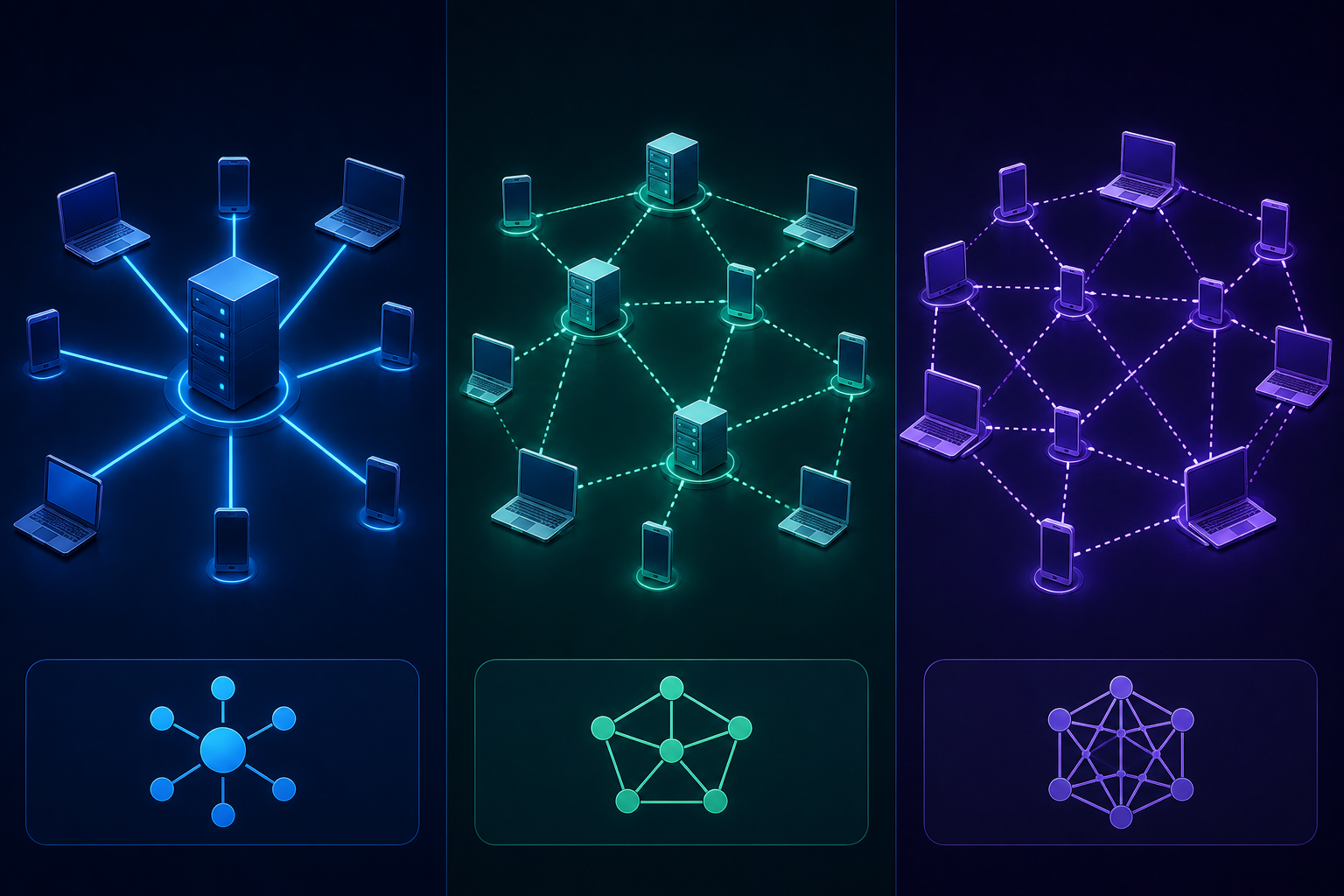
If you try to picture this, the diagrams are quite telling. A centralized model looks like a star, with every ray pointing to a single dot in the middle. Remove that dot, and everything falls apart. A decentralized map looks more like a cluster of constellations—connected, but without a single sun. Meanwhile, a distributed system is like a massive web where every node is tangled with others. There is no “leader” in the traditional sense, but data can travel through dozens of different paths at the same time.
Trade-offs
There is no such thing as a free lunch in tech. When you pick one side, you inevitably lose something else. Centralized systems often show great speed at the start and are cheaper to maintain, but they can become money pits later due to security risks. Decentralization requires a heavy investment in coordination and security early on, but it tends to be more cost-effective and stable over time. Distributed systems act as a “middle ground,” where resources are used as efficiently as possible to balance maintenance costs and overall performance.
Applications of Each System Type
Theory is one thing, but I have always found it more interesting to see how these designs work “in the wild.” We interact with all three types of systems every day without even realizing it. Whether you are paying for coffee, scrolling through social media, or uploading a photo to the cloud, you are triggering different architectural choices. Each one is picked for a reason. Developers are constantly trying to find the sweet spot between how easy a system is to manage and how fast it can actually grow.
Centralized Systems in Real-World Applications
Traditional banking is probably the clearest example here. When you send money to a friend, the bank acts as that single “center” that confirms you actually have the cash. It is convenient because one organization is responsible for everything. We see the same thing with social media platforms like Facebook or Instagram. They have total control over your data and what shows up in your feed. I get why corporations go this route—it makes it much simpler to push updates and maintain security, even if it leaves us depending on a single player.
How Decentralized Systems Power Blockchain and Cryptocurrency
This is where the rules of the game flip completely. Bitcoin was the first major statement that we don’t need middlemen to swap value. There is no head office in this network to complain to, yet it runs like clockwork. Ethereum took it a step further with “smart contracts” that execute deals automatically. To support these networks while making a profit, many people turn to specialized hardware like ASIC miners. I think that is where real freedom lies—when the rules are set by transparent code rather than by backroom bureaucrats.
Distributed Systems in Cloud Computing and Beyond
When we talk about massive scale, distributed systems take the stage. Cloud computing platforms like Google Cloud work exactly like this: thousands of servers across the globe link up so you can open a heavy file in a split second.In the world of Big Data, tools like Hadoop help companies process vast amounts of data. I remember a case study about a firm called Company X that switched to a distributed cloud model. They didn’t just speed things up; they managed to cut costs significantly. It is the go-to solution for anyone who needs to scale without limits and avoid a total system crash at the worst possible time.

Future of System Architectures
When I try to picture where these technologies are taking us, I have mixed feelings. On one hand, we are clearly moving toward a world where nobody can just “switch off” your wallet or block your access to information on a whim. On the other hand, managing this scattered reality is getting incredibly complicated. The future of architecture isn’t just about faster servers. It is about finding a way to make billions of devices work together without turning everything into a digital mess. I feel like we are standing at a point where technology stops being just a tool and starts becoming the foundation of a new social contract.
Trends in Decentralization
There is a lot of noise about DeFi (decentralized finance) right now, but I think that is just the start of a massive rebuild. We are seeing these same ideas bleed into supply chains and digital ID verification. Imagine not having to prove who you are to some government official because your digital signature is already verified by thousands of independent nodes across a network. It sounds like something out of a cyberpunk novel, but it is the path we are on. The biggest wall we will hit is regulation. Officials still don’t know how to handle systems that don’t have a head office or a CEO to call.
Distributed Systems in AI and IoT
Then there is IoT (the Internet of Things). Experts estimate that by 2025, there will be over 75 billion connected devices. That number is honestly hard to wrap my head around. Every single sensor needs to swap data, and a central server would just choke under that kind of pressure. This is why distributed systems are becoming so popular—they process info right where it happens. When you throw AI (Artificial Intelligence) into the mix, things get even wilder. Distributed neural networks could learn much faster by using the idle power of millions of tiny devices instead of just relying on massive server farms owned by tech giants.
Conclusion
I often catch myself thinking that the debate over architectures is more than just a dry tech talk. It is a conversation about how we want to treat each other online and who we are willing to trust with our information. Centralized systems brought us the stability we are used to, decentralization gave us a shot at real transparency, and distributed networks gave us the tools to handle massive data. We aren’t picking just one model for every single task anymore; we are building a complex, hybrid reality.
Don’t expect the entire world to go decentralized overnight. That is not going to happen, and to be honest, we don’t really need it to. It is much more important to learn how to mix the perks of different approaches: the speed of the cloud, the security of blockchain, and the simple ease of old-school banking services. My personal takeaway after looking at all these models is simple—the best system is the one that fixes your specific problem right here and now. Tech moves fast, and our job isn’t just to keep up with trends, but to understand what we are actually trading for all that efficiency.
Published Articles
 Popular
Bitcoin Pizza Guy: The Story Behind the First Real Bitcoin Purchase
Introduction The history of Bitcoin is full of dramatic ups and downs,...
 Popular
The Meme Economy: How Internet Humor Shapes Culture, Markets, and Crypto
Introduction Ten years ago, the idea that a picture of a dog...
 Popular
What is the Omniverse? Exploring the Ultimate Multiversal Concept
Introduction Do you know what the omniverse is? Is this concept real?...

Bitcoin Taproot Explained: What the Upgrade Means for BTC
Introduction Unfortunately, the most popular cryptocurrency today – Bitcoin – was not...

Crypto On-Ramps and Off-Ramps Explained: How Fiat and Crypto Move In and Out
Entering the world of digital assets often feels like trying to cross...

Crypto Basics Explained: A Beginner’s Guide to Cryptocurrency and Trading
Introduction The world of finance is changing right before our eyes. Just...