
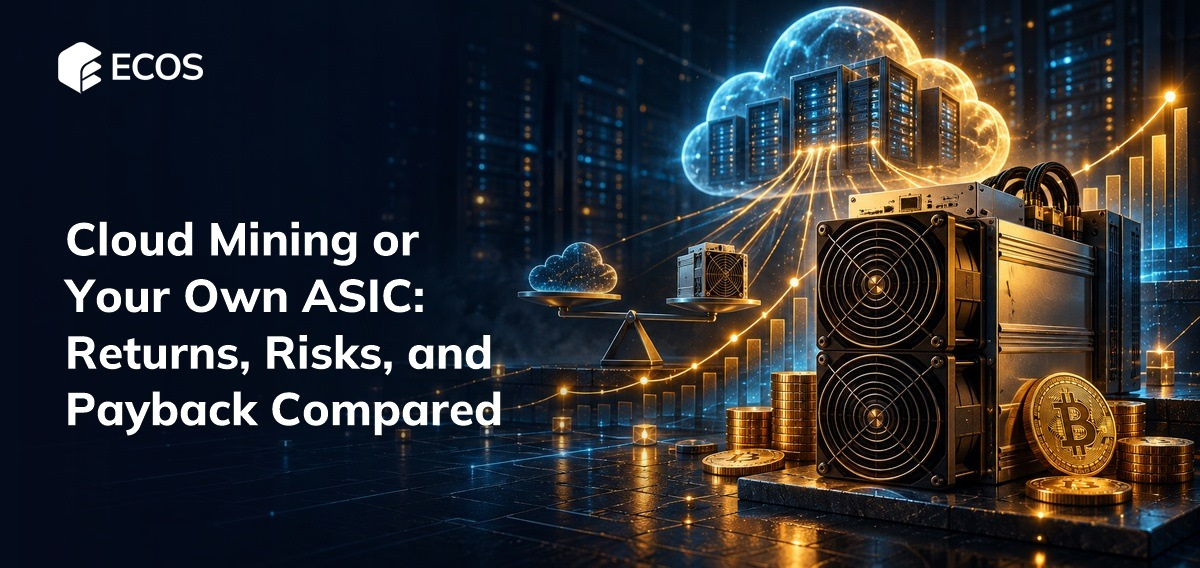
Cloud Mining or Your Own ASIC: Returns, Risks, and Payback Compared
Introduction
Mining Bitcoin can involve either purchasing a remote service contract or owning the physical hardware yourself. When exploring cloud mining vs ASIC mining, both paths provide exposure to crypto rewards, yet the money reaches that output through very different arrangements. A cloud customer buys a service, while an ASIC owner buys equipment and takes full responsibility for keeping it productive.
This core distinction impacts nearly every aspect of the investment: initial capital requirements, ongoing expenses, operational control, and potential points of failure. A low entry barrier can easily mask restrictive contract terms, while physical ownership might seem straightforward until power, ventilation, noise, repairs, and downtime enter the equation.
A comprehensive cloud mining vs ASIC mining comparison must therefore begin with cash flow and responsibility rather than advertised yields. This guide explores how each model functions, what expenses to expect, how risks are distributed, and why any projected payback timeline remains conditional.
What You Actually Buy
A cloud mining contract
Cloud mining gives the customer a contractual claim on a stated amount of hashrate for a defined period. The provider purchases and operates the machines, connects them to a pool, handles the facility, and calculates the customer's share of output. The customer usually receives cryptocurrency after service charges and payout conditions are applied.
The asset in this arrangement is the contract, not a specific miner sitting in the customer's possession. Its value depends on the provider continuing to operate, reporting production correctly, and honoring withdrawals. Contract language may permit changes when mining becomes uneconomic, electricity costs rise, or local rules affect the facility.
An ASIC miner
An application-specific integrated circuit miner is physical equipment designed to run one mining algorithm efficiently. A Bitcoin ASIC repeatedly calculates SHA-256 hashes. It cannot be repurposed for ordinary computing, and its usefulness depends on its efficiency relative to newer machines competing on the same network.
Ownership gives the buyer control over the machine, pool selection, wallet address, operating schedule, and eventual sale. It also transfers the practical work. The owner must secure suitable power, remove heat, manage noise, monitor the unit, replace failed parts, and arrange repairs without assuming that revenue will continue during an outage.
How Mining Revenue Is Created
Both routes ultimately rely on the same underlying economics. A miner contributes hashrate to the Bitcoin network, normally through a mining pool. The pool distributes rewards according to its rules after accounting for accepted work and fees. The amount of BTC produced by a fixed amount of hashrate changes as network difficulty, total competition, transaction fees, and block rewards change.
Bitcoin price affects the fiat value of that output, but it does not increase the number of coins already mined. A rising price can improve revenue measured in dollars while difficulty or fees move in the opposite direction. That is why a forecast needs separate assumptions for BTC production and the currency value assigned to it.
Cloud customers and equipment owners face these network variables together. The difference lies in the deductions, operating control, and counterparty chain between the hashrate and the investor's wallet.

Startup Capital and Commitment
Cloud mining entry costs
A contract commonly requires one upfront payment or a series of plan payments. The amount may be lower than the cost of buying a current ASIC, which allows an investor to test mining with less capital. There is no need to fund electrical installation, racks, networking, spare fans, or a suitable room.
The quoted price still needs context. Contract duration, hashrate, expected service fees, payout minimums, and termination rules determine what the payment buys. Two plans with the same nominal hashrate can have different economics if one carries higher maintenance deductions or gives the operator broader rights to suspend service.
The cost of owning hardware
An ASIC purchase is only the first capital expense. Home operation may require a higher-capacity circuit, safe cabling, surge protection, ventilation, ducting, and sound control. A hosted machine can avoid construction at home, although deposits, shipping, setup charges, and minimum hosting periods may apply.
Working capital matters as well. Electricity and hosting bills usually arrive before the equipment has recovered its purchase price. An owner who cannot cover those bills during a weak market may have to switch the unit off or sell it when used-machine prices are depressed.
Electricity Changes the Calculation
Electricity is the largest recurring cost for many ASIC owners. The relevant figure is the full delivered rate, including energy, transmission, taxes, demand charges, and any tiered pricing. Multiplying a miner's wall power by 24 hours and the number of operating days gives consumption; the result must then be priced at the actual local rate.
A specification-sheet power figure is a starting point, not a complete facility estimate. Power supplies lose some energy, cooling fans consume electricity, and hot climates can require additional ventilation or air conditioning. Even a small difference in the effective rate compounds across continuous operation.
Cloud contracts move this work to the provider, but they do not make electricity free. Power can be embedded in the contract price, deducted as a maintenance fee, or used as a reason to suspend an unprofitable contract. The investor needs to understand which method applies and whether the rate can change.
Hosting and the Reality of Operation
Running an ASIC at home is demanding. Modern units draw substantial power, produce persistent high-frequency fan noise, and release nearly all consumed electricity as heat. An ordinary room may quickly become unsuitable. Dust, unstable connectivity, high ambient temperature, and poor airflow reduce reliability.
Professional hosting can solve much of this problem. The host supplies industrial power, cooling, network access, and on-site technicians, then charges the owner for the service. The machine remains the investor's property, although retrieving it can depend on paid invoices, shipping arrangements, and the host's contract.
Hosting also creates counterparty risk. An owner may technically hold title to a miner while another company controls physical access. Before sending equipment, the investor should examine insurance, serial-number records, maintenance procedures, access rights, termination terms, and the process for returning the unit.
Maintenance, Failures, and Downtime
ASIC miners contain fans, power supplies, control boards, and hash boards that operate under heat and load. Fans and power supplies are relatively routine replacements. A failed hash board can be slower and more expensive to diagnose, especially where qualified repair services are scarce.
Every repair has two costs: parts and labor, plus the BTC that was not produced while the machine was offline. Shipping to a distant repair center can extend the interruption. Warranty coverage helps only when the fault is covered, the claim is accepted, and turnaround time is reasonable.
Cloud mining places maintenance with the operator. That is convenient, yet it also limits visibility. A customer may see a reduced payout without being able to inspect the underlying machines. Service-level terms, historical uptime information, and clear reporting matter more than a dashboard that only displays projected earnings.
Control, Custody, and Transparency
An ASIC owner can usually direct pool payouts to a wallet under their control. Pool records provide an independent view of hashrate, accepted shares, and payments. Physical access also makes it possible to verify the machine model, firmware, serial number, and operating condition.
Cloud mining adds several layers of trust. The provider chooses the hardware and facility, measures production, applies fees, and initiates customer payouts. If the contract does not identify how hashrate is delivered or how deductions are calculated, the customer has limited ability to reconcile the result.
Custody does not end when BTC is paid. Leaving proceeds on a provider account exposes them to withdrawal restrictions and account security failures. Sending regular payouts to a controlled wallet can reduce that exposure, subject to network fees and any minimum withdrawal threshold.
Liquidity and Exit Options
A cloud contract is often difficult or impossible to resell. The customer may be locked in until expiry even when personal circumstances or market expectations change. Early termination may produce no refund, and a contract that stops because revenue falls below fees may never resume.
An owned ASIC is a saleable asset, but its liquidity is uneven. Used-machine prices respond to Bitcoin price, network economics, equipment generation, and demand for available hosting. A machine that looks valuable in a strong market may attract few buyers after a profitability squeeze.
Transport and condition affect the exit price too. Buyers may discount a unit with an uncertain service history or expired warranty. Shipping a heavy miner across borders can add cost and delay. Resale value should be modeled conservatively rather than treated as guaranteed recovery capital.
Provider and Contract Risk
Cloud mining performance depends on a business that the customer cannot directly supervise. Fraud is one concern, but ordinary business failure can produce the same loss. A genuine operator can suffer power disputes, equipment seizures, insolvency, cyber incidents, or a breakdown in banking and payment access.
Due diligence should focus on verifiable operations and enforceable terms. The provider should explain the legal entity, facility arrangement, fee schedule, payout method, duration, and circumstances that allow suspension or cancellation. Claims of fixed or guaranteed returns conflict with the variable economics of mining.
Contract risk can remain even when the provider operates real machines. Unilateral fee changes, vague force-majeure clauses, withdrawal limits, and a remote legal jurisdiction can weaken the customer's position. A polished interface does not substitute for readable terms and evidence of ongoing production.
Ownership Risks Beyond Repairs
Direct ownership removes some provider dependence, yet it concentrates other risks around the machine. Fire safety, electrical compliance, theft, water damage, and ventilation become the owner's responsibility at home. Insurance may exclude commercial activity or specialized equipment unless it is declared.
Firmware and network security need attention as well. Unverified firmware can redirect hashrate or compromise the device. Management interfaces should not be exposed openly to the internet, passwords should be changed, and updates should come from trusted sources.
Regulation can change the operating environment. Local noise rules, electricity tariffs, import duties, taxes, or restrictions on mining may affect costs and legal use. An owner cannot assume that today's site conditions will remain available throughout the payback period.
Cloud Mining vs ASIC Mining Cost Model
A fair cloud mining vs ASIC mining model uses the same hashrate, forecast period, BTC price scenarios, and difficulty assumptions for both options. Comparing a short promotional contract with years of hardware output produces a misleading result unless residual equipment value and all later operating costs are included.
Cloud contract cash flow
For a cloud contract, begin with the purchase payment. Estimate BTC production by period, then deduct maintenance, pool, withdrawal, and conversion charges according to the actual terms. Include delays caused by payout thresholds and any period when the provider may suspend mining.
The result should be shown both in BTC and in the investor's spending currency. Measuring only fiat value can hide whether the contract produced fewer coins than expected. Measuring only BTC can hide the cash cost of the original payment and ongoing fees.
Owned ASIC cash flow
For an owned miner, include purchase price, tax, shipping, installation, and setup. Recurring costs should cover delivered electricity or hosting, pool fees, repairs, replacement parts, insurance where relevant, and labor or monitoring time. Expected resale value belongs at the end of the model, discounted for age and uncertainty.
Revenue must be reduced for realistic downtime. A machine does not run every hour of every year: maintenance, power interruptions, heat events, pool changes, and failures all remove production. A conservative uptime assumption is more useful than a perfect one.
Opportunity cost
Both choices tie up capital that could have remained liquid or purchased BTC directly. The comparison should therefore include a simple benchmark: what would happen if the same initial cash and subsequent operating payments were used to buy Bitcoin on a schedule? This does not predict the best choice, but it exposes the cost of choosing mining exposure.
Payback Is a Moving Target
Payback occurs when cumulative net cash inflows equal the total cash committed. The formula is simple; the inputs are not. Difficulty can rise, the BTC price can fall, fees can change, and hardware can fail. A date calculated at purchase can move months or years as those variables develop.
A robust model uses at least a base case, a weaker case, and a severe stress case. The weaker cases should combine adverse changes rather than moving only one input. In real markets, falling BTC prices can coincide with poor resale demand, while a repair can occur during the same period.
Cloud mining vs ASIC mining should also be tested for a no-payback outcome. If the model assumes that every position eventually recovers its cost, it understates risk. The investor needs to know the loss if a contract terminates early or a machine becomes uneconomic before resale.

A Worked Comparison Without Price Guessing
Consider two alternatives offering comparable hashrate over the same planning period. Option A is a cloud contract with a fixed upfront price and a maintenance deduction. Option B is a purchased ASIC placed with a third-party host and billed monthly for power. Actual prices are deliberately omitted because they change across providers, machines, and locations.
For Option A, record the exact contract term, hashrate, fee formula, expected uptime, payout threshold, and termination trigger. For Option B, record the delivered equipment cost, host deposit, monthly rate, pool fee, repair reserve, expected downtime, and conservative resale value.
Apply one BTC production forecast to both. Then calculate net BTC and net cash flow period by period. If the cloud provider uses different hardware or uptime, adjust the production input instead of assuming equal output. The owned-machine case should stop generating revenue during modeled repairs.
The useful conclusion is not a single winner. The calculation reveals which assumptions drive each result. A cloud contract may be more sensitive to fees and contract continuity. An owned unit may be more sensitive to electricity, failure, and resale value. Those sensitivities show where due diligence matters most.
When Cloud Mining May Fit
Cloud mining may suit someone who wants measured mining exposure without installing equipment or managing daily operations. It can also make sense where household electricity is expensive, safe power capacity is unavailable, or noise and heat make home operation unrealistic.
The convenience is valuable only when the provider can be checked and the terms are understandable. Investors should be comfortable with limited control, restricted exit options, and dependence on another company. A small initial allocation can limit damage while the payout process and reporting are tested.
When Owning an ASIC May Fit
Ownership may suit a technically capable investor with reliable low-cost power, an appropriate site, and time to monitor equipment. It can also appeal to someone who values pool choice, wallet control, transparent hashrate data, and the possibility of selling the machine.
The owner needs a cash reserve and a practical response to failure. If a repair bill or several unprofitable months would force an immediate sale, the project is undercapitalized. Access to competent hosting or repair support can matter as much as the miner's headline efficiency.
Questions to Ask Before Committing Capital
A decision is easier to audit when the assumptions are written down. Before paying for either route, answer the following questions with evidence rather than promotional estimates:
What exact hashrate, algorithm, term, machine model, and efficiency are being purchased?
Which fees are fixed, which can change, and who controls those changes?
What delivered electricity or hosting rate applies, including taxes and ancillary charges?
How will downtime, repairs, payout delays, and network difficulty be modeled?
Who controls the equipment, mining pool, payout account, and final wallet at each stage?
Can the contract or machine be sold, transferred, removed, or terminated, and at what cost?
What evidence supports the provider, host, facility, and historical operating claims?
How much can be lost if the stress case occurs and payback is never reached?
Answers should be reflected in the spreadsheet or cash-flow record used for the decision. If a cost cannot be estimated, it should appear as an explicit uncertainty rather than disappearing from the model.
Common Comparison Mistakes
A common cloud mining vs ASIC mining mistake is comparing advertised cloud revenue with an ASIC's gross output. That leaves fees out of one side and operating costs out of the other. The correct comparison uses net cash flow after every cost over the same period.
Another mistake is treating current mining output as constant. A fixed amount of hashrate can produce fewer BTC as competition grows. Forecasts should include difficulty changes and be refreshed as the network evolves.
Resale value is also easy to overstate. An ASIC is not equivalent to cash, and its price may fall precisely when the owner wants to exit. Cloud contracts can have even less liquidity because many cannot be transferred at all.
Finally, a projected payback date is sometimes presented as a contractual result. It is only the output of a scenario. Changing one or two major assumptions can move it sharply or remove it altogether.
Managing the Risks
Position size is the first control. Capital allocated to mining should be money the investor can leave committed and potentially lose. Borrowing to fund a machine or contract adds repayment pressure to an already variable cash flow.
Operational diversification can reduce a single point of failure, although it cannot make mining safe. Owners may use reputable pools and secure wallets; cloud customers may avoid concentrating funds with one opaque operator. Splitting exposure does not repair a poor underlying contract.
Records are essential. Keep invoices, contracts, machine serial numbers, pool statements, wallet transactions, electricity or hosting bills, repair history, and tax records. Monthly comparisons between forecast and actual output reveal when the original plan has stopped matching reality.
Key Takeaways
Cloud mining buys a service and shifts operations to a provider, while ASIC ownership buys a specialized physical asset and its operating responsibilities.
Electricity, hosting, maintenance, downtime, and fees must be included before returns are compared.
Cloud contracts carry provider and contract risk; owned machines carry equipment, site, repair, and resale risk.
Neither route is fully liquid. Contract transfers may be prohibited, and used ASIC prices can fall quickly.
Payback is a scenario result, not a promise, and some reasonable stress cases may never reach break-even.
The better fit depends on capital, power access, technical ability, desired control, and tolerance for counterparty risk.
Conclusion
The practical cloud mining vs ASIC mining choice comes down to which responsibilities and risks the investor can manage. A contract reduces hands-on work, but places operations, reporting, and access in a provider's hands. Hardware offers greater control and a possible resale route, while demanding reliable power, maintenance, and enough cash to survive interruptions.
Build both cases from net cash flow, use identical market assumptions, and test conditions in which payback never arrives. A modest, well-documented position is easier to monitor than a plan that depends on perfect uptime or a rising Bitcoin price.
FAQ
- Is cloud mining cheaper than buying an ASIC?
The initial payment can be lower, but total cost depends on contract length, maintenance deductions, payout rules, and termination terms. Compare net cash flow over the same period.
- Can an ASIC be profitable with residential electricity?
Sometimes, although many residential rates are too high once full power, cooling, and installation costs are included. Calculate with the actual delivered tariff.
- Which option gives more control?
Owning the ASIC generally gives more control over the pool, wallet, firmware, schedule, and sale. Hosting can still limit physical access.
- Are cloud mining returns guaranteed?
No. Mining output, fees, provider continuity, Bitcoin price, difficulty, and contract provisions can all change the result.
- How should payback be calculated?
Add every cash outflow, subtract costs from mining revenue by period, and find when cumulative net inflows recover the investment. Test adverse scenarios too.
- What is the biggest risk of owning an ASIC?
There is no single risk. High electricity costs, equipment failure, downtime, regulatory changes, and falling resale value can combine and prevent break-even.
Published Articles
Bitcoin Mining ROI: How to Calculate Profitability and Forecast
Introduction The Antminer S21 XP consumes 3.5 kW per hour and mines around 0.00014 BTC per day at current network difficulty. With electricity at $0.07 per kWh and Bitcoin at $100,000, that produces roughly $14 in rev...
How to Add Cloud Mining to a Crypto Portfolio
Learn how to add cloud mining to a crypto portfolio, choose a sensible allocation, track net returns, and control provider and liquidity risk.

Long-Term Cloud Mining Strategy: Planning Bitcoin Accumulation Over Several Years
Build a long-term cloud mining strategy around contract costs, mining difficulty, payout records, risk limits, and realistic Bitcoin accumulation goals.
What Is ASIC Mining? How ASIC Miners Work
Learn what is ASIC mining, how purpose-built miners process hashes, which coins they support, and what costs and risks affect an operation.
Cloud Mining or Staking: Which Is Better?
Compare cloud mining vs staking by returns, liquidity, custody, fees, asset exposure, and risk to find the approach that fits your goals.
Passive Income with Bitcoin Cloud Mining: Is Mining a Viable Long-Term Strategy?
Explore passive income with bitcoin cloud mining, including contract mechanics, changing returns, provider risk, and the case for a long-term strategy.