
Crypto Margin Trading Explained: Leverage, Risks, and Strategies
Introduction
Crypto margin trading amplifies everything about trading — the potential gains, the potential losses, and the speed at which either can happen. Where a regular spot trade lets you buy or sell what you own, margin trading lets you control a position larger than your actual capital by borrowing funds from the exchange.
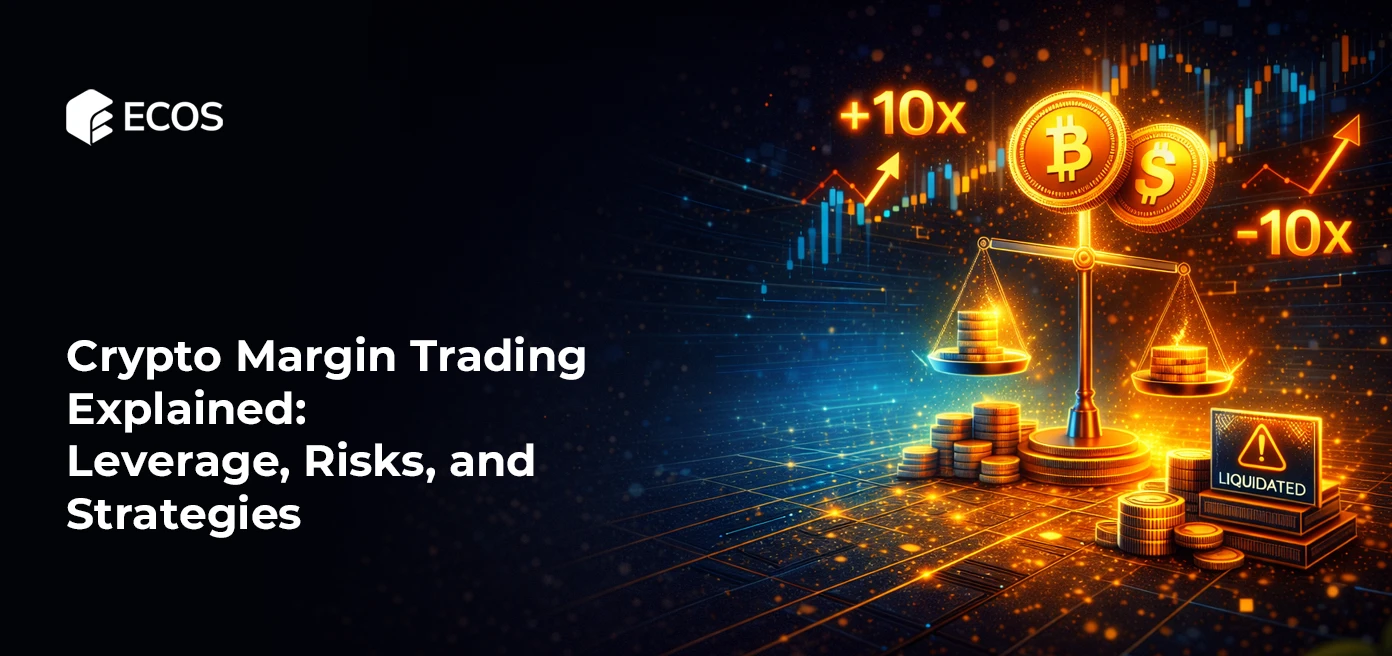
The appeal is obvious. If Bitcoin moves 5% in your favor on a 10x leveraged position, you don’t gain 5% — you gain 50%. But the math works identically in reverse. That same 5% move against you wipes out half your margin, and a 10% move liquidates it entirely.
Understanding what crypto margin trading is, how liquidation actually works, which platforms offer it, and whether it belongs in your trading approach is the purpose of this guide. We’ll cover the mechanics honestly — including the parts that brokerages tend to leave out of the marketing material.
What Is Crypto Margin Trading?
Crypto margin trading is the practice of trading cryptocurrencies using borrowed capital to increase position size beyond what your account balance would otherwise allow. The funds you deposit serve as collateral — called margin — and the exchange lends you the rest up to a specified multiple.
The ratio between your own funds and the total position size is the leverage. A 5x leveraged position means you’re controlling $5,000 worth of crypto with $1,000 of your own money; the exchange has lent you the other $4,000. A 20x leveraged position on the same capital controls $20,000 — but requires only a 5% adverse move to eliminate your entire $1,000.
Margin trading exists in two forms: isolated and cross margin. With isolated margin, each position uses only the funds you specifically allocate to it — if that position gets liquidated, it can’t draw on your other account balances. Cross margin pools your entire available balance as collateral for all open positions simultaneously. Cross margin reduces the risk of individual position liquidation but means a single bad trade can affect your whole account.
Margin trading is distinct from futures trading, though the two are often confused. In a margin trade, you’re borrowing to buy or sell the actual cryptocurrency spot. In a futures trade, you’re entering a contract that derives its value from the underlying asset without necessarily taking delivery. Some platforms blur this distinction with perpetual contracts, but the structural difference matters for how interest, expiry, and settlement work.
How Crypto Margin Trading Works
Leverage Explained
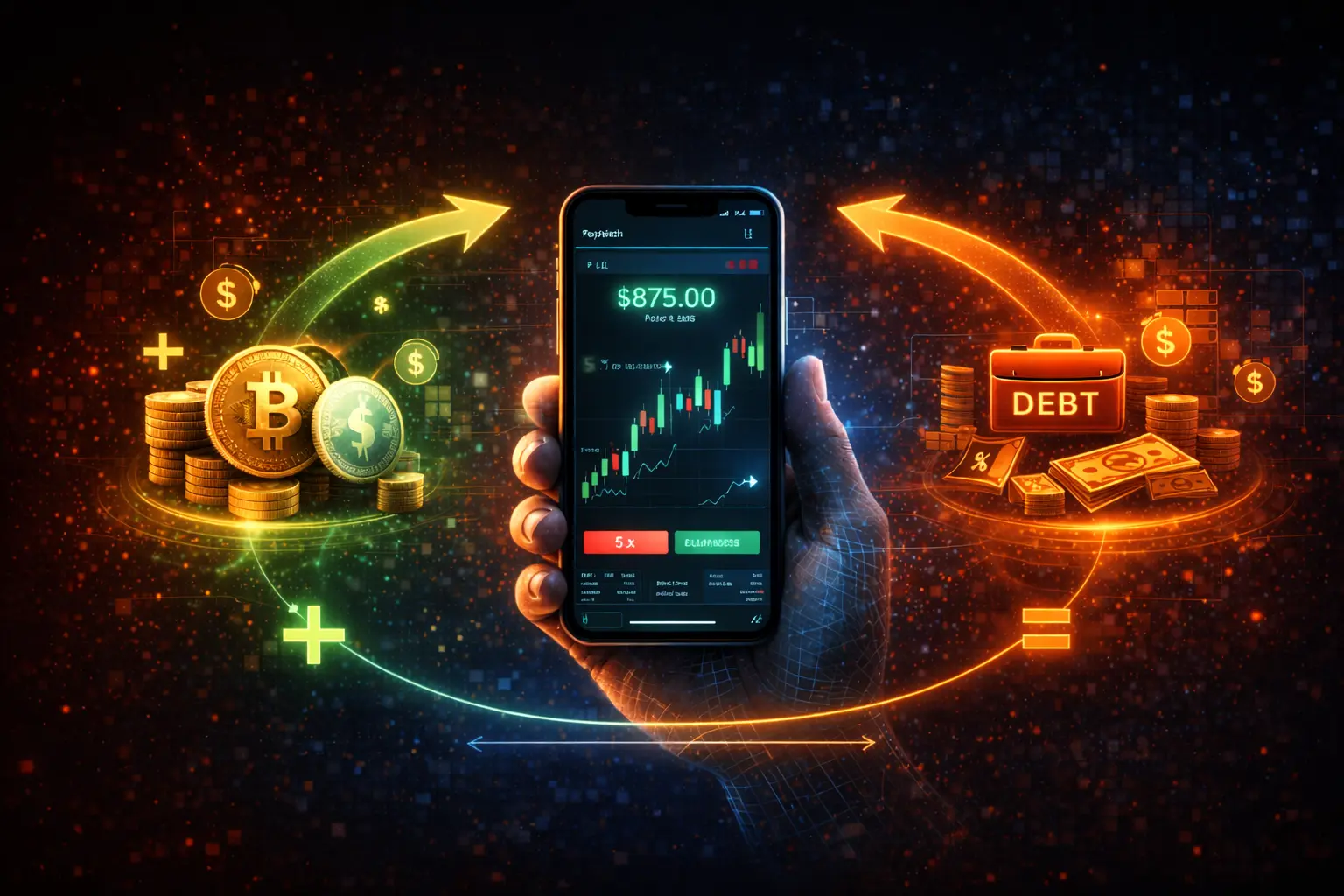
Leverage is the multiplier that determines how much total exposure your margin buys you. At 2x leverage, a $1,000 deposit controls $2,000 of crypto. At 10x, the same deposit controls $10,000. At 100x — offered by some exchanges — $1,000 controls $100,000, meaning a single 1% price move equals a 100% gain or loss on your capital.
The interest on borrowed funds accrues continuously. Most exchanges charge hourly or daily borrow rates that vary by asset and market conditions. At 10x leverage on a position held for a week, borrowing costs can materially reduce profits even if the trade direction is correct. This is a cost that simple APY calculations often obscure — the effective cost of leverage is borrow rate multiplied by borrowed amount multiplied by holding duration.
Higher leverage doesn’t just amplify gains — it dramatically narrows the margin for error. At 10x, you have a 10% price buffer before liquidation (minus fees). At 50x, that buffer is roughly 2%. Markets can move 2% in minutes during volatile sessions, which is why high leverage is frequently described as speculation with a countdown clock.
Initial Margin and Maintenance Margin
Initial margin is the deposit required to open a leveraged position. It’s expressed as a percentage of the total position size. A 10% initial margin requirement corresponds to 10x leverage — you deposit 10% of the position and borrow the remaining 90%.
Maintenance margin is the minimum balance you must maintain to keep the position open. It’s always lower than the initial margin. On Binance’s spot margin, for example, the maintenance margin ratio sits at a level designed to give the exchange time to issue a margin call before forced liquidation becomes necessary.
When your account equity falls below the maintenance margin level, the exchange issues a margin call — a notification that you need to add funds or reduce your position. If you don’t act quickly enough and prices continue moving against you, the exchange proceeds to liquidation. The speed of this process varies by platform, but in volatile markets it can happen before a margin call notification even reaches you.
Liquidation Mechanism
Liquidation is the forced closure of your position when your margin falls below the maintenance threshold. The exchange sells your collateral to repay the borrowed funds, and whatever remains returns to your account. If the market moves so fast that liquidation doesn’t fully cover the borrowed amount — a situation called negative equity or going into debt — different platforms handle this differently.
Most major exchanges use an insurance fund to cover losses from positions that go into negative equity, protecting other users. Others implement auto-deleveraging (ADL), where highly profitable traders on the opposite side of the market absorb the loss. The existence of an insurance fund is a meaningful risk consideration when choosing a margin trading exchange — platforms with thin or absent insurance funds create scenarios where your losses can exceed your deposited margin.
Liquidation doesn’t happen at a single price point in practice. The liquidation price your exchange shows is calculated from current market conditions, but because liquidation is executed through market orders, slippage during execution can mean the actual outcome differs from the projected one. In fast-moving markets with thin liquidity, this divergence can be significant.
Bitcoin Margin Trading Explained
Bitcoin margin trading specifically refers to using leverage to trade BTC positions — going long (betting on price increase) or short (betting on price decrease) with borrowed funds. Bitcoin is the most liquid cryptocurrency, making it the most commonly margined asset across exchanges.
BTC margin trading attracts both directional traders and hedgers. A Bitcoin miner holding large BTC inventory might open a short margin position to hedge against price drops without selling the underlying. An institutional player might use margin to express a view on Bitcoin’s short-term direction without committing full capital to the position.
The volatility of Bitcoin creates both the opportunity and the hazard in BTC margin trading. Bitcoin has historically moved 5–15% in single days during active market periods. At 10x leverage, a 10% day means the difference between a 100% gain and complete liquidation, depending on direction. This is why position sizing — the percentage of your margin account deployed into any single Bitcoin margin trade — is arguably the most important variable in managing leveraged Bitcoin exposure.
Major Bitcoin margin trading exchanges include Binance, Bybit, OKX, Kraken, and dYdX. Each offers different leverage limits, borrow rates, and liquidation mechanics. Regulatory restrictions limit or prohibit margin trading for residents of certain jurisdictions — including restrictions in the United States for some platforms and products.
How to Margin Trade Crypto Step by Step
Choosing a Margin Trading Exchange
Platform selection is the first decision and it has more lasting impact than most traders initially realize. Key factors to evaluate:
- Leverage limits — most regulated platforms cap leverage at 5x–10x. Some offshore exchanges offer up to 100x or 125x. Higher limits aren’t inherently better — they primarily indicate the platform’s risk appetite and regulatory posture.
- Supported assets — some platforms offer margin on only a handful of major tokens; others support hundreds of pairs. Verify that your target asset is available before account setup.
- Borrow rates — these vary substantially between platforms and between assets on the same platform. At significant position sizes and holding durations, borrow rate differences directly affect net returns.
- Insurance fund depth — larger insurance funds provide better protection against socialized losses from liquidation shortfalls.
- Regulatory standing — platforms operating under recognized regulatory frameworks (Coinbase, Kraken, Interactive Brokers) provide greater legal protections but typically offer lower leverage and stricter verification requirements.
- Isolated vs cross margin availability — both modes should be available; defaulting to isolated margin is generally safer for new users.
Opening a Leveraged Position
Once your account is funded and margin trading is enabled, the process varies by platform but typically follows this sequence. Navigate to the margin trading section — separate from spot trading on most platforms. Select the trading pair (BTC/USDT, ETH/USDT, etc.) and margin mode (isolated or cross).
Set your position size and leverage multiple. The platform will calculate the required initial margin and show you the estimated liquidation price before you confirm. Review the liquidation price carefully relative to current market conditions — if it’s only a few percent away, you’re taking on significant risk.
Choose your order type. Market orders execute immediately at the best available price; limit orders execute only when price reaches your specified level. For leveraged positions, limit orders give more price certainty but carry execution risk if the market moves quickly past your level.
Confirm the position and note the liquidation price displayed by the exchange. This is the price at which your position will be force-closed. Set alerts at levels above this price to give yourself warning before liquidation becomes imminent.
Monitoring Margin and Risk
An open margin position requires ongoing attention in a way that spot holdings don’t. The margin ratio — your equity divided by your total position value — should be monitored regularly. Most platforms display this in real time.
Adding collateral to an existing position increases your margin ratio and raises the liquidation price away from current levels. This is sometimes called topping up or adding margin. Conversely, reducing position size through partial closes also improves your margin ratio.
Stop-loss orders placed at predetermined levels outside the liquidation price protect against unexpected moves. A stop-loss at minus 5% on a 10x position closes the trade at a manageable loss rather than risking full liquidation at minus 10%. Many professional margin traders treat stop-loss orders as non-negotiable components of any leveraged position.
Best Crypto Margin Trading Platforms
The best platform for a given trader depends heavily on their jurisdiction, experience level, and target assets. These are the options with the strongest combinations of liquidity, reliability, and transparency in 2026.
- Binance — the largest global crypto exchange by volume, offering margin trading on hundreds of pairs with both isolated and cross margin modes. Borrow rates are competitive; insurance fund is one of the largest in the industry. Availability restricted in some jurisdictions including the United States.
- Bybit — strong reputation for derivatives and margin products, competitive borrow rates, and a well-regarded liquidation engine. Popular among active traders for its interface and execution quality. Insurance fund is substantial.
- OKX — broad asset coverage, institutional-grade infrastructure, and competitive rates. Offers unified margin accounts that simplify collateral management across multiple positions. Available in most international markets.
- Kraken — one of the few major regulated exchanges offering margin trading to US residents (with restrictions). Lower leverage limits (up to 5x) reflect its regulatory posture; more transparent fee structure than offshore alternatives.
- dYdX — decentralized perpetual exchange running on its own Cosmos chain. Non-custodial margin trading without KYC for most users. Institutional liquidity has grown significantly; suitable for users prioritizing self-custody and transparency over fiat on-ramp convenience.
- Bitfinex — one of the earliest platforms to offer crypto margin trading. Deep liquidity on BTC and ETH pairs; peer-to-peer lending model where interest rates are set by market supply. Professional-oriented interface.
Advantages of Margin Trading Cryptocurrency
Capital efficiency is the primary benefit that drives sophisticated traders toward margin. Instead of committing $50,000 to a Bitcoin position, a trader using 5x leverage can achieve the same exposure with $10,000, freeing the remaining capital for other opportunities or as a reserve.
Short selling — the ability to profit from price declines — is only available through margin or derivatives. In a spot-only portfolio, falling prices can only be managed by selling. With margin, traders can express a bearish view by borrowing and selling, then buying back at lower prices to close the position.
Hedging becomes practical with margin access. A long-term Bitcoin holder who wants to protect against a short-term downturn without selling their position can open a short margin trade sized to offset expected losses. This is a routine strategy in institutional portfolio management that margin trading extends to retail participants.
Volatility capture is another application. Crypto markets regularly produce short-term moves of several percent that don’t fundamentally change asset values but create trading opportunities. Modest leverage (2x–5x) applied to well-timed entries can turn these moves into meaningful returns, though this requires both timing accuracy and strict risk management.
Risks of Crypto Margin Trading
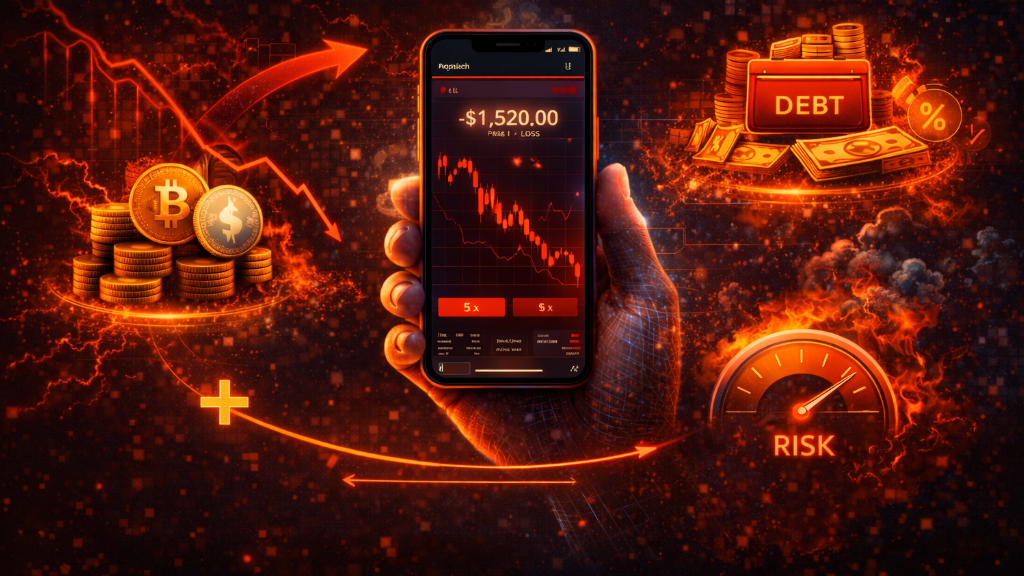
Liquidation is the most obvious risk. However, the dynamics around it deserve more attention than they usually receive. In thin markets or during rapid price moves, liquidations can cascade. One large liquidation depresses price, triggering other liquidations at lower levels. This creates a feedback loop that can move prices far beyond what fundamental analysis would suggest. Being on the wrong side of these cascades can be devastating, even with reasonable leverage.
Borrow costs erode returns silently. A trader who is correct about direction but wrong about timing can lose money on a margin trade. This happens because borrow costs drain their margin while the market consolidates. This is especially acute in sideways markets. In such cases, leverage amplifies neither wins nor losses but fees keep accumulating.
Emotional risk management is significantly harder with leveraged positions. The psychological pressure of watching a position approach liquidation affects decision-making. These effects are often very difficult to prepare for in advance. Many traders who manage unlevered positions well find that leverage introduces a specific quality of anxiety. This often leads to poor exit timing, such as panic-selling or holding past rational points.
Regulatory risk is structural. The legal status of crypto margin trading varies by jurisdiction. It has also changed significantly in several markets over recent years. Platforms that are accessible today may restrict or exit certain markets with limited notice. Assets held on margin at a platform are also subject to counterparty risk. The exchange’s solvency and security practices determine whether your funds are actually there when you want them.
Margin Trading vs Futures Trading
The distinction between margin trading and futures trading is frequently blurred in crypto, partly because perpetual futures contracts dominate cryptocurrency derivatives markets and behave somewhat like leveraged spot positions.
In traditional margin trading, you borrow actual cryptocurrency and trade it in the spot market. You own the underlying asset (or owe it, in a short). Interest is charged on borrowed funds. There’s no contract expiry.
In futures trading, you enter a contract that tracks the price of an underlying asset. You don’t own the asset itself. Perpetual futures — which have no expiry date — use a funding rate mechanism instead of interest to keep the contract price anchored to spot. When perpetual contracts trade at a premium to spot, longs pay shorts; when they trade at a discount, shorts pay longs.
The practical differences matter for cost and tax treatment. Funding rates on perpetual futures can be significantly positive or negative depending on market conditions, sometimes substantially higher than spot margin borrow rates and sometimes effectively negative (paying the holder). For tax purposes in most jurisdictions, futures positions are treated differently from spot margin positions — a distinction that matters for calculating taxable gains and losses.
Margin trading typically offers more straightforward execution for traders who want direct exposure to the spot asset. Futures trading offers better capital efficiency at high leverage and is the preferred instrument for institutional hedging and speculation in crypto markets.
Is Crypto Margin Trading Suitable for Beginners?
Candidly, no — not as a starting point. The combination of leverage mechanics, liquidation dynamics, borrow cost management, and the psychological pressures of leveraged positions requires a foundation of experience that most beginners haven’t developed.
The data supports this. Studies of retail derivatives trading consistently find that the majority of retail leveraged traders lose money over any meaningful period. The distribution of outcomes is skewed: experienced traders can generate outsized returns with leverage, but inexperienced traders are more likely to accelerate losses than gains.
This doesn’t mean margin trading is categorically off-limits for newer traders. Starting with very low leverage — 2x at most — on small position sizes while trading assets you understand well is a reasonable way to learn the mechanics. The important discipline is keeping positions small enough that liquidation is an expensive lesson rather than an account-ending event.
Before using margin, a trader should be able to consistently manage spot positions with stop-losses, understand technical price levels, and have enough experience to separate rational analysis from emotional reaction in real market conditions. These are the minimum competencies that make leverage a tool rather than a liability.
Conclusion
Crypto margin trading offers enhanced capital efficiency, short exposure, and hedging through borrowed funds. While a powerful tool for disciplined traders, it carries a high risk of total account liquidation if used carelessly.
Understanding mechanics like initial and maintenance margin, liquidation prices, and borrow rates is essential. However, managing the emotional pressure of leveraged positions is the true challenge. Choosing the right exchange—prioritizing insurance fund depth and transparent liquidation engines over high leverage—is critical for long-term success.
More Questions
Trading cryptocurrencies using borrowed funds to control a position larger than your balance. Your deposit serves as collateral (margin) to secure the loan from the exchange.
Leverage multipliers amplify both gains and losses. At 10x leverage, a $1,000 margin controls a $10,000 position. A 5% price increase yields a 50% profit, while a 5% drop results in a 50% loss.
Using leverage to open long or short positions specifically on BTC. Due to its high liquidity, Bitcoin is the most common asset for margined trading via pairs like BTC/USDT.
Enable margin on your exchange, fund your wallet, choose a leverage level, and set your position size. Always check the liquidation price and use stop-loss orders to protect your capital.
The main risks include total liquidation, high borrowing costs, and “liquidation cascades” where forced sales drive prices further down. Emotional stress can also lead to poor decision-making.
In margin trading, you borrow and trade actual assets in the spot market. Futures are contracts tracking the asset’s price without ownership. Futures typically use funding rates, while margin trading involves interest on borrowed funds.
Published Articles
 Popular
Bitcoin Pizza Guy: The Story Behind the First Real Bitcoin Purchase
Introduction The history of Bitcoin is full of dramatic ups and downs,...
 Popular
The Meme Economy: How Internet Humor Shapes Culture, Markets, and Crypto
Introduction Ten years ago, the idea that a picture of a dog...
 Popular
What is the Omniverse? Exploring the Ultimate Multiversal Concept
Introduction Do you know what the omniverse is? Is this concept real?...

Bitcoin Taproot Explained: What the Upgrade Means for BTC
Introduction Unfortunately, the most popular cryptocurrency today – Bitcoin – was not...
Crypto On-Ramps and Off-Ramps Explained: How Fiat and Crypto Move In and Out
Entering the world of digital assets often feels like trying to cross...

Crypto Basics Explained: A Beginner’s Guide to Cryptocurrency and Trading
Introduction The world of finance is changing right before our eyes. Just...