
Crypto Private Keys Explained: What They Are, How Bitcoin Keys Work, and Why They Matter

Introduction
In crypto, ownership works fundamentally differently than in traditional finance. There are no banks where you open an account or rent a safe deposit box, and there is no support desk that can restore access if something goes wrong. In cryptocurrencies, users are always responsible for protecting their own funds, and the foundation of this system is the private key – a unique cryptographic element that determines who truly controls digital assets.
For many users, the concept of a crypto private key remains abstract. Beginners often treat a wallet as an app or an account, without realizing that a wallet private key is the only proof of ownership. Losing the key means losing access to funds, while key compromise means a third party can gain full control.
In this article, we take a detailed look at what private keys crypto are, how they are created, what they control, how different key types compare, how they are used in wallets, and why protecting keys is critical for every crypto user.
What Is a Crypto Private Key?
To understand how digital assets work and how to keep them safe, it is essential to know what is a private key crypto. A private key is a long, randomly generated string of characters that serves as cryptographic proof of ownership. This key gives the user the ability to sign transactions and control assets on a blockchain.
Private keys are generated using entropy – a random value that makes keys practically impossible to guess. Entropy can come from different sources: hardware randomness, environmental noise, or user actions (such as mouse movement and keystrokes). Keys are often created by combining entropy with cryptographic algorithms such as SHA-256 to produce a 256-bit key. Many wallets also use a hierarchical deterministic (HD) structure. From a single seed phrase (mnemonic phrase), a whole tree of private keys and addresses can be generated. The process works like this: the seed phrase is converted into a large number (the seed), and a defined algorithm derives private keys for different cryptocurrencies and addresses.
In crypto, private keys crypto do not store coins. The blockchain only records which addresses control certain balances, and a crypto private key is used to create a digital signature proving that the key holder is authorized to move funds associated with a specific address.
In most cases, users do not interact with the key directly. A wallet generates and stores the crypto wallet private key securely, while the user manages assets through an interface. Still, responsibility for the key always remains with the owner, which makes private keys one of the most critical topics in crypto. A key cannot be recovered through email or customer support – losing it means losing access to funds.
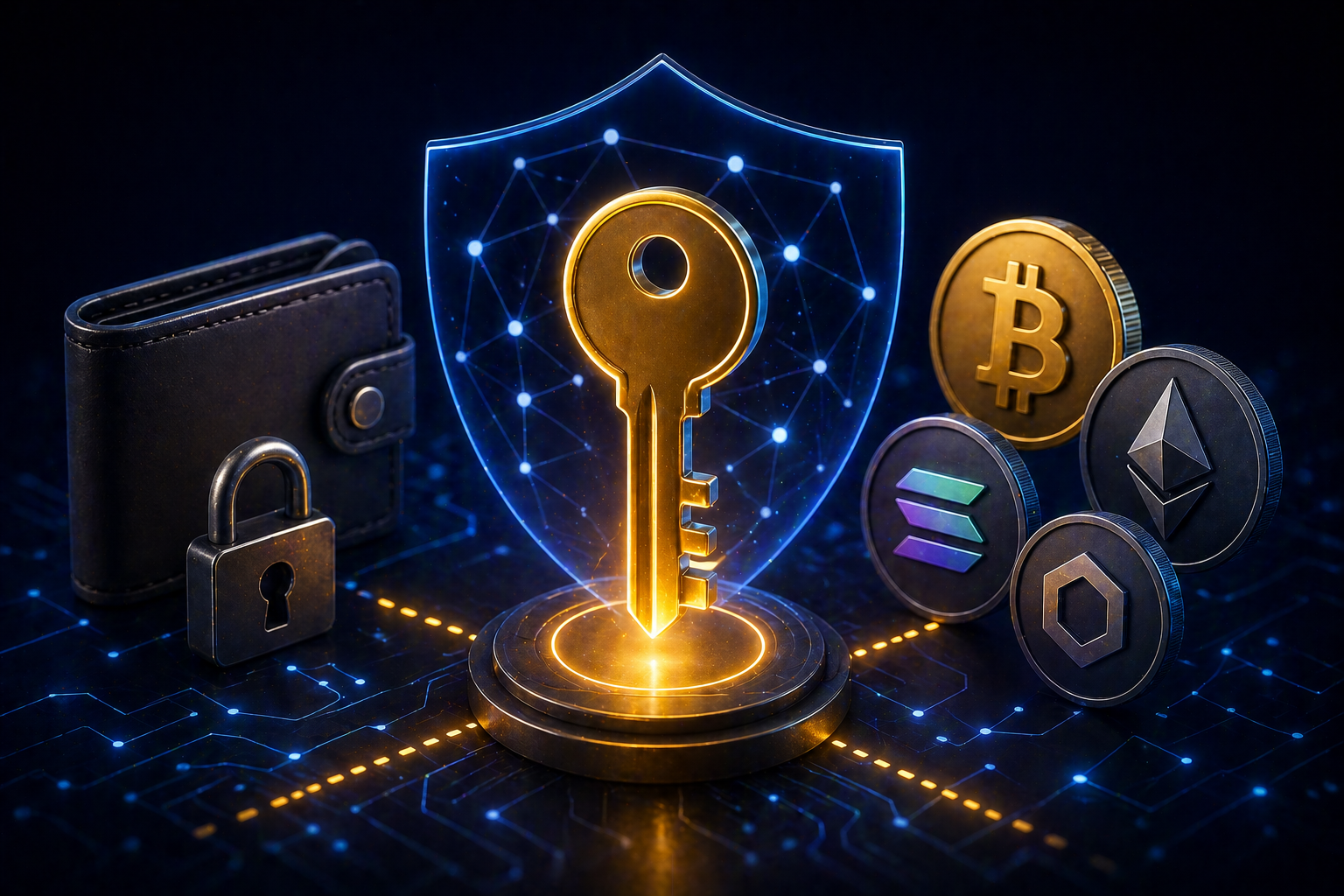
Bitcoin Keys Explained
The private key system in the Bitcoin ecosystem deserves special attention. To understand why a bitcoin key matters, it helps to see how keys, addresses, and control over funds are connected in the BTC network. This is also why Bitcoin is often described as “money without intermediaries.”
Bitcoin Public Key vs Private Key
Bitcoin uses a key pair: a public key and a private key. The private key bitcoin is the secret part of the pair that is known only to the wallet owner, while the public key can be shared and is used to generate addresses.
The relationship is one-way. Knowing the public key or address does not allow anyone to derive the private key. This is what makes the system secure. In practical terms, a bitcoin key is not a single object, but a sequence: private key → public key → address, where funds are received.
How Bitcoin Keys Are Generated
Bitcoin keys are created using cryptographically secure random number generation. bitcoin keys are not issued by a central authority and are not registered in advance – each wallet generates them independently. Modern wallets generate a crypto wallet key automatically without user involvement. But behind this convenience is a critical point: if the generation process is compromised or the backup phrase is lost, restoring a private key bitcoin is impossible.
What a Bitcoin Key Controls
A bitcoin key does not store cryptocurrency. It is simply a set of characters that gives you the unique ability to sign transactions that move funds associated with specific addresses on the blockchain. In other words, whoever controls the key controls the funds.
This is why Bitcoin has no concept of “freezing” or “reversing” transactions. If a private key is lost or stolen, the network cannot distinguish between a legitimate owner and an attacker. Control is defined purely by cryptography, not identity.
Private Keys in Crypto Wallets
Technically, a crypto wallet is not a place where coins are stored, but a tool for key management. A crypto wallet private key is the central element of any wallet architecture. Even though users interact through an interface, all wallet operations ultimately come down to private keys and digital signatures.
How Wallets Generate Private Keys
Modern wallets create private keys crypto using a cryptographically secure random number generator. Randomness is the core: a key is a large number selected from a vast range of possible values. The probability that two users generate the same key is effectively zero.
Most of the time, users see not the private key, but a seed phrase – a set of words from which the key can be recovered. This phrase is a human-readable representation of key material. Losing the seed phrase means losing all associated wallet private key values. This is also what scammers most often try to steal, because with it they can restore your wallet elsewhere.
How Private Keys Are Used in Transactions
When a user sends cryptocurrency, the wallet constructs a transaction and signs it using a crypto private key. The signature proves to the network that the transaction was created by the key owner and has not been modified.
It is important to emphasize that the private key bitcoin – or the private key for any other asset – is never transmitted to the network. It is used locally, while only the digital signature is recorded on-chain. This security property is one of the key differences between cryptocurrencies and centralized authorization systems.
Key Storage: Hot vs Cold Wallets
How you store a private key wallet directly affects your security level. In hot wallets (installed on a phone or computer), the key is stored on an internet-connected device, which improves convenience but increases compromise risk.
Cold wallets, by contrast, isolate the cryptocurrency key from the internet. Transactions are signed offline, which significantly reduces the likelihood of theft. Regardless of the wallet type, the principle remains the same: whoever controls the crypto wallet key controls the funds.
Why Wallets Never “Store Coins”
A common misconception is that a wallet “stores” crypto. In reality, assets exist only on the blockchain. A wallet manages keys that grant access to those records. That is why switching devices or apps does not affect funds as long as private keys or a seed phrase are preserved – and why even the best wallet interface is useless without access to keys.
Types of Crypto Private Keys
Not all private keys crypto are used the same way. As wallets and infrastructure evolved, multiple key management models emerged, each designed for different priorities – from convenience to stronger security. Understanding these differences helps you choose a storage approach deliberately.
Single-Key Wallets
The simplest model is a wallet controlled by a single private key. In this case, one key fully controls access to funds. This approach is common in basic software wallets and early generations of crypto wallets.
The advantage is simplicity: you only need to secure one wallet private key or a single seed phrase. The obvious drawback is that loss or compromise means complete and irreversible loss of funds.
HD Wallets and Derived Keys
Most modern wallets use a hierarchical deterministic structure known as HD wallets. In this model, one master seed can generate many derived keys for different addresses.
For the user, this is convenient: a single seed phrase restores all crypto wallet private key values. Each address uses a unique key, which improves privacy and security. The HD model has become the standard for managing bitcoin keys and most other cryptocurrencies.
Multi-Signature Wallet Keys
Multi-signature wallets require multiple private keys to authorize transactions. Instead of a single crypto private key, the wallet may require, for example, two out of three keys to approve a transfer.
This model is widely used in corporate custody, DAOs, and shared fund management. It reduces single points of failure and protects against the loss of one key. Responsibility is distributed across participants, which makes a private key wallet part of a more complex access-control system.
Private Key Examples and Common Formats
In day-to-day use, users rarely see a private key, but understanding common formats helps clarify how control actually works. At a technical level, private keys are large numbers, but for usability they can be represented in different forms.
The simplest form is a hexadecimal string. In this format, a crypto private key example may appear as a long sequence of letters and numbers. This representation is common in software and internal wallet processes, but it is rarely shown directly due to the high risk of mistakes.
Bitcoin and some other networks use WIF (Wallet Import Format). It is designed to simplify key import between wallets. In WIF, a private key bitcoin is encoded to reduce the chance of input errors and to signal the relevant network context.
At the user level, the most common representation is the seed phrase. It consists of a set of words from which all bitcoin keys or other wallet keys can be mathematically derived. While a seed phrase is not the key itself, it provides full control over all associated private key wallet values.
It is critical to understand that format does not change the underlying reality. Whether a key is presented as a string, a seed phrase, or an encrypted file, what is a crypto key remains the same: it is the only element that proves the right to control funds.
Security and Risks of Private Keys
The security of your crypto assets depends directly on how well you protect your private key. Unlike banking systems, there are no recovery mechanisms and no way to reverse transactions.
The main risk is losing the key. If a user loses a wallet private key or a seed phrase, access to funds is lost permanently. The blockchain does not distinguish a “rightful owner” and provides no recovery procedure, even if the amount is significant.
Key compromise is equally dangerous. If a crypto private key falls into the hands of an attacker, they gain full control over the assets. In that case, theft looks like a normal transaction, and the network cannot distinguish it from legitimate activity.
There are also indirect risks, including:
- storing keys unencrypted;
- using malicious applications;
- phishing sites that imitate wallets;
- backups stored in the cloud without protection.
Human error is especially important: mistakes during copying, misunderstanding what are private keys crypto, or trusting third-party services are common causes of loss. This is why key protection is not a one-time action, but an ongoing process that requires discipline and attention.
Coinbase Wallet and Private Keys
When it comes to storing cryptocurrency, many users face a key question: who controls the private key – the user or the platform? Coinbase Wallet provides a useful example.
It is important to separate two concepts: the centralized Coinbase exchange and the self-custodial Coinbase Wallet. On the exchange, users do not control the crypto wallet private key directly – the platform holds the keys. Coinbase Wallet, however, is a non-custodial solution, meaning key control remains with the user.
In Coinbase Wallet, the coinbase wallet private key is generated and stored locally on the user’s device. Access to funds is possible only with the seed phrase, which restores all associated private keys. This means that even Coinbase cannot access the assets without the owner’s involvement.
This illustrates a core crypto principle: if you control the keys, you control the funds. But with that control comes responsibility. Losing the seed phrase in Coinbase Wallet has the same consequence as in any self-custodial wallet – assets become inaccessible.
Coinbase Wallet is a clear example of the trade-off between convenience and self-custody. The user gains full control over the private key crypto, while taking on all risks related to key security and storage.
Private Keys vs Public Keys vs Addresses
Users often confuse three related but fundamentally different concepts: the private key, the public key, and the address.
A private key crypto is the secret element that authorizes transaction signing. It must never be shared and is not used to receive funds. Its only function is proving to the network that a transaction was created by the rightful controller of the assets.
A public key is mathematically derived from the private key. It can be shared without compromising security and serves as an intermediate element. In most cases, users do not interact with it directly, but an address is derived from the public key.
An address is a shortened, hashed representation of the public key. Addresses are used to receive funds and are what wallets display. When someone sends you cryptocurrency, they interact with the address, not the wallet’s private key.
The hierarchy is essential:
- private key – control and signing;
- public key – signature verification;
- address – a convenient identifier for transfers.
This structure explains why sharing an address is safe, while exposing a key is critical. The entire crypto system is designed so that control belongs only to the private key holder, while other elements can be public.

Common Mistakes With Crypto Private Keys
Most crypto losses are caused not by blockchain vulnerabilities, but by human error. Even when users understand what is a crypto key, they often repeat the same mistakes with private keys crypto.
One of the most common errors is storing a wallet private key digitally without protection. Screenshots, cloud notes, or unencrypted files make the key vulnerable to theft and leaks. In such cases, device compromise often equals fund loss.
Another frequent issue is trusting third-party services. Users enter a crypto private key or seed phrase on phishing websites without verifying the source. A single such entry can lead to total asset loss because attackers do not need to hack a wallet – they receive the key directly.
Backup mistakes are also common. Some users create only one seed phrase copy and store it in an insecure location. Losing that copy is equivalent to losing all associated private keys. Others create too many copies, increasing leakage risk.
Finally, underestimating complexity often leads to misunderstanding what are private keys crypto. Users confuse keys with addresses, passwords, or accounts, which creates a false sense of security and results in costly decisions.
How to Protect Your Crypto Keys
Securing your private key is the foundation of safe crypto usage. Whether you use Bitcoin, altcoins, or DeFi applications, control always comes down to one question: who holds the crypto private key?
The first rule is never to share keys with anyone. No legitimate service, wallet, or platform will ask for a wallet private key or a seed phrase. Any such request is almost certainly a scam.
The second step is choosing the right storage method. For meaningful amounts, cold wallets are recommended, where the crypto wallet private key is isolated from the internet. This reduces the risk of hacking, malware, and phishing.
It is also important to:
- store your seed phrase offline in physical form;
- avoid photos and cloud storage;
- keep multiple backups in separate secure locations;
- regularly verify the authenticity of the software you use.
Ultimately, protecting keys is not a single action but a set of habits. Understanding what is a private key crypto should be paired with discipline and a security-first mindset.
Conclusion
Private keys are the foundation of the entire crypto ecosystem. Understanding what a private key is and how it works is essential for truly grasping self-custody and digital asset ownership.
In crypto, control is defined not by an account or a name, but by possession of the key. Private keys perform the core function: they authorize transaction signing and enable asset control on-chain. Losing a key means losing access, while exposure means handing control to a third party with no ability to reverse the outcome.
As crypto markets grow and infrastructure becomes more complex, the topic of keys becomes increasingly important. Understanding the differences between keys, addresses, and wallets, recognizing common mistakes, and following basic security rules turns the crypto private key from a source of risk into a tool for confident, informed crypto use.
Ultimately, owning cryptocurrency is not only an investment – it is a responsibility. And the private key is the element that makes that responsibility real.
Published Articles
 Popular
Bitcoin Pizza Guy: The Story Behind the First Real Bitcoin Purchase
Introduction The history of Bitcoin is full of dramatic ups and downs,...
 Popular
The Meme Economy: How Internet Humor Shapes Culture, Markets, and Crypto
Introduction Ten years ago, the idea that a picture of a dog...
 Popular
What is the Omniverse? Exploring the Ultimate Multiversal Concept
Introduction Do you know what the omniverse is? Is this concept real?...

Bitcoin Taproot Explained: What the Upgrade Means for BTC
Introduction Unfortunately, the most popular cryptocurrency today – Bitcoin – was not...

Crypto On-Ramps and Off-Ramps Explained: How Fiat and Crypto Move In and Out
Entering the world of digital assets often feels like trying to cross...

Crypto Basics Explained: A Beginner’s Guide to Cryptocurrency and Trading
Introduction The world of finance is changing right before our eyes. Just...