
Crypto rug pulls: what are they & how to avoid them
Introduction
The crypto market often feels like a digital “Wild West,” where flashy promises of high returns hide simple traps. We are used to stories of sudden wealth, but the reality of 2026 shows a different side: in the first six months alone, investors lost about $500 million to fraud. These aren’t just dry report figures; these are real savings of people who trusted the wrong projects.
I believe a “rug pull” is the most deceitful type of scam in the industry. Imagine you’ve invested in a project, you see the price climbing, and in the next second, the developers simply empty the liquidity pool and vanish. Your investment turns into useless code instantly. In this article, I will break down how these schemes work and which red flags you should watch for to avoid leaving your money in the pockets of anonymous scammers.
What is a rug pull in crypto?
Let me put it as simply as possible. Imagine walking into a carnival and seeing a magician. He performs incredible tricks, collects money from the crowd in a hat, and then — poof! — he vanishes with that hat before the show even ends. A rug pull in crypto works the exact same way. Developers create a new token, promise the world, build up massive hype, and once enough investor money is in the project, they just take everything and delete their social media accounts.
I am often asked why this is so easy to pull off. It all comes down to decentralization. On platforms like Uniswap or PancakeSwap, anyone can list a token for sale without any real vetting. This is the dark side of freedom: the blockchain provides anonymity, which scammers exploit. It is vital to realize this isn’t just a bad business plan. It is deliberate theft where the investor is left holding worthless “dust” that cannot be sold because there is no liquidity left in the pool.
How a crypto rug pull works
A scam is rarely a random event. It is always a clear script that starts with hype and ends with empty investor wallets. I often see people fall for the same tricks because the mechanics of the fraud are polished to a T. Scammers only need to create a facade of utility and wait for the crowd’s greed to do the rest.
Liquidity withdrawal scam
This is perhaps the most classic version. To make a token tradable, developers create a liquidity pool on a decentralized exchange (DEX). They put in their new tokens and liquid currency, like Ethereum or USDT. As investors start putting in their funds, the pool grows. At some point, the scammers just take all the valuable currency, leaving you with a pile of worthless tokens that can no longer be exchanged for anything.
Malicious smart contract code
This part is a bit more complex and clever. Scammers hide special functions in the contract code that a regular user won’t notice. I have come across projects where you can buy a token but technically cannot sell it — these are known as “honeypots.” It also happens that developers write in the ability to infinitely mint new coins for themselves, which instantly devalues your investment.
Developer token dump
Sometimes the creators of a project act more modestly and do not touch the liquidity pool directly. Instead, they keep a huge percentage of the total coins issued. As soon as the price skyrockets on the marketing wave, they start selling off their holdings en masse. This crashes the rate in seconds, and the team simply vanishes with the profit while you are still trying to figure out what happened.
Types of rug pull scams
Scammers are constantly coming up with new ways to cover their tracks and lure money out of people. I have noticed that the lines between different schemes often blur, but the industry generally identifies several main categories. Knowing these differences helps you understand at what stage a project might “collapse.” In July 2025, for instance, nearly half of all cases belonged to the crudest, most classic type of fraud.
Hard rug pull
This is the most aggressive and obvious scenario. Developers intentionally bake malicious functions into the smart contract code. I call this “daylight robbery.” For example, they might code an ability to suddenly stop trading for everyone but themselves or simply drain all funds from the protocol. Statistics from July 2025 show that 45% of all cases were exactly this — traditional thefts. A prime example is the GreenTech Token project, where the creators simply siphoned off $15 million and vanished.
Soft rug pull
This one is much more subtle and devious because, technically, the code might look clean. Scammers play on trust and marketing. They might promise long-term development while quietly dumping their massive token reserves onto the market, crashing the price. It doesn’t happen instantly like a “hard” pull, but the result is the same — investors are left with worthless assets. In July, these “liquidity” schemes accounted for about 35% of all losses, as seen with BioEnergy Coin, which lost $30 million.
Exit scam vs rug pull
Many people confuse these terms, and I don’t blame them. The line is thin. A rug pull usually happens in the early stages of a project’s life, often on decentralized exchanges, and aims for a quick liquidity grab. An exit scam is a broader concept. It can happen even to a major centralized exchange or a platform that has operated for years. A classic example is the Turkish exchange Thodex, whose CEO simply fled with $2 billion of user funds. That was an exit scam of an established business.
Real examples: list of rug pull crypto cases
Looking back at the big stories, I often think about how easily greed beats caution. In July 2025, the industry was rocked by two major cases — QuantumX and EcoChain. The former promised a next-gen blockchain resistant to quantum threats and raised $25 million before the developers suddenly drained the liquidity. EcoChain played on the trendy “green energy” theme, sucking $40 million out of investors in just a month and a half.
But if we look deeper into history, the list of rug pull crypto expands with even bolder examples. Remember OneCoin — this massive Ponzi scheme defrauded people of an incredible $4 billion. Or the Turkish exchange Thodex, whose CEO simply flew away with $2 billion in user funds. I am still amazed at the 2020 SushiSwap case, where the lead developer withdrew $14 million worth of ETH, although he later returned it under massive community pressure. These cases show that the scale of fraud can range from small overnight tokens to international platforms.
Why rug pulls happen so often
I often wonder why, despite all the news about hacks, people keep putting money into shady projects. The answer is quite simple: the technical barrier to entry has almost vanished. Today, creating a token and listing it on a decentralized exchange (DEX) costs pennies and takes just a few clicks. Statistics back this up — 60% of scam tokens were listed on exactly these unregulated platforms. This is the flip side of the freedom blockchain offers: there is no censorship, but there is no protection either.
The second reason is the psychological hook. Scammers skillfully inflate the price to create an illusion of success. On average, a scam token’s value skyrockets by 200% before everything collapses. When you see those numbers on your screen, critical thinking often shuts down, replaced by FOMO. In the first half of 2026 alone, investors handed over half a billion dollars to scammers. As long as anonymity remains the main rule of the game, this fraud machine will keep running at full capacity.
Warning signs of a rug pull crypto project
I always say: if it looks too good to be true, it probably is. In the crypto world, intuition is your best friend, but it must be backed by facts. Scammers often leave traces, even when they try to hide behind flashy websites. I have learned to look past the marketing fluff and search for specific technical holes that reveal the developers’ intentions long before they hit the “exit” button.
Unlocked liquidity
To me, this is the biggest red flag. In a legitimate project, developers lock liquidity using a smart contract for a set period. It is their way of saying, “We won’t take your money tomorrow.” If the liquidity is unlocked, it means the creators can drain all funds from the pool at any second. Based on my observations, sudden and large withdrawals from pools often serve as the final act before a project vanishes.
No audit or transparent team
I am very suspicious of projects where developers hide behind NFT avatars. Anonymity is part of the blockchain culture, but when it comes to your money, it is a massive risk. If a project has not passed a security audit by a well-known firm, I wouldn’t touch it. Scammers fear audits because a professional check would immediately highlight hidden theft functions or the ability to infinitely mint tokens that they have baked into the code.
Unrealistic promises and aggressive marketing
When I see a token advertised by every other influencer, I get nervous. According to 2026 statistics, 70% of all rug pull projects used exactly this kind of aggressive marketing to lure victims. Promises of “guaranteed gains” or 1000% returns are just bait. Scammers know how to play on our FOMO (fear of missing out) and use bright visuals to distract your attention from empty or dangerous code.
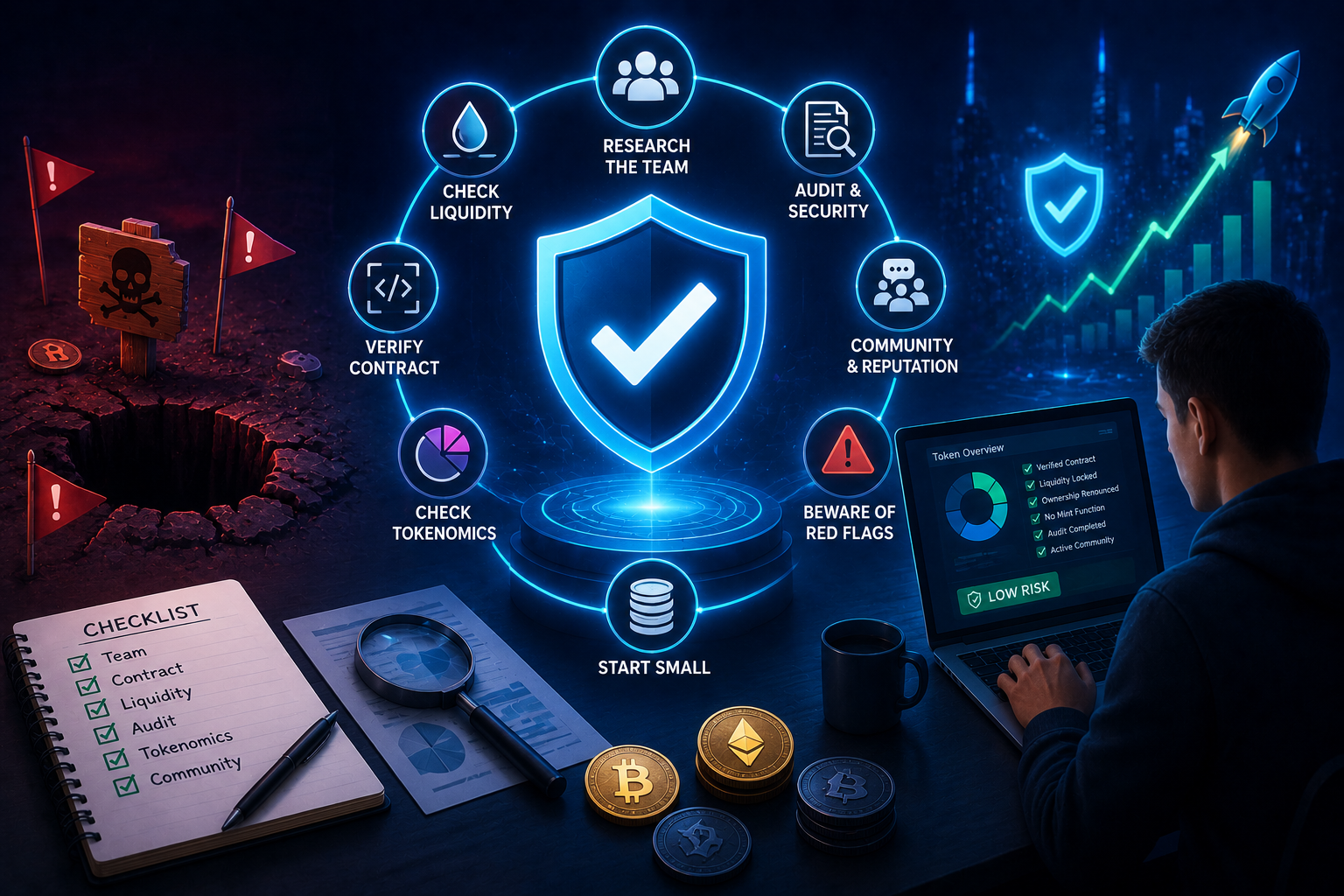
How to check if a token is a rug pull risk
Before I send my money to a new project, I always perform a “technical inspection.” It doesn’t take much time, but it often saves thousands of dollars. First, I head to sites like Etherscan or BscScan to check the “Holders” section. If I see a single wallet holding 20% or 30% of all tokens, that’s my cue to close the tab immediately. Scammers often keep the lion’s share of coins to crash the market later with a single move.
I also suggest using specialized detectors like Rug Doc or Token Sniffer. These tools automatically scan the contract for functions that allow developers to steal funds. If the tool flags it as “High Risk,” I don’t try to argue with logic — I just walk away. Checking the code for minting capabilities or sudden changes in sell taxes is a fundamental step you can’t ignore. 60% of scam tokens were launched on DEXs without any vetting, so your own caution is the only real insurance you have.
Rug pull vs pump and dump
I often see newcomers mixing up these two schemes, and honestly, in the heat of a market frenzy, they can look very similar. But there is a fundamental difference in who is “holding the knife.” In a pump and dump, an entire group of manipulators — who didn’t necessarily create the token — coordinates to drive the price up. They pick a low-cap coin, buy it en masse, and hype it up to create artificial demand. Once the price peaks, they all sell at once, leaving everyone else holding the bag.
A rug pull is a deeper, more technical trap set by the creators themselves. It isn’t just about price manipulation; it is about direct control over the code or liquidity pools. The scammers don’t just sell their coins; they literally “turn off” the project by sucking all investor funds out of it. While in a “pump” you could theoretically get out with a profit while the price is rising, a “rug” often strips you of the technical ability to sell at all. My research shows that the average scam token price jumps by about 200% before the collapse, which perfectly mimics a typical “pump” and makes people drop their guard.
Regulation and law enforcement response
For a long time, the crypto space was a sort of safe harbor for scammers, but I see the situation is starting to shift. Regulators worldwide have finally moved from simple warnings to active measures. After losses from scams hit the $500 million mark in the first half of 2026, law enforcement began paying much closer attention to decentralized finance. The FBI and Interpol are now working closely with analytics firms to track the path of stolen money, even through complex transaction chains.
I believe that total anonymity on the blockchain is a myth that scammers mistakenly continue to bank on. The US Department of Justice has proven more than once that it can find the culprits years after the crime was committed. The introduction of MiCA rules in Europe is also forcing exchanges to vet projects more strictly. Of course, reaching every anonymous team on a DEX is still difficult, but the circle is tightening. To me, this is a good sign: the more real arrests and fund recoveries we see, the fewer people will want to pull the rug.
How to avoid rug pull scams
Protecting your assets isn’t a one-time check; it is a whole system of habits. First, I always look at the liquidity. If it’s not locked in a smart contract for at least a year, I don’t even consider the project. That is the baseline. I also suggest using technical detectors like Token Sniffer. If the tool finds “mint” or “honeypot” functions in the code, just run away.
The events of July 2024 showed that even projects with beautiful websites can turn out to be empty shells. I recommend investing only amounts you are prepared to lose and always checking token distribution. If five wallets hold half of all coins, you are held hostage by their desire to take profits. Use reputable exchanges with strict listing standards — this significantly reduces the risk of stumbling upon total garbage.
Community governance
Another thing is how decisions are made. Projects with decentralized governance (DAOs) make me feel much safer. When changes to the code or fund movements require a vote from token holders, the risk of developers suddenly “vanishing” drops. I believe an active and critical community is the best kind of audit. If project moderators respond to tough questions with bans or aggression, it’s a sure sign they are hiding something from you.
Conclusion
Wrapping things up, I want to say that a “rug pull” is a harsh lesson for any investor, but it is one you can avoid if you don’t let your emotions take the wheel. We have seen that in the first half of 2024 alone, scammers drained half a billion dollars by exploiting people’s trust and the anonymity of decentralized finance. That is a massive figure, but behind every stolen cent is a mistake that could have been prevented with the right approach.
I believe the key to staying safe lies in healthy skepticism. Don’t be lazy about checking liquidity locks, use detectors to scan smart contracts, and always look at how a project interacts with its community. The crypto market offers incredible opportunities, but it also demands maximum responsibility. Remember: your primary goal isn’t to make millions overnight, but to protect what you already have without falling for the tricks of anonymous scammers.
Published Articles
 Popular
Bitcoin Pizza Guy: The Story Behind the First Real Bitcoin Purchase
Introduction The history of Bitcoin is full of dramatic ups and downs,...
 Popular
The Meme Economy: How Internet Humor Shapes Culture, Markets, and Crypto
Introduction Ten years ago, the idea that a picture of a dog...
 Popular
What is the Omniverse? Exploring the Ultimate Multiversal Concept
Introduction Do you know what the omniverse is? Is this concept real?...
Bitcoin Taproot Explained: What the Upgrade Means for BTC
Introduction Unfortunately, the most popular cryptocurrency today – Bitcoin – was not...
Crypto On-Ramps and Off-Ramps Explained: How Fiat and Crypto Move In and Out
Entering the world of digital assets often feels like trying to cross...
Crypto Basics Explained: A Beginner’s Guide to Cryptocurrency and Trading
Introduction The world of finance is changing right before our eyes. Just...