
Crypto Whales Explained: What They Are and How They Move the Market

Introduction
The crypto market can shift in minutes — and the reason is not always obvious. Bitcoin drops sharply with no news to explain it. Ethereum gains 8% in an hour. An altcoin nobody mentioned yesterday suddenly tops the volume charts. Behind many of these moves sits the same force: crypto whales. A whale in crypto is not a mythical creature or an exchange term with a fixed legal definition. It is an informal label for a market participant holding enough of an asset that a single transaction can noticeably move the price. Understanding what crypto whales are, how they act, and what their activity means for everyone else is a practical skill for anyone working with digital assets.
What Is a Crypto Whale?
What is a whale in crypto? It is an individual, organization, or wallet controlling a large enough volume of cryptocurrency that its trading actions influence the market price. There is no official threshold at which a participant becomes a whale — but the community has developed working benchmarks.
For Bitcoin, a whale is traditionally defined as an address holding at least 1,000 BTC. In early 2025, roughly 2,000 such addresses existed, collectively controlling more than 40% of the circulating supply. For Ethereum and other major assets the numbers differ, but the logic is the same: a small number of addresses holds a disproportionately large share of the market.
Crypto whales come in many forms. Early investors who bought Bitcoin for fractions of a dollar in 2009–2012 and never sold. Institutional funds managing crypto portfolios worth billions. Exchanges holding user funds in cold wallets. Mining companies sitting on accumulated reserves. Government agencies — several governments have confiscated Bitcoin and become holders of large positions through asset seizures.
What unites all of them is a position size large enough to move markets.

What Is a Bitcoin Whale?
A Bitcoin whale is a market participant with a large position specifically in BTC whose actions can move Bitcoin’s price. Not necessarily an individual — the wallet may belong to a corporation or a fund. This is the most studied and most frequently discussed whale category, because Bitcoin is the most liquid and highest-capitalization crypto asset.
What is a Bitcoin whale from a market perspective? When a wallet holding 5,000 BTC starts moving coins to an exchange, that is a signal. Not necessarily a sell signal — the transfer may be technical or related to rebalancing between wallets. But the market reacts to the sheer fact of large volume moving.
The best-known Bitcoin whales include Satoshi Nakamoto, with an estimated 1 million BTC sitting in early wallets that have never moved. The U.S. government, holding assets seized from Silk Road and other enforcement actions. MicroStrategy, the public company that made Bitcoin the core asset of its corporate balance sheet. Binance and Coinbase, whose cold wallets hold hundreds of thousands of user coins.
The behavior of these players is tracked publicly — precisely because the blockchain is transparent. But anonymous whales whose identities are unknown are just as numerous.
How Crypto Whales Influence the Market
Large Buy Orders
When a whale buys a large volume of an asset, it is not just a transaction — it is an event with consequences. On a retail exchange, a large market buy order absorbs liquidity from the order book upward, pushing the price higher as it fills.
Even when a whale uses limit orders or an OTC desk to avoid directly moving the market, the accumulation of a large position becomes visible through on-chain data over time. When other participants notice this, they often join the buying — creating additional demand pressure that amplifies the move.
Historically, large purchases by well-known institutional players — MicroStrategy, Tesla in 2021 — preceded or accompanied significant Bitcoin price increases.
Market Dumps
The opposite scenario: a large whale sale creates supply the market cannot absorb quickly. When a whale sells through an exchange order rather than OTC, slippage works the other way — each successive order fills at a lower price as order book liquidity drains.
Even a rumor or an on-chain signal that a whale intends to sell can trigger preemptive selling by other participants. The market starts falling before the whale has actually sold anything. This is the classic panic mechanism, and in crypto — with its relatively thin liquidity — it plays out especially sharply.
Large transfers from cold wallets to exchange addresses are traditionally read by the market as preparation to sell, even when the actual intent is different.
Liquidity Impact
Whales affect the market not only through direct trades, but through the simple act of holding. When large holders do not sell, they remove supply from circulation. Researchers call this mechanism “holding” — hodling in crypto slang. The more coins locked in the hands of long-term holders, the less free supply is available for trading.
With flat or growing demand, shrinking available supply creates upward price pressure. This is why analysts track the coins age destroyed metric and the split between active and inactive supply — to understand how whale behavior reshapes market structure.
Whale Behavior and Market Signals
Whale activity is observable — and that is one of the unique features of the crypto market. In traditional finance, large positions are disclosed with a delay and only partially. On the blockchain, every transaction is public and available in real time.
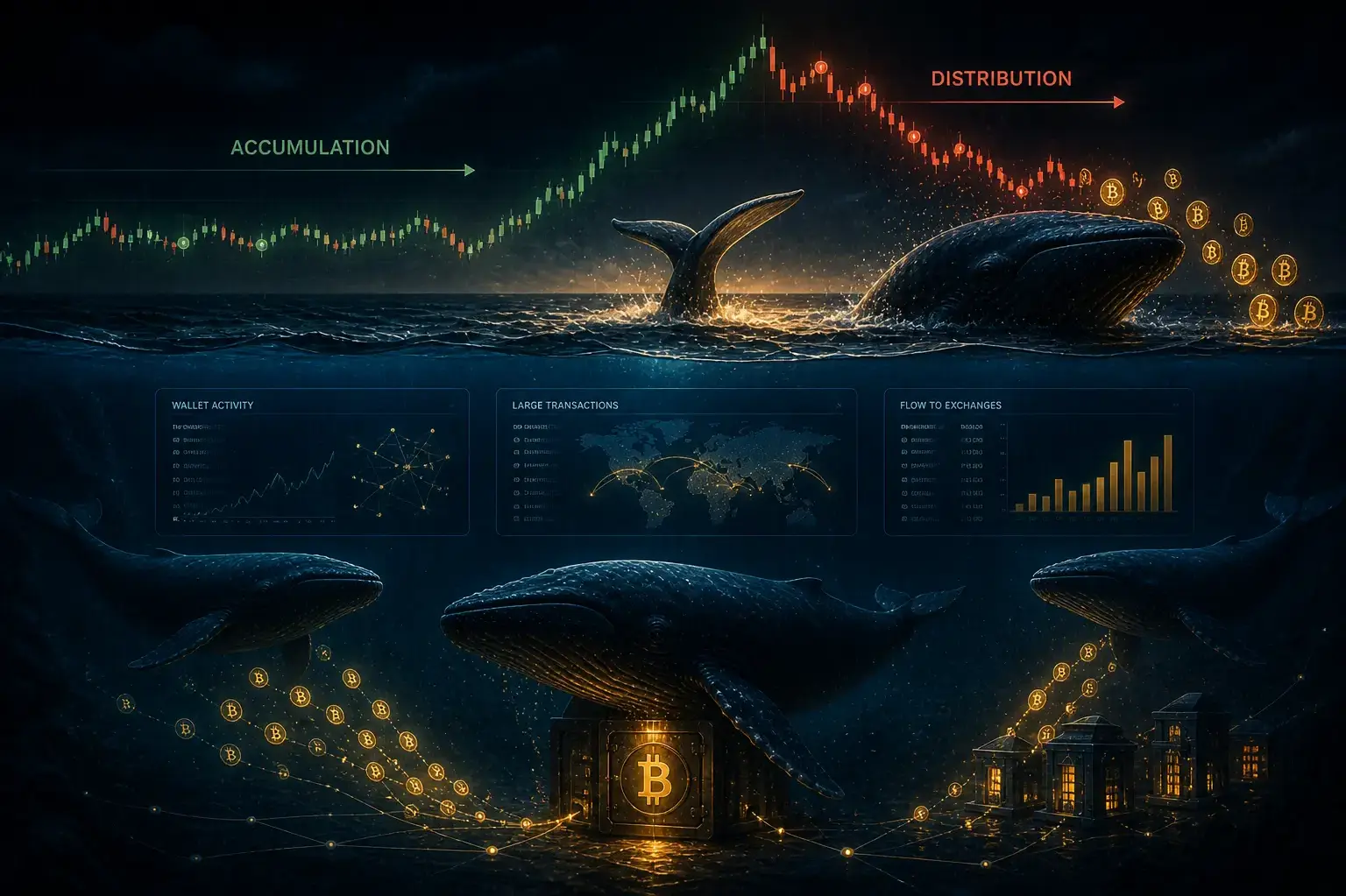
Several whale behavior patterns are well known to analysts. Accumulation in a sideways market: a whale methodically buys in small orders without moving the price, building up a position. By the time accumulation is complete and the price starts rising, outside observers have already missed it. Distribution before a top: a whale sells the position in pieces while the market is still rising, transferring the asset to retail buyers. By the time the reversal comes, the large position has already been realized.
It is important to understand: not every large-volume transfer is a trading signal. Exchanges routinely move coins between hot and cold wallets for operational purposes. Custodial services consolidate client balances. Distinguishing a genuine whale move from a technical operation is a non-trivial task even for professional analysts.
How to Track Crypto Whales
Blockchain Transparency
The public blockchain is the primary tool for observing whales. Every transaction is recorded in an immutable ledger and accessible to anyone. A Bitcoin explorer like Mempool.space or Blockchair lets you see all transactions in real time, including large ones.
Several key metrics matter for whale analysis: the balance of large addresses and how it changes over time, coin flows between cold wallets and exchanges, the age of unmoved coins (UTXO age bands for Bitcoin), and supply concentration — what share of the total is held by the top 100 or top 1,000 addresses.
Whale Alert Tools
Specialized whale monitoring services automatically track large transactions and publish them in real time. Whale Alert is the best known, operating as a standalone service and posting notifications on social media. Transactions of $1 million and above are captured almost instantly.
Beyond Whale Alert: Glassnode is an on-chain analytics platform with data on large holder behavior. CryptoQuant specializes in flows between exchanges and wallets. Nansen adds labels to blockchain addresses — exchanges, smart contracts, known funds. Arkham Intelligence attempts to de-anonymize large wallets and link them to real-world entities.
Exchange Flow Data
A separate and highly significant data category is coin flows onto and off exchanges. When a large volume moves from a cold wallet to an exchange address, that is a potential preparation to sell. The reverse movement — from an exchange to a cold wallet — is often read as accumulation and removal from circulation.
The Exchange Net Position Change metric shows whether exchange reserves are growing or shrinking. Rising reserves during a price decline is a bearish signal. Falling reserves during a rally is additional confirmation of the bullish move.
Are Crypto Whales Good or Bad for the Market?
The question has no clean answer, and an honest one requires looking at both sides.
Arguments for whales: they provide market liquidity. A large holder willing to buy or sell significant volume near the market price makes the market deeper. Institutional whales attract attention from traditional investors and legitimize crypto as an asset class. Long-term holders reduce volatility: their coins do not participate in daily trading.
Arguments against: concentration of assets among a small number of players creates manipulation risk. Coordinated action by several whales can artificially create a price move and then exit the position at the expense of retail participants. High concentration also contradicts the decentralization principle that underlies the ideology of most cryptocurrencies.
The reality is that whales are an inseparable part of any financial market. Their presence in crypto is simply more visible because of blockchain transparency.
How Retail Traders Can Respond to Whale Activity
The primary mistake when watching whales is trying to copy their moves with a delay. By the time a whale transaction becomes public and goes viral, the market has already reacted. Chasing a large move means buying at peak attention.
A few approaches that actually help. Use whale data as context, not as trading signals. Whale accumulation during a sideways market is background information that shifts the overall read on a situation — it does not provide an entry point. Monitor exchange reserves systematically. A sustained decline in exchange coin balances during a price rise is one of the most reliable on-chain indicators available.
Do not react to single transactions. One transfer of 10,000 BTC is not a signal. A series of similar moves over several days is a pattern. Use whale activity to calibrate risk. If on-chain data shows growing concentration of coins on exchange addresses, reducing a position or taking partial profits is more rational than adding leverage.
The Psychology Behind Whale Behavior
Behind whale actions lies more than position math — there are motivations that often diverge from what the market assumes.
A long-term holder with a 10,000 BTC position does not think in terms of daily or even monthly price movement. The time horizon is years. Moving 500 coins to an exchange could mean anything: covering operating expenses, preparing an OTC deal, technical rebalancing. The market reads it as preparation to sell and reacts. The whale probably never thought about that reaction.
Institutional whales operate differently. Their actions are often dictated not by market timing but by regulatory requirements, portfolio liquidity needs, or board-level corporate decisions. When a public company announces a Bitcoin purchase, it is a corporate decision made long before the actual transaction. By the time the buy happens, it is barely a surprise to anyone watching.
This matters: in most cases, whales do not consciously and coordinately manage the market. They are simply large — and therefore visible. Their price impact is a side effect of scale, not always an intentional strategy.
Key Takeaways
- A crypto whale is a market participant with a position large enough that a single transaction can noticeably shift an asset’s price. For Bitcoin, the threshold typically starts at 1,000 BTC.
- Bitcoin whales are the most studied category: early investors, institutional funds, exchanges, mining companies, and government agencies.
- Whales influence the market through large buys and sells, and through holding positions that reduce available supply.
- The blockchain allows real-time tracking of whale activity through tools like Whale Alert, Glassnode, and CryptoQuant.
- Asset concentration among a small number of players creates manipulation risk, but also provides liquidity and institutional legitimacy.
- For retail traders, whale data is useful as context for reading market conditions — not as direct signals to copy.
Expert Insight
Glassnode analysts note in their regular on-chain reports that periods of declining Bitcoin exchange reserves have historically correlated with bull market phases: when large holders withdraw coins from exchanges, they reduce the supply available for sale and create structural upward price pressure.
This observation matters less as a trading signal than as a reminder of market logic. A whale removing coins from an exchange is voting to hold the position — and that action, unlike statements and forecasts, costs real money. This is why on-chain data about large holder behavior is considered one of the most reliable leading indicators in crypto market analysis.
Conclusion
Crypto whales are neither enemies nor allies of the retail investor. They are large players whose actions are driven by their own goals: capital preservation, position optimization, corporate strategy, or simple long-term holding.
Understanding their behavior is useful for the same reason that understanding any significant market force is useful: not to blindly follow, but to correctly read context. Blockchain transparency provides tools for this that exist nowhere in traditional markets. Using them means trading with open eyes.
More Questions
A whale in crypto is a market participant controlling enough cryptocurrency that their trades can noticeably move the market price. For Bitcoin, the threshold is typically 1,000 BTC or more. Whales include both individuals — early investors — and organizations: exchanges, hedge funds, mining companies.
A crypto whale is any holder of a large position in digital assets whose actions can move the market. The term comes from poker, where “whales” are players with very large stacks. In crypto it applies to addresses with balances far beyond those of typical retail participants.
There is no single official threshold. In the Bitcoin community, a whale is an address holding at least 1,000 BTC. For Ethereum and other assets the benchmarks differ. In practice, a whale is any participant whose individual transaction can meaningfully change an asset’s market price.
A Bitcoin whale is a large BTC holder whose actions influence Bitcoin’s price. The most well-known examples include early miners sitting on millions of coins, institutional buyers like MicroStrategy, and major exchanges holding user funds in custody.
Both. Whales provide liquidity and attract institutional capital, which benefits the market overall. On the other hand, high position concentration among a few players creates manipulation risk and contradicts the decentralization principle. Most analysts view whales as an unavoidable feature of any financial market.
Monitoring tools include: Whale Alert — a real-time alert service for large transactions; Glassnode and CryptoQuant — on-chain analytics platforms with large holder behavior data; Nansen — a wallet labeling tool; Arkham Intelligence — a service that attempts to de-anonymize large addresses. Blockchain data is public and freely accessible through any block explorer.
Published Articles
 Popular
Bitcoin Pizza Guy: The Story Behind the First Real Bitcoin Purchase
Introduction The history of Bitcoin is full of dramatic ups and downs,...
 Popular
The Meme Economy: How Internet Humor Shapes Culture, Markets, and Crypto
Introduction Ten years ago, the idea that a picture of a dog...
 Popular
What is the Omniverse? Exploring the Ultimate Multiversal Concept
Introduction Do you know what the omniverse is? Is this concept real?...

Bitcoin Taproot Explained: What the Upgrade Means for BTC
Introduction Unfortunately, the most popular cryptocurrency today – Bitcoin – was not...

Crypto On-Ramps and Off-Ramps Explained: How Fiat and Crypto Move In and Out
Entering the world of digital assets often feels like trying to cross...

Crypto Basics Explained: A Beginner’s Guide to Cryptocurrency and Trading
Introduction The world of finance is changing right before our eyes. Just...