
NFTs: The Ultimate Guide to Non-Fungible Tokens, How They Work
NFTs: A Simple Guide
Something strange happened in March 2021. A digital collage by an artist named Beeple sold at Christie’s for $69.3 million. Not a painting. Not a sculpture. A JPEG file. The buyer got a blockchain record saying they owned it. The file itself stayed publicly visible to anyone with a browser.
That sale put NFTs on front pages worldwide and sparked a debate that still hasn’t fully settled: why do NFTs exist, and what are they actually for? The hype that followed was real, the crash that came after was equally real, and the underlying technology kept developing through both.
This guide explains what NFTs are, how they work technically, where they’ve found real uses, and what the honest case for and against them looks like in 2026.
What Are NFTs?
NFT stands for non-fungible token. Fungible means interchangeable — one dollar bill can replace another, one Bitcoin is equivalent to any other Bitcoin. Non-fungible means the opposite: each item is unique and not interchangeable with another.
An NFT is a unique digital record on a blockchain that proves ownership of a specific item. The item can be anything digital — an image, a piece of music, a video clip, a game item, a piece of code, a domain name, an event ticket. The NFT doesn’t store the item itself (usually); it stores a pointer to it and a record of who owns it.
Three properties distinguish NFTs from regular files: verifiable uniqueness (the blockchain confirms only one “official” version exists), provable ownership (the record shows who holds it), and transferability (ownership can be sold or sent without a central authority’s permission). A screenshot of an NFT exists, but the NFT ownership record doesn’t transfer with it.
NFTs vs. Cryptocurrencies
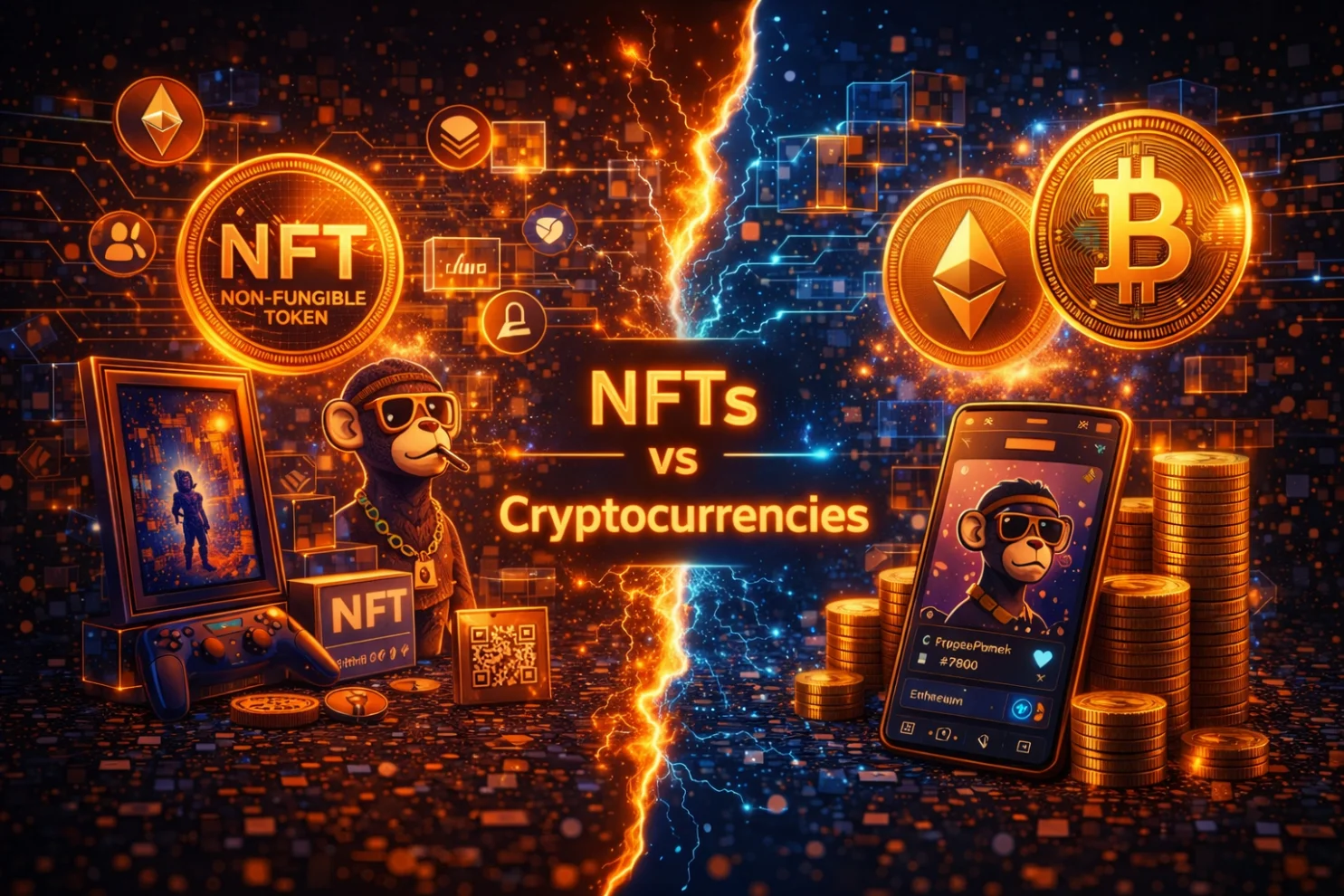
The confusion between NFTs and cryptocurrencies like Bitcoin or Ethereum is understandable — both live on blockchains. The difference is fungibility.
Bitcoin is designed to be interchangeable. Send me 1 BTC, I’ll send you 1 BTC back — same value, same utility. NFTs are explicitly not interchangeable. CryptoPunk #7804 is not the same as CryptoPunk #7523. Bored Ape #8817 cannot be substituted for Bored Ape #3749. Each has its own blockchain record, its own attributes, its own ownership history.
What is NFTs Bitcoin or NFTs ETH in practical terms? Most NFTs are created on Ethereum using the ERC-721 token standard, which defines how non-fungible tokens are structured and transferred. ETH (Ethereum’s currency) is used to pay gas fees when buying, selling, or minting NFTs on the Ethereum network. Bitcoin’s blockchain doesn’t natively support NFTs in the same way — though Bitcoin Ordinals, launched in 2023, introduced a method of inscribing data directly onto individual satoshis, creating a Bitcoin-native NFT-like system with meaningful adoption.
The Foundation of NFTs: Blockchain
Every NFT lives on a blockchain — a distributed ledger maintained by thousands of computers simultaneously. No single entity controls it. Records added to the blockchain are permanent and tamper-resistant: changing a historical record would require rewriting the chain from that point forward while outpacing the entire rest of the network’s computing power.
Ethereum dominates NFT infrastructure. The ERC-721 standard (proposed by Dieter Shirley in 2017, formalized in 2018) established the framework most NFTs still use. ERC-1155 came later, allowing both fungible and non-fungible tokens within the same contract — useful for games that need both currency and unique items.
Other blockchains have built significant NFT ecosystems. Solana attracted NFT projects with lower transaction fees and faster confirmation times. Polygon (a layer-2 network on Ethereum) became popular for gaming NFTs and projects wanting Ethereum’s security at lower cost. Flow blockchain was built specifically for NFTs, powering NBA Top Shot. Each chain makes different tradeoffs between decentralization, speed, and cost.
How NFTs Work: The Basics
When someone creates (mints) an NFT, they deploy or interact with a smart contract on the blockchain. The contract generates a unique token ID and associates it with a wallet address — the creator’s initially. This record contains: the token ID, the owner’s address, a URI pointing to the token’s metadata, and the contract’s address.
The metadata is usually a JSON file hosted somewhere (ideally on IPFS for permanence, sometimes on centralized servers for convenience) that describes the item: name, description, image URL, attributes. The actual image or media file is typically stored separately.
This creates a important nuance: owning an NFT usually means owning a blockchain record that points to a file. If the file hosting disappears, the NFT’s blockchain record still exists but points to nothing. This has happened — platforms that hosted NFT metadata have shut down, leaving owners with valid blockchain records pointing to broken links.
Smart Contracts
Smart contracts are self-executing programs stored on the blockchain. For NFTs, they do several things automatically: enforce ownership rules, execute transfers when conditions are met, and pay royalties to creators on secondary sales.
The royalty mechanism was one of NFTs’ most innovative features. A creator could set a 10% royalty in their smart contract, meaning every time the NFT sold on a secondary market, 10% automatically went to the original creator. Traditional art doesn’t work this way — Basquiat’s estate doesn’t get a cut when his paintings resell for millions.
In practice, royalty enforcement became contested. In 2022-2023, major marketplaces including Blur and later OpenSea made royalties optional to compete for trading volume. This removed a key economic incentive for creators. Some newer NFT contracts use technical mechanisms to enforce royalties regardless of marketplace — the debate over on-chain versus off-chain royalty enforcement continues.
The Process of Making NFTs
Minting an NFT involves these steps. First, create the digital asset — the artwork, music, video, whatever it is. Second, prepare the metadata: name, description, attributes, link to the file. Third, choose a blockchain and deploy or use an existing smart contract. Fourth, sign a transaction from your wallet paying the gas fee. The contract executes, the token is created, and your wallet address becomes the recorded owner.
Platforms like OpenSea, Rarible, and Zora simplify this process significantly — you upload a file, fill in details, pay gas, and the minting happens behind the scenes. Some platforms offer “lazy minting,” deferring the actual blockchain transaction until someone buys the NFT, which means no upfront gas cost for creators.
Gas costs have been one of the NFT ecosystem’s consistent pain points. Minting an NFT on Ethereum mainnet during peak periods could cost $100 or more in gas fees. Ethereum’s move to proof-of-stake in 2022 (“The Merge”) reduced energy consumption but didn’t directly solve gas costs. Layer-2 solutions and alternative chains have largely addressed this for everyday transactions.
Where to Trade NFTs: Online Markets
The NFT marketplace landscape in 2026 has consolidated significantly from the 2021 peak. Several distinct tiers exist:
- OpenSea — the longest-running major marketplace, supporting Ethereum, Polygon, and Solana NFTs. Lost significant market share to Blur but remains a primary discovery and secondary trading platform.
- Blur — a pro-trader focused marketplace that surpassed OpenSea in trading volume by offering zero fees and token incentives for traders. Dominant for high-volume traders; less focused on casual buyers.
- Magic Eden — started as the dominant Solana NFT marketplace, has since expanded to Ethereum and Bitcoin Ordinals. Strong position in gaming NFTs.
- Foundation — curated platform focused on digital art, requiring invitation or application for creators. Higher average sale prices, more editorial curation.
- Zora — creator-focused platform with a strong open-edition NFT focus and deep integration with Ethereum and Layer-2 networks.
Specialized markets also exist for specific categories: NBA Top Shot for basketball highlight videos, Nifty Gateway for curated drops, and chain-specific marketplaces for Solana, Tezos, and other ecosystems.
How NFTs Are Used
The question of why NFTs exist gets more interesting when you look at actual use cases rather than speculative trading. Several categories have found real traction.
NFTs in Art: Changing Creative Work
Digital art NFTs gave creators a way to sell originals in a medium where “original” previously had no meaning. Before NFTs, buying a digital artwork gave you a file identical to every other copy. An NFT gives the buyer a verifiable claim to the “official” version.
The art NFT market has its own culture and notable examples. CryptoPunks (10,000 algorithmically generated pixel characters, created by Larva Labs in 2017) became the canonical example of provable digital scarcity — some have sold for millions. Beeple’s $69.3 million Christie’s sale remains the highest price for a single NFT at auction. Artists like Xcopy, Pak, and Tyler Hobbs built careers and significant communities through NFT sales.
Beyond speculation, NFTs changed creator economics. A photographer could sell limited-edition digital prints directly to collectors without galleries. A generative artist could write code that creates unique outputs for each collector. Royalties (when enforced) meant secondary market activity could benefit creators long after the initial sale.
NFTs in Games: New Ways to Own Items
Gaming is where NFTs have found the most sustained non-speculative utility. Traditional game items — skins, weapons, characters — exist at the pleasure of the game company. The company closes, or changes the rules, and your items disappear. NFT game items are player-owned assets on the blockchain.
Gods Unchained (a trading card game) and Axie Infinity (a creature-battling game) demonstrated early models. Axie attracted particular attention in 2021 when players in the Philippines were earning meaningful income by breeding and battling creatures — until the economics collapsed when the token price fell.
More recent games have taken a subtler approach, using NFTs for specific items without making the entire economy NFT-based. Parallel (a sci-fi card game) and Sorare (fantasy football) have found audiences without the boom-bust cycles of earlier play-to-earn models.
NFTs in Music and Entertainment: Connecting With Fans
Musicians using NFTs have generally focused on direct fan relationships rather than speculation. Kings of Leon released an album as an NFT in 2021 — buyers got limited-edition vinyl, front-row concert seats, or special visual artwork. The value proposition was access and connection, not investment.
3LAU, RAC, and a number of independent artists have used NFTs to sell directly to superfans, bypassing streaming platforms that pay fractions of a cent per play. For artists with dedicated followings, this created a viable alternative revenue stream.
Event ticketing is a cleaner NFT use case that doesn’t rely on speculation. An NFT ticket can be verified on-chain, carry programmable resale restrictions (preventing scalpers from charging 500% markup), and deliver post-event perks automatically. Ticketmaster’s competitors have experimented with NFT tickets; some artists have issued them directly.
More Ways to Use NFTs
Beyond art, games, and music, several other applications have found varying degrees of adoption:
- Identity and credentials — verifiable credentials for education, professional certifications, and memberships. A university degree as an NFT is tamper-proof and checkable without calling the issuing institution.
- Real estate — experimental tokenization of property ownership, making fractional real estate investment possible without traditional intermediaries. Early-stage, but active development in several jurisdictions.
- Domain names — Ethereum Name Service (ENS) domains are NFTs, giving owners blockchain-based control over human-readable addresses.
- Collectibles and licensing — sports leagues, film studios, and brands have issued NFTs as official licensed collectibles or loyalty rewards.
- Access tokens — NFTs functioning as membership passes that grant access to exclusive communities, events, or content. Bored Ape owners got access to an online club and real-world events.
Why NFTs Are Valuable
Value in NFTs comes from several sources, not all equally durable. Scarcity is the most cited reason: there’s only one CryptoPunk #7804. But artificial scarcity only holds value if people want the thing being scarced. The genuine value question is why anyone would pay for digital ownership of something that can be freely copied.
The answers that have held up: cultural status (owning a landmark NFT from a significant collection carries meaning in certain communities, similar to owning a recognized artwork), community membership (some NFT collections function as exclusive clubs with real networking and social value), creator economics (the most durable use case — artists selling verifiable originals and earning from secondary sales), and utility (game items, tickets, and credentials have functional value independent of status).
The speculative value that dominated 2021 has largely deflated. Total NFT trading volume in Q1 2024 was a small fraction of the 2021-2022 peak. The collections with remaining market value are those that either maintained cultural relevance or had genuine utility.

Expert Opinions on NFTs
The expert landscape on NFTs is genuinely divided, and the divisions are substantive.
Critics make strong technical points. The majority of NFT value is speculative and has been proven ephemeral — an estimated 95% of NFTs were considered worthless by September 2023, according to a study by dappGambl. The environmental criticism of proof-of-work NFTs was valid (though substantially addressed by Ethereum’s move to proof-of-stake). The royalty enforcement problem is unresolved. And for many use cases, a database would work just as well without the complexity of blockchain.
Proponents point to the cases where blockchain properties matter. An NFT ticket that can’t be counterfeited and automatically enforces resale terms is a genuine improvement over paper tickets or centralized digital tickets that a platform can revoke. An artist earning royalties from secondary sales without trusting any intermediary is a meaningful capability that didn’t exist before. And verifiable ownership of digital goods addresses a real limitation of purely digital assets.
The honest middle ground: NFTs are a useful building block for specific problems — verifiable digital ownership, programmable asset rights, and provenance tracking. They’re not useful for most things, and the speculative market that inflated around them obscured both their genuine capabilities and their genuine limitations.
The Challenges of NFTs
NFTs have faced serious structural challenges that go beyond market cycles.
Intellectual property enforcement is unclear. Owning an NFT of an artwork doesn’t automatically grant copyright. People have minted NFTs of others’ work without permission — the blockchain record says they own the token, not the underlying rights. Resolving who owns what when the blockchain record and copyright law point in different directions is an active legal area.
Environmental concerns were significant during Ethereum’s proof-of-work period. NFT minting contributed to energy consumption. The Merge resolved this for Ethereum; proof-of-work chains like Bitcoin Ordinals still carry the carbon argument.
Scams and fraud have been pervasive. Rug pulls (where creators collect sales proceeds and abandon the project), wash trading (creating artificial volume by trading with oneself), and phishing attacks targeting wallet holders were endemic in the 2021-2022 boom. Regulatory scrutiny increased as these problems became visible.
Market liquidity outside top collections is thin. Most NFTs are hard to sell at any price. The bid-ask spread on illiquid NFTs can be enormous, and finding a buyer can take months or never happen at all.
The Future of NFTs
Where NFTs are going in 2026 and beyond looks quite different from the 2021 picture. The speculative retail trading boom is over. What remains is more targeted and arguably more interesting.
Institutional adoption of NFT infrastructure is growing. Major brands are using NFTs for loyalty programs and product authentication. Luxury goods companies are issuing NFT certificates of authenticity tied to physical items, creating a verifiable provenance trail. Sports leagues are using NFTs for ticketing and fan engagement.
Bitcoin Ordinals brought NFTs to the Bitcoin blockchain in a novel way — inscribing data directly onto satoshis rather than using a separate token layer. This created a new collector community and significant trading volume, though the approach is technically different from ERC-721 NFTs.
AI-generated art and NFTs intersect in interesting ways. Generative systems that produce unique outputs on demand, with ownership recorded on-chain, blur the line between software and collectible. This space is actively developing.
The most durable future for NFTs probably looks like infrastructure rather than a market: the underlying ownership and provenance mechanism for digital goods, running quietly under applications that don’t emphasize the blockchain layer. The same way most people use HTTPS without knowing it, NFTs might end up as the plumbing for digital ownership that nobody thinks about consciously.
Conclusion
NFTs exist because digital ownership didn’t. Before them, owning a digital file meant having a copy indistinguishable from every other copy. NFTs introduced verifiable uniqueness, provable ownership, and transferability to digital goods for the first time.
Whether that capability justifies the prices paid during the 2021 peak is a different question from whether the capability is useful. The speculative bubble is a separate story from the technology. Both stories are true simultaneously.
The use cases that have proven durable — artist royalties, verifiable credentials, game item ownership, event ticketing — share a common thread: they use blockchain’s specific properties (tamper-resistance, programmability, decentralized verification) to solve problems that genuinely require those properties. The use cases that haven’t survived are those that were primarily about speculation.
NFTs are not going away. They’re going quiet — moving into infrastructure, specific markets, and the background of applications that value ownership as a core building block without needing the term on the label.
Published Articles
 Popular
Bitcoin Pizza Guy: The Story Behind the First Real Bitcoin Purchase
Introduction The history of Bitcoin is full of dramatic ups and downs,...
 Popular
The Meme Economy: How Internet Humor Shapes Culture, Markets, and Crypto
Introduction Ten years ago, the idea that a picture of a dog...
 Popular
What is the Omniverse? Exploring the Ultimate Multiversal Concept
Introduction Do you know what the omniverse is? Is this concept real?...
Bitcoin Taproot Explained: What the Upgrade Means for BTC
Introduction Unfortunately, the most popular cryptocurrency today – Bitcoin – was not...
Crypto On-Ramps and Off-Ramps Explained: How Fiat and Crypto Move In and Out
Entering the world of digital assets often feels like trying to cross...
Crypto Basics Explained: A Beginner’s Guide to Cryptocurrency and Trading
Introduction The world of finance is changing right before our eyes. Just...