
Pegging in Cryptocurrency: What It Is, How It Works, and the Risks You Need to Know
What Does “Pegging” Mean in Crypto?
Crypto markets are famous for volatility. A coin worth $1.00 on Monday might trade at $0.70 by Friday. That unpredictability works for speculation but makes crypto nearly unusable for everyday transactions, savings, or business contracts. Pegging exists to solve that problem.
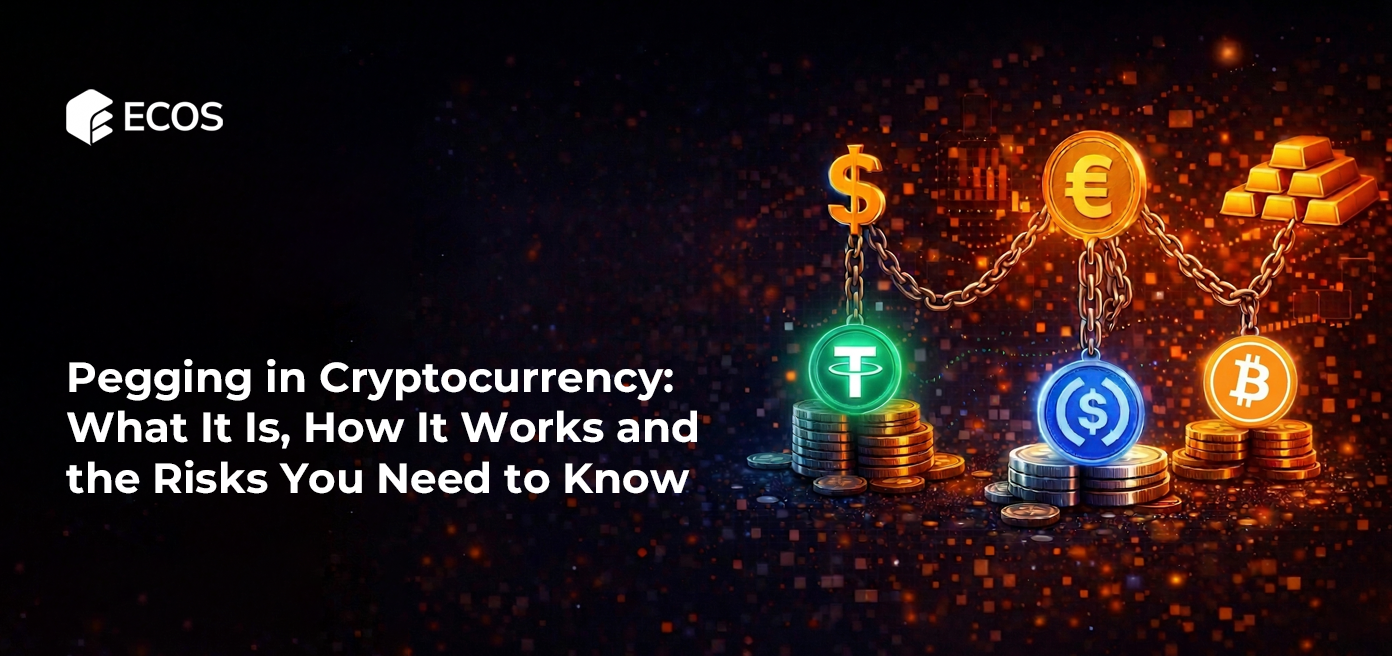
What does pegging mean in crypto? At its core, pegging is the mechanism by which one cryptocurrency maintains a fixed exchange rate against another asset — most commonly the US dollar, but also gold, other fiat currencies, or even other cryptocurrencies. A pegged crypto is engineered to stay at $1.00 (or 1 gram of gold, or 1 euro) regardless of what the broader market does.
The resulting instrument is a stablecoin — a token designed for stability rather than appreciation. USDT, USDC, DAI, and FRAX are all pegged cryptocurrencies, each using different mechanisms to hold their anchor. Understanding peg crypto means understanding both why this stability is valuable and what holds it in place mechanically.
How Pegging Works in Cryptocurrency
There’s no single way to peg a cryptocurrency. The method matters enormously, because it determines how robust the peg is, who controls it, and what can cause it to fail.
All pegging mechanisms share a common goal: ensure that the token’s market price stays close to the target value. When price drifts above the peg, the mechanism needs to contract supply or reduce demand. When price falls below, it needs to expand supply or increase demand. The difference between pegging models is how they accomplish this.
The Mechanism Behind Pegged Cryptocurrencies
Reserve-Backed Stablecoins
The most straightforward approach: the issuer holds real assets equal in value to every token in circulation. USDC holds cash and US Treasury bills; each USDC is redeemable for one dollar through Circle. USDT makes the same claim, backed by a mix of assets that has historically included commercial paper, secured loans, and Treasury bills.
Reserve-backed pegs work because arbitrage keeps them honest. If USDC trades at $0.99, buyers can purchase it cheaply and redeem it with Circle for $1.00, capturing a profit. If it trades at $1.01, sellers can mint new USDC by depositing dollars and sell them at a premium. This redemption mechanism is the anchor — as long as the issuer can honor redemptions, the market will enforce the peg.
The vulnerability is the issuer. If reserves are insufficient, mismanaged, or frozen by regulators, the peg breaks. The Silicon Valley Bank incident in March 2023 briefly took USDC to $0.87 when news broke that Circle held $3.3 billion in SVB deposits. The peg recovered once the US government guaranteed SVB deposits, but the episode showed what happens when reserve confidence wavers.
Algorithmic Stablecoins
Algorithmic stablecoins attempt to maintain their peg without holding external reserves, instead using smart contract logic and token economics. The theory: if the peg crypto trades above $1.00, the protocol mints more tokens to increase supply and bring price down. If it trades below, it burns tokens or creates demand incentives to push price back up.
TerraUSD (UST) was the highest-profile algorithmic stablecoin, paired with LUNA in a mint/burn mechanism. Holders could always exchange 1 UST for $1 worth of LUNA and vice versa, which in theory maintained the peg. In May 2022, coordinated selling overwhelmed the mechanism. LUNA’s value collapsed, making the arbitrage incentive disappear — and UST lost its peg catastrophically, falling from $1.00 to near zero within days, destroying approximately $40 billion in combined value.
Algorithmic pegs offer decentralization and capital efficiency but carry much higher failure risk than reserve-backed alternatives. No major algorithmic stablecoin has maintained its peg through sustained market stress.
Hard Pegging vs. Soft Pegging: Key Differences
The distinction between hard and soft pegs describes how tightly the peg is enforced and through what mechanism.
A hard peg commits absolutely to a fixed exchange rate. One USDC is always redeemable for one dollar from the issuer — there’s no tolerance for deviation. The commitment is legal and operational: if you send Circle a dollar, you get a USDC; if you redeem a USDC, you get a dollar. Hard pegs require reserves precisely equal to circulating supply, and any gap breaks the peg’s credibility immediately.
A soft peg aims to keep price near a target value but allows some flexibility. Central banks use soft pegs in traditional forex markets — targeting a rate while allowing movement within a band. In crypto, some assets use soft pegs: DAI maintains its dollar peg within a narrow range through over-collateralization and monetary policy controls, but small deviations (DAI at $1.002 or $0.998) are expected and acceptable. The mechanism works to push price back toward target without guaranteeing exact equivalence at any given moment.
Examples of Pegged Cryptocurrencies
The most widely used pegged cryptocurrencies in 2026:
- USDT (Tether) — the largest stablecoin by market cap (~$140B+). Dollar-pegged, reserve-backed with cash and Treasury bills. Issued by Tether Limited (BVI).
- USDC (USD Coin) — the second largest (~$60B). Dollar-pegged, reserve-backed exclusively with cash and short-term US Treasuries. Issued by Circle (US-registered).
- DAI — crypto-collateralized, soft-pegged to USD. Governed by MakerDAO. Maintains peg through over-collateralization and stability fees.
- FRAX — fractionally-collateralized, partially algorithmic. Uses a hybrid model aiming for capital efficiency while maintaining more robust backing than purely algorithmic designs.
- PYUSD (PayPal USD) — dollar-pegged stablecoin issued by PayPal, launched 2023. Backed by dollar deposits, short-term Treasuries, and similar cash equivalents.
- Gold-pegged tokens — PAXG (Paxos Gold) and XAUT (Tether Gold) peg to physical gold held in custody. Each token represents ownership of one troy ounce of gold.

Types of Pegging in Cryptocurrency
Hard Pegging
Hard pegging is the dominant model for fiat-backed stablecoins. The issuer maintains a 1:1 reserve and offers direct redemption at the fixed rate. Market forces enforce the peg: any deviation creates arbitrage opportunities that traders exploit until price returns to par. Hard pegs are the most credible when reserves are transparent and verifiable, which is why USDC’s monthly attestation reports and USDT’s quarterly disclosures matter — they’re evidence the redemption guarantee is real.
Soft Pegging
Soft pegging allows a target range rather than a fixed point. DAI exemplifies this: MakerDAO’s stability fee and the Dai Savings Rate create demand and supply incentives that keep DAI close to $1.00 without committing to exact equivalence. The protocol can tolerate DAI at $0.995 or $1.003 without breaking, because the mechanisms are designed to nudge price back toward target rather than guarantee instantaneous correction.
Over-collateralization is the main tool: borrowers must lock up more value in ETH, wBTC, or other approved assets than the DAI they receive. If collateral value falls, vaults get liquidated, which burns DAI and reduces supply. This creates a floor below which DAI won’t stay for long — but not a perfectly fixed floor.
Algorithmic Pegging
Algorithmic pegging is the most experimental model. It relies entirely on protocol incentives rather than external reserves. When peg crypto price rises above target, the protocol mints more tokens. When it falls below, it creates burn incentives or secondary token rewards to reduce supply.
The fundamental problem: these mechanisms work under normal conditions but can spiral during stress. If confidence breaks — as it did with UST — the sell pressure overwhelms the algorithm’s ability to respond. Without underlying asset reserves, there’s nothing to redeem against, and the peg becomes a self-reinforcing death spiral. Post-LUNA, the DeFi community largely shifted toward hybrid and over-collateralized models.
Risks and Challenges of Pegging in Crypto
De-Pegging
De-pegging — when a pegged asset loses its fixed exchange rate — is the primary risk of any stablecoin. It can happen gradually (USDT briefly touched $0.96 during the LUNA collapse) or catastrophically (UST fell to near zero within 72 hours). De-pegging events destroy value held in the pegged asset and cascade into connected DeFi protocols that use it as collateral.
What is depegging in practical terms? It means that 1 USDT or 1 DAI no longer reliably buys $1 worth of goods or redeems for a dollar from the issuer. For anyone using stablecoins as stable savings or collateral, that gap is a direct financial loss.
Market Manipulation
Large players can attack pegged assets deliberately. The UST depeg was partially attributed to coordinated selling designed to exhaust the Luna Foundation Guard’s Bitcoin reserves, which were deployed to defend the peg. Once the reserve was depleted, the peg had no support. Reserve-backed stablecoins face similar risks if large holders coordinate redemptions faster than the issuer can liquidate reserves.
Crypto Volatility
For crypto-collateralized stablecoins like DAI, sharp drops in collateral value threaten the peg. If ETH falls 50% in a day, vaults that were comfortably over-collateralized suddenly approach liquidation. Mass liquidations can suppress ETH price further (liquidators sell ETH to cover debts), creating a feedback loop. MakerDAO survived the March 2020 crash — when ETH fell 50% in hours — but vault holders lost collateral and the system required emergency governance.
Smart Contract Vulnerabilities
Algorithmic and crypto-collateralized stablecoins run on smart contracts. Code bugs, oracle failures (where the price feed a contract relies on is manipulated or fails), and governance attacks all represent failure modes that reserve-backed stablecoins avoid — because their peg mechanism doesn’t depend on code running correctly, but on human institutions honoring redemption commitments.
The bZx flash loan attacks in 2020 and multiple oracle manipulation exploits since have demonstrated that smart contract-based pegs face a category of technical risk entirely absent from fiat-backed models.
The Role of Pegging in the Evolution of Crypto
Pegged assets solved the usability problem that made early crypto impractical for commerce. Bitcoin’s 2017 volatility — swinging from $1,000 to $20,000 and back to $3,000 within 12 months — was thrilling for speculators and impossible for merchants. Stablecoins gave DeFi a stable unit of account and medium of exchange.
The stablecoin market grew from near zero in 2017 to over $200 billion in combined market cap by 2024. That growth wasn’t speculative — it reflected real demand. DeFi protocols use stablecoins as base collateral. Crypto traders use them to hold value between positions. Businesses in countries with weak local currencies use USDT as a dollar substitute. Remittance corridors use USDC to move money internationally faster and cheaper than traditional wire transfers.
Regulation has shaped the pegging landscape significantly. The EU’s MiCA framework (effective 2024–2025) created specific requirements for stablecoin issuers operating in Europe — reserve composition, disclosure standards, and volume limits for non-euro stablecoins. US stablecoin legislation under consideration would mandate federal licensing and reserve requirements that Circle already meets but Tether would need to restructure to comply with.
The likely evolution: reserve-backed stablecoins become more regulated and institutionally integrated, while algorithmic models remain experimental and primarily deployed in DeFi contexts where users explicitly accept the higher risk profile.

How to Invest in Pegged Cryptocurrencies
Holding a pegged cryptocurrency isn’t the same as investing in it — by design, there’s no price appreciation. But there are ways to generate returns on stablecoin holdings:
- Lending and yield protocols — platforms like Aave, Compound, and Morpho allow depositing stablecoins to earn lending interest. Rates vary from 2–15%+ depending on market conditions and platform risk.
- Liquidity provision — providing stablecoin liquidity to DEX pools (like Curve Finance’s 3pool) earns trading fees and often additional token incentives. Risk includes smart contract exposure.
- Centralized exchange yield products — Coinbase, Kraken, and others offer yield on USDC holdings, typically 4–6%, with counterparty risk to the exchange.
- T-bill-backed stablecoins — products like OUSD (from Origin Protocol) or Ondo Finance’s USDY pass through the yield from underlying Treasury holdings directly to token holders. These combine stablecoin utility with fixed-income returns.
For anyone holding pegged assets for stability rather than yield, the key decision is which stablecoin. USDC’s reserve transparency and US regulatory alignment make it the choice for risk-conscious holders. USDT’s deeper liquidity makes it the default for active trading. DAI’s decentralization and crypto-native governance appeal to DeFi users who want to avoid dependence on centralized issuers.
Whatever you hold, understanding the peg mechanism is understanding the risk. A stablecoin is only as stable as the mechanism backing it — and that mechanism has failed before.
FAQ
What is peg in crypto?
A peg in crypto is a fixed exchange rate between a cryptocurrency and another asset — most commonly the US dollar. Pegged cryptocurrencies, known as stablecoins, use various mechanisms (reserve assets, collateral, or algorithmic controls) to maintain this fixed rate. The goal is price stability: 1 USDC should always equal $1.00, regardless of broader market movements.
What does pegging mean in crypto?
Pegging in crypto means designing a token so its market price stays fixed to a target value. The peg can be maintained through fiat reserves held by an issuer, over-collateralized crypto holdings in a smart contract, or algorithmic supply expansion and contraction. When the mechanism works, the token trades at exactly (or very close to) the target price indefinitely.
What is depegging?
Depegging is when a pegged cryptocurrency loses its fixed exchange rate. A stablecoin that depegs might fall from $1.00 to $0.95 or lower. Depegging can be temporary (USDC briefly hit $0.87 during the SVB crisis but recovered) or permanent (UST fell to near zero in May 2022). Depegging destroys the fundamental utility of a stablecoin and can cascade into connected DeFi protocols.
What is pegging in finance?
In traditional finance, pegging refers to fixing the exchange rate between two currencies. Countries have historically pegged their currency to the US dollar (as Saudi Arabia still does) or to gold (the Bretton Woods system, which ended in 1971). The goal is economic stability — predictable exchange rates reduce uncertainty for trade and investment. Crypto pegging applies this concept within blockchain networks, with stablecoins as the pegged instrument.
Are pegged cryptocurrencies safe?
Safety depends entirely on the pegging mechanism. Reserve-backed stablecoins like USDC carry counterparty risk (the issuer must be solvent and honorable) and regulatory risk (assets can be frozen). Crypto-collateralized stablecoins like DAI carry collateral crash risk and smart contract vulnerability. Algorithmic stablecoins like the former UST carry catastrophic failure risk if confidence breaks. There is no risk-free pegged asset — only different risk profiles.
Published Articles
 Popular
Bitcoin Pizza Guy: The Story Behind the First Real Bitcoin Purchase
Introduction The history of Bitcoin is full of dramatic ups and downs,...
 Popular
The Meme Economy: How Internet Humor Shapes Culture, Markets, and Crypto
Introduction Ten years ago, the idea that a picture of a dog...
 Popular
What is the Omniverse? Exploring the Ultimate Multiversal Concept
Introduction Do you know what the omniverse is? Is this concept real?...

Bitcoin Taproot Explained: What the Upgrade Means for BTC
Introduction Unfortunately, the most popular cryptocurrency today – Bitcoin – was not...

Crypto On-Ramps and Off-Ramps Explained: How Fiat and Crypto Move In and Out
Entering the world of digital assets often feels like trying to cross...

Crypto Basics Explained: A Beginner’s Guide to Cryptocurrency and Trading
Introduction The world of finance is changing right before our eyes. Just...