
Solana vs Ethereum Explained: Which Blockchain Is Better?
What Is Ethereum?
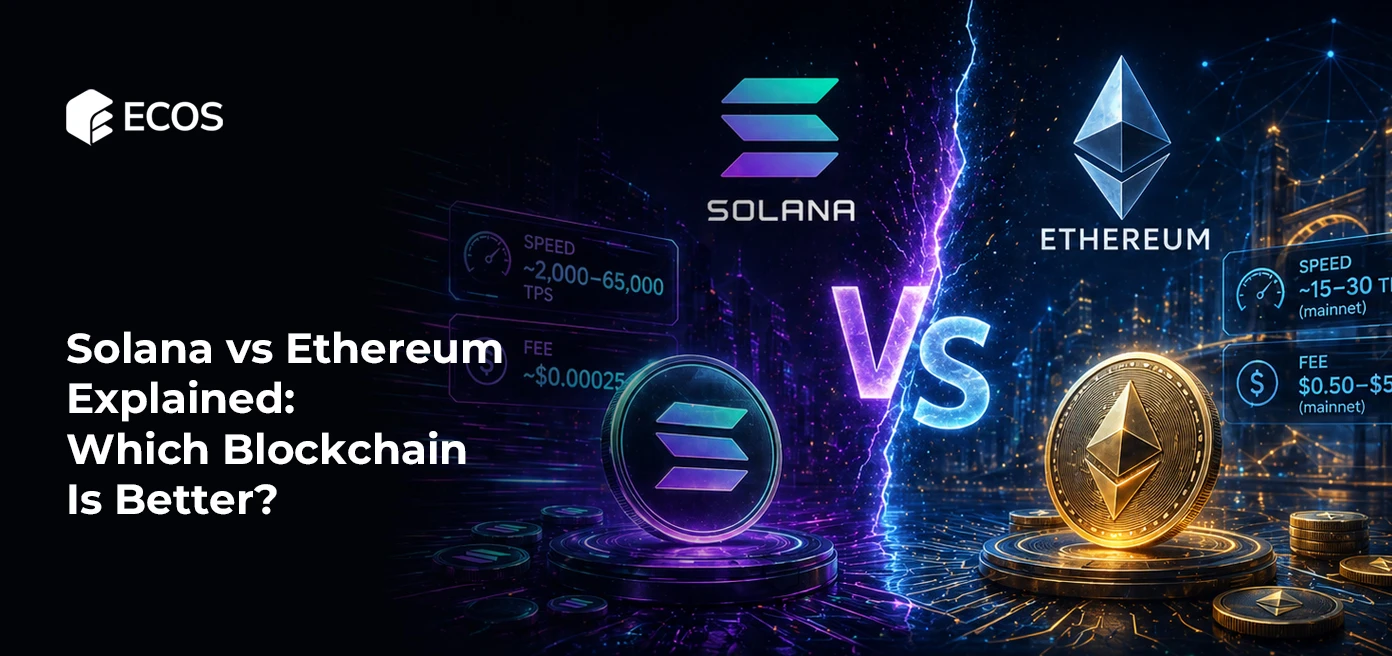
Ethereum launched in 2015 and effectively created an entirely new category of technology — the programmable blockchain. Before it, there was essentially one thing you could do on a blockchain: send a coin from one address to another. Vitalik Buterin and his team proposed something different: what if you could run code on a blockchain? That idea gave birth to smart contracts, and from there came DeFi, NFTs, DAOs, and most of what the industry calls Web3 today. Ethereum is not just the ETH token. It’s a platform on which developers build decentralized applications. While the solana vs ethereum debate often highlights differences in speed and cost, Ethereum remains the industry’s cornerstone. As of 2026, the Ethereum ecosystem hosts thousands of protocols with tens of billions of dollars in total value locked (TVL). By any measure, it’s the largest smart contract ecosystem in existence — by a significant margin.
In September 2022, Ethereum completed its transition to Proof-of-Stake consensus — an event known as The Merge. Energy consumption dropped by roughly 99.95%. Alongside that, the Layer 2 ecosystem has expanded dramatically: Arbitrum, Optimism, Base, and others now process transactions off the main chain, pushing throughput into the thousands of TPS at fractions of a cent per transaction.
What Is Solana?
Solana launched in 2020 with one specific promise: fast and cheap. Founder Anatoly Yakovenko, a former Qualcomm engineer, proposed an unconventional solution — adding a mechanism called Proof-of-History to Proof-of-Stake. The basic idea: instead of validators constantly negotiating the timing of each transaction, the blockchain embeds a cryptographically verifiable timestamp directly. This eliminates the coordination delay and allows thousands of transactions per second to be processed.
In practice, Solana really is fast. A transaction confirms in a fraction of a second and costs less than a cent — typically around $0.00025. For comparison, a transaction on Ethereum’s mainnet during periods of congestion could run $5 to $50 or more. That cost advantage made Solana a natural home for applications requiring high transaction frequency: gaming, trading, and payments.
Solana is an independent blockchain. Worth stating clearly, because the question comes up often: is Solana on Ethereum, or is Solana built on Ethereum? Neither. These are separate networks with different architectures, different programming languages, and separate ecosystems. Tokens issued on Solana exist only on Solana — they don’t live on Ethereum.
Is Solana Built on Ethereum?
Independent Blockchain Explanation
The short answer: no. Solana is a fully independent blockchain with its own architecture, its own validators, and its own ruleset. There’s no technical connection to Ethereum whatsoever. The confusion tends to arise for a couple of reasons. Both are programmable blockchains with smart contracts. And some tokens exist on both networks — but not because the chains are linked. That happens through bridges: specialized protocols that lock a token on one chain and issue a wrapped copy on another.
Key Differences in Architecture
Ethereum was built around the principle of maximum decentralization: anyone should be able to run a node from a regular consumer computer. That required a tradeoff on speed — the mainnet handles around 15 to 30 transactions per second.
Solana made a different tradeoff. To run a validator, you need serious hardware: a powerful processor, hundreds of gigabytes of RAM, a fast internet connection. That reduces decentralization — fewer validators can physically participate — but it opens the door to high throughput. Different priorities produce fundamentally different architectural decisions.
Ecosystem Separation
Developers building on Ethereum write code in Solidity — the language purpose-built for the EVM (Ethereum Virtual Machine). Solana developers use Rust — one of the most performant programming languages available, but significantly harder to learn.
Practically, this means an application can’t simply be ‘ported’ from one chain to another — it requires a complete rewrite. Developer communities are also distinct. Around Ethereum, ten years of tooling, libraries, frameworks, and documentation have accumulated. Solana is catching up fast, but the gap is still noticeable.
Solana vs Ethereum: Key Differences
Let’s look at specific parameters. The table below summarizes the comparison.
| Feature | Ethereum | Solana |
| Launch year | 2015 | 2020 |
| Speed (TPS) | ~15–30 (mainnet), thousands on L2 | ~2,000–65,000 |
| Transaction fee | $0.50–$5+ (mainnet), fractions on L2 | ~$0.00025 |
| Consensus | Proof-of-Stake | Proof-of-Stake + Proof-of-History |
| Smart contract language | Solidity, Vyper | Rust, C, C++ |
| DeFi TVL | Dominant (~$50–70B) | Growing (~$5–10B) |
| Network reliability | Never went down | Several outages recorded |
| NFT ecosystem | Largest | Active, fast-growing |
| Decentralization | High | Moderate (fewer validators) |
Speed (TPS Comparison)
TPS — transactions per second — is the standard benchmark for comparing blockchains. Ethereum mainnet processes around 15 to 30 TPS. That’s been the subject of much criticism and much debate, and the answer the ecosystem landed on was Layer 2. Second-layer networks offload computation from the main chain: Arbitrum and Optimism handle thousands of TPS, and transaction costs drop to fractions of a cent.
Solana claims a theoretical ceiling of 65,000 TPS. Real-world throughput during normal load runs closer to 2,000 to 4,000 TPS — still an order of magnitude beyond Ethereum mainnet without L2. The key caveat: that speed comes at the cost of higher hardware requirements for validators, which affects network decentralization.
Transaction Fees
The fee difference is one of Solana’s most cited advantages over Ethereum. On Ethereum mainnet, fees depend on network congestion: $0.50 to $2 during quiet periods, $20 to $100 or more during peak activity (the 2021 NFT boom, where minting could cost hundreds of dollars in gas, is a vivid example).
Solana keeps fees at around $0.00025 regardless of network load. For applications involving high transaction frequency — decentralized exchanges, games, payment services — that’s a meaningful difference. One important qualification: Layer 2 on Ethereum today also delivers sub-cent fees, which closes much of the gap for many use cases.
Scalability
Ethereum addresses scalability through a layered architecture. The base chain handles security and finality. The execution layer (EVM) processes smart contracts. Layer 2 sits on top for speed and throughput. That structure allows each layer to be optimized independently. The downside: users face additional complexity — different addresses, different tokens, the need to bridge assets between networks.
Solana scales horizontally: all performance lives within a single chain. No bridges needed, no network switching. Simpler for users. The tradeoff is that under serious stress, the network can stall — and it has. Between 2021 and 2022, Solana experienced several significant outages, the longest running roughly 17 hours.
Solana vs ETH Technology Comparison
Consensus Mechanisms
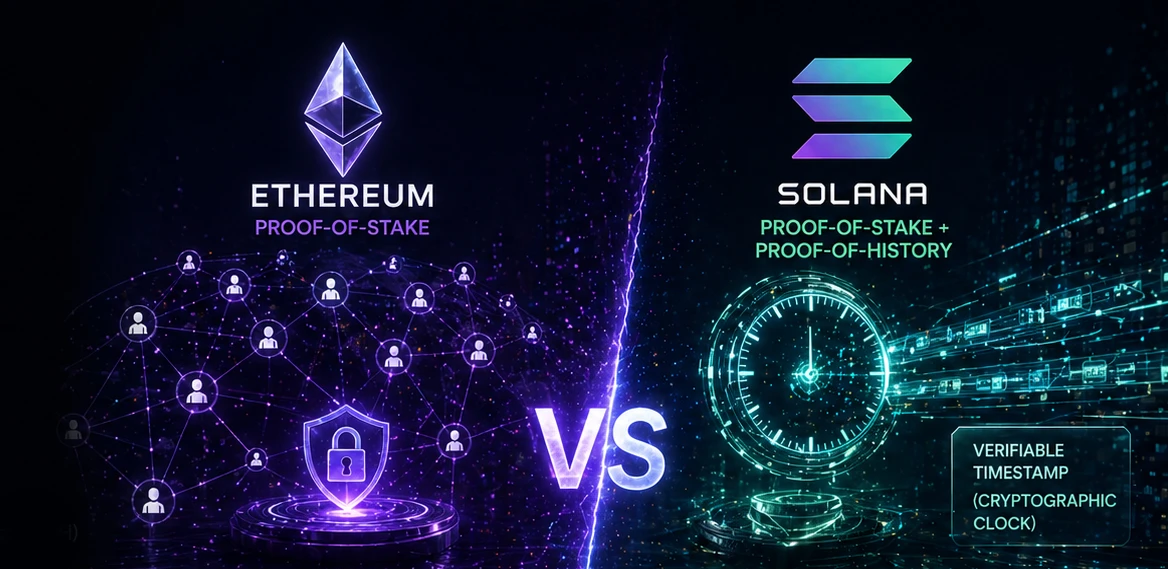
After The Merge, Ethereum runs on Proof-of-Stake. Validators stake a minimum of 32 ETH and earn the right to validate transactions and produce blocks. Misbehaving results in ‘slashing’ — partial loss of the staked amount. With around 900,000 validators globally, attacking the network would require an extraordinary financial commitment.
Solana adds Proof-of-History on top of PoS. It’s not a separate consensus mechanism — it’s more like a cryptographic clock. Every transaction receives a verifiable timestamp, so validators don’t need to spend time agreeing on the sequence of events. That’s what enables the speed. But it means validators need powerful hardware, which is why there are far fewer of them than on Ethereum.
Network Architecture
Ethereum is modular. The base layer handles security and decentralization. The execution layer (EVM) runs smart contracts. Layer 2 stacks on top for throughput. Each layer can evolve separately, which is the key advantage of the design.
Solana is monolithic. Everything happens in one chain: consensus, execution, data storage. That delivers speed and user simplicity, but creates a single point of pressure: if one component is overwhelmed, the whole network feels it.
Developer Ecosystem
Ethereum has a multi-year head start, and it shows. Solidity is one of the most studied languages in crypto. Hardhat, Foundry, Truffle — mature development tools. Documentation, tutorials, audit firms — all of this grew alongside the ecosystem from 2015. According to Electric Capital research, Ethereum consistently attracts the largest number of active developers among all blockchains.
Solana uses Rust — powerful but demanding. The barrier to entry is higher than Solidity. But developers who do show up tend to be more experienced and build more performant applications. The Anchor framework simplified Solana development considerably, and the ecosystem has grown noticeably over the past two years.
Solana vs Ethereum Use Cases
Each blockchain has natural niches — not because of marketing positioning, but because the technical characteristics make certain tasks more practical than others.
Ethereum dominates DeFi. Uniswap, Aave, Compound, MakerDAO, Curve — the largest decentralized finance protocols are here. The combined TVL of the Ethereum ecosystem including Layer 2 sits in the $50 to $70 billion range. Institutional participants who take fund security seriously typically choose Ethereum: the track record of reliability and years of audited code matter.
Solana has captured high-frequency trading and gaming. Jupiter, Raydium, Orca — the native DEXs run significantly faster and cheaper than their Ethereum mainnet equivalents. The Solana NFT market (Magic Eden and others) competes with OpenSea by volume. The Solana mobile ecosystem — the Saga phone and Seeker — represents a unique experiment integrating blockchain directly into the device.
PayFi — payment applications built on blockchain — is another area where Solana performs well. Visa conducted stablecoin settlement experiments on Solana. Transaction speed and cost make it attractive for real-world payment scenarios.
Solana vs Ethereum Performance
Performance comparison is more than a TPS table. What those numbers represent matters too.
Ethereum mainnet is slow by design — that’s an honest statement. But ‘slow’ here means every block passes through roughly 900,000 validators distributed globally. That’s the price of decentralization. Transaction finality in Ethereum takes a few minutes. During that time, the transaction receives confirmation from a globally distributed network. For financial operations involving large sums, that matters.
Solana is faster. A transaction confirms in under a second. But there are significantly fewer validators — a few thousand versus nearly a million on Ethereum. The network operates reliably most of the time, but several major stalling incidents raised questions about resilience under pressure.
Important context: Layer 2 on Ethereum has substantially closed the performance gap. Base, Arbitrum, and Optimism deliver thousands of TPS at sub-cent fees. If the comparison is Solana vs Ethereum+L2 rather than Solana vs Ethereum mainnet alone, the picture becomes far less one-sided.
Advantages of Ethereum and Solana
Each blockchain has areas where it’s objectively stronger.
Ethereum: largest DeFi and NFT ecosystem, highest decentralization among smart contract blockchains, a flawless reliability record (mainnet has never gone down), the greatest number of audited protocols, Bitcoin and Ether ETFs opening institutional capital flows, and a developed Layer 2 ecosystem.
Solana: transaction speed without additional layers, fees under $0.001, a single liquidity space without the need to bridge assets, natural fit for high-frequency application development, strong ecosystem of mobile and consumer products, and a younger, rapidly growing user base.
Risks and Limitations
An honest analysis requires an honest look at the problems too.
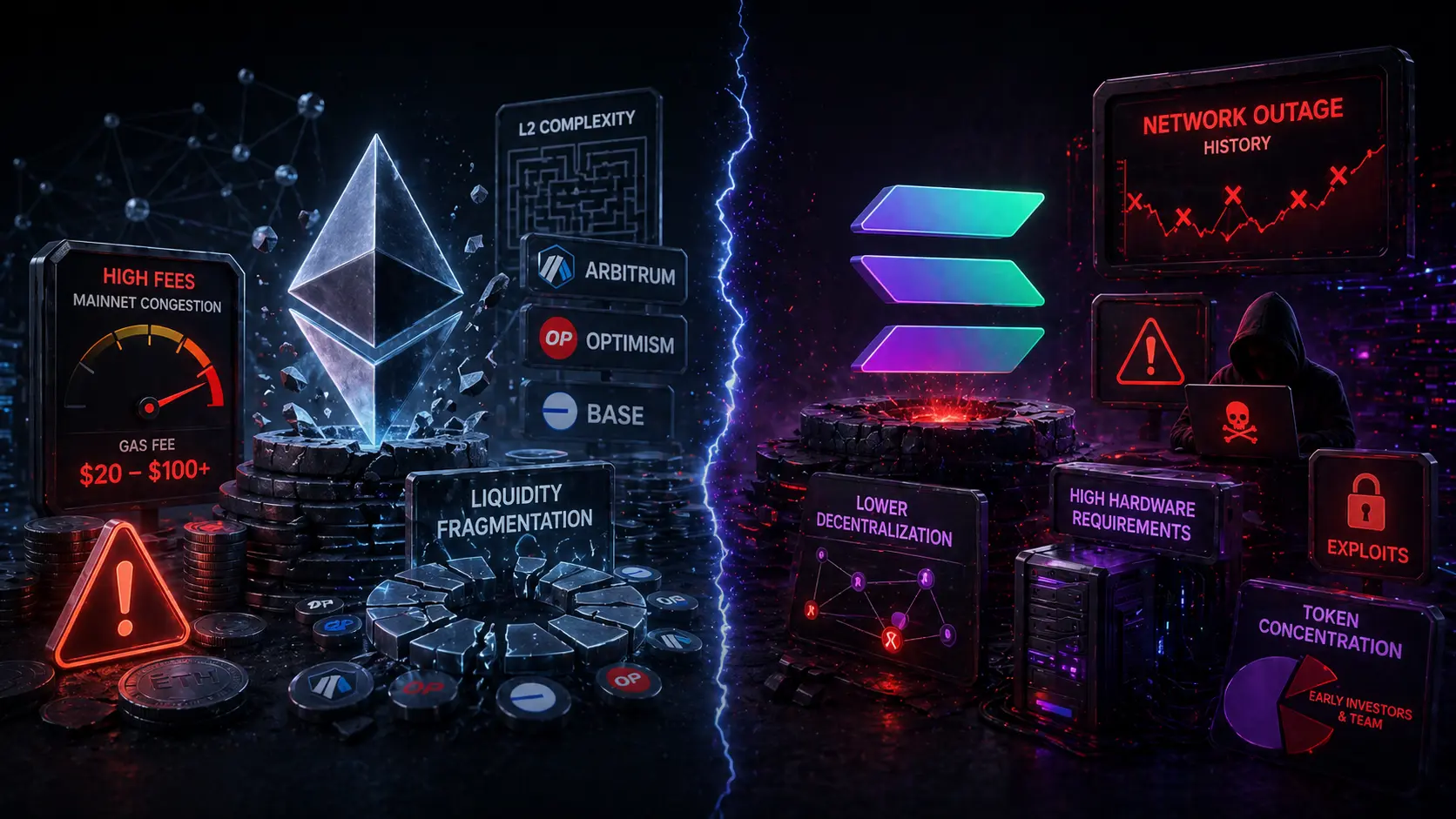
Ethereum: high mainnet fees during congestion — users need to understand which L2 to use and how to move assets there. Liquidity fragmentation across dozens of networks. Complexity for new users who need to grasp the difference between mainnet, Arbitrum, Base, and Optimism.
Solana: the outage history — the network stalled multiple times in 2021 and 2022. The situation has improved since, but the reputational impact remains. Lower decentralization: validator hardware requirements limit participation. Several major Solana protocols suffered hacks and exploits. Concentration of SOL tokens among early investors and the team has drawn criticism.
Future of Solana vs Ethereum
Both blockchains are actively developing, and both are moving toward greater scalability.
Ethereum continues executing its roadmap. After The Merge, next stages include further sharding development, proto-danksharding (EIP-4844, already implemented), and full danksharding. The goal is to make Layer 2 even cheaper by expanding data space on the base chain. Verkle Trees — an upcoming upgrade — should lower node resource requirements and improve decentralization.
Solana is developing Firedancer — a new validator client built by Jump Crypto. It’s expected to multiply throughput and improve network reliability significantly. Solana is also doubling down on its mobile ecosystem and institutional partnerships.
The competition between the two isn’t a zero-sum game. Most likely both find their niches: Ethereum as the security and finality layer for large-scale DeFi and institutional capital, Solana as the platform for high-frequency consumer applications. Though both are actively contesting the same territory.
Key Takeaways
- Solana and Ethereum are independent blockchains with different architectures. Solana is not built on Ethereum and has no technical connection to it.
- On speed, Solana leads: ~2,000–65,000 TPS versus 15–30 TPS on Ethereum mainnet. Including Layer 2, the gap narrows considerably.
- Solana fees are lower by orders of magnitude: $0.00025 versus $0.50–5+ on Ethereum mainnet. Layer 2 closes this gap for many scenarios.
- Ethereum dominates DeFi and NFTs by liquidity volume and protocol count. Solana leads in high-frequency trading, gaming, and mobile applications.
- Ethereum has a stronger reliability record: mainnet has never stopped. Solana has experienced several major outages, though stability has improved.
- The choice between the two depends on the use case: large-scale DeFi and security favor Ethereum; speed and low fees without L2 favor Solana.
Expert Insight
According to Gemini’s Cryptopedia: “Solana and Ethereum are two leading smart contract platforms competing for developers and users. Ethereum is the established player with the largest ecosystem and maximum decentralization. Solana offers significantly higher throughput and lower fees through its unique Proof-of-History mechanism.”
That framing accurately captures the tradeoffs. Adding a practical perspective: the question of ethereum or solana rarely has a universal answer. Protocols managing billions in TVL that need maximum security and broad user reach choose Ethereum or its L2. Teams that need speed, low fees, and access to a mobile-native audience right now look at Solana. A growing number of projects deploy on both simultaneously.
Conclusion
A direct answer to ‘which blockchain is better — Solana or Ethereum?’ honestly comes down to: it depends on what you’re trying to do.
Ethereum is the more mature, more decentralized, more battle-tested platform with the largest ecosystem. Its mainnet speed and cost limitations are well-known problems being addressed through Layer 2. If you’re building something serious with significant capital involved, or simply want reliability — Ethereum and its L2 ecosystem are probably the obvious choice today.
Solana is a fast, cheap, and ambitious platform that has grown from virtually nothing into the second-largest smart contract ecosystem in a few years. The outage history is a real negative that the team is actively fixing. For applications where speed is critical and multi-billion liquidity isn’t necessary right here — Solana is a strong option.
Competition between the two is intensifying — and that’s good for the entire industry.
More Questions
It depends on your goals. Ethereum is the gold standard for security, decentralization, and deep DeFi liquidity. Solana excels in speed and low costs, making it ideal for high-frequency trading, gaming, and mobile apps.
No. Solana is a completely independent blockchain with its own architecture and consensus. There is no technical dependency, though bridges allow assets to move between them.
The core distinction is consensus: Ethereum uses Proof-of-Stake, while Solana adds Proof-of-History (cryptographic timestamps) for faster processing. Architecturally, Ethereum is modular (relying on Layer 2s), whereas Solana is monolithic (everything happens on one chain).
In terms of uptime, yes. Ethereum has run continuously since 2015. Solana has faced historical outages, though its stability has significantly improved. Ethereum also maintains a higher degree of decentralization.
Not directly. You must use a bridge to “wrap” Ether into a Solana-native token (wETH). It tracks the price of ETH but operates on Solana’s infrastructure.
Published Articles
 Popular
Bitcoin Pizza Guy: The Story Behind the First Real Bitcoin Purchase
Introduction The history of Bitcoin is full of dramatic ups and downs,...
 Popular
The Meme Economy: How Internet Humor Shapes Culture, Markets, and Crypto
Introduction Ten years ago, the idea that a picture of a dog...
 Popular
What is the Omniverse? Exploring the Ultimate Multiversal Concept
Introduction Do you know what the omniverse is? Is this concept real?...
Bitcoin Taproot Explained: What the Upgrade Means for BTC
Introduction Unfortunately, the most popular cryptocurrency today – Bitcoin – was not...
Crypto On-Ramps and Off-Ramps Explained: How Fiat and Crypto Move In and Out
Entering the world of digital assets often feels like trying to cross...
Crypto Basics Explained: A Beginner’s Guide to Cryptocurrency and Trading
Introduction The world of finance is changing right before our eyes. Just...