
Tokenized Stocks Explained: How Blockchain Is Transforming Equity Trading
Introduction
Equity markets run on infrastructure built in the 1960s. Settlement takes two business days. Trading stops at 4 PM New York time. Fractional shares exist at some brokers but not others. Investors outside major financial centers often face brokerage restrictions, high fees, or outright denial of access to US or European equities.
Tokenized stocks are a direct response to these constraints. The idea is straightforward: take a traditional share — Apple, Tesla, Amazon — and represent it as a digital token on a blockchain. The token tracks the price of the underlying stock, can be traded around the clock, settles instantly, and can be split into arbitrarily small pieces.
Whether tokenized stocks deliver on all of this in practice is more complicated. The technology works. The regulatory picture is still forming. And the platforms offering them carry risks that traditional brokerage accounts don’t. This guide explains what tokenized stocks actually are, how the mechanics work, and what investors need to understand before using them.
What Is a Tokenized Stock?
Tokenized Stock Definition
A tokenized stock is a blockchain-based digital token that represents economic exposure to a traditional equity security. The token is designed to track the price of an underlying stock — say, one unit of TSLA — so its value moves in line with the stock it mirrors.
Tokenized stock and the actual stock are not the same thing. Owning a tokenized share of Apple does not make you a Apple shareholder in the legal sense recognized by Apple, the SEC, or US securities law. What you hold is a contractual claim on a token issuer who promises their token tracks the stock’s price. The legal and economic substance of that claim depends entirely on who issued the token and how.
This is the first and most important thing to understand about tokenized stocks: the token is a derivative, not the underlying asset.
How Blockchain Represents Traditional Shares
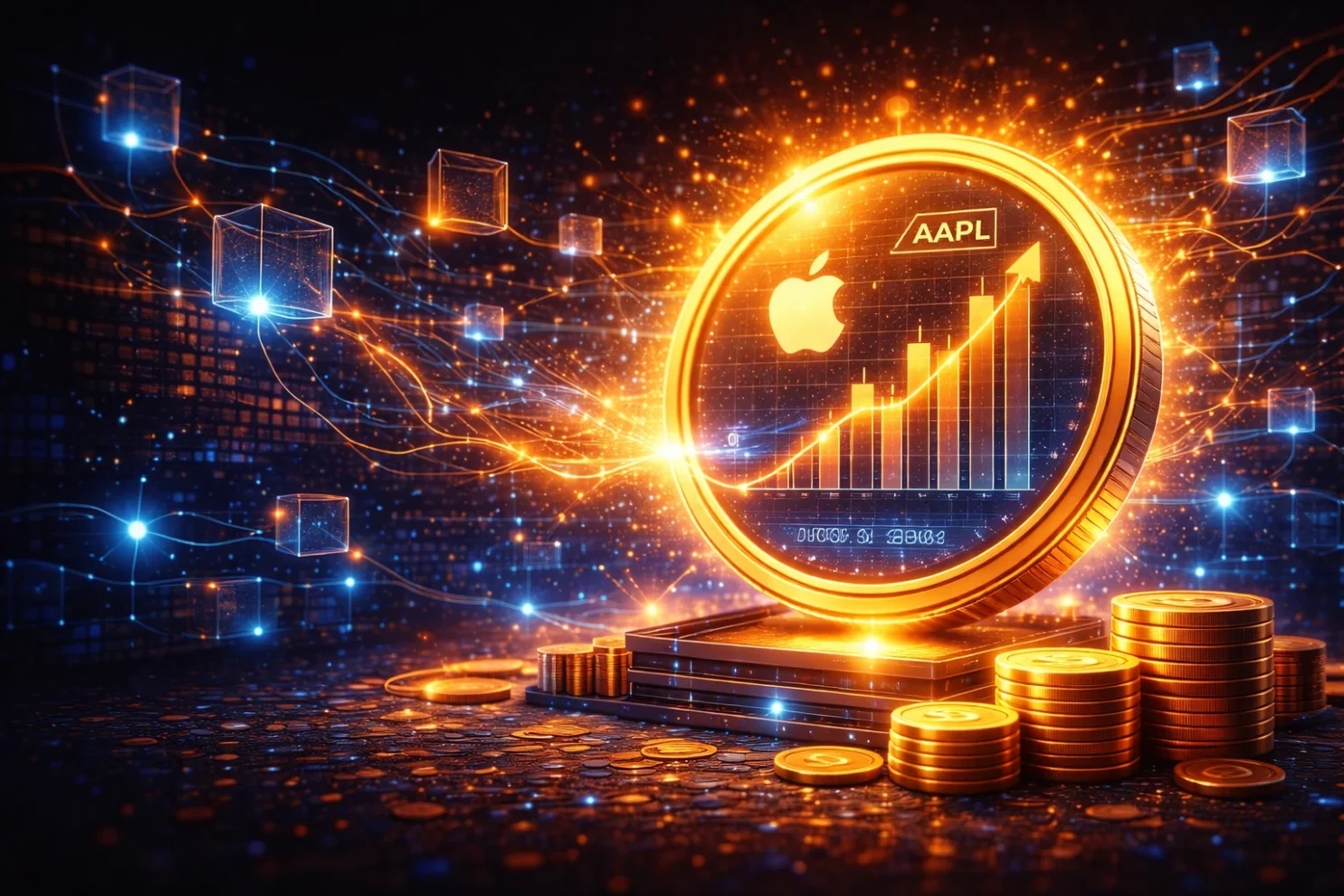
The mechanics vary by issuer, but the most common structure works like this. A regulated broker or financial institution buys actual shares of the target stock and holds them in custody. The custodian then issues tokens on a blockchain — typically one token per share or a fractional equivalent — that represent a claim on those underlying shares.
The token lives on a public blockchain (Ethereum is most common, but Polygon and Solana have also been used). Smart contracts govern how many tokens exist, who holds them, and under what conditions they can be redeemed. When the stock pays a dividend, the issuer may distribute equivalent value to token holders. When you want to exit, you sell the token on the trading platform or, in some structures, redeem it directly with the issuer for the underlying share or cash.
Some platforms have used a synthetic model instead — no actual shares are held in custody, and the token’s price is maintained through oracle feeds and hedging contracts. This is common in DeFi protocols like Synthetix, which offered synthetic stock exposure before regulatory pressure changed the landscape. The synthetic model carries different risks: there’s no underlying asset backing the token.
Why Tokenization Became Popular
The 2021 retail trading boom exposed friction that most investors had accepted as normal. Robinhood restricting GameStop purchases in January 2021 pushed thousands of retail traders to ask: why can a broker unilaterally block me from a trade? Crypto exchanges, which had been running 24/7 without trade halts, looked appealing by comparison.
Around the same time, platforms like Binance, FTX, and Mirror Protocol launched tokenized stock products targeting non-US users who wanted Apple or Tesla exposure without a US brokerage account. FTX’s tokenized stocks reached over $500 million in notional volume at peak before FTX collapsed in 2022, which killed most of those products overnight.
The 2024-2026 period brought a different wave: institutional-grade tokenization infrastructure, with companies like Backed Finance and Securitize building regulated tokenized stock products primarily on Ethereum and Polygon. The SEC’s evolving stance on tokenized securities — moving from skepticism toward conditional acceptance in 2025 — gave the market a clearer path.
How Tokenization of Stocks Works
Blockchain-Based Asset Representation
When a tokenized stock issuer creates a product, they follow a specific process. First, the underlying shares are purchased and placed in custody with a regulated custodian — a bank or licensed broker. The custodian provides proof of holdings. Then, a smart contract is deployed on the target blockchain that governs token issuance. The contract mints tokens in an amount corresponding to the shares held in custody.
The token standard matters. Most tokenized stocks use ERC-20 (fungible tokens on Ethereum) or similar standards on other chains. Some issuers use permissioned token standards that restrict transfers to Allowlist addresses — meaning you need to pass KYC verification before you can hold or trade the token. This is common for regulated issuers who need to comply with securities law.
Price tracking works through oracles — services that bring off-chain data (like stock prices from Bloomberg or NYSE) onto the blockchain. The token itself doesn’t automatically know the current stock price; the price is fed in and used by the trading platform or smart contract to price transactions.
Smart Contracts and Ownership
The smart contract is where the tokenized stock’s rules live. It defines total supply (number of tokens in existence), who can hold and transfer tokens (Allowlist addresses or anyone), how redemptions work, and what happens when dividends occur.
For permissioned tokens, the contract includes transfer restriction logic. Before any transfer executes, the contract checks that both sender and receiver are on the approved list. This compliance mechanism is what lets regulated issuers operate within securities law frameworks.
Ownership of the token is recorded on the blockchain’s public ledger. There’s no central database to update — the blockchain is the record. This means if the issuer’s servers go down, the ownership record persists. It also means if you lose access to your wallet, there’s no password reset.
Custody of Underlying Shares
Custody is the critical link between the on-chain token and the off-chain asset. The shares backing a tokenized stock sit somewhere — a brokerage account, a bank’s securities division, a regulated custodian. If that entity fails, is sanctioned, or is hacked, the backing for the token disappears.
This is not hypothetical. FTX’s tokenized stocks (which were backed by CM-Equity, a German broker) became inaccessible when FTX collapsed, even though the actual shares were held separately. Users eventually recovered their exposure, but only through a complicated claims process.
Due diligence on the custodial structure is therefore not optional. Who holds the shares? Under what legal framework? What happens in a bankruptcy? These questions have answers for well-structured tokenized stock products. For poorly-structured ones, they don’t.
Tokenized Stocks vs Traditional Stocks
The comparison table summarizes the key practical differences:
| Feature | Tokenized Stocks | Traditional Stocks |
| Trading hours | 24/7 (depends on platform) | Exchange hours only |
| Fractional ownership | Yes, down to small fractions | Usually whole shares only |
| Settlement | Near-instant (on-chain) | T+1 or T+2 |
| Geographic access | Broad (fewer broker restrictions) | Depends on broker/jurisdiction |
| Custody | Issuer or DeFi protocol | Broker or central depository |
| Dividends | Sometimes passed through | Paid directly to shareholder |
| Voting rights | Rarely | Yes (common shares) |
| Regulatory protection | Limited, varies by issuer | Well-established (SEC, etc.) |
Settlement speed is where tokenized stocks win most clearly. Traditional stock settlement running T+1 means capital is tied up overnight after a trade. On-chain settlement of tokenized stocks happens in seconds or minutes, freeing capital immediately. For active traders, this matters.
Trading hours are a genuine advantage for users in non-US time zones. A retail investor in Southeast Asia or Eastern Europe who wants Apple exposure at 10 PM local time can’t access traditional US equity markets. A tokenized stock platform operating 24/7 removes that restriction.
Fractional shares are increasingly available through traditional brokers (Fidelity, Schwab, Interactive Brokers all offer them), so this advantage has narrowed. But tokenization can take fractionalization further — to 0.001 of a share — which some DeFi protocols enable.
The disadvantages are real. Voting rights are rarely passed through. Dividend handling varies. Regulatory protection is thinner. And the counterparty risk of the token issuer is an additional layer of risk that doesn’t exist with a traditional share.
Benefits of Tokenized Stocks
- 24/7 trading — equity markets close. Tokenized stock platforms generally don’t. This matters most for users in time zones far from US market hours.
- Global access — traditional brokerage accounts require legal agreements with firms that operate in your jurisdiction. Many retail investors in emerging markets have no practical access to US equities. Tokenized stock platforms with lighter KYC requirements change this, though the regulatory picture is evolving.
- Fractional ownership at the token level — tokens can be issued and traded in amounts smaller than one share. At $175 per share, even one Apple share requires $175. At 0.01 AAPL tokens, entry cost drops to $1.75. This matters for lower-income investors and dollar-cost averaging at small amounts.
- Faster settlement — on-chain settlement is near-instantaneous. For platforms that support DeFi integration, tokenized stocks can be used as collateral in lending protocols, yield strategies, or liquidity pools — use cases that don’t exist for traditional shares.
- Programmability — tokenized stocks can be incorporated into smart contract logic in ways traditional shares can’t. Conditional trades, automated portfolio rebalancing, and tokenized stock-backed loans are all possible on-chain without traditional financial intermediaries.
Risks of Tokenized Stocks
The risks here are specific and serious enough to deserve more than a bullet list.
Counterparty and custody risk is the primary concern. Every tokenized stock traces back to an issuer holding underlying assets. That issuer can fail, be sanctioned, mismanage assets, or simply shut down. When FTX shut down in November 2022, its tokenized stock product shut down with it. Users got their money back eventually — but not immediately, and not without effort.
Regulatory uncertainty is structural. Tokenized stocks representing US securities that are offered to US investors without SEC registration violate the Securities Act of 1933. Most current platforms either restrict US users, operate through registered entities, or use structures designed to keep them out of direct SEC jurisdiction. The regulatory envelope keeps changing. A product that’s available today may be restricted or shut down by next quarter.
Liquidity can be thin. Tokenized stock platforms have a fraction of the trading volume of NYSE or NASDAQ. Wide bid-ask spreads and shallow order books mean you may not be able to execute large orders at fair prices. In volatile markets, this gap widens.
Technical risk is real. Smart contract bugs have drained billions from DeFi protocols. A bug in a tokenized stock contract could allow unauthorized minting, freeze withdrawals, or destroy value. Most reputable issuers have their contracts audited, but audits are not guarantees.
Oracle manipulation risk exists for any token that relies on price feeds. If a malicious actor manipulates the price oracle feeding stock prices to a tokenized stock contract, the contract could mint or burn tokens based on false prices. This has happened in DeFi with synthetic assets.
Tokenization of Stocks and Blockchain Technology
The blockchain component of tokenized stocks does more than provide a distributed ledger. It changes the settlement logic, the programmability of the asset, and the composability of the exposure.
Settlement on blockchain is atomic — either the full transaction completes or nothing changes. There’s no scenario where you send payment and don’t receive the token, or receive the token without payment clearing, because both sides of the transaction execute simultaneously. This eliminates settlement risk in a way that T+1 systems can’t fully replicate.
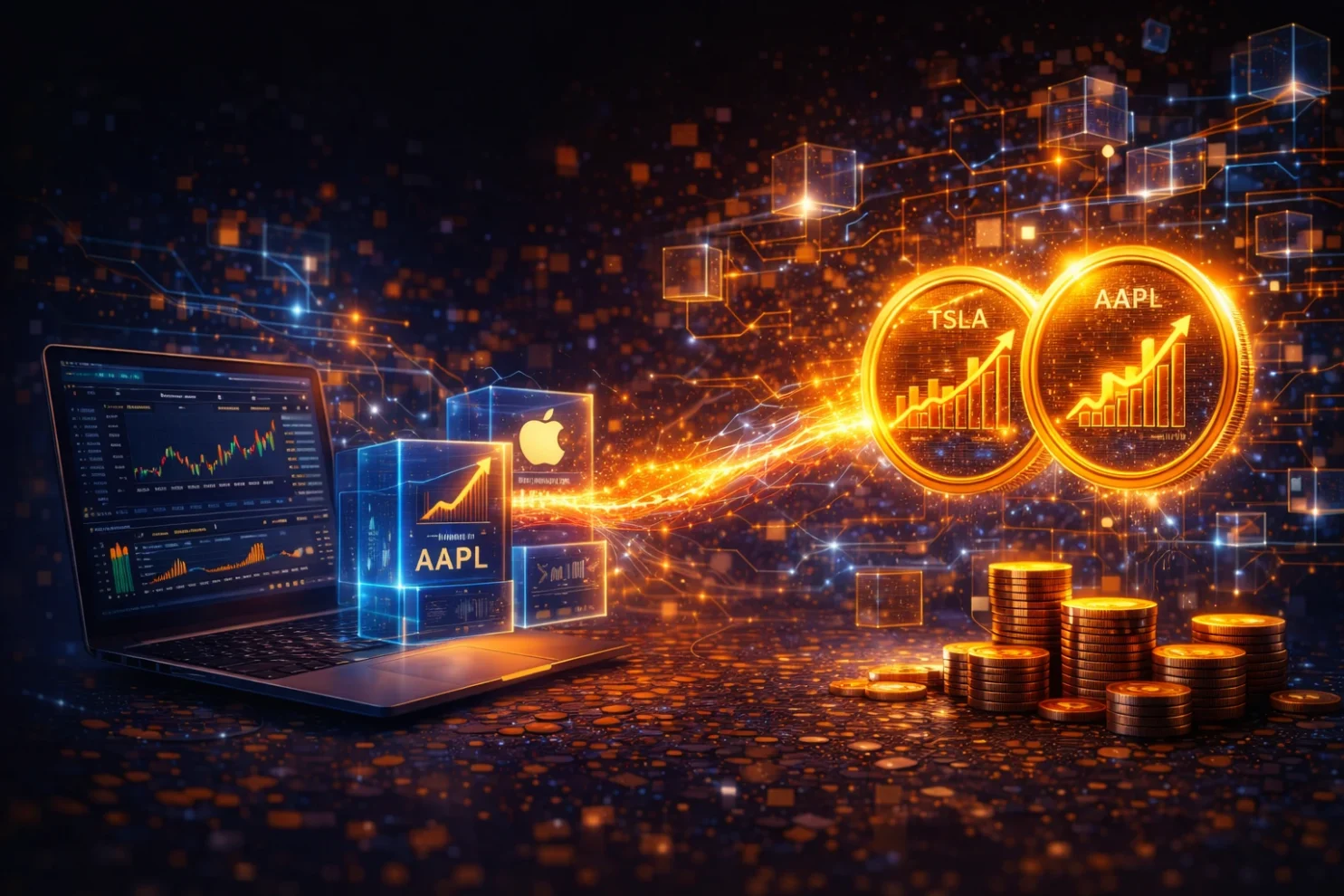
Composability is the more transformative property. You can deposit a tokenized AAPL token into a lending protocol as collateral for a stablecoin loan, add it to a liquidity pool with a stablecoin to earn trading fees, or use it in an automated investment strategy that rebalances based on on-chain signals. None of this is possible with traditional shares without going through financial intermediaries at each step.
The 2025-2026 institutional tokenization wave brought major players into the space. BlackRock’s BUIDL fund (tokenized money market), Franklin Templeton’s OnChain US Government Money Fund, and Ondo Finance’s tokenized Treasury products established that institutional-grade tokenized assets were viable. Tokenized equities followed the same trajectory, with platforms like Backed Finance tokenizing ETFs and individual stocks on Ethereum for non-US users.
The underlying blockchain infrastructure also determines the tradeoffs. Ethereum offers the deepest DeFi ecosystem but higher transaction costs. Polygon and Stellar offer lower costs but less ecosystem depth. Solana offers high throughput but different smart contract security tradeoffs. Where a tokenized stock lives determines what you can do with it.
Conclusion
Tokenized stocks offer 24/7 trading, global access, and fractional ownership—advantages that matter to those excluded from traditional US equity markets. However, the risks are specific: issuer dependency, regulatory shifts, and smart contract exposure. The collapse of platforms like FTX serves as a warning that these tokens are only as reliable as the institutions backing them.
As we move through 2026, institutional involvement is transforming these from speculative DeFi assets into regulated financial instruments. This increases legitimacy but also tightens access. When choosing a product, investors must verify who holds the underlying shares, the governing regulatory framework, and available liquidity.
More Questions
A digital token representing economic exposure to a traditional equity. It tracks the price of an underlying stock via a contractual claim on the issuer. They enable fractional ownership and 24/7 trading on blockchains.
Legally, these are typically classified as securities. Their status depends on the issuer’s structure, whether actual shares are held in custody, and local jurisdiction. Many restrict US users to bypass specific registration requirements.
Issuers buy real shares, hold them with a licensed custodian, and mint tokens representing those shares. Smart contracts manage supply, while price oracles ensure the token matches the stock’s market value. Some use synthetic models backed by hedging contracts instead of actual shares.
Major risks include counterparty failure (issuer/custodian insolvency), regulatory crackdowns, low liquidity, smart contract bugs, and oracle price manipulation.
Tokenized stocks settle instantly, trade 2009-style 24/7, and allow for tiny fractional buys. Traditional stocks have T+1 settlement and stronger investor protections but fixed hours. Tokenized versions rarely offer voting rights.
Providers like Backed Finance and Ondo Finance offer these assets, though most exclude US residents. Availability depends on your jurisdiction and KYC status. Always verify the custodial and regulatory framework before investing.
Published Articles
 Popular
Bitcoin Pizza Guy: The Story Behind the First Real Bitcoin Purchase
Introduction The history of Bitcoin is full of dramatic ups and downs,...
 Popular
The Meme Economy: How Internet Humor Shapes Culture, Markets, and Crypto
Introduction Ten years ago, the idea that a picture of a dog...
 Popular
What is the Omniverse? Exploring the Ultimate Multiversal Concept
Introduction Do you know what the omniverse is? Is this concept real?...
Bitcoin Taproot Explained: What the Upgrade Means for BTC
Introduction Unfortunately, the most popular cryptocurrency today – Bitcoin – was not...
Crypto On-Ramps and Off-Ramps Explained: How Fiat and Crypto Move In and Out
Entering the world of digital assets often feels like trying to cross...
Crypto Basics Explained: A Beginner’s Guide to Cryptocurrency and Trading
Introduction The world of finance is changing right before our eyes. Just...