
Web3 Domains: The Future of Decentralized Internet Addressing
Introduction
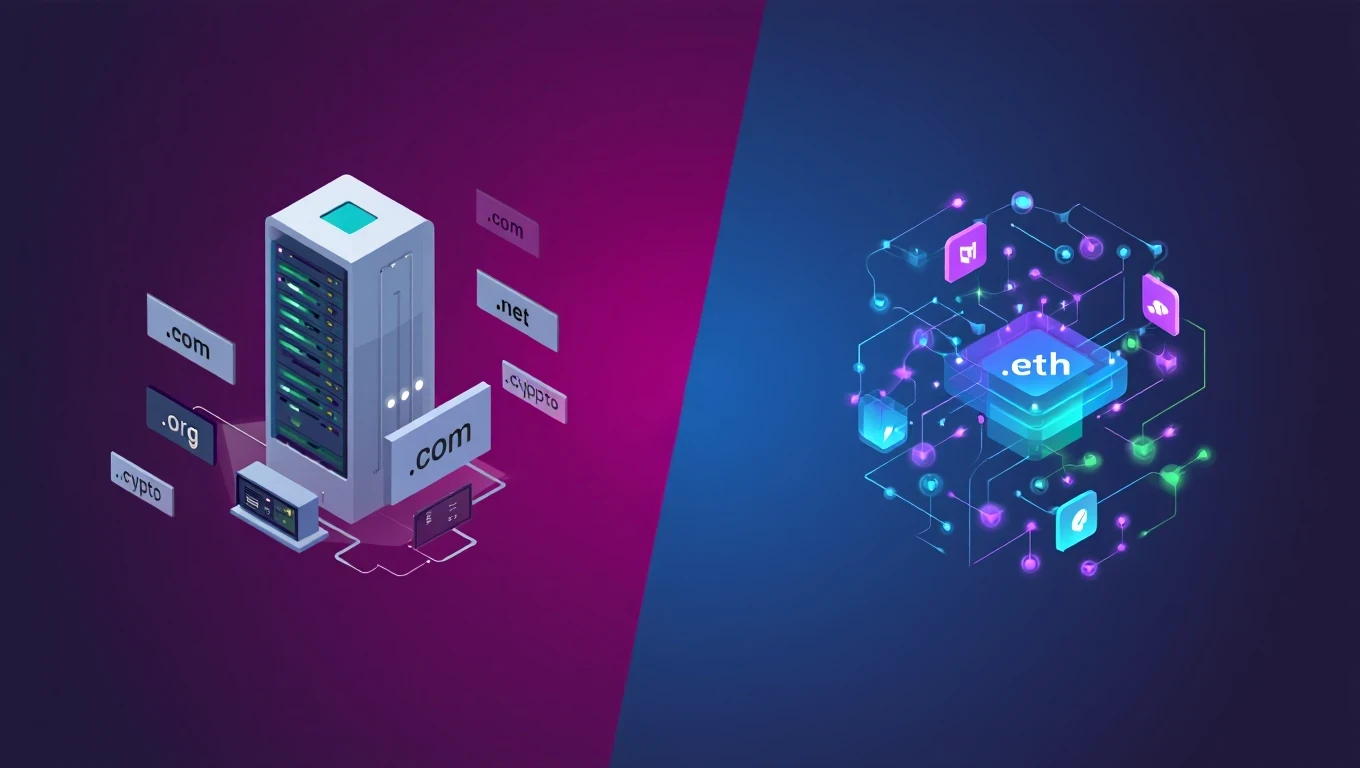
Every website address you type into a browser runs through the same infrastructure: DNS, the Domain Name System. A global network of servers managed by ICANN and a handful of registrars translates human-readable addresses like example.com into IP addresses computers understand. It’s centralized, it’s censorship-prone, and it’s been that way since 1983.
Web3 domains are a different proposition entirely. Instead of a registrar issuing you a lease on a domain name, a blockchain mints you an NFT. The domain lives in your wallet. No one can take it, no government can seize it, and no registrar can let it expire while you’re not paying attention. Your domain, permanently.
Whether that proposition is practically useful — or just theoretically compelling — depends on where web3 domain infrastructure actually stands in 2026. This guide covers how decentralized domains work, the main providers, how to buy web3 domains, and where the real limitations still sit.
What Are Web3 Domains?
Web3 domains are blockchain-based naming records that map human-readable identifiers to on-chain addresses. Instead of DNS records stored on centralized servers, web3 domain names live on public blockchains as NFTs. Whoever holds the NFT in their wallet controls the domain.
The most common uses today are:
- Wallet addresses — replace a 42-character Ethereum address like 0x71C7656EC7ab88b098defB751B7401B5f6d8976F with something memorable like alice.eth. The domain resolves to the address when someone tries to send crypto.
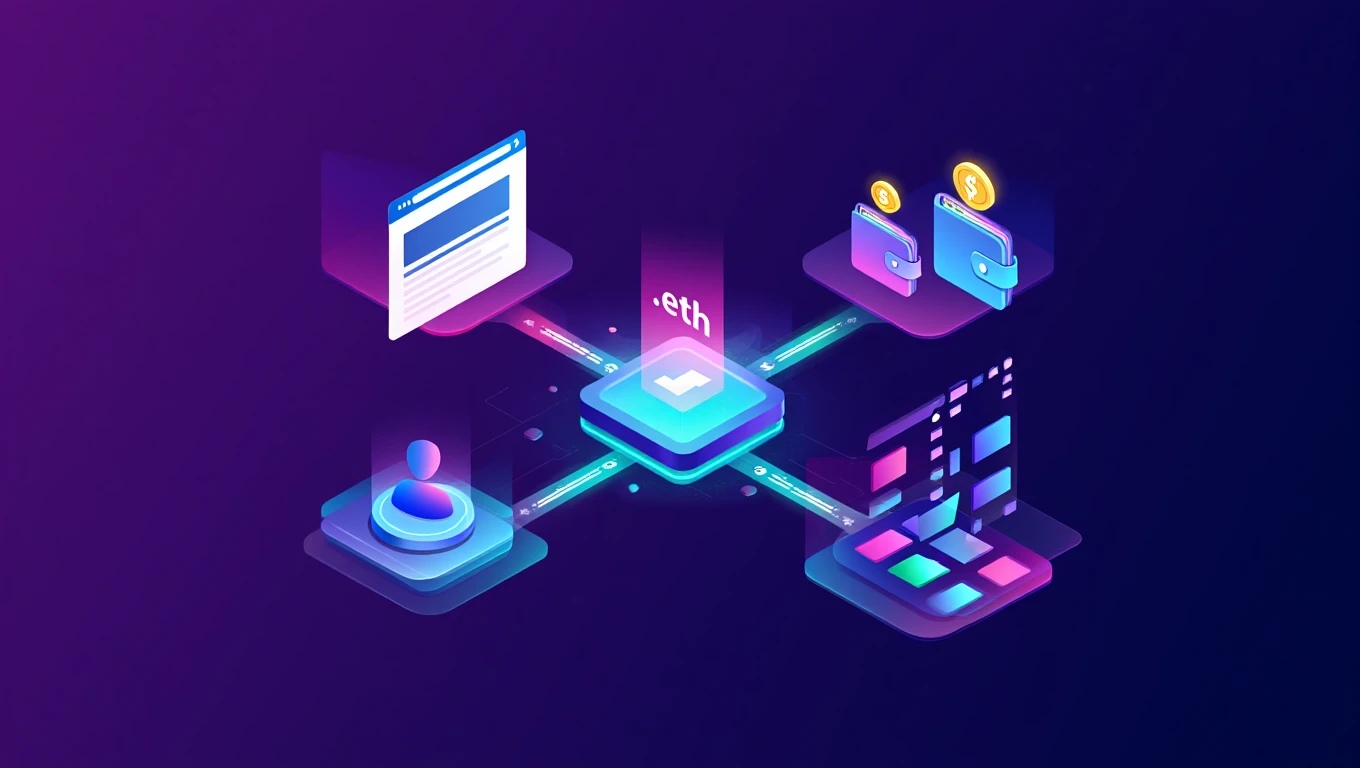
- Decentralized websites — host content on IPFS (InterPlanetary File System) and point your web3 domain at it. The site exists outside any company’s servers and can’t be taken down by a hosting provider or domain registrar.
- Digital identity — a single web3 domain can serve as a portable identity across Web3 apps: your username in DeFi protocols, your profile handle in decentralized social networks, your verified wallet address for payments.
Traditional domain names (.com, .org, .io) are leases. You pay annually and the registrar maintains the authority to revoke or transfer your domain. Web3 domain names are ownership records on a public ledger. Pay once, own permanently — at least for providers that use the no-renewal model.
How Decentralized Domains Work
Blockchain Domain Ownership
When you register a web3 domain, the registrar mints an NFT on the relevant blockchain and sends it to your wallet. For ENS (.eth domains), this happens on Ethereum. For Unstoppable Domains (.crypto, .nft, .x, and others), minting occurs on Polygon.
The NFT represents ownership. Transfer the NFT and you transfer the domain. Sell it on OpenSea and the buyer gets the domain. This is meaningfully different from traditional DNS: there’s no registrar database to update, no transfer authorization email, no five-day waiting period. Ownership changes the moment the NFT moves between wallets.
The blockchain record is the authoritative source of truth. No company’s server needs to be up for the ownership record to exist. Even if ENS as an organization ceased to exist tomorrow, the records on Ethereum would remain intact.
Smart Contracts and Domain Records
Underneath a web3 domain is a smart contract registry. For ENS, this is the ENS Registry contract deployed on Ethereum mainnet, which maps domain names to resolver contracts. The resolver contract stores the actual records: which Ethereum address this domain points to, which IPFS hash it resolves for web content, which other blockchain addresses it maps to.
Records you can set on a web3 domain include:
- Crypto addresses — ETH, BTC, SOL, and most major chains. One domain, many chains.
- Content hash — IPFS hash for a decentralized website.
- Text records — email, Twitter/X handle, avatar URL, description, any arbitrary key-value data.
- Other names — set a canonical name for a contract or wallet.
Updating records costs gas on Ethereum (for ENS) or a small transaction fee on Polygon (for Unstoppable Domains). The records update immediately once the transaction confirms.
Linking Domains to Wallet Addresses
The most practical use case in 2026 is replacing wallet addresses in payments. Rather than copying and pasting 42 characters, a sender types alice.eth into a compatible wallet app and sends. The wallet queries the ENS resolver, gets back the associated Ethereum address, and routes the payment.
Support for this across major wallets is now reasonably broad. MetaMask, Rainbow, Coinbase Wallet, Trust Wallet, and most DeFi-native applications resolve ENS names in their send flows. Unstoppable Domains names work in a large but slightly smaller set of supported apps.
The lookup itself happens through a combination of on-chain calls and off-chain gateways. For Ethereum ENS names, the lookup hits Ethereum mainnet. Layer 2 ENS names (ENS recently extended to allow L2 registrations) may resolve through different infrastructure. Speed is generally fast enough that users don’t notice the extra lookup step.
Web3 Domain Names Explained
The naming landscape in web3 looks different from traditional TLDs. Rather than .com, .org, or country codes, web3 registrars have introduced new extensions designed to signal crypto-native identity.
ENS staked its identity on a single TLD: .eth. Simple, recognizable, strongly associated with Ethereum. If you’re in crypto, you know what alice.eth means. ENS also supports DNS integration — you can import an existing .com domain into ENS and give it on-chain resolution capabilities, bridging the two systems.
Unstoppable Domains went broader. Their portfolio of TLDs includes .crypto, .nft, .x, .wallet, .dao, .888, .blockchain, .bitcoin, and more. The strategy is to capture naming across use cases: .dao for decentralized organizations, .nft for NFT-centric identities, .wallet for payment-focused addresses. Whether the breadth dilutes value or expands it is genuinely debated in the community.
Handshake is a third approach — a separate proof-of-work blockchain that attempts to decentralize the root zone of DNS itself, rather than creating new TLDs. Less adoption than ENS or Unstoppable, but a more architecturally ambitious attempt at decentralization.
Shorter names are more valuable — as in traditional domains. alice.eth sold for 35 ETH in 2022. Three-character .eth names went through a speculative frenzy in 2021-2022. The secondary market on OpenSea and Blur regularly trades desirable names, particularly short strings, common words, and number combinations.
How to Buy Web3 Domains
Choosing a Web3 Domain Provider
Two providers dominate the market. The choice depends on which ecosystem you’re most active in and what you want the domain for.
ENS is the right choice if you primarily use Ethereum and want the most widely integrated domain name. The .eth TLD has the deepest wallet support, the most protocol integrations, and a community-governed DAO that controls the protocol. Downsides: annual renewals, and gas costs for registration and record updates can be significant on Ethereum mainnet.
Unstoppable Domains makes sense if you prefer a one-time purchase with no renewals, want TLD variety, or are building on Polygon. Their browser extension and native app handle the resolution side. The downside is that the protocol is controlled by a company rather than a DAO.
Beyond these two: Space ID (.bnb on BNB Chain, .arb on Arbitrum), Lens Protocol (handles for the Lens social graph), and zkSync Name Service are active in their respective ecosystems. If you live primarily on another L2, the chain-native naming service may be more practical.
Registering a Domain Name
For ENS, go to app.ens.domains. Search for the name you want with the .eth extension. If it’s available, you’ll see a registration price (based on character length — names under five characters cost more) and a yearly renewal fee. The registration process takes two transactions: a commitment transaction that locks in your intent, then the actual registration transaction after a 60-second waiting period. This two-step design prevents front-running.
For Unstoppable Domains, go to unstoppabledomains.com. Search, add to cart, pay (credit card or crypto). One transaction, no renewal. The domain is minted to your wallet as an ERC-721 token on Polygon.
Prices as of 2026: ENS .eth names cost $5/year for names 5+ characters, $160/year for 4-character names, and $640/year for 3-character names. Unstoppable Domains prices vary by TLD and name desirability, typically $5–$40 one-time for common names.
Connecting a Crypto Wallet
Both providers require a Web3-compatible wallet to complete registration. MetaMask is the most commonly used. For ENS, the wallet needs ETH for gas fees and the registration cost. For Unstoppable Domains, you can pay with a credit card and have the domain minted to a wallet address you specify — no gas required on your end.
After registration, you need to set up your records. In ENS, this means going to your name’s manager page and setting a Primary Name (which associates the domain with your Ethereum address), then adding crypto addresses, content hash, or text records as needed. In Unstoppable, you connect your wallet on their website and use the dashboard to add addresses across chains.
Web3 Domain Registration Process
A full ENS registration walkthrough, step by step:
- Step 1 — go to app.ens.domains, connect your MetaMask wallet, search for your desired .eth name.
- Step 2 — select registration duration (1 year minimum, longer to save on gas per year). Review the total cost including gas estimate.
- Step 3 — click Begin. Send the commitment transaction (Step 1 of 2). Wait 60 seconds for the frontrun-protection window.
- Step 4 — send the registration transaction (Step 2 of 2). Your name is now registered and the NFT is in your wallet.
- Step 5 — go to My Account, find your new name, and set it as your Primary Name so your wallet address resolves to it.
- Step 6 — add records: set your ETH address (if different from the registering address), add BTC or other chain addresses, set a content hash if hosting a decentralized site.
The Unstoppable Domains process is simpler: search, add to cart, pay, specify your wallet address, done. Record management happens through their web dashboard after minting.
Unstoppable Domains vs ENS
The comparison comes up constantly. Here’s a side-by-side breakdown of the key practical differences.
| Unstoppable Domains | ENS (Ethereum Name Service) | |
| Blockchain | Polygon, Ethereum | Ethereum |
| Renewal fees | None (one-time purchase) | Annual renewal required |
| TLDs | .crypto, .nft, .x, .wallet, .dao, others | .eth |
| Browser support | Requires extension or compatible browser | Requires extension or compatible browser |
| NFT standard | ERC-721 | ERC-721 |
| Governance | Company-controlled | DAO-governed (ENS DAO) |
| Integration focus | Payments, dApps, websites | Payments, dApps, identity |
| Price range | $5 – $40+ (one-time) | $5/year and up (renewal) |
The renewal vs. one-time purchase debate is the most discussed difference. ENS argues that renewals fund ongoing development and create a more sustainable economic model for the DAO. Unstoppable argues that having to renew a domain permanently undermines the ownership value proposition of web3.
Governance matters too. ENS is run by ENS DAO, where holders of ENS tokens vote on protocol changes. This is more aligned with web3’s decentralization ethos — the protocol’s future isn’t controlled by a single company. Unstoppable Domains is a company; their protocol decisions don’t require token holder approval.
In practice, ENS has more ecosystem integrations and is more widely recognized. If you had to pick one domain that would work in more wallets and more protocols, .eth is the safer choice. If you prefer one-time payment and TLD variety, Unstoppable makes sense.
Use Cases for Web3 Domains
Where decentralized domains actually get used in 2026:
- Crypto payments — replacing wallet addresses in payment flows. This is the highest-adoption use case. Sending ETH to alice.eth is meaningfully better UX than sending to 0x71C7656EC7ab88b098defB751B7401B5f6d8976F.
- Decentralized websites — hosting static sites on IPFS and pointing a web3 domain at them. Used by DAOs for governance portals, DeFi protocols for frontends that can’t be taken down, and privacy-focused individuals. Requires either a compatible browser extension (MetaMask’s built-in resolver, Brave browser) or manual IPFS gateway access.
- DeFi identity — ENS names appear as display names in Uniswap, Aave, and other Ethereum-native DeFi protocols when you connect a wallet. It’s a small detail that makes on-chain activity more readable.
- Decentralized social — Farcaster and Lens Protocol both integrate ENS and their own naming systems as profile handles. Your web3 domain can serve as your persistent identity across multiple social applications.
- DAOs and organizations — using yourorganization.eth as a canonical identifier for a DAO, pointing it at the organization’s multi-sig address and governance portal. Better than telling contributors to find you by a 42-character address.
- NFT speculation and investment — desirable web3 domain names trade as collectibles. Short names, number combinations, and recognizable words have secondary market value independent of utility.
Limitations of Web3 Domains
The pitch for web3 domains is compelling. The practical situation has meaningful friction points that haven’t fully resolved.
Browser support is still a barrier. Typing alice.eth into Chrome’s address bar doesn’t work without a browser extension or middleware. Brave browser has built-in ENS support, but most users still use Chrome or Safari. The UX gap between web3 domain resolution and traditional DNS resolution is real and slows mainstream adoption.
Record management requires on-chain transactions. Changing where your domain points requires gas and a wallet interaction. For non-technical users accustomed to updating DNS records through a web dashboard, this is friction. ENS has improved the UI significantly, but the underlying transaction requirement remains.
Secondary market speculation has created a land rush that makes good names expensive or unavailable. Common words, short strings, and recognizable names were registered early by speculators. New users registering their actual name may find it taken and listed at speculative prices on secondary markets.
The decentralization claim varies by provider. ENS is genuinely decentralized — the contracts run on Ethereum mainnet and governance is by DAO. Unstoppable Domains’ protocol is controlled by a company. If that company made decisions adversarial to users, there’s no DAO override. The decentralization ethos doesn’t equally apply to every provider.
Interoperability between systems is limited. An ENS name and an Unstoppable Domains name are separate systems with separate integrations. Wallet support for both is good but not universal. A developer building a dApp has to decide which naming systems to support, and supporting all of them adds complexity.
Conclusion
Web3 domains solve a real problem—long wallet addresses—and point toward a user-owned model of internet identity. The infrastructure exists, and wallet support is broad, making the payment use case highly functional.
The decentralized website model works technically but requires significant setup. Outside of Brave, which now natively supports .brave and other TLDs, browser support remains extension-dependent. DNS hasn’t been replaced; it has been paralleled.
ENS remains the Ethereum-native leader, while Unstoppable Domains wins on one-time ownership and TLD variety. By 2026, aggregators like Endless Domains have further simplified management. Choosing between them depends on whether you value DAO governance and .eth recognition or permanent ownership without renewal fees. Buying a domain today is a practical supplement for DeFi and on-chain identity, even if it isn’t yet a total DNS replacement.
More Questions
Blockchain-based naming records stored as NFTs. Unlike traditional DNS, they are minted to a user’s wallet, granting total control. They replace complex crypto addresses with human-readable names and host decentralized IPFS websites.
They function as on-chain smart contracts that map names to data, such as wallet addresses or IPFS content hashes. This bypasses centralized servers, relying instead on blockchain registries to resolve queries.
For ENS (.eth), use the ENS Manager app and pay an annual renewal fee. For Unstoppable Domains, purchase via their website for a one-time fee. Both require a crypto wallet to mint the domain NFT.
The process of minting a domain NFT on a blockchain. ENS involves a two-step registration to prevent front-running, while Unstoppable allows for direct purchasing. Once registered, you can configure records to point to various decentralized destinations.
ENS (.eth) is a decentralized DAO on Ethereum requiring annual rent. Unstoppable Domains is a company-led service offering various TLDs (.crypto, .x, .brave) with no renewal fees. ENS has deeper integration in the Ethereum ecosystem, while Unstoppable offers simpler pricing.
Published Articles
 Popular
Bitcoin Pizza Guy: The Story Behind the First Real Bitcoin Purchase
Introduction The history of Bitcoin is full of dramatic ups and downs,...
 Popular
The Meme Economy: How Internet Humor Shapes Culture, Markets, and Crypto
Introduction Ten years ago, the idea that a picture of a dog...
 Popular
What is the Omniverse? Exploring the Ultimate Multiversal Concept
Introduction Do you know what the omniverse is? Is this concept real?...
Bitcoin Taproot Explained: What the Upgrade Means for BTC
Introduction Unfortunately, the most popular cryptocurrency today – Bitcoin – was not...
Crypto On-Ramps and Off-Ramps Explained: How Fiat and Crypto Move In and Out
Entering the world of digital assets often feels like trying to cross...
Crypto Basics Explained: A Beginner’s Guide to Cryptocurrency and Trading
Introduction The world of finance is changing right before our eyes. Just...