
How to Build and Diversify a Crypto Portfolio and Track Your Assets

Introduction
A crypto portfolio is more than a list of coins in an exchange account. It is a planned collection of digital assets, cash-like reserves, and sometimes yield-bearing positions chosen to serve a particular goal. The plan defines how much risk the investor can accept, how long the capital can remain invested, how assets will be stored, and what events will trigger a review.
This guide explains what is a crypto portfolio, how to build one from the ground up, and how to diversify without collecting dozens of tokens that move together. It also covers practical ways to monitor results. The material is educational and is not personalized financial advice. Crypto assets can be extremely volatile or illiquid, and fraud, technical failures, or a failed project can wipe out most or all of an investment. A portfolio process does not remove those risks. It makes them easier to see before they become expensive.
Understanding a Crypto Portfolio
What is a crypto portfolio in practical terms? It is the complete set of crypto-related positions an investor controls, considered as one system instead of a series of unrelated trades. That includes assets held on exchanges, coins in self-custody wallets, stablecoins, staking positions, DeFi deposits, and cash reserved for future purchases or taxes. A useful record also shows acquisition cost, current value, location, liquidity, and the reason for holding each position.
Possible holdings include established network assets such as Bitcoin and Ether, stablecoins, infrastructure tokens, decentralized-finance assets, exchange-related tokens, gaming or metaverse assets, NFTs, and speculative small-cap projects. These categories do not carry equal risk. A stablecoin adds issuer, reserve, and de-pegging risk; a staked asset adds validator and lock-up risk; a DeFi position adds smart-contract and protocol risk.
Holding one cryptocurrency concentrates the outcome in one network, one market narrative, and one set of technical or regulatory risks. A portfolio spreads exposure, but diversification inside crypto has limits because many assets fall together during market stress. Investors distribute capital to reduce dependence on a single failure, create liquidity for rebalancing, and align different holdings with different roles.
A portfolio view also separates ownership from exposure. A token in a wallet, a derivative position, and shares in a crypto-related company may respond to similar market forces while creating different legal, custody, and liquidation risks. Indirect exposure and outstanding obligations belong in the record alongside on-chain balances. Strategic holdings should also be kept separate from temporary trading inventory. Otherwise, a short-term trade can quietly become a long-term concentration after its price falls.
How to Build a Crypto Portfolio From Scratch
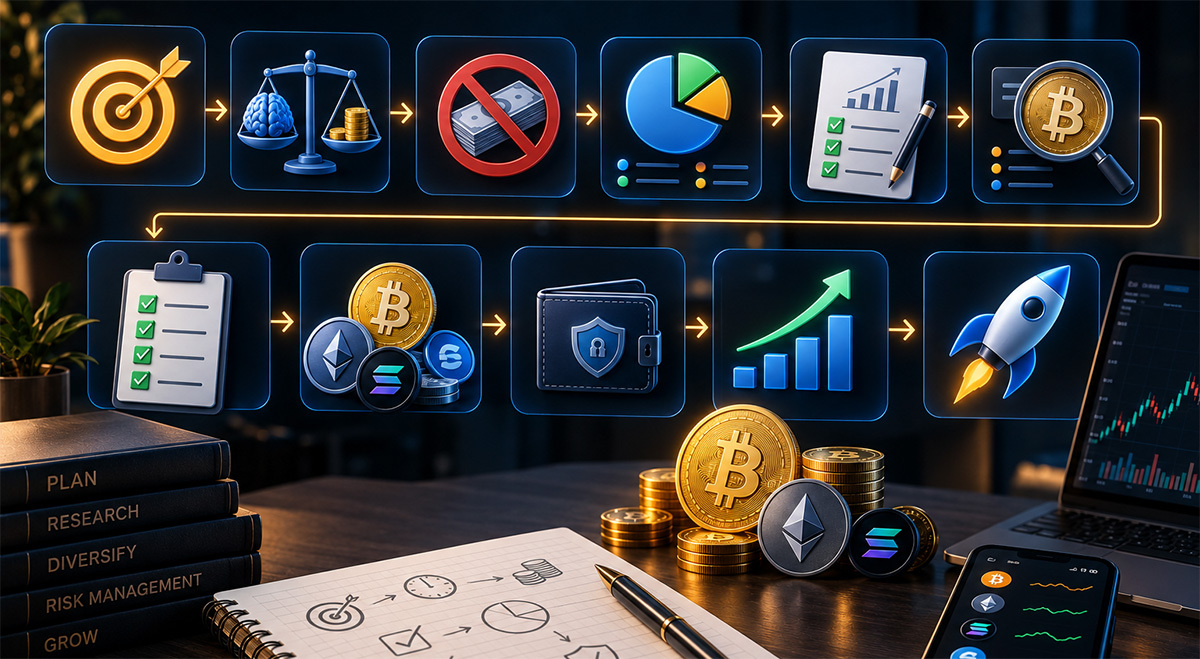
Building a crypto portfolio begins with a written goal. Is the money intended for long-term accumulation, active trading, experimenting with blockchain applications, or a future purchase? Set the time horizon and decide how much can be lost without putting rent, debt payments, an emergency fund, or another essential goal at risk.
Next, assess risk capacity as well as emotional tolerance. Capacity is the financial ability to absorb a loss; tolerance is the willingness to remain invested during a sharp decline. The lower of the two should guide the allocation. Decide in advance how much of the overall investment portfolio may be placed in crypto and avoid borrowed money.
Choose categories before individual tokens. A simple framework may use a core of established liquid assets, a smaller satellite allocation to higher-risk sectors, and a reserve for fees, taxes, or future purchases. Research each asset's purpose, supply mechanics, governance, liquidity, custody options, development activity, and major concentration risks.
Give every position a target percentage and an acceptable range. A range avoids needless trading while still revealing meaningful drift. Record the investment thesis, the developments that would invalidate it, and the maximum acceptable loss or exposure. This written policy keeps headlines and sudden price moves from deciding the allocation.
Before buying, perform a basic due-diligence checklist. Confirm how the network or protocol works, who can change it, how tokens enter circulation, where reliable liquidity exists, and whether ownership is concentrated. Review security history and understand how the position can be sold or transferred. Write a one-sentence role for every asset: long-term core, liquidity reserve, sector exposure, experiment, or active trade. If the role cannot be stated clearly, the position is not ready for inclusion. Start smaller than the eventual target and learn the operational steps before increasing the allocation.
Which Assets Can Be Included in a Crypto Portfolio?
Bitcoin is often used as a liquid core holding because of its market depth and established network. Ether may provide exposure to smart-contract activity and applications. Other layer-one or layer-two assets introduce different technology and ecosystem risks. Stablecoins can help with liquidity but should never be treated as risk-free cash.
DeFi and infrastructure tokens may offer exposure to exchanges, lending, data, storage, or interoperability. Staking can generate rewards while adding lock-up, slashing, validator, and tax considerations. NFTs and very small tokens are difficult to value and may have thin liquidity. A portfolio should not include an asset merely because it represents a different ticker; the investor must understand what distinct risk or function it adds.
Crypto Portfolio Diversification Strategy
Diversification begins with position limits. Set a maximum for one asset, one ecosystem, one issuer, one protocol, and one custody provider. Then examine correlation: five tokens that all depend on the same chain or market theme may behave like one concentrated bet. Diversification can also include time, using staged purchases instead of committing all capital on one date.
Do not confuse quantity with quality. Adding unfamiliar tokens may increase risk instead of reducing it. Ask whether a new position genuinely changes the portfolio's sources of return, liquidity, or resilience. Keep enough liquid assets for planned withdrawals and transaction costs. The wider financial picture matters as well: spreading money among crypto categories is not the same as diversifying across cash, bonds, equities, property, and other asset classes.
Diversification should be tested under scenarios rather than assumed from percentages. Ask what happens if Bitcoin falls sharply, a stablecoin loses its peg, one exchange freezes withdrawals, a major bridge fails, or a jurisdiction restricts a service. Map which holdings and access routes are affected by each event. A portfolio that appears balanced by market value may still have one operational bottleneck. Scenario review can reveal that the same email account, hardware device, exchange, or stablecoin supports several supposedly independent positions. Reducing those shared dependencies is a practical form of diversification.
Examples of Crypto Portfolio Structures
A conservative crypto sleeve might allocate 60% to Bitcoin, 25% to Ether, 10% to diversified stablecoin liquidity, and 5% to carefully researched satellite assets. A balanced example could use 45% Bitcoin, 30% Ether, 10% infrastructure or layer-two assets, 10% stablecoin liquidity, and 5% speculative positions. An aggressive example may lower the core to 55% combined and raise sector or small-cap exposure, but it should still use explicit position limits.
These allocations are examples, not recommendations. Using several stablecoins may reduce dependence on one issuer, but it also creates more operational work. Percentages should reflect the investor's goal, jurisdiction, tax treatment, storage skills, and capacity for loss. A workable structure is one the owner can explain, monitor, and maintain during both rallies and long drawdowns.
How to Manage a Crypto Portfolio
Management means comparing actual holdings with the written plan. Rebalancing restores target weights after prices move. It can be calendar-based, such as quarterly or semiannually, or threshold-based, such as acting when a position moves five percentage points outside its band. New contributions can often rebalance the portfolio with fewer taxable sales and lower fees.
Look for concentration hidden behind different ticker symbols. Several tokens may rely on the same chain, bridge, custodian, stablecoin, or governance group. Record each strategic change with its date and reason. An allocation change prompted by a new goal or lower risk capacity has a clear basis; buying more of a recent winner often does not. Infrequent decisions made under written rules also leave a much clearer record than constant reactions to the market.
Management also includes a decision schedule. Separate routine monitoring from formal review so that every price alert does not become a trade. A monthly operational check can verify balances, rewards, backups, and access; a quarterly strategic review can reassess targets and theses. Define which events justify immediate action, such as a security breach, loss of redemption access, or a material change in token economics. Tax consequences, spreads, network fees, and lock-up periods must be estimated before rebalancing because the theoretical target may not justify the cost of reaching it.
How to Track a Crypto Portfolio
To understand how to track a crypto portfolio, begin with a complete inventory of wallets, exchange accounts, staking platforms, and DeFi protocols. A spreadsheet can work for a small portfolio. Dedicated tracking apps can import public addresses or connect through read-only exchange keys. Never give a tracker withdrawal permission, a private key, or a seed phrase.
Record asset quantity, cost basis, fees, current value, realized and unrealized results, allocation, storage location, lock-up period, and tax lots where applicable. Reconcile tracker data with actual balances because token migrations, staking rewards, wrapped assets, and DeFi positions can be misclassified. Back up the records and protect accounts with strong unique passwords and multifactor authentication.
When estimating a crypto portfolio's value, use consistent prices and timestamps. A thinly traded token may display a last price that could not be achieved for the full holding. Track the quoted value alongside an estimate of liquid value after spreads, fees, taxes, and withdrawal limits. Missing or duplicated transactions can distort cost basis, especially after transfers between personal wallets. Reconcile records periodically, label internal transfers correctly, and export independent backups in a common format. One tracking app should never be the only record of ownership history.
Metrics to Monitor
Portfolio value alone is not enough. Monitor allocation drift, concentration by asset and ecosystem, realized and unrealized return, volatility, maximum drawdown, liquidity, stablecoin exposure, staking yield after inflation and fees, and counterparty exposure. Compare performance with a relevant benchmark and with the risk taken, not only with the best-performing token.
Operational indicators matter too: note how much is held on each platform, upcoming unlocks, protocol changes, security alerts, and tax obligations. A high quoted yield may hide a falling token price or rising protocol risk. Metrics should show whether the portfolio still serves its goal. If they merely encourage more frequent trading, they are creating noise rather than useful oversight.
Where to Store Crypto Portfolio Assets
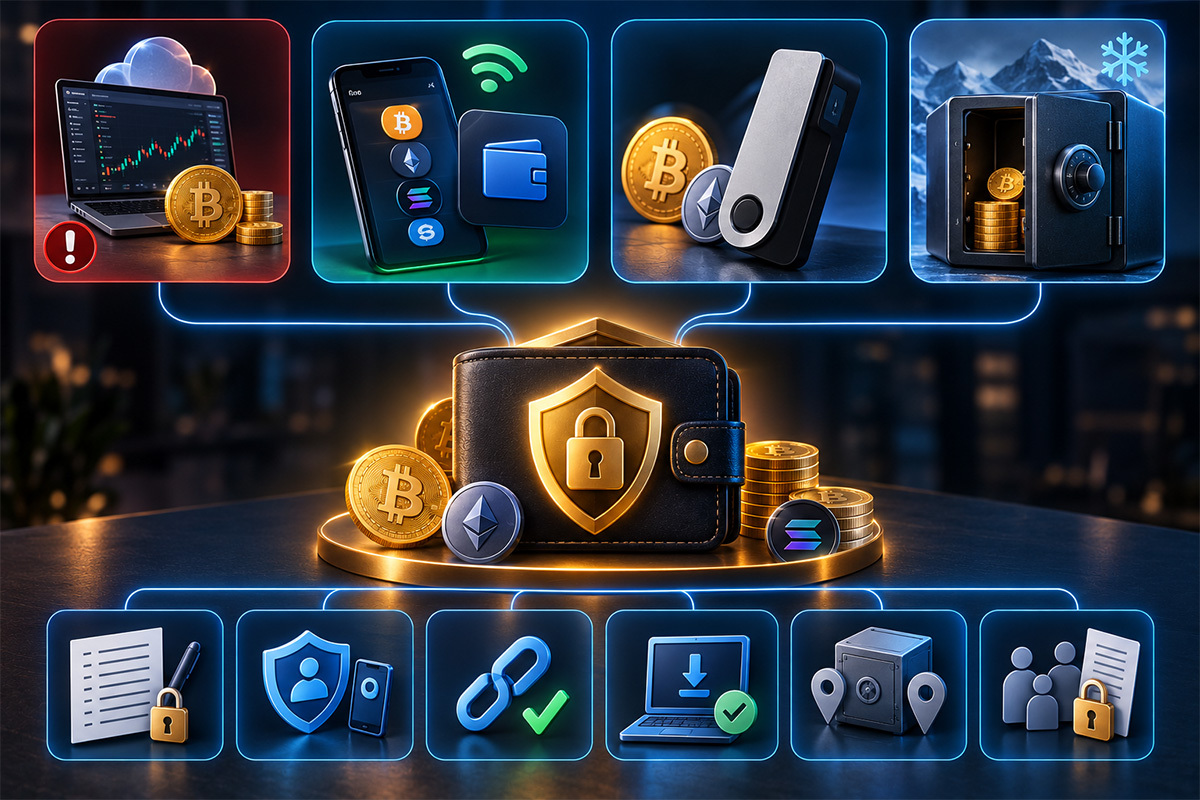
Custody is part of portfolio construction. Exchange custody is convenient for trading but exposes the investor to platform failure, account restrictions, hacking, and legal uncertainty. Self-custody removes some intermediary risk while placing full responsibility for private keys, backups, transactions, and inheritance on the owner.
Hot wallets suit small operational balances but remain connected to the internet. Hardware or other cold-storage methods can reduce online exposure for long-term holdings. Large portfolios may use more than one storage method and avoid a single point of failure. Test recovery procedures with small amounts, protect seed phrases offline, verify addresses, and maintain a secure inheritance plan. Never store a seed phrase in a portfolio tracker.
Use several layers of security. Protect the email account linked to exchanges, enable phishing-resistant multifactor authentication where available, whitelist withdrawal addresses, and verify the source of software and firmware. Store recovery information separately from the device it restores, and never photograph seed words or keep them in cloud notes. Material balances may justify geographically separated backups and clear instructions that trusted heirs can follow without gaining access today. Added complexity is not automatically safer. Every wallet, chain, bridge, and signing method creates another place for mistakes, so the custody arrangement must remain understandable and testable.
Main Crypto Portfolio Risks
Market risk includes extreme volatility, correlation spikes, liquidity gaps, and permanent loss. Project risk includes flawed economics, abandoned development, governance capture, or token dilution. Technical risk includes smart-contract bugs, bridges, wallet malware, phishing, and irreversible transactions. Counterparty risk arises from exchanges, lenders, custodians, stablecoin issuers, and service providers.
Regulatory and tax treatment can change, and rules vary by jurisdiction. Operational errors, lost keys, weak backups, and overtrading are equally important. Diversification does not guarantee against loss, especially when the entire crypto market falls. Risk control depends on limiting exposure, using secure custody, maintaining liquidity, and refusing investments that cannot be understood.
Key Takeaways
A crypto portfolio is a complete system of holdings, storage locations, liquidity, and rules.
Goals, time horizon, and risk capacity should determine the allocation before token selection.
Diversification requires different risk drivers, not simply more tickers.
Target ranges and periodic rebalancing help control concentration.
Tracking tools should receive only public addresses or read-only access, never seed phrases.
Custody, taxes, fees, and exit liquidity belong in the portfolio plan.
Expert Perspective
Guidance from the U.S. Securities and Exchange Commission notes that asset allocation depends on time horizon and risk tolerance, while diversification spreads exposure and rebalancing restores the intended mix. FINRA also warns that crypto assets can be highly volatile and that their safety depends heavily on protecting private keys. The practical lesson for digital assets is straightforward: define the purpose and limit of every holding, verify custody, and review the whole system instead of judging each coin in isolation.
Conclusion
Knowing what is a crypto portfolio is only the starting point. A durable setup needs a clear goal, a loss limit, a short list of understandable asset categories, secure storage, and written target ranges. Monitoring and occasional rebalancing keep actual holdings aligned with that plan. No structure removes crypto risk. Still, disciplined allocation, custody, and recordkeeping can stop one impulsive trade or one operational failure from determining the entire outcome.
FAQ
- How many assets should a crypto portfolio contain?
There is no universal number. A small set of well-understood assets can be more diversified than many tokens driven by the same underlying risk.
- How often should a crypto portfolio be rebalanced?
Many investors review it quarterly or semiannually, or rebalance when an allocation moves outside a predetermined range.
- Are stablecoins a safe portfolio reserve?
They may reduce price volatility, but they still carry issuer, reserve, de-pegging, platform, and regulatory risks.
- Can a spreadsheet track a crypto portfolio?
Yes. It can work for a modest number of accounts if balances, cost basis, fees, and storage locations are reconciled securely.
- Should crypto be kept on an exchange?
An exchange can be convenient for trading balances. Long-term holdings require a careful comparison of platform risk and the responsibilities of self-custody.
- Does diversification prevent losses?
No. It reduces dependence on a single asset or failure point, but many crypto markets can decline at the same time.
Published Articles

Crypto Savings Accounts and Staking: Ways to Earn Income from Cryptocurrency
Learn how to earn interest on cryptocurrency through savings accounts and staking, including reward sources, liquidity, custody, fees, and key risks.
Bitcoin Wallet for Cloud Mining: How to Choose and Secure Your Wallet
Find the best Bitcoin wallet for cloud mining, compare hardware and software options, and learn how to secure every mining payout.

Degen in Crypto Explained: Meaning, Culture, and Risks
Introduction Not every term that gets coined in crypto culture starts as a compliment. "Degen" — short for degenerate — began as an insult imported from gambling circles. It was later repurposed by crypto traders as a...

Types of Crypto Wallets: Choosing the Right Cryptocurrency Wallet
Introduction Every time someone loses access to cryptocurrency, the cause is almost always one of two things: either they kept funds on an exchange that collapsed or froze withdrawals, or they lost control of a wallet...
Seed Phrase Explained: BIP39, Recovery Words, and Crypto Wallet Security
Introduction 12 words on paper. Nothing else. No password, no email, no support line. That is the entire mechanism for recovering access to a crypto wallet. That is also why losing that piece of paper can mean losing...
Top Crypto Trading Indicators Explained
Introduction Most traders who open a Bitcoin chart for the first time see chaos. Candles move up and down without obvious logic, volume changes unpredictably, and the news cycle seems to contradict price action. Crypt...