
What Is a Crypto Wallet Address? Bitcoin Address Explained Simply
Introduction
Sending cryptocurrency for the first time can feel unexpectedly confusing. There’s no bank account number or email to type. Instead, you encounter a long string of letters and numbers that looks nothing like any identifier you’ve used before. That string is a crypto wallet address, and understanding what it is — and how to use it correctly — is one of the most practical things anyone new to crypto can learn.
Mistakes with wallet addresses are not reversible. A wrong address means lost funds, permanently. No customer service line can recover them. No transaction can be undone. That makes understanding what a wallet address is, how it works, and what to watch out for genuinely important — not just useful background knowledge.
This guide explains crypto wallet addresses from first principles: what they are, how they’re generated, the different formats they come in, and how to use them without making expensive mistakes.
What Is a Crypto Wallet Address?
A crypto wallet address is a unique identifier that represents a destination on a blockchain network. It functions similarly to a bank account number: anyone who knows your wallet address can send cryptocurrency to it. Unlike a bank account number, a wallet address is derived mathematically from cryptographic keys rather than assigned by any institution.
What is a wallet address, technically speaking? It is a shortened, encoded version of a public key — one half of the cryptographic key pair that underlies every blockchain account. The public key itself is too long and unwieldy to use directly, so wallet software applies a hashing function and an encoding scheme to produce a shorter, more manageable string. That string is the wallet address.
A cryptocurrency wallet address is specific to a particular blockchain. A Bitcoin address only works on the Bitcoin network. An Ethereum address only works on Ethereum and EVM-compatible chains. Sending Bitcoin to an Ethereum address, or vice versa, will not work as intended — in most cases the funds are permanently lost. The address format gives some visual clues about which network it belongs to, but checking carefully before any send is essential.
What does wallet address mean in practical terms? It means: this is the location where funds can be received. The address itself contains no funds. The blockchain records a balance associated with that address, and the private key associated with that address is what allows spending from it. The address is public and can be shared freely. The private key must never be shared.
What Is a Bitcoin Wallet Address?
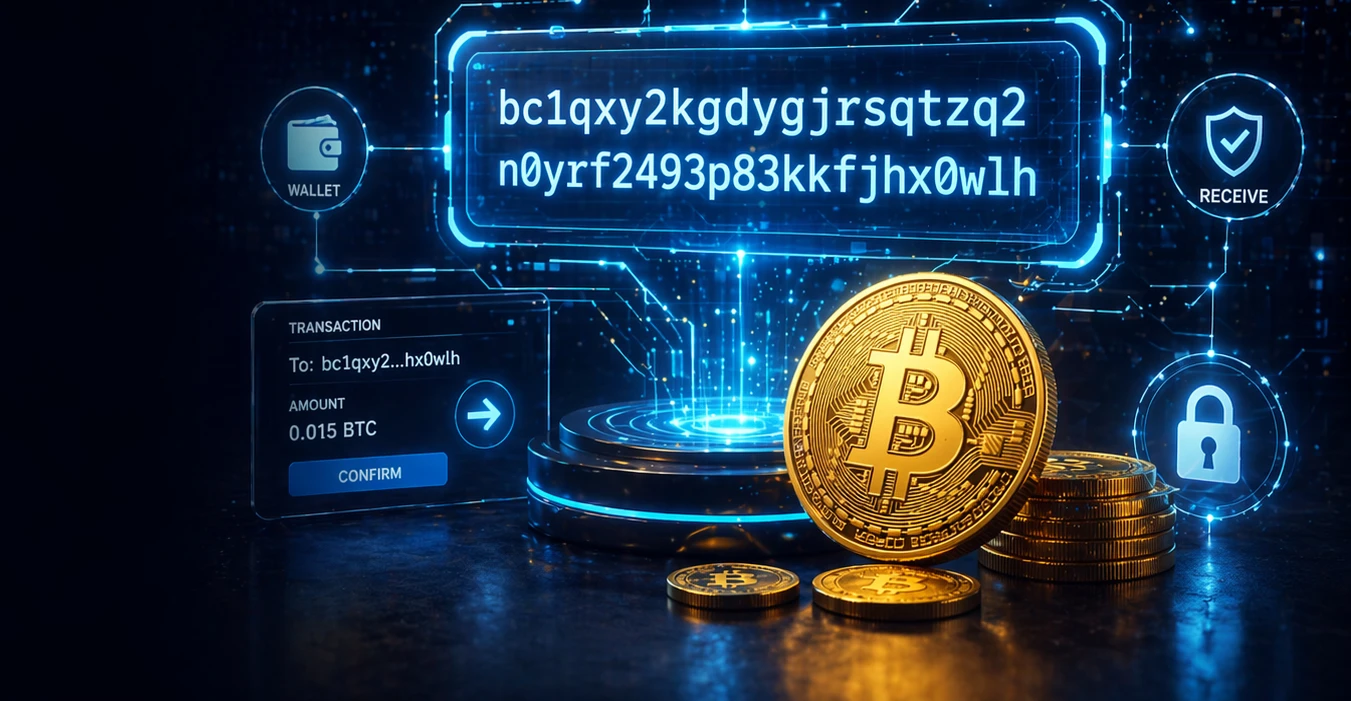
A bitcoin wallet address is a crypto wallet address specifically formatted for the Bitcoin network. What is a bitcoin wallet address at its core? It is an encoded hash of a public key, expressed in a format that Bitcoin nodes can validate. Every time you want someone to send you Bitcoin, you provide them with one of your Bitcoin wallet addresses.
Bitcoin addresses are generated locally by your wallet software using public key cryptography. No central registry assigns them. No registration process is required. Anyone can generate a valid Bitcoin address at any time using open-source software, without connecting to the internet, without identifying themselves. This permissionless generation is one of Bitcoin’s foundational properties.
Bitcoin Address Format
Bitcoin has three main address formats in active use, each identifiable by its prefix:
- Legacy addresses (P2PKH) begin with the number 1. Example: 1A1zP1eP5QGefi2DMPTfTL5SLmv7Divf. These are the original Bitcoin address format, supported by every Bitcoin wallet and exchange. They are slightly less efficient than newer formats.
- SegWit addresses (P2SH) begin with the number 3. Example: 3J98t1WpEZ73CNmQviecrnyiWrnqRhWNLy. They wrap SegWit transactions in a script hash format, providing compatibility with older systems while enabling lower transaction fees.
- Native SegWit addresses (Bech32) begin with bc1. Example: bc1qar0srrr7xfkvy5l643lydnw9re59gtzzwf5mdq. These are the most efficient format, enabling the lowest transaction fees. Most modern wallets default to this format.
All three formats represent valid Bitcoin receiving addresses. Funds sent to any of them arrive in the same wallet. The format affects transaction fees and compatibility with older software, not the underlying security or ownership.
Public Key vs Wallet Address
The relationship between a public key and a wallet address is one of compression and encoding. A Bitcoin public key is 65 bytes in its uncompressed form — a 130-character hexadecimal string. Processing it through two cryptographic hash functions (SHA-256 followed by RIPEMD-160) produces a 20-byte hash. Adding a version byte and a checksum, then encoding in Base58 (for legacy addresses) or Bech32 (for native SegWit), produces the final address.
This transformation is one-way. Given a wallet address, it is cryptographically infeasible to reverse-engineer the public key, and even more infeasible to recover the private key from either. The address reveals nothing about the private key. Sharing your wallet address carries no security risk from a key exposure perspective — the risk comes only from privacy, since anyone with your address can see your transaction history on the public blockchain.
Examples of BTC Addresses
Recognizing address formats by sight helps avoid sending to the wrong network or address type. A legacy address looks like: 1BvBMSEYstWetqTFn5Au4m4GFg7xJaNVN2. A P2SH address looks like: 3J98t1WpEZ73CNmQviecrnyiWrnqRhWNLy. A native SegWit address looks like: bc1qar0srrr7xfkvy5l643lydnw9re59gtzzwf5mdq. Each format is immediately distinguishable from the others by its opening characters.
The Bitcoin genesis block address — 1A1zP1eP5QGefi2DMPTfTL5SLmv7Divf — is one of the most recognizable in crypto history. It belongs to the first block ever mined, in January 2009, and has received thousands of small BTC donations over the years. Its balance has never been spent.
How Wallet Addresses Work
Sending Crypto
To send cryptocurrency, you need two things: the recipient’s wallet address and sufficient balance plus network fees in your own wallet. Your wallet software constructs a transaction specifying the recipient address and the amount. It then signs that transaction using your private key — proving ownership of the funds without revealing the private key itself. The signed transaction is broadcast to the network.
The process takes a few seconds on your end. What follows depends on network traffic and fee level. Bitcoin transactions typically confirm within 10–60 minutes. Ethereum transactions confirm in seconds to minutes. Layer-2 transactions confirm nearly instantly. The confirmation time is determined by when a miner or validator includes your transaction in a block.
Receiving Crypto
Receiving cryptocurrency is passive. You share your wallet address with the sender — by copying and pasting it, sharing a QR code, or both. You do nothing else. When the sender broadcasts their transaction, the blockchain network propagates it. Once included in a confirmed block, the funds are reflected in your wallet balance.
You do not need to be online to receive funds. Your wallet address exists on the blockchain independently of whether your device is powered on. The funds are associated with the address the moment the transaction confirms, regardless of your activity. When you next open your wallet software and it syncs with the network, the updated balance appears.
Blockchain Verification
Every transaction on a public blockchain is permanently recorded and publicly visible. Anyone can look up any wallet address using a blockchain explorer — a web tool that queries the blockchain database. Enter a Bitcoin address into a Bitcoin explorer like Mempool.space or Blockchain.com/explorer, and you see the complete transaction history: every incoming and outgoing transaction, with timestamps, amounts, and the addresses involved.
This transparency is a feature, not a flaw. This transparency enables anyone to verify a received payment without relying on the recipient’s word. Auditing fund flows becomes a straightforward process as a result. Furthermore, the public nature of the ledger means that wallet addresses are pseudonymous rather than private. The address does not directly reveal who owns it, but transaction patterns and connections to identified addresses can reduce anonymity significantly.
Types of Crypto Wallet Addresses
Bitcoin Address Types (Legacy, SegWit)
Legacy addresses (starting with 1) remain fully functional and widely supported. Their main limitation is higher transaction fees compared to SegWit addresses, because they include more data per transaction. If you’re using an old hardware wallet or an exchange that hasn’t upgraded, you may still encounter legacy addresses.
SegWit (Segregated Witness) addresses, both P2SH (starting with 3) and native SegWit Bech32 (starting with bc1), reduce transaction size and therefore fees. Native SegWit is the most efficient format. Most exchanges and wallets now generate native SegWit addresses by default. Compatibility with legacy addresses is maintained: you can send from a native SegWit address to a legacy address and vice versa without any issues.
Ethereum Addresses
Ethereum addresses have a completely different structure from Bitcoin addresses. Every Ethereum address is a 42-character string beginning with 0x, followed by 40 hexadecimal characters. Example: 0x71C7656EC7ab88b098defB751B7401B5f6d8976F. The same address format works across Ethereum mainnet and all EVM-compatible networks: Arbitrum, Optimism, Base, Polygon, BNB Chain, and others.
This cross-chain compatibility is convenient but introduces a risk. Sending tokens on the wrong network sends them to an address that exists on that network — but without the chain’s native token, you may not be able to pay fees to move them. Sending Ethereum mainnet ETH to an Arbitrum address sends it to the Arbitrum network instead, where it can only be used or bridged from that network. Always verify not just the address but the network.
Multi-Chain Wallets
Modern non-custodial wallets like MetaMask, Trust Wallet, and Coinbase Wallet generate separate addresses for each blockchain from a single seed phrase. The same 12 or 24-word seed phrase controls Bitcoin addresses, Ethereum addresses, Solana addresses, and others — each derived through different cryptographic paths. These wallets show network-specific addresses when you switch between chains.
The practical implication: never send a coin to an address on the wrong network. Even if you own the wallet on both networks, recovering misrouted funds often requires advanced technical steps and may not always be possible. A few seconds of verification before sending prevents problems that can take hours to resolve — if they can be resolved at all.
Wallet Address vs Private Key
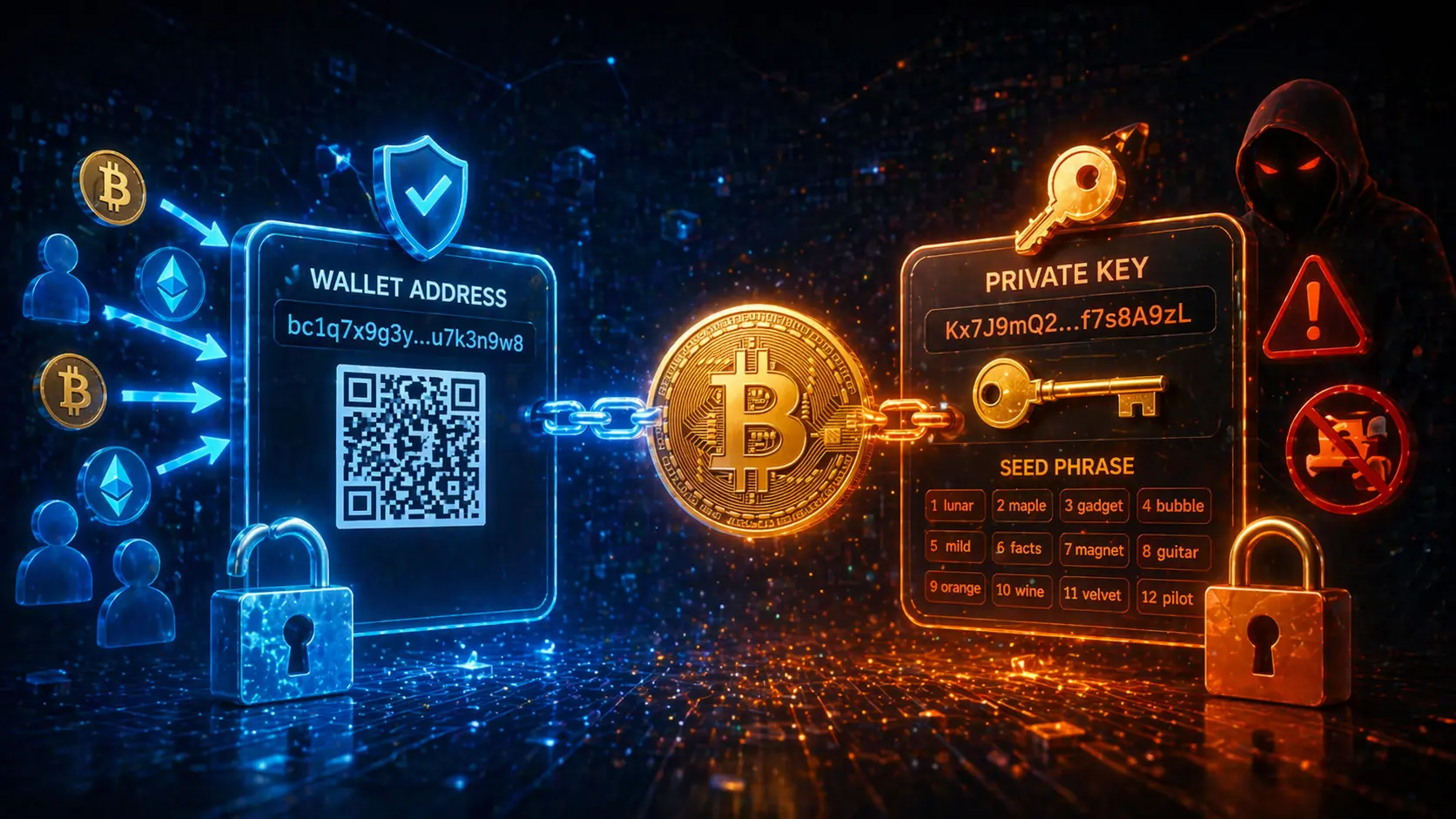
The relationship between a wallet address and a private key is the most important concept in cryptocurrency security. They serve opposite purposes and require opposite handling.
A wallet address is public. Share it freely. It is the destination that others use to send you funds. Knowing your wallet address gives nobody any ability to spend your funds. Post it publicly if needed — on a website, a business card, a social media profile. Public sharing of a wallet address carries no security risk.
A private key is secret. Never share it with anyone, ever, under any circumstances. The private key is what proves ownership of the funds associated with an address. Anyone with your private key has complete, irreversible control over all funds at that address. No exception exists. No legitimate service, wallet provider, or support team will ever need your private key.
Seed phrases — the 12 or 24-word backup phrases generated when you create a non-custodial wallet — are functionally equivalent to private keys for all practical security purposes. Sharing a seed phrase is the same as giving away every private key in the wallet. Hardware wallets, paper wallets, and encrypted digital backups all exist specifically to keep private keys and seed phrases secure from unauthorized access.
How to Find Your Wallet Address
Finding your wallet address depends on the type of wallet you use. The process is straightforward in every case.
- Software wallets (MetaMask, Trust Wallet, Phantom) — open the wallet application. The address appears on the main screen or under the account name. Most wallets display a QR code alongside the text address for easy sharing. Switch between networks within the app to see network-specific addresses.
- Hardware wallets (Ledger, Trezor) — connect the device to your computer and open the companion software. Navigate to the account and coin you want. The wallet displays the receiving address, which the hardware device verifies on its own screen to prevent clipboard hijacking attacks.
- Exchange wallets (Coinbase, Binance, Kraken) — log in and navigate to the deposit section. Select the cryptocurrency you want to receive. The exchange generates and displays a deposit address for that coin. Note that many exchanges rotate deposit addresses periodically for privacy and compliance reasons — always generate a fresh address rather than reusing an old one.
- Watch-only wallets and blockchain explorers — if you already know an address and just need to view it, paste it into any blockchain explorer for the relevant network. No login or account is required.
How to Use a Wallet Address Safely
- Always copy and paste addresses — never type a wallet address manually. A single incorrect character sends funds to a different address, likely unowned by anyone, making recovery impossible. Copy the full address and paste it directly into the send field.
- Verify the full address after pasting — clipboard hijacking malware exists that replaces copied wallet addresses with the attacker’s address. After pasting, compare at minimum the first six and last six characters against the original. Better yet, verify the complete address.
- Send a test transaction first — for large amounts, send a small test transaction and confirm it arrives correctly before sending the main amount. The cost of a test transaction is almost always less than the cost of a mistake.
- Verify the network — confirm that the address corresponds to the correct blockchain network. A valid-looking Ethereum address on the wrong network (mainnet vs Arbitrum, for example) can still result in accessible funds in most cases, but recovery requires extra steps.
- Use address books in wallet software — most wallets allow saving frequently used addresses with labels. Saving a verified address prevents re-entering it each time and reduces the window for clipboard hijacking attacks.
- Check QR codes carefully — if scanning a QR code to get an address, verify the address that populates in the send field matches what you expected. QR code tampering is a known attack vector in physical environments.
Common Problems With Wallet Addresses
Sending to the wrong address is the most common and most costly mistake. It is also completely irreversible. If you send Bitcoin to an address that belongs to nobody — a random invalid string or an address generated by an attacker — those funds are gone. The blockchain has no undo function. No authority can reverse a confirmed transaction.
Sending to the right address but the wrong network is a subtler problem. Sending ETH as an ERC-20 token when the recipient expects native ETH, or sending USDC on Ethereum to an address expecting USDC on BNB Chain, results in funds that arrive at a valid address on the wrong network. If you control the wallet on that network, you can usually recover them — but it requires accessing that network, having gas tokens for fees there, and knowing what you’re doing.
Address reuse is a privacy issue rather than a security issue in most cases. Bitcoin’s UTXO model makes address reuse slightly less private than using fresh addresses for each transaction, since it links multiple transactions to the same address on the public blockchain. Most modern wallets generate a new receiving address after each transaction for this reason. Funds sent to old addresses are not lost — they are still accessible — but reusing addresses reduces privacy.
Phishing attacks impersonate legitimate wallet interfaces or support services. They ask users to enter seed phrases or private keys on fake websites. Legitimate wallet software and support teams never ask for a private key or seed phrase. If any service requests this information, it is an attempted theft.
Key Takeaways
- A crypto wallet address is a unique public identifier on a blockchain. It functions like a bank account number but is derived mathematically from cryptographic keys rather than assigned by any institution.
- Bitcoin addresses come in three formats — Legacy (1…), P2SH SegWit (3…), and native SegWit Bech32 (bc1…) — each with different efficiency characteristics but the same security model.
- Wallet addresses are public; private keys are secret. Sharing an address is safe and necessary. Sharing a private key or seed phrase compromises all funds in that wallet permanently.
- Always verify the full address and the network before confirming any transaction. Copy-paste rather than type, check first and last characters, and send a test transaction for large amounts.
- Mistakes are irreversible — no customer support can recover funds sent to the wrong address on a public blockchain. The blockchain has no undo function.
- Different blockchains use different address formats — Bitcoin, Ethereum, Solana, and other networks each have distinct address structures. A valid address on one network is not a valid destination on another.
Expert Insight
According to Gemini’s Cryptopedia: “A wallet address is a randomly generated set of numbers and letters. It’s the public part of the two encrypted keys (public and private) that are necessary to verify a transaction. The wallet address is what you share with others so that they can send you cryptocurrency.”
This definition underscores an important point: wallet addresses are randomly generated, not sequentially assigned. There is no central directory of addresses, no registration process, and no institution that knows which address belongs to which person. This design is intentional — it supports the permissionless and pseudonymous nature of public blockchains. The tradeoff is that responsibility for security rests entirely with the holder of the private key, with no institutional safety net.
Conclusion
A crypto wallet address is one of the simplest concepts in cryptocurrency once the analogy clicks: it is an address in the postal sense, but for digital assets on a blockchain. Share it when you want to receive funds. Keep the corresponding private key completely private. Verify addresses carefully before sending. These three habits cover the vast majority of what a crypto user needs to know about wallet addresses in daily practice.
The technical depth goes further — address derivation, cryptographic hash functions, SegWit efficiency gains, cross-chain risks — but none of that complexity is needed for safe, practical use. Most errors with wallet addresses come not from misunderstanding the cryptography but from rushing: failing to double-check an address before hitting send, or failing to verify a network before depositing. Slowing down for thirty seconds of verification is the most effective safety measure available.
FAQ
What is a crypto wallet address?
A crypto wallet address is a unique public identifier used to receive cryptocurrency on a specific blockchain network. It is a string of letters and numbers derived from a cryptographic public key. Share your wallet address with anyone you want to receive funds from — knowing your address gives them no ability to spend your funds. Only the corresponding private key can authorize spending.
What is a Bitcoin wallet address?
A bitcoin wallet address is a crypto wallet address formatted specifically for the Bitcoin network. Bitcoin addresses come in three formats: Legacy (starting with 1), P2SH SegWit (starting with 3), and native SegWit Bech32 (starting with bc1). All three formats receive Bitcoin securely. The Bech32 format is the most efficient and generates the lowest transaction fees. Bitcoin addresses are not compatible with other blockchain networks.
What is the difference between a wallet address and a private key?
A wallet address is public and safe to share. It is the destination others use to send you funds. A private key is secret and must never be shared. It is the cryptographic proof of ownership that authorizes spending funds from the associated address. Sharing an address is like sharing your email for someone to contact you. Sharing a private key is like handing someone your house keys — anyone with it has complete control over all associated funds.
Can I use the same wallet address multiple times?
Yes, Bitcoin funds sent to an address you have previously used are still accessible. However, reusing addresses reduces privacy because all transactions to that address are linked on the public blockchain. Most modern wallets automatically generate a new receiving address after each transaction. For Ethereum and most other chains, address reuse is standard practice and does not create any privacy complications beyond what blockchain transparency already implies.
What happens if I send crypto to the wrong address?
Sending cryptocurrency to the wrong address makes the funds almost certainly unrecoverable. Should the address belong to nobody — such as a mistyped or random string — the assets are permanently lost. In the event that the address belongs to another person, they gain full ownership of those funds. No blockchain, no exchange, and no support team can reverse a confirmed transaction. This is why verifying the full address before sending is essential, ideally by sending a small test amount first.
Published Articles
 Popular
Bitcoin Pizza Guy: The Story Behind the First Real Bitcoin Purchase
Introduction The history of Bitcoin is full of dramatic ups and downs,...
 Popular
The Meme Economy: How Internet Humor Shapes Culture, Markets, and Crypto
Introduction Ten years ago, the idea that a picture of a dog...
 Popular
What is the Omniverse? Exploring the Ultimate Multiversal Concept
Introduction Do you know what the omniverse is? Is this concept real?...
Bitcoin Taproot Explained: What the Upgrade Means for BTC
Introduction Unfortunately, the most popular cryptocurrency today – Bitcoin – was not...

Crypto On-Ramps and Off-Ramps Explained: How Fiat and Crypto Move In and Out
Entering the world of digital assets often feels like trying to cross...

Crypto Basics Explained: A Beginner’s Guide to Cryptocurrency and Trading
Introduction The world of finance is changing right before our eyes. Just...