
What is Render Crypto? Understanding the Future of Decentralized Rendering
What is Render Crypto?
Three-dimensional rendering has a compute problem. A single frame of photorealistic animation can take hours on professional hardware. A full feature film might consume millions of CPU-GPU hours across months of production. That hardware is expensive to buy and expensive to operate — which is why rendering has historically been the domain of well-funded studios, not independent creators.
Render crypto — specifically the Render Network and its RNDR token — attacks this problem from a different angle. Instead of building centralized render farms, the Render Network connects creators who need GPU compute with operators who have idle GPUs sitting in data centers, mining rigs, or gaming setups worldwide. The RNDR token is how this marketplace functions: creators pay for render jobs in RNDR, operators earn RNDR for completing them.
The result is a distributed GPU network that can scale to meet demand spikes without requiring any single entity to own all the hardware. Render crypto is the economic layer that makes this coordination possible.
What is RNDR, and How Does it Work?
RNDR (pronounced “render”) is the native utility token of the Render Network, founded by Jules Urbach and launched by OTOY Inc. in 2017. The network went live on Ethereum mainnet in 2020, migrated its token to Solana in 2023, and operates today as one of the more established decentralized compute protocols in the blockchain ecosystem.
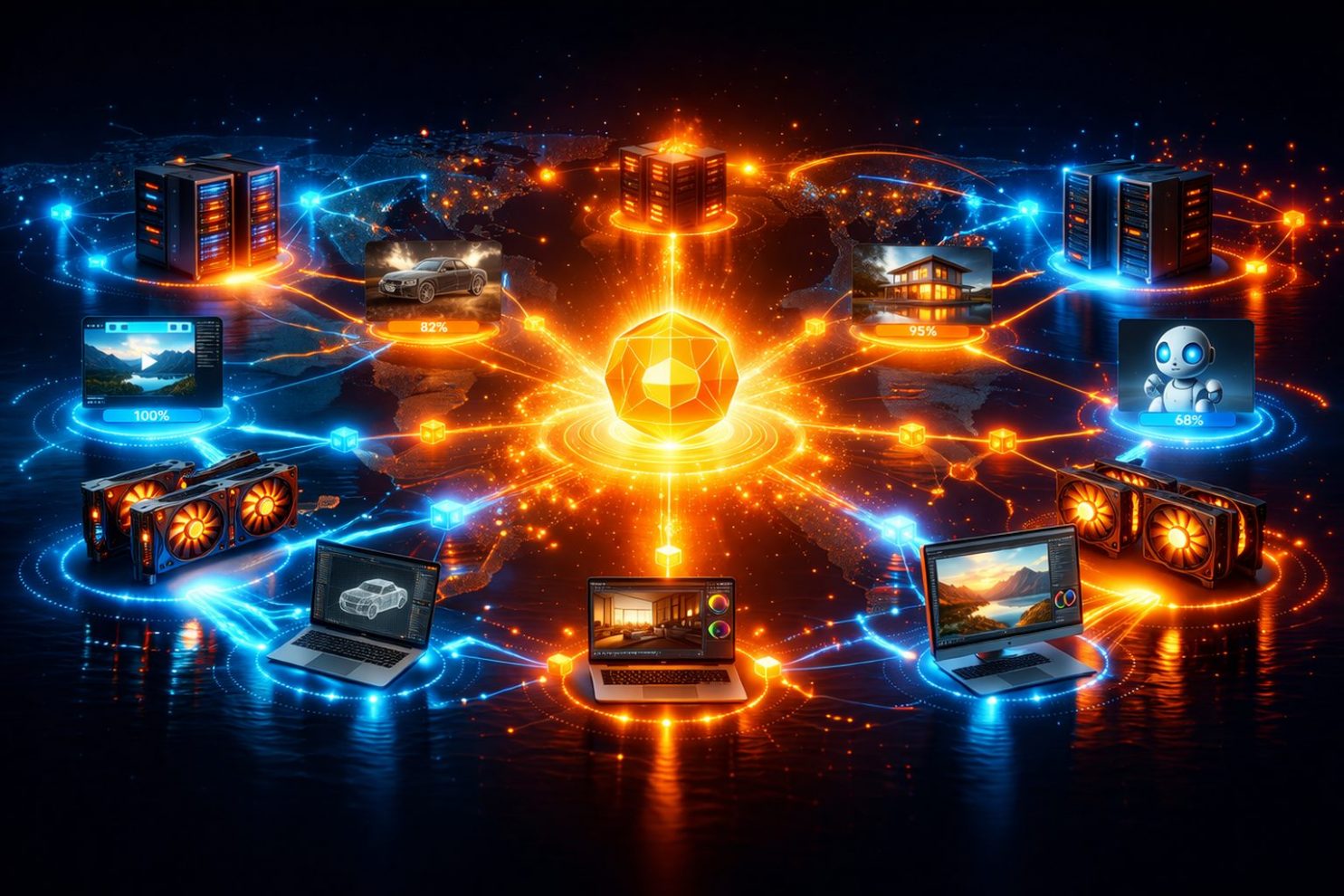
The basic workflow: a creator submits a render job through the Render Network interface. They specify the scene files, output requirements, and how much RNDR they’re willing to pay. The network’s job distribution system matches that request to available GPU operators whose hardware meets the requirements. The operator renders the frames, the output is verified, and RNDR transfers from creator to operator automatically.
Verification is handled through a proof-of-render system. The network uses multiple redundant nodes to check output quality before payment clears — preventing operators from submitting corrupted or incomplete renders and collecting fees. The system isn’t fully trustless (it still relies on OTOY’s infrastructure for some functions), but it significantly reduces the need for manual oversight.
What is RNDR token functionally? It’s a medium of exchange within this marketplace, but also serves governance purposes — RNDR holders can participate in protocol decisions through the Render Network Foundation. The token also ties into OTOY’s broader ecosystem, including OctaneRender, a GPU-accelerated rendering engine used by professional studios.
How RNDR Token Powers the Render Network
The RNDR token does several things simultaneously within the Render Network ecosystem:
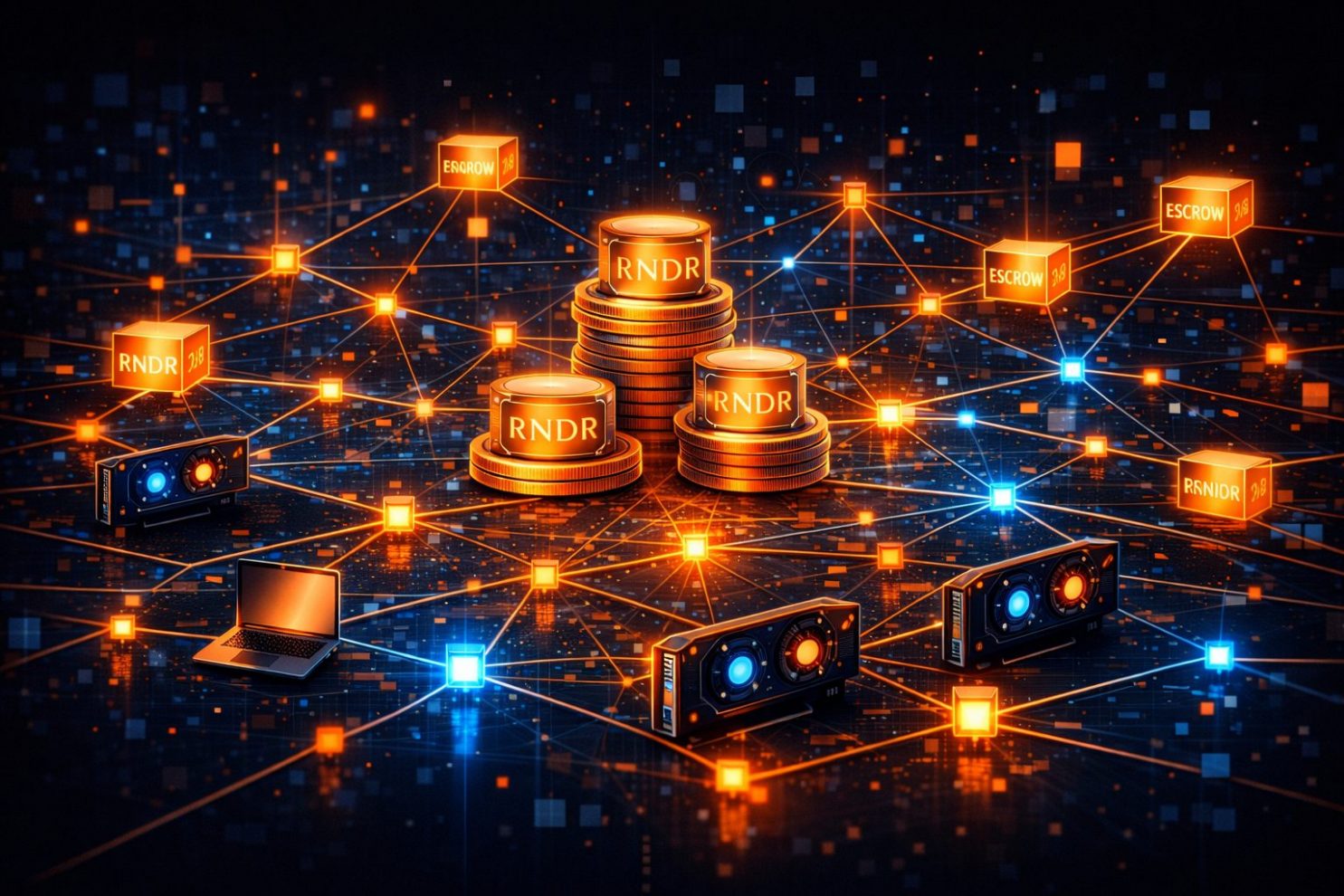
- Payment settlement — creators lock RNDR into escrow before a render job begins. Once the output passes verification, the escrowed tokens release to the operator. This structure protects both parties.
- Work incentivization — operators wouldn’t contribute their hardware without compensation. RNDR pricing for render jobs is competitive with centralized cloud rendering services, giving operators a real economic reason to participate.
- Network security — the economic stakes involved in RNDR transactions create incentives for honest behavior. An operator who submits bad renders loses their reputation score and future work opportunities, which is worth more than any short-term fraud.
- Governance participation — the Render Network Foundation uses RNDR to involve the community in major protocol decisions, from fee structures to technical upgrades.
- Ecosystem integration — RNDR connects to OTOY’s suite of tools. Creators using OctaneRender, Octane X, or other OTOY products can access the decentralized network directly from familiar interfaces.
The token supply has a fixed cap of approximately 536 million RNDR. After the migration to Solana in 2023, the token was rebranded from RNDR to RENDER, though both tickers still appear across exchanges. The migration brought faster transaction finality and significantly lower fees — a practical improvement for a network where many small payments flow constantly.
What is RNDR Crypto and Its Role in the Blockchain Ecosystem?
Render crypto sits at the intersection of two growing sectors: decentralized compute and the creator economy. Both have strong growth vectors, and the Render Network is one of the few projects with active usage in both.
On the compute side, Render competes with protocols like Akash Network (general compute), Filecoin (storage), and newer entrants in the GPU network space. The distinction is specialization — Render is specifically built for GPU rendering workloads, with tooling designed around the actual workflows that 3D artists and studios use.
On the creator economy side, the use cases are expanding. Visual effects studios use Render for overflow capacity. Game developers render asset previews. Architects render photorealistic visualizations for client presentations. The Render Network’s integration with Unreal Engine and support for multiple rendering engines (Octane, Blender Cycles, and others) broadens its potential user base considerably.
The RNDR token’s role in the blockchain ecosystem specifically is as a demand-driven utility token — its value is theoretically tied to actual usage of the underlying network. When more render jobs flow through the network, more RNDR changes hands. This usage-to-value connection distinguishes it from tokens whose value is primarily speculative.
The Solana migration positioned RNDR within a faster, lower-cost L1 ecosystem while maintaining Ethereum bridging for users who prefer to hold assets there. Solana’s transaction throughput and fee structure better match the high-frequency, small-value payment flows that characterize render job settlement.
RNDR vs. Traditional Rendering Services
Understanding render crypto requires comparing it to the existing alternatives. Traditional rendering solutions fall into two categories: owned hardware and cloud rendering services.
Owned hardware means a studio buys and operates its own render farm. Capital costs are significant — a professional render farm can run into millions of dollars. Operating costs (power, cooling, maintenance, IT staff) add up continuously. Hardware depreciates. And the capacity is fixed: during quiet periods, expensive hardware sits idle; during crunch periods, there may not be enough capacity regardless of budget.
Cloud rendering services — AWS, Google Cloud, Conductor, RebusFarm, and others — solve the capacity problem by renting GPU time on demand. But pricing can be high, and the infrastructure is still centralized. If a provider has outages, your deadline slips. If they change pricing, your budget takes a hit. And your scene files and proprietary assets live on someone else’s servers.
The Render Network offers a different tradeoff table:
- Cost — competitive pricing against cloud rendering, with the advantage of unused GPU supply from operators who would otherwise earn nothing from idle hardware.
- Scalability — the distributed network can absorb large jobs by parallelizing across many nodes simultaneously.
- Privacy options — the network offers tiered privacy settings, including options that keep scene data encrypted and never expose it to operators in raw form.
- Decentralization risk — unlike a single cloud provider, there’s no single point of failure. If individual nodes go offline, work redistributes.
- Token volatility — unlike paying in USD, creators paying in RNDR face price exposure. If RNDR appreciates significantly before a large render job completes, the effective cost changes.
For small to medium creators, the accessibility of Render crypto is a meaningful differentiator. Setting up a cloud rendering account at a major provider involves contracts, billing relationships, and technical configuration. The Render Network’s interface is designed for creators, not infrastructure engineers.
What is the RNDR Blockchain, and How Does it Work?
What is RNDR blockchain specifically? The Render Network doesn’t operate its own dedicated blockchain. Instead, it uses existing blockchain infrastructure for its payment and governance layers while running its operational logic through its own distributed protocol.
Originally built on Ethereum, the Render Network used ETH-based smart contracts for token transfers and job escrow. Gas costs on Ethereum made small payments impractical during high-activity periods, which motivated the 2023 migration to Solana.
On Solana, the RENDER token (formerly RNDR) uses the SPL token standard. Transactions confirm in under a second and cost fractions of a cent — a significant practical improvement for a network where render job payments might be worth a few dollars each. Solana’s ecosystem also brought access to DeFi liquidity, DEX trading, and wallet compatibility that the Render Network’s user base benefits from.
The actual render job orchestration — matching jobs to nodes, distributing scene files, collecting outputs, running verification — happens off-chain through Render Network’s own protocol layer. The blockchain is used for the financial settlement: locking escrow, releasing payments, recording governance votes.
For the RNDR wallet question: any Solana-compatible wallet (Phantom, Solflare, Backpack) can hold RENDER tokens. Ethereum-side RNDR can be held in any EVM-compatible wallet (MetaMask, Coinbase Wallet). A bridge exists for moving tokens between the two chains.
What are the Benefits of Using Render Crypto for Rendering?
The case for using Render crypto rather than traditional options comes down to a few specific advantages:
- Access to distributed GPU capacity — the network aggregates GPU resources that would otherwise be unavailable or prohibitively expensive to access. For a solo creator who needs a burst of compute for a single project, this is practically useful.
- Lower effective costs in competitive conditions — the marketplace model creates price competition among GPU operators. When GPU supply exceeds demand on the network, prices fall. This dynamic doesn’t exist in traditional cloud rendering, where providers set prices centrally.
- Integration with professional tools — OctaneRender’s integration with 3ds Max, Cinema 4D, Maya, Houdini, and Blender means creators can access the Render Network from inside the software they already use.
- Censorship resistance — no single company can deny you access to the network or shut down your render jobs for policy reasons. Permissionless access is meaningful for creators working on content that might attract platform restrictions elsewhere.
- Token upside exposure — creators who hold RNDR may benefit if token value appreciates. This is a double-edged consideration, but some creators view it as a bonus component of using the ecosystem.
The limitations are worth noting too. The Render Network is still maturing — not every rendering engine is supported, support varies across job types, and the queue behavior can differ from what creators expect from centralized services. Quality control through proof-of-render has improved substantially but isn’t perfect.
Where to Buy Render Token (RNDR)?
Render token (RNDR/RENDER) is available on most major cryptocurrency exchanges. The most liquid markets are on centralized exchanges, with decentralized options available for Solana-native users.
- Binance — one of the highest-volume RNDR markets globally, with RNDR/USDT and RNDR/BTC pairs.
- Coinbase — lists RNDR for US users, with straightforward fiat onboarding.
- Kraken — reliable option for European users, competitive fees.
- OKX — high liquidity, multiple RNDR trading pairs.
- Bybit — active RNDR spot and derivatives markets.
- Jupiter (Solana DEX) — for users who prefer decentralized trading, Jupiter aggregates the best rates across Solana DEX liquidity for RENDER token.
The token appears under two tickers depending on the exchange and chain: RNDR for the Ethereum-bridged version and RENDER for the native Solana token. Both represent the same underlying asset. When checking “render BTC” or “render USDT” pairs, confirm which version you’re trading.
How to Buy RNDR Token Crypto
The process for buying RNDR token on a centralized exchange follows the standard pattern:
- Step 1 — create and verify an account on an exchange that lists RNDR (Coinbase, Binance, Kraken, OKX).
- Step 2 — complete identity verification (KYC). Most exchanges require this before allowing purchases.
- Step 3 — deposit funds. Options typically include bank transfer, credit/debit card, or crypto transfer from another wallet.
- Step 4 — navigate to the RNDR trading pair (RNDR/USDT is the most liquid option on most exchanges).
- Step 5 — place your order. For first-time buyers, a market order executes immediately at the current price. A limit order sets the price you’re willing to pay and executes when the market reaches that level.
- Step 6 — withdraw to a personal wallet if you plan to hold or use RNDR within the Render Network. Leaving tokens on exchanges carries counterparty risk.
For RNDR wallet setup: Phantom wallet on Solana is the most straightforward option for the native RENDER token. MetaMask works for the Ethereum-bridged RNDR. The Render Network’s own interface supports connection with multiple wallet types.
Render Token Crypto: What’s the Future of This Technology?
The Render Network’s trajectory depends on several intersecting trends, all of which are moving in its favor in 2026.
GPU compute demand is structural and growing. Machine learning training and inference consume extraordinary amounts of GPU resources. 3D content creation is expanding as game engines become film production tools and virtual production replaces physical sets. The metaverse narrative may have cooled, but the underlying demand for rendered content hasn’t. More creators producing more complex 3D content means more potential render jobs flowing through networks like Render.
The integration between Render and broader AI compute is developing. OTOY has positioned the Render Network not just for traditional 3D rendering but as GPU infrastructure for generative visual workflows. If AI-assisted 3D content generation becomes a primary creative workflow — generating base scenes that artists then refine — the GPU demand involved fits directly into what the Render Network is designed to handle.
Competition in decentralized GPU networks is real and growing. Akash, io.net, Nosana, and other protocols are fighting for the same GPU operators and the same enterprise clients. The Render Network’s advantage is its established creative community and deep integration with professional tools — advantages that take years to build and are hard to replicate quickly.
Regulatory context matters too. As a utility token with genuine usage backing its demand, RNDR is better positioned than purely speculative tokens in a regulatory environment that increasingly scrutinizes crypto assets. Its connection to real computational services gives it a cleaner story than most.
The honest uncertainty: token price and network usage don’t always correlate cleanly. RNDR has seen significant price volatility that doesn’t track neatly with render job volume. Speculative interest in the broader GPU compute narrative (particularly its overlap with machine learning) amplifies price moves beyond what fundamentals would suggest. Investors should distinguish between the token’s speculative characteristics and the network’s genuine utility.
Published Articles
 Popular
Bitcoin Pizza Guy: The Story Behind the First Real Bitcoin Purchase
Introduction The history of Bitcoin is full of dramatic ups and downs,...
 Popular
The Meme Economy: How Internet Humor Shapes Culture, Markets, and Crypto
Introduction Ten years ago, the idea that a picture of a dog...
 Popular
What is the Omniverse? Exploring the Ultimate Multiversal Concept
Introduction Do you know what the omniverse is? Is this concept real?...
Bitcoin Taproot Explained: What the Upgrade Means for BTC
Introduction Unfortunately, the most popular cryptocurrency today – Bitcoin – was not...
Crypto On-Ramps and Off-Ramps Explained: How Fiat and Crypto Move In and Out
Entering the world of digital assets often feels like trying to cross...
Crypto Basics Explained: A Beginner’s Guide to Cryptocurrency and Trading
Introduction The world of finance is changing right before our eyes. Just...