
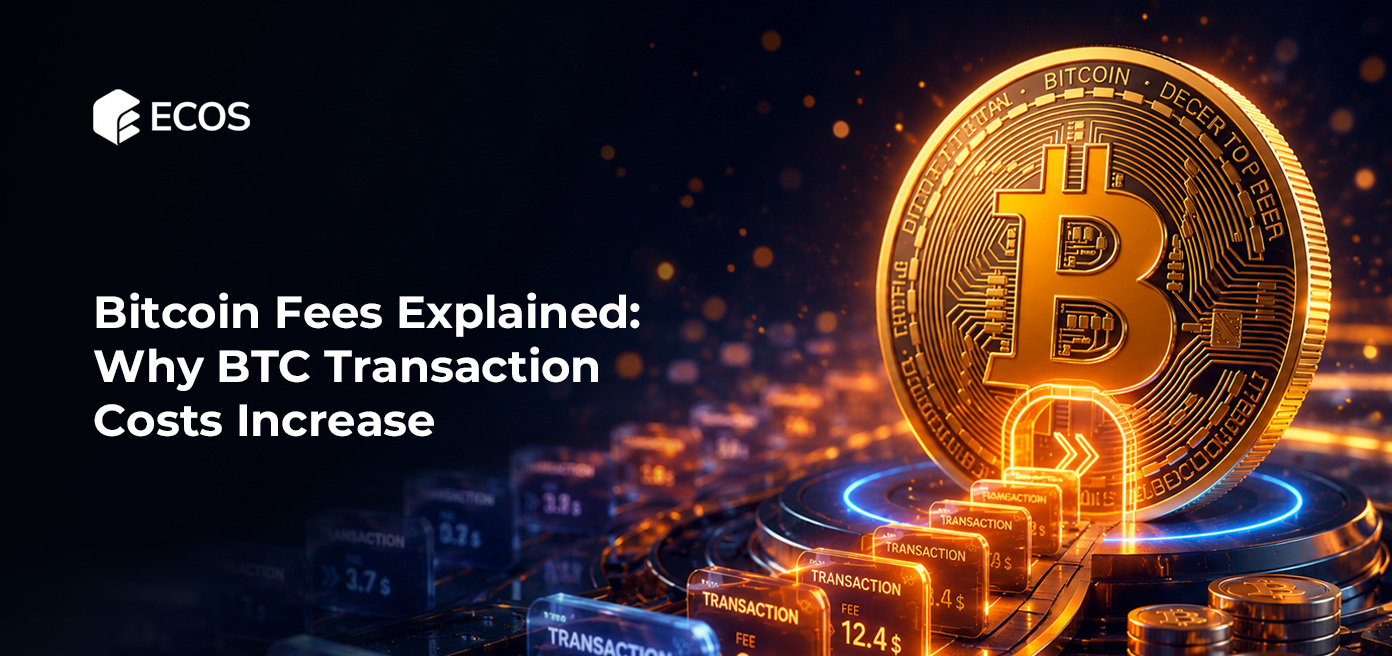
Bitcoin Fees Explained: Why BTC Transaction Costs Increase
Introduction
In April 2023, the average Bitcoin transaction fee exceeded $30. Sending $50 cost as much as sending $50,000. Users accustomed to fees of a few cents faced a reality that contradicted everything they had been told about cryptocurrency as a "cheap alternative to banks." What happened? The launch of the Ordinals protocol created massive demand for Bitcoin block space. The mempool overflowed. Fees spiked. This is not an anomaly or a bug. It is the planned behaviour of the system. Understanding why Bitcoin fees are so high and how they work allows for informed decisions about transaction timing and cost.
What Are Bitcoin Transaction Fees?
A Bitcoin transaction fee is a payment voluntarily attached to a transaction by the sender to incentivise miners to include it in the next block. Without a fee, a transaction is still technically possible, but in practice it may wait for confirmation indefinitely — no one is obligated to process it for free. An important distinction: Bitcoin transaction fees do not go to protocol developers, the exchange, or the wallet. They go entirely to the miner who added the block containing your transaction to the blockchain. Bitcoin fees are measured in satoshis per byte (sat/vByte). This means the cost of a transaction depends not on the amount sent but on the transaction size in bytes — that is, the number of inputs and outputs. A transaction with ten inputs costs more than a transaction with one input for the same amount.
Why Are Bitcoin Fees So High?
Limited Block Space
Every Bitcoin block has a maximum size of approximately 1 MB (up to 4 MB weight units with SegWit). This means that roughly every 10 minutes, only a limited number of transactions can enter the blockchain — around 2,000–3,000 for standard transactions per block. This architecture is deliberate. Satoshi Nakamoto built in the block size limit to protect network decentralisation: smaller blocks make it easier to run a full node. But the limit creates scarcity — block space becomes a competitive resource.
Supply and Demand for Transactions
When demand for transactions exceeds available block space, a queue forms. Miners select transactions from the mempool by highest fee: the more you pay, the sooner your transaction gets included in a block. During low-activity periods (2019–2020, certain weeks of 2023), fees dropped to $0.01–0.10 per transaction. During periods of frenzy — new protocol launches, BTC rallies, mass exchange withdrawals — fees spiked sharply.
Competition in the Mempool
The mempool is the buffer of unconfirmed transactions waiting to enter a block. During peak load, the mempool can hold tens of thousands to hundreds of thousands of transactions. When the mempool is congested, users begin competing: each raises their fee to move up in the queue. This creates auction dynamics. Transactions with low fees sink to the "tail" and wait hours or even days until congestion clears.

How Bitcoin Fees Are Calculated
The Bitcoin fee calculation formula is: Fee (in satoshis) = Transaction size (vBytes) × Fee rate (sat/vByte) Transaction size in vBytes depends on the number of inputs (expensive — each contains a signature) and the number of outputs (cheaper). A P2PKH transaction with one input and two outputs takes approximately 226 bytes. With three inputs — around 500 bytes. The fee rate is chosen by the sender. Most wallets offer three options:
- High: transaction enters the next block (approximately 10–20 minutes)
- Medium: confirmation within 30–60 minutes
- Low: confirmation within several hours or during low-load periods
Real-time recommended rates are available at mempool.space — a service showing the current mempool state and fee distribution.
What Is the Bitcoin Mempool?
The mempool (memory pool) is a temporary storage of Bitcoin transactions that have been broadcast to the network but not yet confirmed by miners. Each network node maintains its own copy of the mempool, and they differ slightly. When you send Bitcoin, the transaction first enters the mempool. Miners review the mempool and form a "block candidate" — a set of transactions maximising total fees within the block size limit. Mempool size is a direct indicator of network load. Mempool.space shows the total volume of pending transactions in MB and fee distribution by level. When the accumulated volume exceeds several hundred MB, this signals high congestion and foreshadows rising fees. Transactions with very low fees risk being evicted from the mempool. Most nodes limit their mempool size. When it fills up, nodes begin dropping transactions with the lowest fees.
Common Reasons for Fee Spikes
Bitcoin bull market. When the BTC price rises, user activity increases sharply. More people trade, transfer, and withdraw from exchanges. Demand for block space grows alongside price. New protocol launches. Ordinals (2023), BRC-20 tokens, Runes (2024) — each new protocol operating on top of Bitcoin and writing data to the blockchain creates additional demand for block space, directly competing with ordinary financial transactions. Halving periods. Every four years, the block reward for miners is cut in half. Fees become a more significant part of miner revenue. In post-halving periods, miners may become more selective about including low-fee transactions. Mass exchange withdrawals. When trust crises hit centralised exchanges — as in November 2022 after the FTX collapse — hundreds of thousands of users simultaneously try to withdraw Bitcoin to their own wallets. A simultaneous spike in transactions overloads the mempool. Spam attacks. Bad actors sometimes deliberately flood the mempool with cheap transactions, artificially raising congestion and forcing others to pay more.
Why Are Crypto Fees So High on Other Networks?
Ethereum. Gas fees on Ethereum work differently from Bitcoin. Gas measures the computational complexity of an operation, not just its size in bytes. Smart contract interactions cost significantly more than simple transfers. During the DeFi frenzy of summer 2020 and the NFT boom of 2021, average Ethereum fees reached $50–200 per transaction. Solana. Solana offers a fundamentally different architecture: high throughput reduces congestion. Fees are typically less than $0.01 per transaction, but the network has repeatedly experienced outages under load. Lightning Network. A second-layer payment channel on top of Bitcoin. Lightning fees are measured in thousandths of a cent. The trade-off: Lightning requires opening a channel (an on-chain transaction with a regular fee) and only works with participants who have open channels.
Bitcoin Fees vs Other Blockchain Fees
In a baseline state without congestion, Bitcoin fees are competitive: $0.50–2.00 per transaction. Ethereum L1 under similar conditions is usually more expensive due to its more complex architecture. L2 solutions (Arbitrum, Optimism, Base) offer fees of $0.01–0.10. The key distinction with Bitcoin: fees are predictable under normal conditions and spike sharply during periods of frenzy. Ethereum evolved differently: EIP-1559 (2021) introduced a base fee burning mechanism, making gas prices more predictable but not necessarily cheaper. For large transfers — tens or hundreds of thousands of dollars — a Bitcoin fee of $5–20 is insignificant as a percentage. For micropayments, Bitcoin L1 is economically unviable at any load above minimal. Lightning Network is the right tool for micropayments.
How to Reduce Bitcoin Transaction Fees
Choose the right time. Fees are lowest on weekends and during UTC night hours. Business activity generating most transactions is concentrated in European and North American working hours. Use SegWit addresses. Bech32 format addresses (starting with bc1) use SegWit, which reduces transaction size in vBytes by approximately 30–40% compared to Legacy addresses. Fewer bytes — lower fee at the same sat/vByte rate. Check the mempool before sending. Mempool.space shows current recommended rates in real time. If you are not in a rush, choose a low rate and send during low-load periods. Consolidate UTXOs. If you have accumulated many small UTXOs (outputs from previous transactions), this increases the size of future transactions. Consolidating UTXOs during low-fee periods reduces future costs. Lightning Network for frequent small payments. If you regularly send small Bitcoin amounts, Lightning Network is the right layer for such operations. Fees are fractions of a cent, speed is seconds. RBF (Replace-By-Fee). Most modern wallets support RBF — the ability to increase the fee on an already sent but not yet confirmed transaction. If you sent a transaction with a low fee and the mempool suddenly became congested, RBF lets you speed it up.

Common Misconceptions About Bitcoin Fees
"High fee = faster confirmation in any conditions." This is true only during a congested mempool. If the mempool is empty, even a minimum-fee transaction will enter the next block within minutes. "The fee depends on the transaction amount." No. Sending 1 BTC costs the same as sending 0.001 BTC if the transactions are the same size in bytes. "Zero fee is impossible." Technically a fee-free transaction is permissible in the Bitcoin protocol, but in practice almost no miner will include it — especially with a congested mempool. "Bitcoin is too expensive for payments." This is true for Bitcoin L1 during high-load periods. On Lightning Network, Bitcoin competes with Visa on speed and beats it on transaction cost. "High fees are a bug." They are a feature. Fees serve as a prioritisation mechanism in a scarce system and represent an increasingly important part of miner rewards as the block subsidy declines.
History of Bitcoin Fees: Patterns and Lessons
Studying Bitcoin fee history reveals their nature better than any theoretical explanation. 2017: the first mass fee peak. In December 2017, at the peak of the bull market, the average fee exceeded $55. The network was unprepared for the scale of demand. This experience accelerated SegWit adoption and Lightning Network development. 2021: double peak. The 2021 bull market created two waves of high fees: April–May (Bitcoin reached $65,000) and November (Bitcoin reached $69,000). Average fees held in the $10–50 range. Between peaks — drops to $1–3. 2023: Ordinals and a new reality. The launch of the Ordinals protocol in January 2023 changed the nature of demand for block space. For the first time, a significant portion of Bitcoin transactions were not financial — they were NFTs and tokens inscribed in the blockchain. Fees reached $30+ while BTC prices were significantly below previous peaks. 2024: Runes and halving. The launch of the Runes protocol coincided with the April 2024 halving. On halving day, the average fee exceeded $100 — a historical record in absolute terms. This situation clearly demonstrated that protocols built on Bitcoin are now a permanent source of competition for block space. Key lessons from this history: fees always return to low levels after peaks; demand sources have diversified beyond financial transactions; Layer 2 solutions grow during high-fee periods.
Bitcoin Fees and ECOS: Cloud Mining as a Tool
High Bitcoin fees create an additional dimension for those considering mining as a way to obtain BTC. Mined Bitcoin does not need to pass through the network when credited to the miner — it is allocated directly. This means no transaction fees at the stage of receiving mining rewards. Cloud mining platforms like ECOS allow participation in BTC mining without the need to manage hardware. Withdrawal fees for mined coins are determined by the current network state at the time of withdrawal — which is precisely why understanding mempool mechanics and choosing the right withdrawal timing has practical value for any miner.
Key Takeaways
- Bitcoin fees are determined by a market auction for space in limited block space. The sat/vByte rate, not the transfer amount, determines transaction cost.
- The mempool is the queue of unconfirmed transactions. Its size and fee levels in real time are displayed at mempool.space. Checking it before sending is baseline practice.
- The main causes of fee spikes: bull market, new protocol launches (Ordinals, Runes), halving, and mass exchange withdrawals.
- SegWit addresses reduce fees by 30–40% by reducing transaction size in bytes. bc1 addresses (Bech32) should be used by default.
- Lightning Network is the right layer for frequent small payments. Bitcoin L1 is optimal for large transfers or cases where settlement finality is critical.
- Fees are not an architectural bug but a market pricing mechanism. As the block subsidy declines after halvings, fees become the key source of rewards for miners.
Expert Insight
Gemini, in its educational section, describes the Bitcoin fee mechanism as follows: "Bitcoin miners are incentivised to include transactions in blocks through transaction fees. Users compete with each other for block space by offering higher fees to have their transactions prioritised." This description reveals the essence of the system: Bitcoin fees are not arbitrary charges but the equilibrium price of an auction. During low demand, the market price approaches zero. During frenzy, it reflects competition for a scarce resource. This is precisely why fees are so unpredictable in the short term and so predictable in their logic — they behave like any market with limited supply.
Conclusion
High Bitcoin fees are a symptom of success, not failure. A network for whose space users worldwide compete has value. Understanding the mechanics — mempool, sat/vByte, SegWit, Lightning — allows management of this cost by choosing the right moment, the right address format, and the right network layer for each payment type.
Frequently Asked Questions
- Why are Bitcoin fees so high?
Bitcoin fees are high during periods of network congestion: when demand for block space exceeds available capacity (~2,000–3,000 transactions per block), users compete through auction. High market activity, new protocol launches, and mass exchange withdrawals are the main triggers.
- How is a Bitcoin fee calculated?
Fee = transaction size (vBytes) × rate (sat/vByte). Size depends on the number of inputs and outputs, not the transfer amount. The rate is chosen by the user — most wallets offer high, medium, and low priority options.
- How to reduce a Bitcoin transaction fee?
Use SegWit addresses (bc1), send during low-load periods (weekends, UTC night hours), check current rates at mempool.space. For regular small payments, use Lightning Network.
- What is the Bitcoin mempool?
The mempool is a buffer of unconfirmed transactions. When you send Bitcoin, the transaction enters the mempool and waits for a miner to include it in a block. During congestion, the mempool queue grows, which raises fees.
- Are high Bitcoin fees permanent?
No. Fees drop sharply during low network load periods. History shows regular alternation between peaks and periods of low fees at $0.01–0.50. The long-term trend depends on Bitcoin adoption growth and Layer 2 solution development.
Published Articles

AI Cloud Mining. How AI and Crypto Mining Work Together
What AI cloud mining is, how AI crypto mining platforms work, and whether artificial intelligence can improve cryptocurrency mining efficiency, automation, and profitability.

Bitcoin Halving Investors: What You Need to Know
Introduction April 2024. Block 840,000. Miner rewards dropped from 6.25 to 3.125 BTC — exactly in half. The fourth halving in Bitcoin's history passed without technical issues, without press conferences, without anyon...
Bitcoin Algorithms Explained: SHA-256, Proof of Work, and the Future of Blockchain Technology
Introduction Every ten minutes, a billion calculations happen around the world, and the result is a single line in a ledger — a new Bitcoin block. Behind that line sits specific mathematics: the SHA-256 algorithm, the...

Pi Network: Comprehensive Guide to the Mobile Cryptocurrency. How It Works, Features, and Future Potential
Key Takeaways Introduction What Is Pi Network? What Is Pi Mining? How Does Pi Mining Work? Pi Network Consensus Mechanism Pi network ecosystem and features Is Pi mining legit or a scam? Pi Network Mainnet and token ec...
Bitcoin Mining: Calculate ASIC Electricity Consumption and Power Costs
Calculate Bitcoin mining electricity consumption in kWh, estimate ASIC power costs at German tariffs, and account for runtime, cooling and fixed charges.
Best ASIC Miners: Immediate Deployment Guide to the Most Profitable Mining Hardware
Compare the best ASIC miners from Bitmain, MicroBT, Canaan and Bitdeer. Check power, cooling, delivery and mining economics before buying.