
Pi Network: Comprehensive Guide to the Mobile Cryptocurrency. How It Works, Features, and Future Potential
Introduction
The crypto world often feels like a private club for those with thousands of dollars to spend on high-end GPUs or massive electricity bills. Against this backdrop, the Pi Network project looks tempting, promising users a way to mine coins directly on a smartphone without draining the battery. I often see heated debates about what is Pi crypto — is it a genuine innovation or just clever marketing?
Many newcomers are trying to figure out how does Pi mining work and why it differs so much from traditional Bitcoin mining. In this article, we will break down the basics of the network so you can decide if it is worth your time. We will take a close look at what is Pi network and the mechanisms behind this mobile-based approach to earning digital assets.
What Is Pi Network?
Pi Network is a project launched by a team of Stanford graduates aiming to make cryptocurrency accessible to anyone with a smartphone. The idea is straightforward: remove the technical barriers that stop regular people from entering the digital asset space. Unlike Bitcoin, you do not need to buy expensive hardware or deal with massive electricity bills.
I often hear skepticism regarding these kinds of “free” distributions, and that is a fair point to raise. Right now, the network is in its Enclosed Mainnet phase. This means the ecosystem is live and people are accumulating coins, but there are no external gateways to swap them for other currencies yet. It is essentially a large scale social experiment where network security relies on trust between users rather than raw computing power.
What Is Pi Crypto?
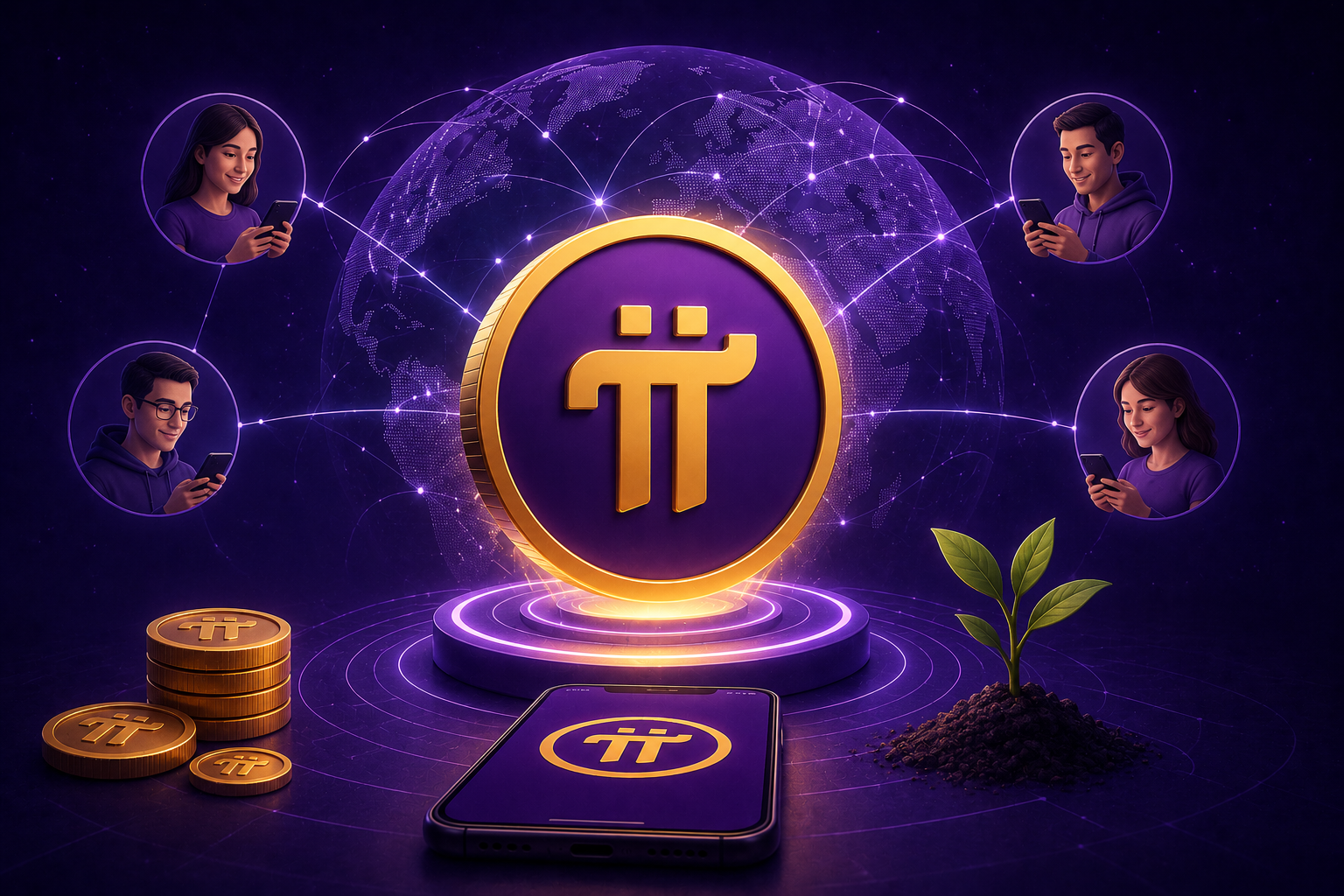
Pi is the digital coin that acts as the foundation for the entire Pi Network ecosystem. Unlike common cryptocurrencies, you cannot just buy it on a major exchange like Binance or Coinbase. Right now, the asset is in an “enclosed network” stage, so its value remains largely theoretical. The coin exists within the mobile app, where users accumulate it by confirming their presence every day.
I think the lack of a market price is exactly what creates so much debate around Pi. While some see it as a chance to join a project early, others worry about wasting their time. The Pi coin does not require heavy computing to create; instead, it is distributed to users for their contribution to security and community growth. However, it is important to realize that until the project moves to the open mainnet phase, the actual purchasing power of these holdings stays uncertain.
What Is Pi Mining?
When people hear the word “mining,” they usually imagine noisy hardware racks and massive electricity bills. However, Pi mining works quite differently. There is no process of solving complex math problems that requires immense power. Instead, the project uses an algorithm based on social trust. You simply tap a button in a mobile app once every 24 hours to prove that you are a real person and not an automated bot.
Technically, this is more of a distribution process than traditional mining. The system grants rewards for helping expand the network and keeping it secure. Many wonder what is mining Pi if it does not strain your phone’s processor. The answer is simple: it is an engagement mechanism. It allows the cryptocurrency to be distributed fairly without harming the environment or requiring users to have special technical skills.
How Does Pi Mining Work?
The core of how does Pi mining work is not hash calculations like Bitcoin, but the Stellar Consensus Protocol. This allows the network to validate transactions without massive energy consumption. Instead of proving validity through hardware power, participants vouch for each other’s reliability. Your activity in the app is simply a signal to the system that you are a real human and part of the community.
Mobile Mining Explained Step by Step
The process starts with installing the official app on your smartphone. After signing up, you just need to open it once a day. A single tap on the lightning bolt button starts a new mining cycle. This does not stress the CPU because the actual calculations do not happen on your device; they occur on the project’s servers according to a specific algorithm.
Role of the Pi App and Daily Sessions
The Pi app is a tool to verify your participation. Daily sessions help filter out bots and fake account farms. If a person does not log into the app, their coins for that period are not granted. This approach ensures that the distribution goes to active users rather than those who created thousands of empty profiles.
Security Circles and Trust Graph
Security in the Pi Network is built on security circles. You add 3–5 people you trust to your own circle. These individual links form a global trust graph. This allows the algorithm to understand which network nodes are reliable when validating operations. The more reliable connections there are, the harder it is for bad actors to attack the system.
Pi Network Consensus Mechanism
Most popular cryptocurrencies, like Bitcoin, rely on the Proof of Work algorithm. This forces thousands of powerful computers to compete in solving meaningless tasks for the sake of network security. Pi Network took a different path and chose the Stellar Consensus Protocol (SCP). There is no power race or massive electricity bills here. Instead, the system relies on a process of voting and agreement between nodes.
It works by creating trusted groups. Each participant builds their own security circle, and these overlapping links form a global network. This solution allows transactions to be confirmed very quickly. I sometimes doubt if this model can withstand serious attacks during global scaling, but so far it lets millions of people participate in the network without special hardware. Essentially, security here is a matter of collective trust rather than raw computing power.
Pi network ecosystem and features
The Pi Network developers do not want their coin to just sit idle while everyone waits for an exchange listing. The goal is to create an environment where the crypto can be spent on real goods or services. The project is slowly building tools to turn the mobile app into a full platform for business and social interaction.
Pi wallet and transactions
To store your coins, there is the Pi Wallet. It is a non-custodial wallet, meaning only you have access to it via a secret passphrase. Inside the network, it is already possible to transfer coins to other users, provided you have passed the identity verification (KYC). Transaction speeds are quite high, and the interface is simplified so that even a beginner can figure it out.
Pi apps and marketplace vision
The project team encourages developers to build third-party apps on their blockchain. The idea is that the network will eventually host its own stores, social networks, and services. Some users in private communities are already trying to trade their coins for electronics or services, creating a sort of barter economy within the platform.
Utility vs speculation
The main conflict within the community is the choice between using the coin and waiting for profit. Most people hope for a price spike after the exchange launch. Meanwhile, the developers insist on utility. They want Pi’s value to depend on how useful the coin is in real life rather than on market charts and speculation.
Is Pi mining legit or a scam?
The question of Pi Network’s legitimacy is the most debated topic in the crypto community. On one hand, skeptics point to the lack of an open-source blockchain and a real market price. The model of attracting new members through referral codes is often compared to multi-level marketing. This leads to fears that the project might just be a tool for collecting data from millions of users for advertising revenue.
However, there are arguments in favor of the project as well. Unlike classic fraudulent schemes, Pi does not require any financial investment from its participants. There are no promises of guaranteed profits or requests to send money for “wallet activation.” The developers are real people with academic backgrounds who have been leading the project for years. For now, Pi stays in a “gray area”: it is not an obvious scam, but it is not a battle-tested technology either. The result of this experiment will only become clear once the network opens up to the outside world.
Pi Network Mainnet and token economics
The economics of Pi rely on a balance between rewarding early adopters and maintaining coin scarcity. The total supply is capped, but the final figures depend directly on the number of active users and their successful identity verifications. Currently, the network is in its “enclosed mainnet” phase. This means the blockchain is live and supports internal transactions, but external connections to other networks or exchanges are blocked by a software firewall.
This strategy was chosen to give the community time for mass KYC completion and the creation of internal services. The developers worry that a premature launch on the open market would allow speculators to crash the coin’s price before it gains any real utility. As a result, the project’s tokenomics focus on gradual distribution and long-term holding rather than instant profits.
Can Pi be traded or sold?
The short answer is officially no. At the current enclosed network stage, Pi coins are locked within the ecosystem. You cannot withdraw them to a regular exchange or trade them for dollars through a bank card. Any offers to buy or sell Pi on external platforms right now are either speculation on “IOUs” or outright scams. The coins listed on some exchanges are not the actual assets from your mobile app.
The only legal way to use your holdings is through internal transfers between users who have successfully passed identity verification (KYC). Some participants spend coins on goods within community test apps, but this is more of a private barter system than free trade. Until the network opens for external connections, any attempts to sell coins on the side violate the platform’s rules and can lead to a permanent account ban.
Future potential of Pi Network
The future of the project depends entirely on the transition to the Open Mainnet stage. If this happens, Pi could become one of the most widely used cryptocurrencies simply because of its massive global user base. The team claims they plan to integrate the coin into everyday payments and apps. However, success is not guaranteed. The main difficulty will be maintaining the price when millions of people suddenly gain the ability to sell their holdings at the same time.
Much depends on whether useful services appear in the ecosystem that people actually want to pay for with Pi. If the project remains just an app for daily button-tapping, interest will fade quickly. But if the marketplace and social features work as intended, the coin could find its niche in micro-payments. It will be a long road, and the outcome is something no expert can predict right now.
Risks and limitations of Pi Network
Joining the Pi Network does not cost money, but it comes with other risks worth knowing. The main one involves privacy. The app requests access to your contact list, and to withdraw coins in the future, you must complete a KYC process by providing passport details. For a project whose technical foundation remains closed, this raises valid questions about how securely such sensitive information is stored.
Another limitation is the time factor. Many users have been logging into the app daily for years, hoping their holdings will eventually have a real price. However, there is still no guarantee that the open network will ever launch. There is also the risk that after listing, the coin’s value will be extremely low because of the massive number of people wanting to sell their assets immediately. Essentially, participants are not risking their money, but rather their time and personal data.
Conclusion
Pi Network remains one of the largest and most controversial experiments in the crypto world. The project has managed to gather tens of millions of participants around the idea of accessible coin mining, yet it has not offered them a way to actually manage their accumulated holdings. Right now, it is a balance between a potential breakthrough and a long-drawn-out wait.
Much will become clear in the near future when the developers face the challenges of the open market and the test of the asset’s real value. Whether it is worth participating is a matter of personal willingness to spend time and share data for a chance at future profit. This is not a classic blockchain project, but rather a test of how far the idea of social trust can go in a digital economy.
Published Articles
Crypto On-Ramps and Off-Ramps Explained: How Fiat and Crypto Move In and Out
Entering the world of digital assets often feels like trying to cross...
 Popular
Bitcoin Pizza Guy: The Story Behind the First Real Bitcoin Purchase
Introduction The history of Bitcoin is full of dramatic ups and downs,...
Crypto Basics Explained: A Beginner’s Guide to Cryptocurrency and Trading
Introduction The world of finance is changing right before our eyes. Just...
 Popular
Uniswap Explained: What It Is, How It Works, and How to Use the UNI DEX
Introduction Decentralization and decentralized platforms that have emerged in recent years have...
 Popular
Bitcoin Lightning Network Explained: What It Is and How Bitcoin Lightning Works
Introduction In the world of cryptocurrency, transaction speed and costs have always...
How Bitcoin ATMs Work: A Complete Guide to Using Crypto ATMs
Introduction Millions of people around the world use cryptocurrencies today – at...