
Bitcoin Mining: Calculate ASIC Electricity Consumption and Power Costs
Introduction
A 3,500 W miner running continuously uses 84 kWh a day. At an illustrative €0.30 per kWh, that is €25.20 in daily electricity before external ventilation or other equipment enters the calculation. The purchase price may be the first number you notice. The meter keeps adding costs afterward.
Estimating Bitcoin mining electricity consumption takes only a few inputs: measured power, running hours and your electricity contract. Germany's tariff terminology deserves some care. The price for each extra kilowatt-hour and the fixed charge already paid for a household connection have different effects on the decision to run an ASIC.
How much electricity does a Bitcoin miner use?
Bitcoin mining electricity consumption is the energy a miner uses over a period, normally measured in kilowatt-hours. Power is its instantaneous demand, expressed in watts or kilowatts. A 3.5 kW machine running for one hour uses 3.5 kWh. Leave it on for longer and the energy total grows.
The ASIC's rated wattage gives you a starting estimate. Firmware settings, temperature and operating conditions affect the actual draw. Bitcoin mining electricity consumption therefore needs a stated operating period as well as a power figure; a specification of 3,500 W alone does not describe a monthly bill.
Use wall power for the device. A chip-efficiency claim can leave out parts of the machine, while an external extractor or coolant pump may sit outside the miner's rating entirely. Whole-network estimates, often expressed in TWh per year, answer a different question from the kWh recorded by your own installation.
Calculating Bitcoin mining electricity consumption
The formula for daily use
Daily energy in kWh = power in W ÷ 1,000 × operating hours.
For steady operation, that multiplication is enough. If power changes during the day, calculate each period separately and add the results. A machine operating at a lower setting for six hours should not be counted as drawing its full rated power for those same hours.
A suitable energy meter can record accumulated kWh directly. Have an electrician select and install appropriate monitoring where necessary. A cheap plug-in monitor is not automatically suitable for the continuous load of an industrial ASIC.
Monthly and annual consumption
A 30-day estimate uses daily kWh multiplied by 30. A 365-day estimate uses daily kWh multiplied by 365. Twelve 30-day periods cover only 360 days, so multiplying a 30-day result by twelve will understate a full year's continuous operation.
Use the actual billing period when reconciling a statement. Maintenance, interruptions and planned shutdowns change the total. If the machine remains powered while it is not hashing, include that standby energy too; zero mining output does not always mean zero electricity use.
Worked example with an Antminer S21
BITMAIN's S21 200 TH/s specification gives nominal wall power of 3,500 W at its 25°C reference condition. Converting to kilowatts gives 3.5 kW.
At uninterrupted nominal operation, 3.5 × 24 = 84 kWh per day. Over 30 days, 84 × 30 = 2,520 kWh. Over 365 days, 84 × 365 = 30,660 kWh. These are calculated reference figures, not a guarantee that every S21 installation will record the same reading.
For a realistic budget, compare the reference with a measured period after the machine has warmed up. Record its operating setting and any external equipment included in the measurement. That makes a later increase in the bill easier to explain.
How much does electricity for Bitcoin mining cost?
To price Bitcoin mining electricity consumption, multiply the relevant kWh by the retail price for those units. Convert cents to euros first: 30 cents/kWh is €0.30/kWh. Using 30 as the euro input would inflate the answer a hundredfold.
Costs at different unit prices
For the S21 reference above, the following rates are hypothetical sensitivity tests, not a German market average or supplier quotation. They assume 24-hour operation and exclude additional equipment and new fixed charges.
- At €0.20/kWh: €16.80 per day, €504 over 30 days, and €6,132 over 365 days.
- At €0.30/kWh: €25.20 per day, €756 over 30 days, and €9,198 over 365 days.
- At €0.40/kWh: €33.60 per day, €1,008 over 30 days, and €12,264 over 365 days.
A ten-cent difference adds €252 to that 30-day bill. Small changes in the tariff become substantial when the equipment runs around the clock.
Unit price, base charge and additional operating costs
On a German contract, the Arbeitspreis is the usage-based price per kWh. Use the amount actually applicable to you, including taxes and relevant charges. A wholesale price shown in a market chart cannot replace the final retail rate on your contract.
The Grundpreis is the fixed charge. If the household pays it already and mining does not change it, adding it again as a new mining expense overstates the additional bill. It can still be allocated when preparing full household accounts; keep that allocation separate from the extra cost caused by switching the miner on.
A new connection or tariff change may introduce additional fixed costs. Suppose it adds €5 per month: add that €5 to the mining budget. External fans and pumps belong there as well. Avoid counting their electricity twice if a meter already measures the entire installation.
For example, a separate 100 W extractor running all day adds 2.4 kWh. At the illustrative €0.30 rate, that is another €0.72 daily, or €21.60 over 30 days. Its label may look modest beside a 3,500 W ASIC, yet leaving it out of every monthly estimate builds a persistent error into the budget.
Your existing monthly advance payment, the Abschlag, may reflect the household's previous consumption. It can therefore remain deceptively small after mining begins. Discuss the revised forecast with the supplier and plan for the actual settlement rather than treating the current direct debit as the final cost.
What dynamic electricity tariffs change
With a dynamic tariff, the unit price varies with the market under the contract's terms. Calculate energy used in each billing interval against its applicable retail rate, then add the intervals. The cheap period advertised by an app does not describe the cost of every hour you intend to mine.
A negative exchange price can coexist with a positive household price once other components are included. Service fees and metering costs also matter. Switching the ASIC off during expensive periods can reduce costs, but it reduces hashing time and potential revenue too. Keep both changes in the same calculation.
Comparing Bitcoin miners by consumption and efficiency
The S21 reference produces 200 TH/s at 3,500 W, giving 17.5 J/TH. BITMAIN's S21 XP 270T reference uses 3,645 W for 270 TH/s, or 13.5 J/TH. The XP performs more hashing per unit of energy, although its total electricity demand is slightly higher.
Canaan's Avalon Q reference is smaller: up to 90 TH/s at 1,674 W and 18.6 J/TH. Its nominal daily energy is about 40.18 kWh. A lower total bill accompanies a lower hashrate here. Comparing devices means keeping watts, output and J/TH together, with the same operating assumptions.
What should you consider when mining at home?
The S21's nominal draw is a continuous 3.5 kW electrical load. Ask a qualified electrician to check the circuit, wiring, protection and connection arrangement before installation. Neither the presence of a compatible voltage nor an adapter establishes that a household outlet can support the planned operation.
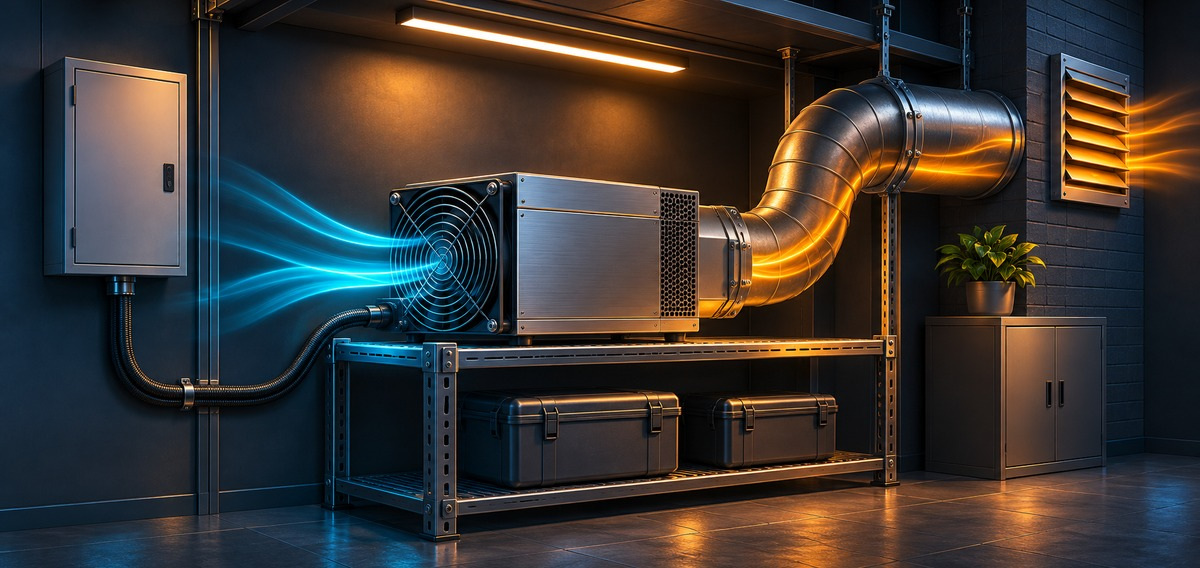
Then consider where the heat goes. Almost all the electricity used by the machine ends up as heat. An enclosed room can need substantial ventilation, which adds its own consumption. Exhaust air returning to the intake makes cooling harder.
Noise can be the more immediate obstacle in a home. Industrial fans may be unacceptable beside living rooms or neighboring properties even when the electrical supply is adequate. A plan that depends on enclosing the machine must also preserve the airflow and operating conditions it requires.
How can you reduce electricity costs?
Measuring Bitcoin mining electricity consumption after a change helps show what you actually saved. Record kWh over a comparable period and note the pool-accepted output. A lower-power setting may reduce hashrate as well as watts; the power reduction alone does not establish a better operating result.
Tariff comparisons should use the miner's expected annual consumption and any additional fixed charges. A seemingly attractive unit rate may come with a larger recurring fee. Dynamic pricing helps only to the extent that your operating schedule can use the cheaper intervals without ignoring the cost of lost production.
Solar generation can supply some of the load, but its timing and quantity must match operation. Energy diverted from export may forgo feed-in revenue. Batteries introduce acquisition costs, losses and limits on how much power they can deliver. A sunny afternoon cannot establish the cost of running through the night.
Useful heat can offset a genuine heating expense when the heat is needed and replaces another source. That credit depends on the actual alternative and usable amount. Summer heat that has to be removed deserves no automatic heating credit in the budget.
Key takeaways
- Calculate kWh from wall power and actual operating hours.
- The nominal S21 200T example uses 84 kWh daily at continuous operation.
- Apply your own retail Arbeitspreis, including relevant taxes and charges.
- Add fixed charges only when mining creates an additional cost in the incremental calculation.
- Lower J/TH and lower total wattage describe different aspects of a machine.
Expert insight
Germany's Bundesnetzagentur distinguishes consumption-based charges from fixed contract charges. Its guidance calculates the annual bill by multiplying the Arbeitspreis by annual consumption and adding the Grundpreis. For a household adding a miner, the practical question is which of those existing charges actually changes.
Conclusion
Calculate Bitcoin mining electricity consumption from a measured or clearly specified power draw, then apply the tariff to the hours you expect to run. Add external equipment and genuinely new fixed costs. Keep this electricity budget separate from the uncertain revenue estimate before deciding whether to buy or operate an ASIC.
FAQ
- How much electricity does an Antminer S21 use?
The 200 TH/s reference is rated at 3,500 W: 84 kWh daily, 2,520 kWh per 30 days and 30,660 kWh per 365 days at continuous nominal operation.
- Should I add my existing household Grundpreis?
It is not a new mining expense if it stays unchanged. Include any additional fixed charges caused by a new connection or contract.
- Does a dynamic tariff guarantee cheap mining?
No. Use actual retail prices for the intervals you mine, including applicable charges. Shutdowns also reduce potential output.
- Does a more efficient miner always use less electricity?
No. It may use less energy per unit of hashing while drawing more total power because it produces more hashrate.
- Is solar-powered mining free?
Account for equipment, storage losses where relevant and any export income forgone. Generation must also coincide with the miner's operating schedule.
Published Articles

Best ASIC Miners: Immediate Deployment Guide to the Most Profitable Mining Hardware
Compare the best ASIC miners from Bitmain, MicroBT, Canaan and Bitdeer. Check power, cooling, delivery and mining economics before buying.

Best Antminer Models
Compare Bitmain models by hashrate, efficiency, price and cooling. Find the best Antminer for your electricity costs, with S21 vs S19 examples.

What Is ASIC Mining? How ASIC Miners Work
Learn what is ASIC mining, how purpose-built miners process hashes, which coins they support, and what costs and risks affect an operation.

Crypto Mining Investment: How to Invest in Bitcoin Mining
Explore crypto mining investment models, operating costs, ROI calculations, company analysis, cloud contracts, and the risks investors should check.

Bitcoin Mining ROI: How to Calculate Profitability and Forecast
Introduction The Antminer S21 XP consumes 3.5 kW per hour and mines around 0.00014 BTC per day at current network difficulty. With electricity at $0.07 per kWh and Bitcoin at $100,000, that produces roughly $14 in rev...

How to Add Cloud Mining to a Crypto Portfolio
Learn how to add cloud mining to a crypto portfolio, choose a sensible allocation, track net returns, and control provider and liquidity risk.