
What Is ASIC Mining? How ASIC Miners Work
Introduction
Bitcoin mining now runs on machines built for one narrow job. These devices fill warehouse racks, draw power around the clock, and test enormous numbers of candidate hashes every second. Their speed has pushed ordinary computers out of serious Bitcoin mining, yet their purpose can be hard to see from the outside.
For a newcomer asking what is ASIC mining, the short answer is specialized computation used to secure a proof-of-work network. An ASIC miner repeatedly applies a specific hashing algorithm while competing to produce a valid block. The network rewards successful miners with newly issued coins and transaction fees.
That simple description leaves out the practical side. Hardware efficiency, electricity, ventilation, pool fees, network difficulty, maintenance, and the market price of the mined coin all shape the result. Understanding the machine is therefore only the first step; a workable mining plan also needs realistic operating assumptions.
ASIC Mining in Plain Language
ASIC stands for application-specific integrated circuit. It is a chip designed around a limited set of calculations instead of the broad range handled by a computer processor. In mining equipment, those calculations are the repeated hashing operations required by a particular blockchain algorithm.
So, what is ASIC mining in practical terms? It is the use of purpose-built hardware to submit proof-of-work calculations to a blockchain. A miner does not solve a gradually unfolding puzzle. It changes input data, calculates a hash, checks the result against the network target, and repeats the process at very high speed.
Specialization gives ASIC hardware its main advantage. Circuits that would support graphics, office software, or other general tasks are removed. The remaining chip area and electrical design can be optimized for hashes per second. The trade-off is equally direct: a machine made for one algorithm has little use when that algorithm is no longer profitable or supported.
Why ASIC Miners Were Developed
Early Bitcoin participants could mine with ordinary CPUs. As more miners joined, graphics cards became attractive because they could perform many similar calculations in parallel. Programmable mining hardware, including FPGAs, improved efficiency again. ASICs followed because a fixed circuit could execute Bitcoin's SHA-256 workload faster with less energy per hash.
Proof-of-work networks automatically adjust to the computing power competing for blocks. When faster machines arrive, total network hashrate tends to rise and difficulty eventually follows. Older hardware then earns a smaller share of the same block opportunities. This competitive cycle explains why mining equipment advances quickly and why efficiency matters as much as headline hashrate.
ASIC development also changed the shape of mining. A home experiment could be run from a desktop in Bitcoin's early years. Modern installations often require industrial electrical service, planned airflow, noise management, monitoring, spare parts, and technicians. The chip is specialized, but a reliable operation depends on much more than the chip.
Inside an ASIC Miner
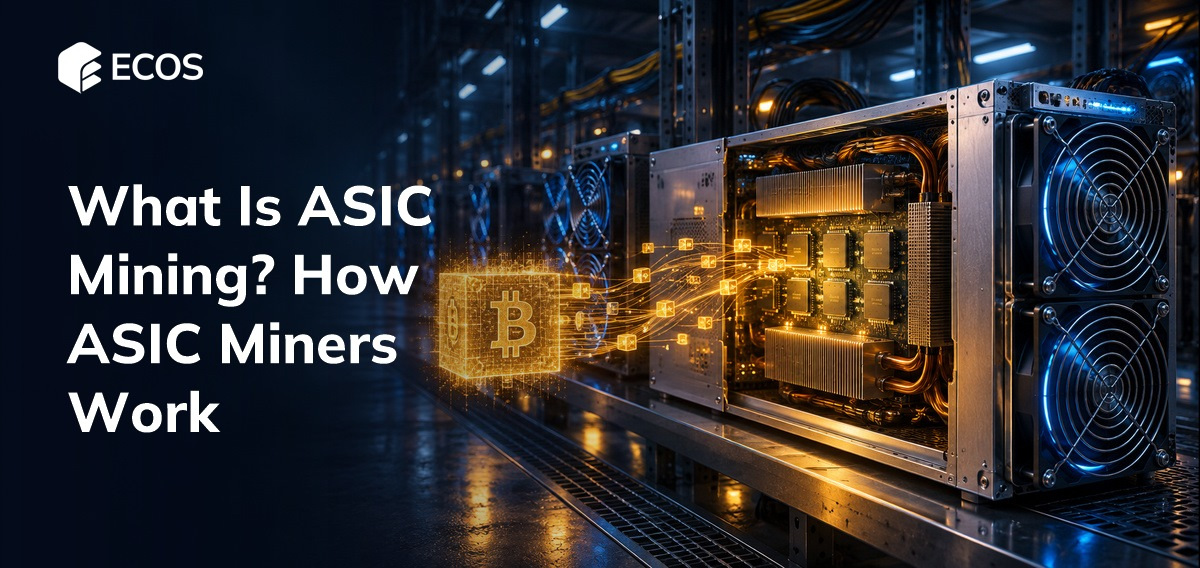
An ASIC miner is a compact computing system rather than a single loose processor. Models differ, but most air-cooled units share a recognizable layout. Hash boards do the calculation, a control board coordinates the device, a power supply converts incoming electricity, and fans move heat away from the chips.
Hash boards and ASIC chips
Each hash board carries rows of ASIC chips connected to power and data lines. The chips receive work from the controller and return results. Multiple boards let the machine reach its rated hashrate, although a failed board may leave the unit running at reduced capacity rather than stopping it completely.
The chips generate substantial heat under continuous load. Heat sinks conduct that energy away from the silicon, while sensors report board and chip temperatures. Firmware may reduce frequency or shut a board down when readings cross safety limits. Dust, blocked airflow, high ambient temperature, and unstable voltage can all make thermal problems worse.
Control board and firmware
The control board connects the miner to a local network and to a mining pool. Its firmware assigns jobs to the hash boards, records temperatures and fan speeds, reports hashrate, and applies operating settings. The web interface normally lets an operator enter pool addresses, worker names, and network details.
Firmware deserves the same care as other security-sensitive software. Unknown images can change performance settings, redirect a portion of hashrate, or create remote access risks. Operators should use software from a trusted source, change default credentials, restrict network access, and document configuration changes before deploying them across a fleet.
Power supply and cooling
The power supply converts facility power into the low-voltage current required by the boards. Its rating must match the miner and the available circuit. Connectors, breakers, cables, and distribution equipment also need appropriate capacity because a loose connection or overloaded circuit can become a fire hazard under continuous load.
Air-cooled miners rely on high-speed fans, which makes them loud and moves a large volume of warm air. Immersion systems place compatible hardware in dielectric fluid and transfer heat through pumps and heat exchangers. Immersion can change noise, cooling, and maintenance requirements, but it adds infrastructure and must be planned around the exact hardware.
How ASIC Mining Works
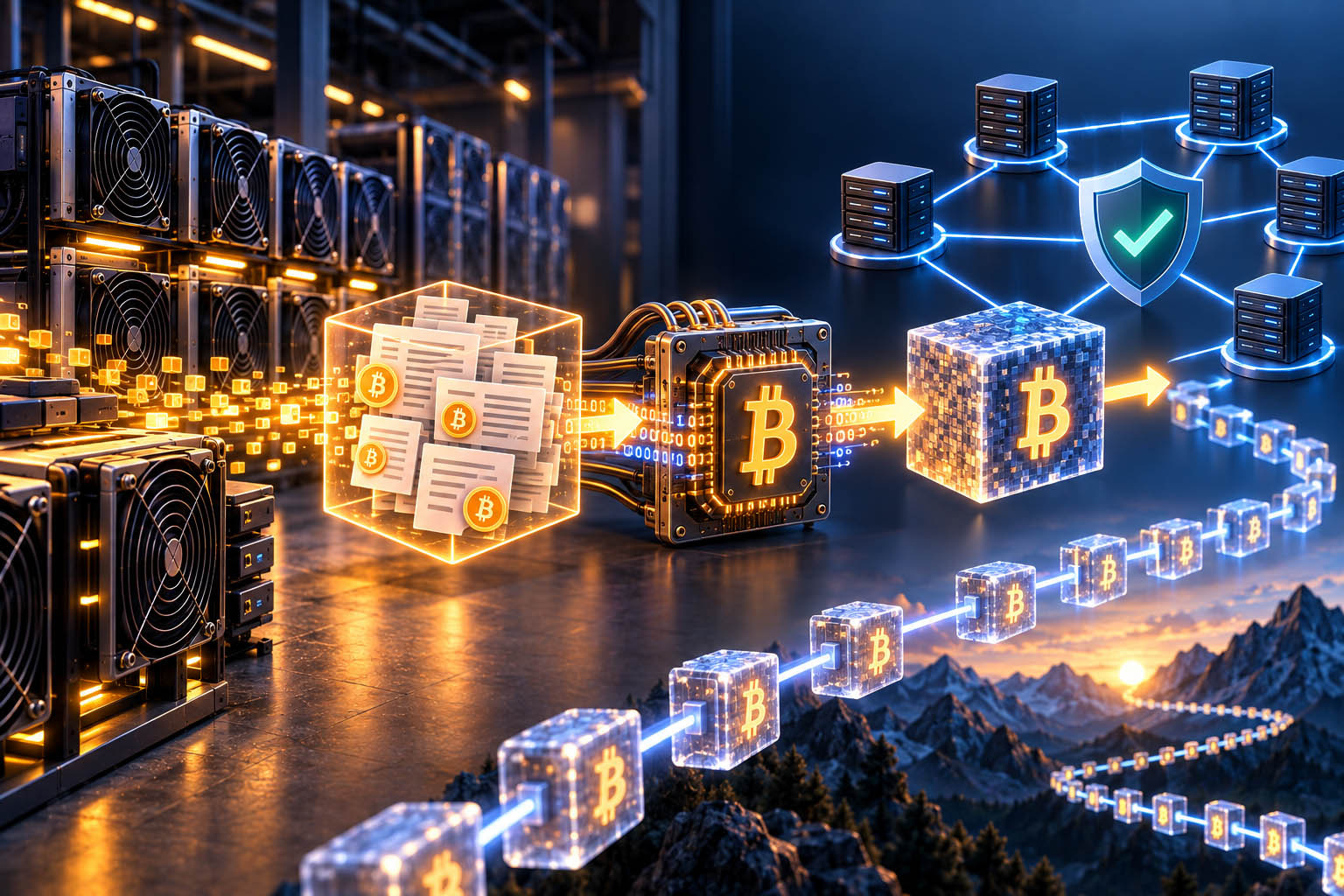
To understand what is ASIC mining at the protocol level, follow one work cycle. A pool or solo miner builds a candidate block header from current network information. The ASIC changes a value such as the nonce, calculates the required hash, and checks whether the output falls below a target. Most attempts fail immediately, so the machine starts another.
Transactions and candidate blocks
Bitcoin nodes relay valid transactions through the network. A miner selects transactions, usually considering fees and block constraints, and constructs a candidate block. A summary of those transactions becomes part of the block header. Changing the candidate block changes the data that the mining hardware hashes.
The miner also includes a coinbase transaction that assigns the potential block reward. This is unrelated to the cryptocurrency exchange with a similar name. In protocol terms, the coinbase transaction creates the permitted block subsidy and collects the transaction fees included in that block.
Hashing and the difficulty target
A cryptographic hash function maps input data to a fixed-length output. Bitcoin applies SHA-256 twice to its block header. Small changes in the input produce unpredictable outputs, so miners cannot calculate a shortcut to a winning hash. They search by testing different inputs at enormous scale.
The network expresses the acceptance threshold through a target and commonly describes mining conditions as difficulty. A valid block hash must be numerically below that target. Bitcoin adjusts difficulty every 2,016 blocks so that blocks continue to arrive at roughly the intended average interval as network hashrate changes.
Finding and validating a block
When a miner finds a qualifying hash, it broadcasts the candidate block. Other nodes independently verify the proof of work, every transaction, the block structure, and the applicable consensus rules. They do not need to repeat all failed attempts; checking the successful hash is quick.
A valid block can still become stale if another block reaches the network first and the competing chain gains more accumulated work. Good connectivity helps a mining operation distribute new blocks and receive updated work promptly. It cannot eliminate normal propagation races, which are part of operating on a distributed network.
Solo Mining and Mining Pools
A solo miner keeps the full block reward when its hardware finds a valid block, subject to network acceptance. The difficulty is timing. A small operator may wait far longer than the statistical average, and there is no schedule guaranteeing a discovery. Income therefore arrives in rare, large events.
Pools combine work from many miners and pay participants according to submitted shares. A share is proof that a miner performed work at a pool-defined threshold, which is easier than the blockchain's block target. Shares let the pool measure contributions even though only an occasional result qualifies as a network block.
Payment methods distribute variance and risk differently. Pay-per-share models offer more predictable credited income while placing block luck on the pool. Other methods tie payments more closely to blocks actually found or to a recent window of shares. Fees, payout thresholds, reserve practices, transparency, and reliability should be reviewed before choosing a pool.
Pools do not make the underlying mining more profitable by themselves. They mainly smooth the timing of revenue and provide infrastructure. Centralization also matters: when too much hashrate gathers under a few coordinators, network observers pay close attention to pool concentration and miner switching behavior.
Hashrate, Efficiency and Power Draw
Hashrate measures how many hash attempts a miner can perform per second. Bitcoin ASICs are commonly rated in terahashes per second. A larger number means more attempts, but it does not describe operating cost. Two machines with similar hashrate may use very different amounts of electricity.
Efficiency connects performance to energy use and is often shown in joules per terahash. Lower values indicate that less energy is needed for the same quantity of work. This metric is crucial when comparing generations, because electricity is normally the largest recurring cost in a mining operation.
Nameplate specifications are a starting point. Wall power can vary with firmware, voltage, temperature, power-supply losses, and operating mode. Actual hashrate can fall during thermal throttling or hardware errors. A serious estimate uses measured wall consumption and effective pool-side hashrate rather than assuming ideal laboratory figures.
Facility overhead belongs in the calculation as well. Fans, pumps, network equipment, lighting, transformers, and cooling systems consume power. Some of that energy may be useful as recovered heat, but only where there is a dependable seasonal or industrial demand. It should not be counted as a saving merely because hot air exists.
Which Coins Can ASIC Miners Mine?
An ASIC supports an algorithm, not every cryptocurrency. A SHA-256 miner can work on compatible SHA-256 networks, with Bitcoin as the main example. Scrypt ASICs target networks such as Litecoin and Dogecoin through their merged-mining arrangement. Other families exist for algorithms used by coins including Kaspa and Zcash.
Algorithm compatibility does not guarantee practical returns. Network difficulty, block rewards, coin price, pool support, and market liquidity all matter. A technically mineable coin may produce too little revenue for a particular machine and electricity rate. Switching networks also requires checking addresses, pool settings, payout assets, and operational support.
Some networks change their mining algorithms or consensus systems. An ASIC cannot usually be reprogrammed into a fundamentally different design. Before buying hardware for a smaller network, review its development plans, hashrate concentration, exchange access, and the number of other uses available to the machine.
ASIC Mining Compared with GPUs and CPUs
The distinction behind what is ASIC mining becomes clearest in a hardware comparison. CPUs are flexible processors built for varied sequential tasks. GPUs contain many parallel processing units and can be redirected among compatible workloads. ASICs give up most of that flexibility to maximize performance on their assigned algorithm.
For mature ASIC-dominated networks such as Bitcoin, CPUs and GPUs cannot compete economically at ordinary power prices. Their hashes per watt are far lower. This does not make GPUs obsolete: they remain useful for algorithms designed around memory or for workloads outside mining, and they generally have a broader resale market.
Flexibility affects downside. A GPU can be sold to a gamer, renderer, or computing user when mining conditions weaken. An ASIC buyer usually sells to another miner whose valuation depends on the same revenue conditions. As a result, used ASIC prices can fall quickly when coin prices decline or a new, more efficient generation becomes widely available.
The Economics of an ASIC Operation
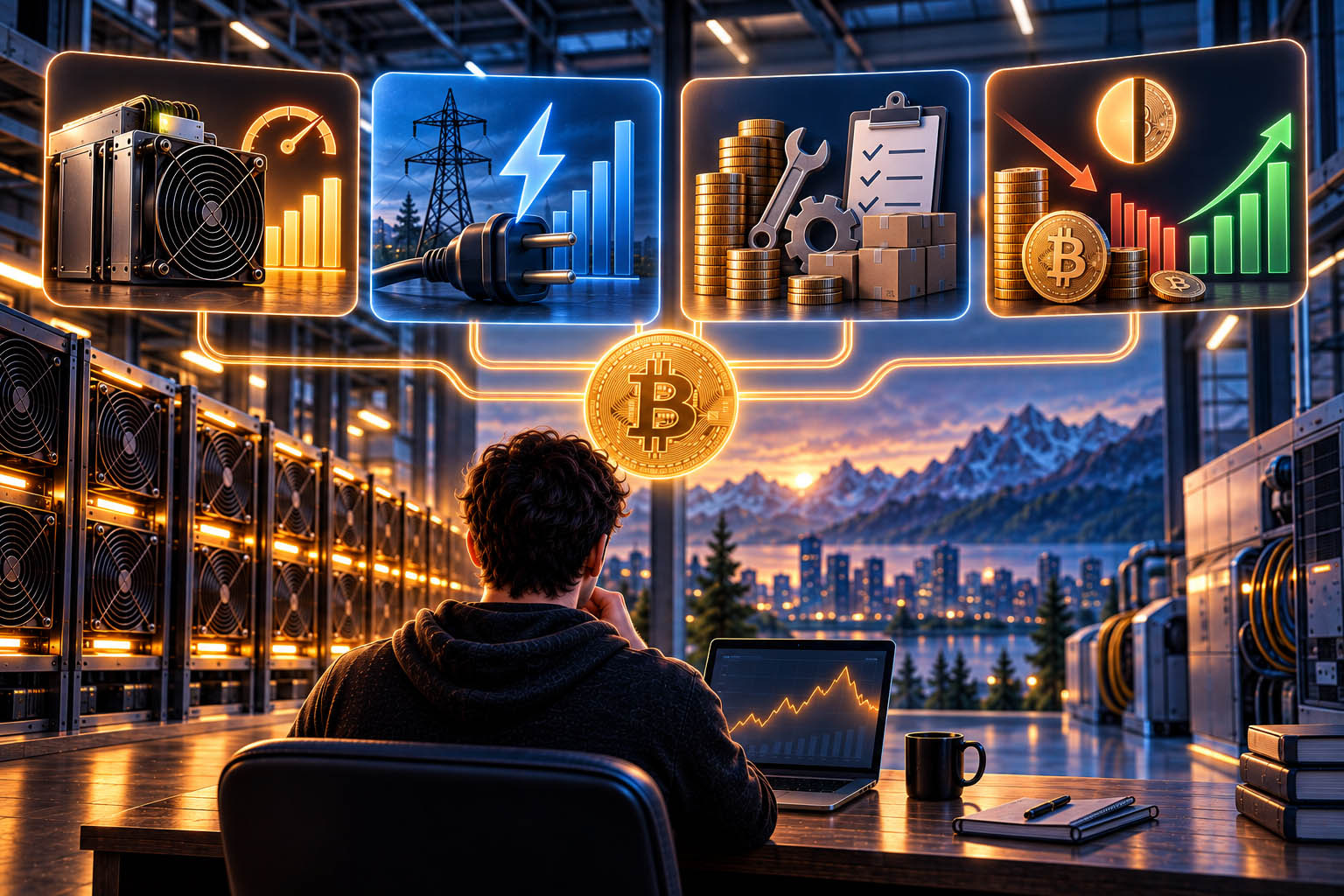
Mining revenue begins with a machine's share of network work. A calculator can estimate expected coins from hashrate, network difficulty, block rewards, and pool assumptions. The estimate changes as soon as any input changes, and short-term block luck creates additional variation. It is a scenario, not a quoted yield.
Electricity cost is calculated from power draw, operating hours, and the all-in rate charged at the site. The all-in figure may include demand charges, taxes, distribution costs, or time-of-use pricing. Hosting contracts can bundle some expenses into a single rate, so the operator must understand what that rate covers and when it can be revised.
Capital and operating expenses extend beyond the miner. Shipping, import duties, wiring, racks, ventilation, networking, pool fees, deposits, repairs, downtime, and staff time can materially alter the result. A reserve for failed fans or power supplies is more credible than assuming uninterrupted operation for the full life of the device.
Bitcoin's block subsidy is reduced at each halving. Difficulty can rise independently as competitors add equipment. Meanwhile, the bitcoin price and transaction-fee market move unpredictably. A model should test several combinations of price, difficulty, uptime, and energy cost instead of relying on a single payback date.
Operational and Financial Risks
ASIC mining joins market risk to physical operations. A machine may perform exactly as designed while its revenue falls below electricity and hosting costs. Conversely, favorable market conditions do not help a unit that is offline, overheating, waiting for parts, or trapped in a dispute with a service provider.
Hardware aging and failure
Fans wear out, power supplies fail, connectors heat up, and hash boards develop faults. Dust and corrosion accelerate damage. Even reliable equipment becomes economically older when a new model delivers more hashes per watt. Maintenance history and access to competent repair services therefore affect resale value and usable life.
Electricity and site constraints
Residential installations can exceed circuit capacity, violate lease terms, or create unacceptable noise and heat. Industrial sites face different constraints, including transformer capacity, demand management, permits, insurance, and cooling design. An electrician familiar with continuous loads should review the installation before equipment is energized.
Counterparty and hosting risk
Hosted mining removes equipment from the owner's direct supervision. Contract wording, title to the hardware, power-rate changes, downtime credits, access rights, repair charges, insurance, and exit procedures become important. Photographs and dashboard readings do not replace proof that the identified machines exist and remain assigned to the customer.
Regulatory and environmental conditions
Rules affecting mining, electricity use, imports, taxes, noise, and land use vary by jurisdiction and can change. Grid operators may also curtail large loads during constrained periods. Environmental assessment depends heavily on the energy source, local grid conditions, equipment life, and whether heat is genuinely used rather than vented.
Security risk
Mining devices are networked computers and should be isolated from sensitive systems. Default passwords, exposed administration panels, malicious firmware, and compromised pool credentials can redirect hashrate or disrupt operations. Wallet security remains separate: rewards should go to an address whose keys and recovery process are controlled safely.
How to Evaluate an ASIC Miner
Someone researching what is ASIC mining often encounters model names before learning how to compare them. Start with the supported algorithm, rated hashrate, efficiency, wall power, input voltage, physical dimensions, noise, operating temperature, warranty, and repair availability. Then confirm those figures through independent operating reports when possible.
A purchase review should cover the complete setup:
Confirm that the model and firmware support the intended algorithm and pool.
Measure the all-in electricity rate and available electrical capacity.
Plan airflow, heat removal, filtration, noise control, and fire safety.
Estimate revenue under lower coin prices, higher difficulty, and downtime.
Include shipping, duties, pool fees, hosting charges, and repairs.
Check warranty terms, parts availability, seller reputation, and serial numbers.
Define how the machine, rewards, and records will be secured.
Used equipment needs additional inspection. Ask for kernel logs, uptime history, board-level hashrate, temperatures, fan readings, error counts, and evidence of previous repairs. Cosmetic condition alone says little about chip stability. The purchase price should leave room for uncertainty, transport damage, and components that fail soon after installation.
A final go/no-go decision should be based on cash flow that the operator can sustain. If a modest change in power price or difficulty makes the site unable to pay its bills, the project has little margin for normal mining volatility. Affordable hardware does not compensate for an unsuitable operating environment.
Cloud Mining and Direct ASIC Ownership
Direct ownership gives the buyer control over a physical machine, its pool settings, maintenance choices, and possible resale. It also brings electrical, cooling, noise, security, and repair work. The owner sees the hardware risk clearly because the equipment is present and operating on a known site.
Cloud mining packages access to hashrate through a contract. The customer may avoid installing a machine, but must examine the provider's infrastructure, fee formula, term, termination rules, payout method, and evidence of operation. Contract revenue can still decline when difficulty rises or the mined asset loses value.
The two arrangements should be compared using net outcomes under the same assumptions. A low advertised cloud-mining entry price may include ongoing service deductions. A purchased ASIC may retain resale value but require capital upfront. Neither structure removes proof-of-work economics; it changes who operates the equipment and who carries each obligation.
Key Takeaways
ASIC miners are purpose-built computers optimized for a specific hashing algorithm.
They secure proof-of-work networks by testing candidate hashes and submitting valid blocks.
Hashrate describes speed, while joules per terahash describes energy efficiency.
Pool participation smooths payouts but introduces fees and pool-related considerations.
Electricity, difficulty, uptime, hardware aging, and coin prices drive economic results.
Safe operation requires suitable power, cooling, networking, maintenance, and wallet controls.
Conclusion
The answer to what is ASIC mining reaches beyond a fast chip. It is a specialized proof-of-work system that combines hardware, electricity, network rules, pool infrastructure, and on-site operations. ASICs make Bitcoin mining possible at today's scale, while their narrow purpose leaves owners exposed to efficiency changes and market conditions.
Before buying a miner or a hashrate contract, trace how blocks create revenue and calculate operating costs. Test difficult scenarios, verify the facility, and keep position size within a loss the budget can absorb. Technical understanding makes risks visible; it cannot remove them.
FAQ
- Can an ASIC miner mine any cryptocurrency?
No. Each ASIC family supports a particular hashing algorithm. It can mine only compatible networks, and profitability still depends on difficulty, rewards, price, fees, and electricity.
- Can Bitcoin still be mined with a GPU?
A GPU can calculate SHA-256 hashes, but it is far less efficient than modern Bitcoin ASICs. At ordinary electricity rates, it is not economically competitive.
- How long does an ASIC miner last?
Physical life varies with temperature, power quality, maintenance, and component wear. Economic life may be shorter when newer machines offer much better efficiency.
- Does a higher hashrate guarantee a profit?
No. Hashrate increases expected output, while power cost, efficiency, difficulty, uptime, fees, and coin price determine whether revenue exceeds total expenses.
- Is pool mining required?
It is optional, but most small miners use pools to reduce payout variance. Solo mining can involve very long periods without finding a block.
- Are ASIC miners suitable for a home?
Some can run at home, but industrial models are loud, hot, and power-hungry. Electrical capacity, ventilation, fire safety, lease rules, and neighbors must be considered first.
Published Articles
Crypto Mining Investment: How to Invest in Bitcoin Mining
Explore crypto mining investment models, operating costs, ROI calculations, company analysis, cloud contracts, and the risks investors should check.
Bitcoin Mining ROI: How to Calculate Profitability and Forecast
Introduction The Antminer S21 XP consumes 3.5 kW per hour and mines around 0.00014 BTC per day at current network difficulty. With electricity at $0.07 per kWh and Bitcoin at $100,000, that produces roughly $14 in rev...
How to Add Cloud Mining to a Crypto Portfolio
Learn how to add cloud mining to a crypto portfolio, choose a sensible allocation, track net returns, and control provider and liquidity risk.
Crypto Mining Containers: How Modular Solutions Power Bitcoin Mining Operations
Learn how crypto mining containers combine power, cooling, networking, and security, and what operators should check before deployment.
Cloud Mining or Your Own ASIC: Returns, Risks, and Payback Compared
Cloud mining vs ASIC mining compared by startup cost, electricity, maintenance, control, risk, liquidity, and uncertain payback.
Long-Term Cloud Mining Strategy: Planning Bitcoin Accumulation Over Several Years
Build a long-term cloud mining strategy around contract costs, mining difficulty, payout records, risk limits, and realistic Bitcoin accumulation goals.