
Bitcoin Mining Rigs Explained: Hardware, Setup, and Profitability Guide
Introduction
Bitcoin runs on proof-of-work. That means someone, somewhere, has to do the computational work that validates transactions and secures the network. The machines doing that work are called mining rigs. Understanding what a mining rig is, how it works, and whether running one makes financial sense has become more relevant than ever in 2026.
Bitcoin mining rigs range from consumer hardware assembled by hobbyists to warehouse-scale industrial installations running thousands of specialized machines. The economics look very different at each end of that spectrum. So do the technical requirements, the setup complexity, and the risks involved.
This guide covers everything from the basic definition of a crypto mining rig through hardware types, component breakdowns, setup steps, profitability math, and a clear-eyed look at what mining actually costs in 2026.
What Is a Mining Rig?
A mining rig is a computer — or a collection of computing hardware — configured specifically to perform the hashing calculations required by a proof-of-work blockchain. The term covers everything from a repurposed desktop PC to a purpose-built ASIC machine running continuously in a data center.
Mining rigs perform one job repeatedly: they take a block header, add a nonce, hash the result, and check whether that hash meets the network’s current difficulty target. If it doesn’t, they increment the nonce and try again. This happens billions of times per second on modern hardware. The machine that finds a valid hash broadcasts it to the network and collects the block reward.
The word “rig” originally came from GPU mining setups, where builders would assemble multiple graphics cards into a custom frame. Today the term applies broadly. A single ASIC unit running alone is a mining rig. So is a farm of 10,000 units operating in parallel. What makes it a rig is that the hardware exists specifically to mine.
What Is a Bitcoin Mining Rig?
A bitcoin mining rig is hardware dedicated to the SHA-256 hashing algorithm used by the Bitcoin network. Bitcoin’s proof-of-work requires finding a hash that starts with a specific number of leading zeros — the more zeros required, the higher the difficulty. SHA-256 is computationally intensive in a way that rewards raw hashing speed above all else.
What is a mining rig in the Bitcoin context specifically? It is almost always an ASIC — an Application-Specific Integrated Circuit designed to run SHA-256 and nothing else. ASIC bitcoin mining rigs are far more efficient at this task than any general-purpose hardware. A top-tier ASIC in 2026 produces over 300 terahashes per second. A high-end gaming GPU manages roughly 0.8 terahashes per second on the same algorithm. The gap is enormous.
Bitcoin mining rigs also require substantial supporting infrastructure. Each unit draws several kilowatts of power. Cooling systems must remove the heat generated continuously. Network connectivity must remain stable. Management software tracks performance and triggers alerts when machines go offline or hashrate drops. A bitcoin mining rig is not a set-it-and-forget-it device — it demands ongoing attention.
Types of Crypto Mining Rigs
ASIC Mining Rigs
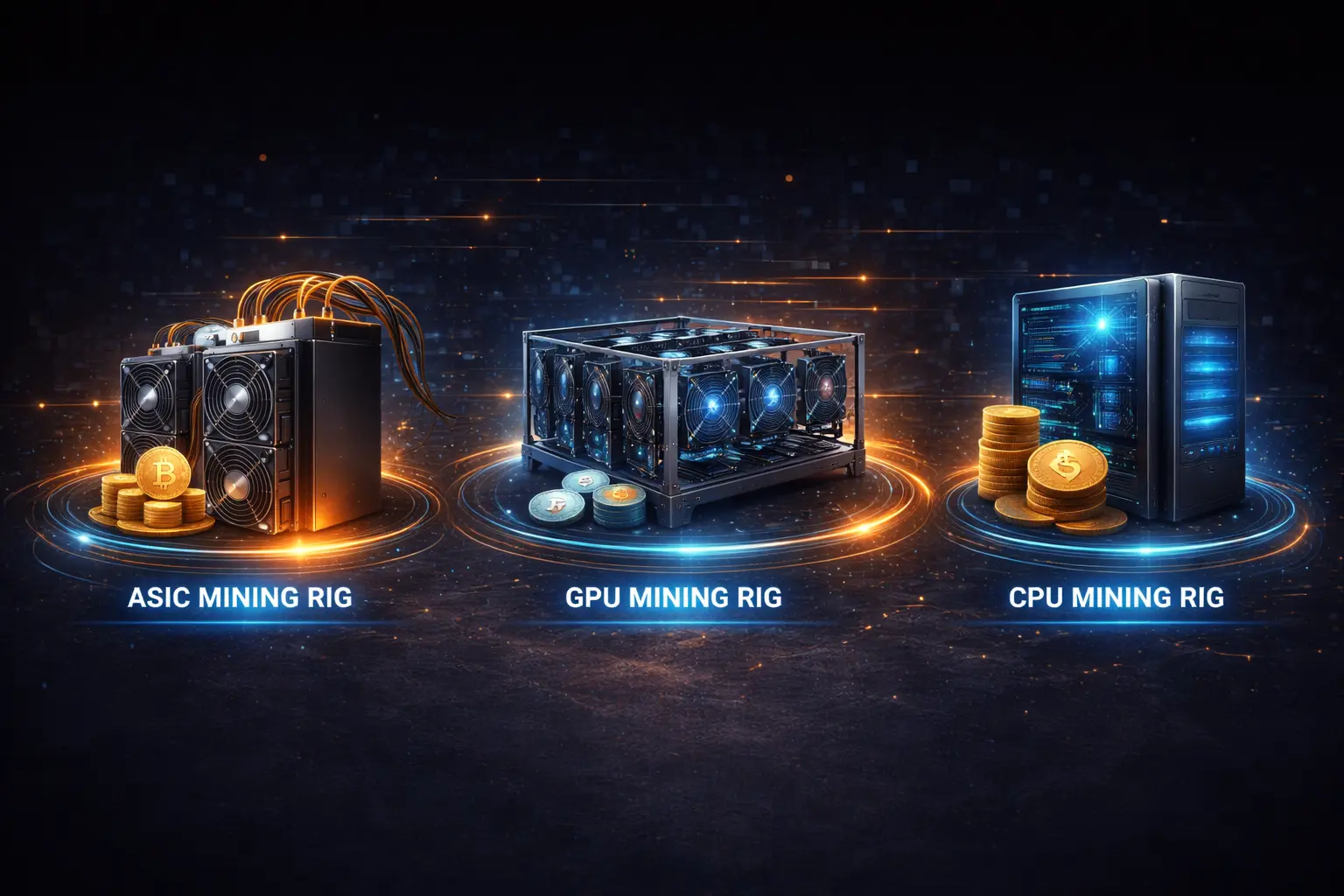
ASIC mining rigs are purpose-built machines. Every component exists to run one algorithm as efficiently as possible. The chip design, power delivery, cooling, and firmware are all optimized for a single task. Bitmain dominates ASIC production with its Antminer line. MicroBT’s Whatsminer series provides the main competition. Both manufacturers release new models roughly annually, each generation offering improved efficiency over the last.
The Antminer S21 Pro, released in late 2024, achieves approximately 234 TH/s at around 3,510 watts — an efficiency of roughly 15 J/TH. The Whatsminer M60S reaches 186 TH/s at 3,441 watts. These numbers define the competitive baseline for SHA-256 mining in 2026. Older models like the S19 series remain operational but face economic pressure as difficulty rises and their efficiency becomes less competitive.
ASIC rigs have one critical limitation: they cannot be repurposed. An Antminer built for SHA-256 cannot mine Ethereum (which moved to proof-of-stake anyway), Litecoin (Scrypt algorithm), or any other coin. When Bitcoin mining becomes unprofitable at a given electricity price, the hardware has little alternative use. This single-purpose nature is the defining tradeoff of ASIC mining rigs.
GPU Mining Rigs
GPU crypto mining rigs use graphics processing units — the same chips found in gaming computers and professional workstations. GPUs are flexible. They can be programmed to run different hashing algorithms. When one coin becomes unprofitable to mine, a GPU rig can switch to another without hardware changes.
GPU rigs typically consist of 4 to 12 graphics cards mounted on an open-frame chassis, connected to a single motherboard with enough PCIe slots or risers to accommodate them all. A dedicated PSU powers the setup. The operating system runs on a small SSD. Management software handles overclocking, power limits, and monitoring.
For Bitcoin specifically, GPU rigs are not viable. The hashrate gap between GPU and ASIC performance on SHA-256 is too large. A GPU rig running SHA-256 would earn fractions of a cent daily while consuming hundreds of watts. GPU mining makes sense for coins that deliberately maintain ASIC resistance — like Vertcoin, which uses Verthash — or for altcoins where ASIC hardware hasn’t yet been developed for the algorithm.
CPU Mining (Is It Relevant?)
CPU mining is almost entirely irrelevant for Bitcoin in 2026. A modern server CPU produces perhaps 10–50 megahashes per second on SHA-256. An ASIC produces 200+ terahashes — roughly 20 million times more. No electricity rate makes CPU Bitcoin mining profitable against that gap.
CPU mining retains a small niche in very specific situations. Some newer cryptocurrencies deliberately design algorithms that run efficiently on CPUs, aiming to maximize decentralization in their early stages. Monero’s RandomX algorithm is the most successful example: it is optimized for CPUs and actively resists GPU and ASIC dominance. For those specific coins, a CPU mining rig remains relevant. For Bitcoin, it does not.
Bitcoin Miner Machines Explained
ASIC Miner Design
Inside an ASIC bitcoin miner, the hashing chips are arranged on custom circuit boards called hash boards. The Antminer S21 Pro, for example, contains three hash boards, each with dozens of BM1370 chips — Bitmain’s proprietary SHA-256 chip. These chips do nothing except hash. They contain no memory controllers, display outputs, or general-purpose logic. Every transistor exists to perform SHA-256 operations faster.
The control board is separate from the hash boards. It runs a stripped-down Linux operating system, manages fan speeds, monitors chip temperatures, and communicates with the pool software. Cooling typically uses axial fans pushing air through the machine from intake to exhaust. Some newer designs use immersion cooling instead, submerging the hash boards in dielectric fluid for better thermal performance.
ASIC machines are designed for continuous 24/7 operation at high temperatures. Chip junction temperatures often run between 70°C and 90°C during normal operation. The design accounts for this. Components are rated for sustained high-temperature use in ways that consumer hardware is not. Even so, dust accumulation, power fluctuations, and aging fans remain common causes of machine failure over multi-year operational periods.
Performance Metrics (Hashrate, Efficiency)
Hashrate measures how many hashing calculations per second a machine performs. For Bitcoin mining, the relevant unit is terahashes per second (TH/s). One terahash equals one trillion hashes. Modern competitive ASICs produce between 150 and 400+ TH/s depending on model and generation.
Efficiency is the more important metric for profitability. It is expressed in joules per terahash (J/TH) — how much energy the machine consumes to produce one terahash of work. Lower is better. The Antminer S21 XP achieves approximately 13 J/TH. Older models like the S19j Pro operate at around 30 J/TH. At a given electricity price, that difference in efficiency directly determines whether a machine earns a profit or runs at a loss.
Manufacturers often specify efficiency at standard temperature (25°C). Real-world efficiency degrades as ambient temperature rises. A machine rated at 15 J/TH in ideal conditions might operate at 17–18 J/TH in a facility running at 35°C. Accurate profitability modeling must account for actual operating conditions, not spec sheet figures.
Power Consumption
Power consumption is the dominant variable in Bitcoin mining economics. Most competitive ASIC miners draw between 3,000 and 6,000 watts. Running a single Antminer S21 Pro at 3,510 watts for 24 hours consumes approximately 84 kWh. At $0.10 per kWh, that is $8.40 per day in electricity costs alone — before any hardware, facility, or maintenance costs.
The electricity rate available to a miner determines more about long-term profitability than any other single factor. Industrial miners in regions with stranded natural gas, hydroelectric surplus, or other low-cost energy sources often operate at $0.02–$0.04 per kWh. Small operators in residential settings typically pay $0.10–$0.20 per kWh. That gap — 5 to 10 times the energy cost — creates vastly different economic outcomes from identical hardware.
Power infrastructure also matters beyond the per-kWh rate. Bitcoin mining rigs require stable power delivery. Voltage fluctuations damage machines. Circuits must be sized correctly for continuous high loads. A single S21 Pro running at 3,510 watts requires dedicated 20-amp 240V circuit capacity. Scaling to multiple machines requires industrial electrical infrastructure that residential settings rarely support.
Crypto Mining Machine Components
A complete crypto mining machine — whether ASIC or GPU — consists of more than just the hashing hardware. Understanding every component helps with both setup and troubleshooting.
- Hashing units — the core compute component. ASICs have integrated hash boards. GPU rigs use discrete graphics cards, typically NVIDIA or AMD, connected via PCIe risers to the motherboard.
- Motherboard — for GPU rigs, a mining-optimized motherboard with enough PCIe slots and stable power delivery. ASIC units have integrated control boards serving this function.
- Power supply units (PSUs) — high-wattage PSUs rated for continuous loads. GPU rigs often need 1,200–2,000W PSUs. ASIC machines typically have integrated or semi-modular power supplies.
- Cooling system — fans for air-cooled units. Industrial setups may use immersion cooling tanks filled with dielectric fluid. Adequate cooling extends hardware lifespan significantly.
- Frame or chassis — open-frame steel racks for GPU rigs allow maximum airflow. ASIC units arrive in their own integrated chassis.
- Operating system and software — Linux-based OS for GPU rigs (HiveOS and RaveOS are popular). ASIC units run embedded firmware with web-based management interfaces.
- Network connection — stable Ethernet connection to the mining pool. WiFi is too unreliable for continuous mining operations.
- Storage — small SSD (32–64 GB) for GPU rig OS. ASIC machines store firmware in integrated flash memory.
How to Build a Crypto Mining Rig
- Step 1: Define your budget and goals — decide whether you are building an ASIC setup for Bitcoin or a GPU rig for flexible altcoin mining. Determine your electricity cost. Run profitability projections before purchasing anything.
- Step 2: Choose hardware — for Bitcoin, select a current-generation ASIC. Compare efficiency (J/TH), hashrate (TH/s), and purchase price. For GPU rigs, select cards based on algorithm efficiency, VRAM, and power draw.
- Step 3: Prepare power infrastructure — calculate total wattage and ensure your electrical circuit can handle continuous load. Install dedicated circuits if necessary. Consider a PDU (power distribution unit) for multi-machine setups.
- Step 4: Assemble the rig — for GPU rigs: mount motherboard to frame, install CPU and RAM, connect PSU, attach risers and GPUs. For ASICs: unbox, inspect for shipping damage, connect power cables and Ethernet.
- Step 5: Install software — flash the operating system onto the SSD for GPU rigs. Configure pool settings in the ASIC web interface. Set overclocking profiles and power limits to optimize efficiency.
- Step 6: Join a mining pool — solo mining Bitcoin with any consumer-scale hardware is statistically impractical. Join an established pool (Foundry USA, Antpool, ViaBTC, F2Pool) and configure your miner to connect using the pool’s stratum address.
- Step 7: Monitor and optimize — track hashrate, temperature, and share acceptance rate continuously. Adjust fan curves, overclocks, and power limits based on real-world performance. Replace thermal paste on GPU rigs annually.
ASIC Mining Rig vs GPU Rig
The choice between ASIC and GPU hardware defines every subsequent decision in a mining operation. Each model serves fundamentally different use cases and carries different risk profiles.
| Feature | ASIC Mining Rig | GPU Mining Rig |
| Algorithm | SHA-256 only (Bitcoin) | Multiple algorithms |
| Hashrate | Very high (100–1,000+ TH/s) | Moderate (hundreds of MH/s) |
| Power consumption | High (3,000–6,000 W typical) | Moderate (100–350 W per GPU) |
| Efficiency (J/TH) | Excellent (15–20 J/TH best models) | Poor for Bitcoin |
| Hardware cost | $2,000–$12,000+ per unit | $200–$1,500 per GPU |
| Flexibility | None — single-purpose | High — switchable algorithms |
| Resale value | Low after obsolescence | Retains gaming market value |
| Best use case | Bitcoin mining only | Altcoin mining, multi-coin |
The core insight from this comparison: ASIC rigs are the right choice for anyone committed to Bitcoin mining long-term and operating in a low-electricity-cost environment. GPU rigs are the right choice for anyone who wants flexibility, intends to mine multiple algorithms, or cannot access low-cost power. The two serve different strategies, not the same strategy at different quality levels.
Mining Rig Profitability
Profitability for a bitcoin mining rig depends on four variables: hashrate, electricity cost, network difficulty, and Bitcoin price. All four change continuously. Projections made today may be wrong within weeks.
The basic calculation: daily revenue equals (hashrate / network hashrate) times daily block reward in BTC times Bitcoin price. Daily cost equals (power consumption in kW) times 24 times electricity rate. Profit equals revenue minus cost. Most mining calculators automate this math using real-time network data.
Network difficulty adjusts approximately every two weeks based on total network hashrate. When more mining rigs come online, difficulty rises and each individual machine earns proportionally less. Post-halving in April 2024, the block reward dropped to 3.125 BTC. At $60,000 per BTC, the total value of each block reward is $187,500. At $90,000 per BTC, it is $281,250. Bitcoin price is the largest single variable in the profitability equation.
Hardware cost recovery (ROI) is the other critical dimension. A single Antminer S21 Pro costs approximately $4,000–$6,000 new in 2026. At $0.05/kWh and BTC at $80,000, a machine earning $15/day after electricity costs would take roughly 270–400 days to recover hardware cost — before accounting for difficulty increases, potential downtime, or maintenance costs. Real ROI periods often exceed projections.
Break-even analysis at different electricity rates makes the electricity variable concrete. At $0.04/kWh, competitive ASICs generally mine profitably across a wide range of difficulty and price conditions. With electricity priced at $0.08/kWh, profitability requires either efficient hardware or favorable BTC prices. Costs reaching $0.12/kWh mean most mining operations run near breakeven or at a loss except during bull market peaks. Finally, residential mining is rarely profitable at $0.15/kWh with any current hardware.
Advantages of Crypto Mining Rigs
- Direct Bitcoin exposure — mining provides Bitcoin accumulation without requiring purchases at market price. Miners receive BTC as block rewards, effectively averaging their acquisition cost over time.
- Network participation — mining contributes to Bitcoin’s security. Running a mining rig makes the network more decentralized and resistant to 51% attacks.
- Infrastructure ownership — unlike cloud mining contracts, owning physical hardware gives full operational control. There is no counterparty risk from a cloud provider.
- Potential for low-cost energy arbitrage — operators with access to cheap electricity can mine profitably even during price downturns, building Bitcoin reserves at below-market cost.
- GPU rig flexibility — GPU mining rigs can switch between algorithms and coins as economics shift, providing an option that ASIC rigs lack entirely.
Risks and Challenges
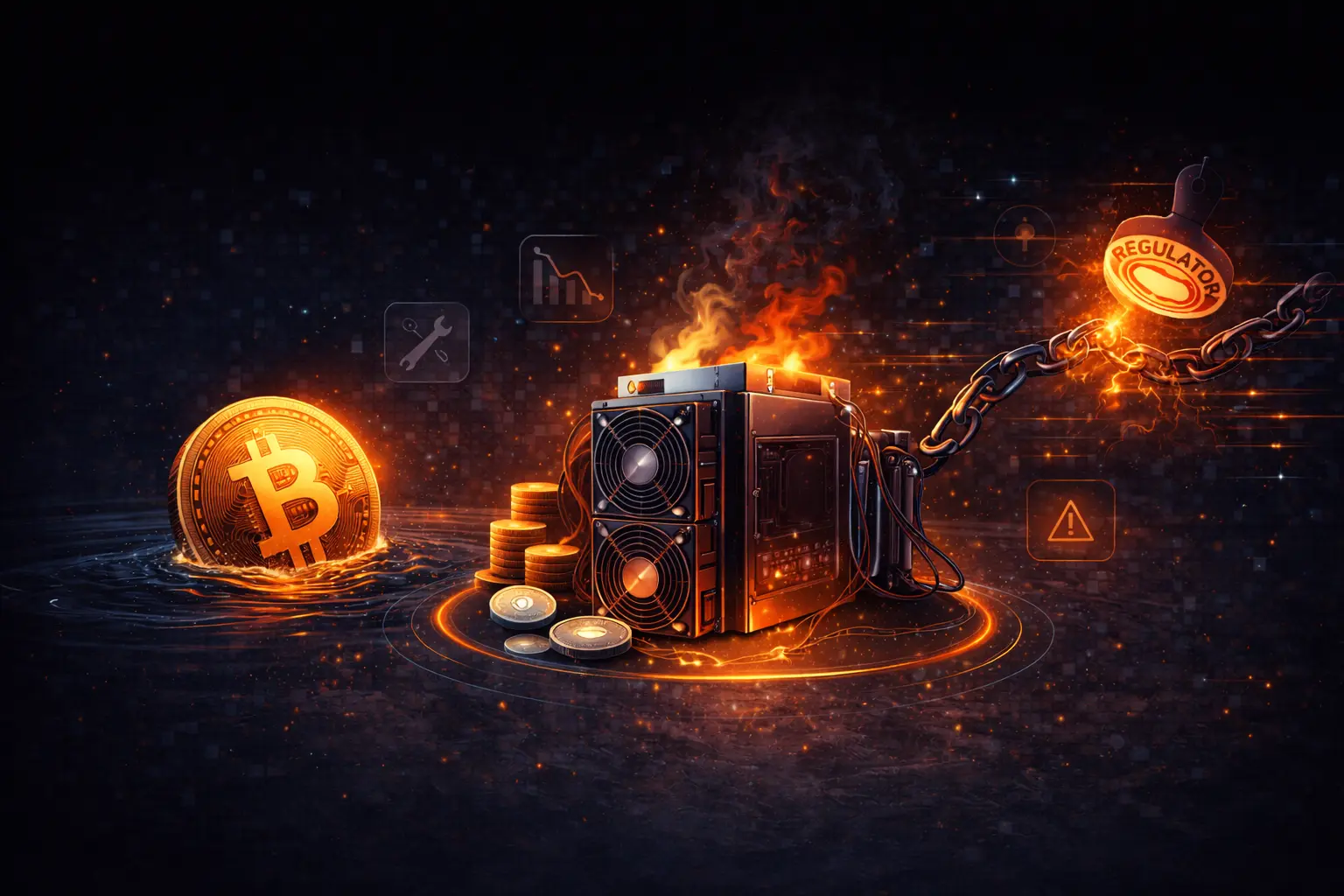
Hardware obsolescence is rapid. An ASIC model released in 2022 may be economically unviable by 2026 as more efficient generations enter the market. The capital invested in older machines cannot be recovered through alternative use — the machines have almost no value outside mining.
Network difficulty growth erodes returns over time. As institutional miners add tens of thousands of ASICs per month, difficulty rises and each individual machine’s share of block rewards shrinks. A machine that earns 0.005 BTC per day today may earn 0.003 BTC per day in 12 months with identical hashrate if difficulty increases 40%.
Regulatory risk varies by jurisdiction. Some countries have restricted or banned cryptocurrency mining due to energy consumption concerns. Operators in affected regions face potential forced shutdowns without compensation. Even in permissive jurisdictions, regulatory environments can shift with limited warning.
Bitcoin price volatility affects mining economics directly. A 50% price drop does not reduce costs but cuts revenue in half. Operations that were profitable at $80,000 BTC may run at a loss at $40,000 BTC. Miners who must sell BTC immediately to cover electricity costs are exposed to price risk in ways that long-term holders are not.
Physical operation is demanding. Mining rigs run 24/7 and require continuous monitoring. Fan failures, power fluctuations, dust accumulation, and firmware bugs all cause downtime. Each hour offline is revenue lost. Managing a farm of more than a few machines requires either dedicated staff or robust remote monitoring systems.
Future of Mining Rigs
The trend in ASIC development points toward continued efficiency improvements and increased integration. Immersion cooling is moving from niche to mainstream as chip power densities rise beyond what air cooling can manage. Several ASIC manufacturers have released immersion-ready units specifically designed for liquid cooling deployment.
Bitcoin’s next halving will occur in approximately 2028, reducing the block reward to 1.5625 BTC. Each halving compresses miner economics. Only the most efficient hardware at the lowest electricity costs survives each halving intact. This dynamic has historically driven consolidation in the mining industry toward large industrial operations.
The rise of ordinals, inscriptions, and Bitcoin-native applications has expanded transaction fee revenue slightly, but fees remain a small fraction of total miner revenue compared to block subsidies. Whether transaction fees can meaningfully compensate for declining subsidies over the long term remains an open question in Bitcoin economics.
AI and machine learning workloads are creating competition for the same low-cost power that miners target. Data centers serving AI inference and training increasingly compete with mining operations for electricity contracts in regions with abundant cheap power. This competition may pressure power costs upward in markets previously favorable to miners.
Key Takeaways
- A bitcoin mining rig is hardware dedicated to performing SHA-256 hashing — almost always an ASIC in 2026, with GPU rigs limited to altcoin mining.
- ASIC efficiency (measured in J/TH) matters more than raw hashrate. The best 2026 models achieve 13–16 J/TH, making older machines at 28–35 J/TH increasingly uncompetitive.
- Electricity cost is the dominant variable in mining profitability. Operations above $0.10/kWh face consistent profitability challenges regardless of hardware quality.
- Network difficulty adjusts every two weeks and grows as more mining capacity comes online, reducing each machine’s share of block rewards over time.
- GPU rigs offer flexibility but cannot compete with ASICs on Bitcoin specifically. Their value lies in algorithm switching across multiple coins.
- Hardware ROI timelines frequently extend beyond initial projections due to difficulty increases, price volatility, and maintenance costs.
Expert Insight
According to Gemini’s Cryptopedia: “Mining rigs are constantly being upgraded with new hardware, which offers more hashpower and energy efficiency. The hashrate is a measure of the computational power being applied to mine cryptocurrency. Mining rigs with higher hashrates have a better chance of successfully mining the next block and receiving the reward.”
This points to the core economics of mining: it is a competition measured in joules per terahash, not just terahashes per second. The operator who mines each hash most cheaply wins the long-term profitability contest, regardless of who has the most raw hashrate. That economic logic is why efficiency (J/TH) has replaced raw hashrate as the primary metric serious miners use to evaluate hardware.
Conclusion
Bitcoin mining rigs are the physical infrastructure that secures the world’s largest proof-of-work blockchain. Understanding what they are, how they work, and what they cost is essential before committing capital to any mining operation.
The technology has matured significantly. ASIC efficiency has improved dramatically over the past decade. The market has professionalized. Small-scale residential mining has become economically marginal in most electricity markets, while large industrial operations with access to cheap power continue to expand.
For anyone considering a mining rig in 2026, the honest assessment requires modeling real electricity costs, realistic Bitcoin price scenarios, current network difficulty, hardware acquisition costs, and the likelihood of continued difficulty growth. The machines work. Whether the economics work for your specific situation depends on inputs that vary enormously by location, capital, and risk tolerance.
FAQ
What is a bitcoin mining rig?
A bitcoin mining rig is hardware dedicated to performing the SHA-256 proof-of-work calculations required to mine Bitcoin. In 2026, this almost always means an ASIC (Application-Specific Integrated Circuit) — a machine built exclusively for this task. ASIC miners produce hashrates of 150–400+ TH/s at efficiencies of 13–30 J/TH depending on model age. Earlier GPU-based bitcoin mining rigs are no longer economically viable for Bitcoin due to the enormous hashrate advantage of ASICs.
What is a crypto mining rig?
A crypto mining rig is any hardware configuration built to mine cryptocurrency through proof-of-work. The term covers ASIC machines (optimized for a single algorithm), GPU rigs (flexible multi-algorithm setups), and historically CPU rigs (now mostly obsolete for profitable mining). The specific hardware required depends entirely on which cryptocurrency and algorithm you intend to mine. Bitcoin requires ASIC hardware. Many altcoins can still be mined with GPU rigs.
How much does a bitcoin mining rig cost?
Current-generation ASIC bitcoin mining rigs cost between $2,000 and $12,000 depending on model and hashrate. A Bitmain Antminer S21 Pro or MicroBT Whatsminer M60S typically costs $4,000–$8,000 new in 2026. Older models like S19-series machines are available used for $500–$2,000 but operate with lower efficiency, which directly reduces profitability. Hardware cost is only part of total investment — power infrastructure, cooling, and facility costs add significantly to the total.
Is bitcoin mining profitable in 2026?
Profitability depends on electricity cost, Bitcoin price, and network difficulty — all of which change continuously. At electricity costs below $0.05/kWh and Bitcoin prices above $70,000, competitive ASIC hardware generally mines profitably. At electricity above $0.10/kWh, profitability requires either favorable Bitcoin prices or unusually efficient hardware. Profitability calculators using real-time difficulty and price data (WhatToMine, NiceHash) provide more accurate current estimates than any static figure.
What is the difference between an ASIC rig and a GPU mining rig?
ASIC rigs are purpose-built for one algorithm and offer far superior efficiency for that specific task. A Bitcoin ASIC produces 200+ TH/s. A GPU produces 0.8 TH/s on the same algorithm. However, ASICs cannot switch algorithms. When the target coin becomes unprofitable, the hardware has no alternative use. GPU mining rigs are far less efficient per algorithm but can switch between different coins. They also retain resale value in the gaming hardware market when mining becomes unprofitable.
Published Articles
Crypto On-Ramps and Off-Ramps Explained: How Fiat and Crypto Move In and Out
Entering the world of digital assets often feels like trying to cross...
 Popular
Bitcoin Pizza Guy: The Story Behind the First Real Bitcoin Purchase
Introduction The history of Bitcoin is full of dramatic ups and downs,...

Crypto Basics Explained: A Beginner’s Guide to Cryptocurrency and Trading
Introduction The world of finance is changing right before our eyes. Just...
 Popular
Uniswap Explained: What It Is, How It Works, and How to Use the UNI DEX
Introduction Decentralization and decentralized platforms that have emerged in recent years have...
 Popular
Bitcoin Lightning Network Explained: What It Is and How Bitcoin Lightning Works
Introduction In the world of cryptocurrency, transaction speed and costs have always...
How Bitcoin ATMs Work: A Complete Guide to Using Crypto ATMs
Introduction Millions of people around the world use cryptocurrencies today – at...