
Bitcoin vs Ethereum: Differences, Use Cases, and Which is the Better Investment
Introduction
In 2024, both assets received spot ETFs in the United States — an event that seemed unlikely just a few years earlier. Bitcoin ETFs attracted tens of billions of dollars in their first months. Ethereum ETFs followed. What this means is straightforward: the conversation about ethereum vs bitcoin investment has moved beyond a niche topic for crypto enthusiasts into mainstream financial planning. But the question remains the same: what exactly should you buy? They look similar on the surface: both trade on every major exchange, both are accepted as collateral in DeFi, both are recognized by regulators as legitimate financial instruments. But beneath the surface sit two fundamentally different assets with different investment profiles. This article breaks down the difference honestly — not with “BTC or ETH” slogans, but with a concrete analysis of what each asset actually is, how they differ in risk and potential, and how to think about them from a portfolio perspective.
What Is Bitcoin as an Investment?
Bitcoin is the first and largest cryptocurrency, created in 2009. As an investment asset, Bitcoin and Ethereum serve different purposes: BTC is most commonly positioned as “digital gold” — a store of value with a fixed supply of 21 million coins.
What makes Bitcoin attractive to investors? Above all, scarcity. Bitcoin’s algorithm automatically halves miner rewards every four years (the halving). The fourth halving occurred in April 2024. Historically, every halving has preceded a new price high — though past results do not guarantee future ones.
Second, network effect. Bitcoin has existed longer than all competitors and has accumulated the greatest trust among institutional investors. BTC was the first to gain corporate buyers (MicroStrategy, Tesla), sovereign reserves (El Salvador, government seizures), and spot ETFs in the US.
Third, simplicity. Bitcoin has no smart contracts, no tokens, no governance. This makes its regulatory status more predictable and reduces the risk of unexpected protocol changes.
Bitcoin’s market capitalization in early 2025 exceeded $1.5 trillion — more than 50% of the entire crypto market. That is a level comparable to the world’s largest companies.
What Is Ethereum as an Investment?
Ethereum is the second-largest cryptocurrency by capitalization, launched in 2015. If Bitcoin is digital gold, Ethereum is more often compared to “digital oil”: a resource consumed to run decentralized applications.
What is an Ethereum investment in terms of mechanics? ETH is the native currency of the Ethereum blockchain, required to pay for transactions (gas fees) in the network. The more activity in the network — DeFi operations, NFT transactions, smart contract deployments — the higher the demand for ETH. This creates an economic link between ecosystem growth and the asset’s price.
After the transition to Proof of Stake in 2022 (The Merge), ETH became deflationary during periods of high network activity: the EIP-1559 mechanism burns a portion of fees, reducing supply. This fundamentally changed the asset’s investment profile compared to the mining era.
Ethereum hosts most of the DeFi ecosystem, the majority of NFT standards, stablecoins (USDC and DAI primarily live on Ethereum), and real-world asset tokenization. This means an Ethereum investment is an indirect bet on the growth of that entire space.
ETH’s market capitalization in early 2025 was approximately $350–400 billion — roughly a quarter of Bitcoin’s.
Bitcoin vs Ethereum: Key Investment Differences
Purpose and Use Case
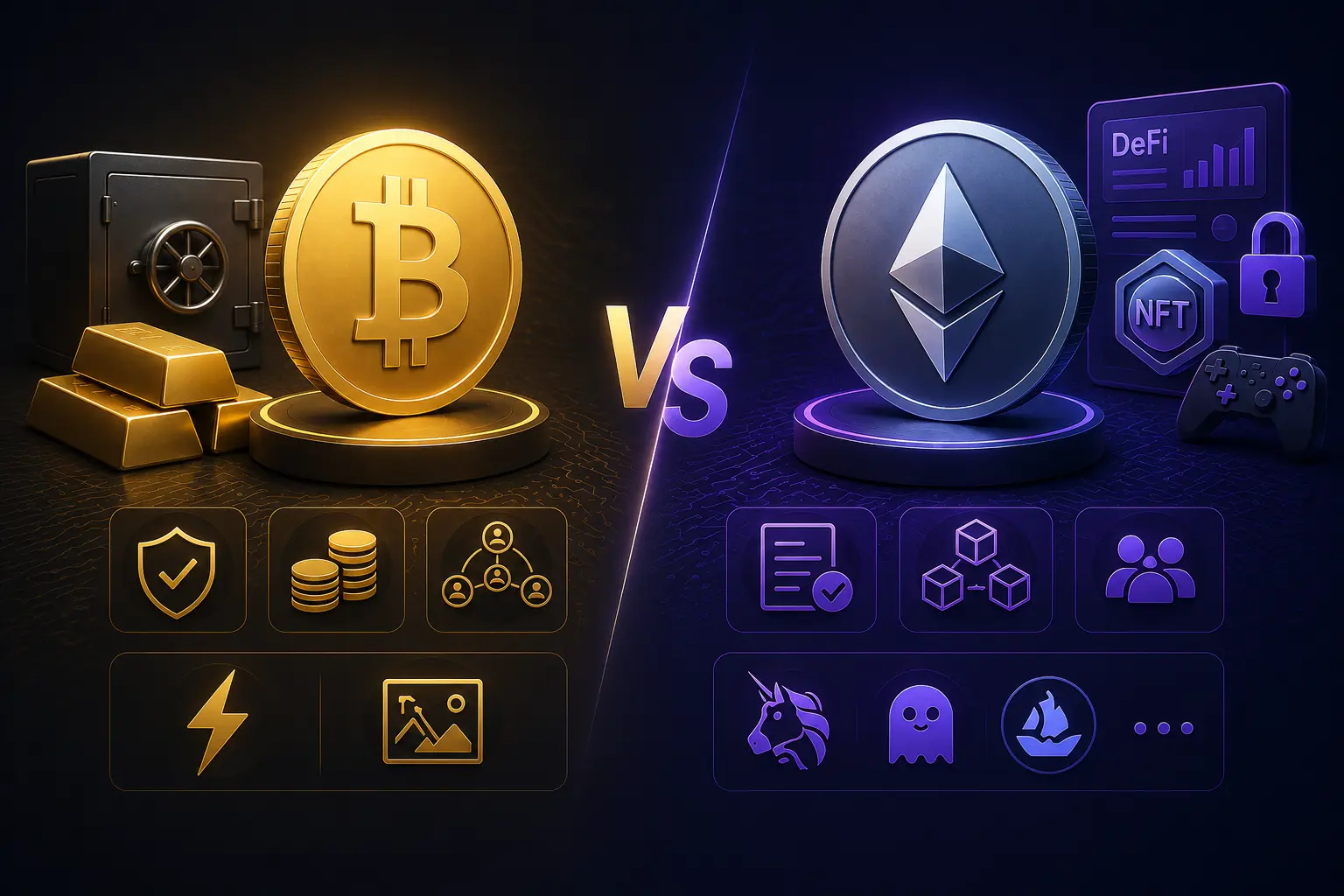
Bitcoin was designed as a peer-to-peer electronic cash system — and evolved into “digital gold,” a store of value. Its network is optimized for security and reliability rather than flexibility. Bitcoin does not support smart contracts at the base layer (though solutions like Lightning Network and Ordinals extend its capabilities).
Ethereum was built as a programmable blockchain — a “world computer.” Its smart contracts allow building protocols without a central operator. This makes ETH useful as an infrastructure asset: without it, Uniswap, Aave, OpenSea, and thousands of other protocols do not function.
Comparing ethereum vs bitcoin investment by purpose: BTC is closer to gold or Treasury bonds in a crypto context. ETH is closer to a technology platform stock that grows with usage volume.
Technology
Bitcoin uses Proof of Work — energy-intensive but time-tested. The Bitcoin base chain has changed little since creation — a deliberate choice ensuring predictability.
Ethereum uses Proof of Stake after The Merge. This reduced the network’s energy consumption by ~99.95% and created new dynamics: ETH holders can stake coins and earn rewards (~3–5% annually) by participating in network validation. Ethereum continues to update actively — which carries risks but also means improved scalability (sharding, rollups).
Market Position
Bitcoin is the undisputed crypto market leader with 50%+ dominance. It was first, has the greatest liquidity, and is most widely recognized among traditional institutional investors.
Ethereum is second by all metrics but first in ecosystem activity. Number of developers, DeFi TVL, active smart contracts — by these measures Ethereum significantly outpaces competitors.
Risk Comparison: Bitcoin vs Ethereum
Volatility
Both assets are highly volatile by traditional finance standards. But there is a difference between them. Historically, ETH has shown greater volatility in both directions than BTC. In bull markets, ETH often outpaces Bitcoin’s gains; in bear markets, it falls further.
This is explained by market size: a smaller capitalization means greater price impact from the same capital inflow or outflow. All else equal, $1 billion entering ETH creates a larger price effect than the same billion in BTC.
Regulatory Risk
Bitcoin is viewed by regulators in most jurisdictions as “digital gold” or a commodity — a position the SEC reinforced in several cases in the US. The Bitcoin spot ETF in the US is a direct consequence of this classification.
Ethereum is more complex from a regulatory standpoint. The debate over whether ETH is a security has not been definitively closed. The Ethereum spot ETF was approved in 2024, but regulatory uncertainty around staking rewards remains. The shift to PoS also introduced new regulatory questions.
Network Risks
Bitcoin: the main risk is hashrate concentration among large mining pools. There is also a 51% attack risk, though at current hashrates this requires enormous resources.
Ethereum: smart contract risks — bugs in the protocol code or dependent applications. Staking centralization risk: large staking providers (Lido, Coinbase) control a significant share of validators. Protocol upgrade risk: active development carries the possibility of unforeseen consequences.
Growth Potential of BTC vs ETH
Comparing the growth potential of ethereum vs bitcoin investment requires understanding different drivers.
For Bitcoin, the main drivers are: institutional adoption (corporate treasuries, sovereign wealth funds), supply scarcity after halvings, use as an inflation hedge. The theoretical “ceiling” if Bitcoin reaches parity with gold (market cap ~$12 trillion in 2025) would put Bitcoin at around $600,000 per coin. This is not a forecast — it is a scale-of-potential reference point.
For Ethereum, the drivers are different: growth in network usage (DeFi TVL, L2 volume, stablecoin supply on Ethereum), institutional tokenization of real-world assets on Ethereum, scaling through rollups (Arbitrum, Optimism, Base), and expansion of staking following ETF approval.
ETH potentially benefits from an “ecosystem multiplier”: the more that is built on Ethereum, the higher the organic demand for ETH. This resembles a “platform investment” model.
Bitcoin and Ethereum: Are They Less Risky Now?
The question of whether bitcoin and ethereum are now much less risky is not rhetorical. There are concrete structural changes that have reduced certain risks.
Spot ETFs. The introduction of exchange-traded funds for BTC and ETH in the US means these assets can now be invested in through traditional brokerage accounts — without self-custody of keys. This reduces operational risk for inexperienced investors and opens the market to pension funds.
Regulatory clarity. MiCA in the EU, legislative progress in the US — the market is moving toward a more predictable regulatory environment. This reduces the risk of sudden bans or asset freezes.
Institutional infrastructure. Custodial services at the level of Fidelity, BlackRock, Coinbase Custody represent a fundamentally different reliability standard compared to self-built wallets of 2013.
Nevertheless, volatility has not gone away. Bitcoin dropped from $73,000 to $50,000 in 2024 before recovering. Ethereum lost more than 60% from its peak in the previous cycle. “Less risky” does not mean “risk-free.”
Historical Performance: BTC vs ETH
Historical performance provides useful context, though past results do not predict future ones.
From Ethereum’s launch in 2015 to the 2021 peak, ETH rose from ~$0.30 to ~$4,800 — more than 16,000x. Bitcoin over the same period rose roughly from $250 to $69,000 — about 276x. By absolute growth figures, ETH significantly outperformed BTC — but from a later starting point and with higher volatility.
In the 2022–2023 cycle, both assets lost more than 70% from their highs. Bitcoin recovered to new all-time highs ($73,000) in early 2024. Ethereum as of 2025 remained significantly below its 2021 peak — reflecting more complex recovery dynamics.
This difference in recovery illustrates an important pattern: Bitcoin behaves more like a “reserve asset” that recovers first and attracts the first institutional capital. Ethereum is more dependent on ecosystem health — when DeFi activity falls, ETH loses organic demand.
Portfolio Strategy: BTC vs ETH
How to think about bitcoin and ethereum in a portfolio context? Several practical positions.
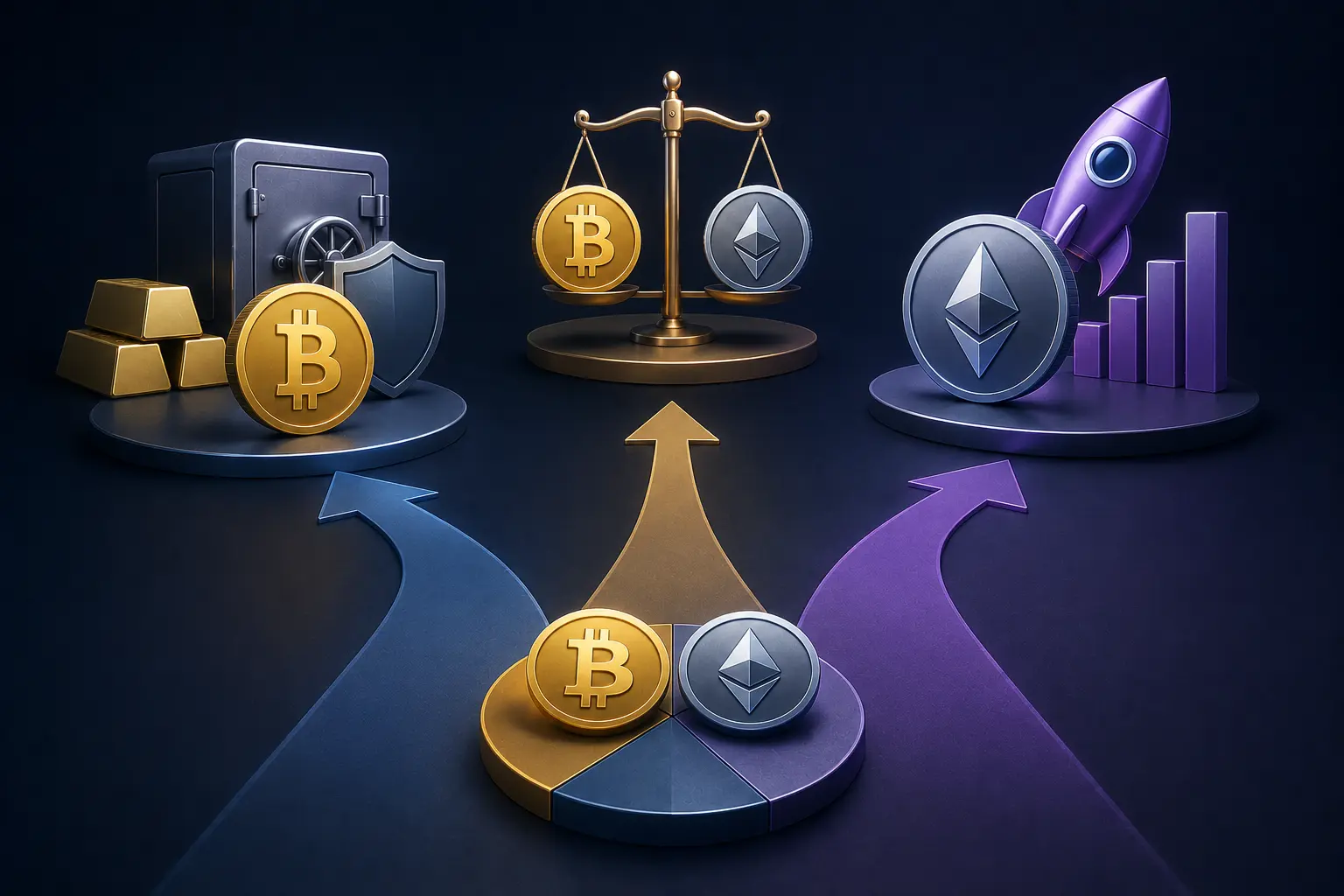
Conservative approach: Bitcoin as the core position. For investors seeking crypto market exposure with minimum specific risk, BTC is the more obvious choice. Greatest liquidity, clearest regulatory status, least dependence on a specific ecosystem.
Moderate approach: BTC + ETH combination. The classic crypto portfolio allocation — 60–70% BTC, 20–30% ETH, the rest in other assets. BTC provides stability relative to the market, ETH provides beta to ecosystem growth.
Investors betting on the growth of DeFi, RWA tokenization, and the L2 ecosystem may prefer a higher ETH weight — with the understanding that volatility will be higher.
Important point: diversification between BTC and ETH is diversification within the crypto market, but not diversification away from it. Both assets correlate strongly during periods of market stress.
Pros and Cons of Ethereum Investment
Pros of an Ethereum investment:
- Ecosystem multiplier: DeFi, NFT, RWA, and L2 growth creates organic demand for ETH
- Deflationary mechanism: EIP-1559 burns a portion of fees, reducing supply during active periods
- Staking yield: ~3–5% annually through staking reduces the opportunity cost of holding the position
- Technology leadership: Ethereum remains the platform of choice for most developers
- Growing institutional infrastructure: spot ETF, custodial services, corporate interest
Cons of an Ethereum investment:
- Higher volatility than Bitcoin in both directions
- Regulatory uncertainty around staking and ETH classification
- Competition from alternative smart contract platforms (Solana, Aptos, Sui)
- Staking centralization risk through large providers
- Dependence on ecosystem activity — in bear markets, gas demand drops sharply
Practical Considerations for Investors
Beyond strategic differences, several practical aspects influence the choice between BTC and ETH.
Custody. Both assets can be held on exchanges or in software or hardware wallets. But ETH has an additional option: staking through liquid protocols (Lido, Rocket Pool) or directly if you hold 32 ETH. This allows the “working” asset to generate income without selling the position. BTC has no such native yield — though wrapped BTC solutions exist in DeFi.
Tax considerations. In most jurisdictions, cryptocurrencies are subject to capital gains tax. ETH staking rewards in some countries are treated as income at the time of receipt. This creates an additional tax burden to account for when choosing a strategy.
ETF accessibility. Spot ETFs for BTC and ETH are available in the US (through iShares, Fidelity, VanEck, and others). However, Ethereum ETFs do not yet include staking yield — meaning ETH ETF investors get price exposure but miss part of the investment thesis (passive income from staking).
Liquidity. BTC trades with greater market depth: spreads are tighter, large orders have less price impact. For institutional investors with large positions, this can be a critical factor.
Key Takeaways
- Bitcoin is digital gold with a fixed supply of 21 million coins, best suited as a store of value and inflation hedge; Ethereum is a programmable platform whose value is tied to ecosystem activity.
- Ethereum vs Bitcoin as an investment: ETH historically shows higher volatility in both directions — greater upside in bull markets and deeper corrections in bear markets.
- Bitcoin’s regulatory status as a commodity is clearer; ETH remains subject to debate, particularly around staking rewards.
- Both assets have become structurally less risky through spot ETFs, institutional infrastructure, and regulatory framework development — but retain high volatility by traditional asset standards.
- BTC/ETH diversification is diversification within the crypto market, not a substitute for broad portfolio diversification.
Expert Insight
VanEck’s analytical review of Bitcoin and Ethereum notes that the two largest crypto assets serve different functions in a portfolio: Bitcoin is closer in characteristics to gold as a store of value, while Ethereum functions more as a technology infrastructure bet — analogous to investing in an internet protocol that serves a growing digital economy.
This distinction matters because it shifts the question from “which is better” to “which do you actually need.” An investor seeking inflation protection and predictability, and an investor betting on the growth of decentralized finance, will arrive at different answers — and both will be right within their own strategy.
Conclusion
Bitcoin and Ethereum are complementary assets, not competitors. They serve different roles: Bitcoin acts as a liquid, transparent store of value, while Ethereum offers exposure to the decentralized economy. For beginners, Bitcoin is often the more intuitive entry point. Ethereum adds a higher-risk growth premium. Both are now mature enough to hold a deliberate place in a diversified portfolio.
More Questions
Bitcoin is a digital gold analog for hedging risk. Ethereum is a bet on Web3, DeFi, and decentralized applications. There is no “better” choice; many investors hold both to balance stability with growth potential.
Bitcoin is a currency with a hard supply cap. Ethereum is a programmable platform for software. Their value drivers are different: one is about scarcity, the other about network utility.
Spot ETFs and regulation have reduced structural risks. However, price volatility remains high. Both assets can still face 50–70% corrections during bear markets.
It is a bet on blockchain usage. ETH is required for transaction fees in DeFi and NFT sectors. Unlike Bitcoin, ETH also offers staking rewards, providing a native yield to holders.
Published Articles

Crypto On-Ramps and Off-Ramps Explained: How Fiat and Crypto Move In and Out
Entering the world of digital assets often feels like trying to cross...
 Popular
Bitcoin Pizza Guy: The Story Behind the First Real Bitcoin Purchase
Introduction The history of Bitcoin is full of dramatic ups and downs,...

Crypto Basics Explained: A Beginner’s Guide to Cryptocurrency and Trading
Introduction The world of finance is changing right before our eyes. Just...
 Popular
Uniswap Explained: What It Is, How It Works, and How to Use the UNI DEX
Introduction Decentralization and decentralized platforms that have emerged in recent years have...
 Popular
Bitcoin Lightning Network Explained: What It Is and How Bitcoin Lightning Works
Introduction In the world of cryptocurrency, transaction speed and costs have always...

How Bitcoin ATMs Work: A Complete Guide to Using Crypto ATMs
Introduction Millions of people around the world use cryptocurrencies today – at...