
Centralized Exchange (CEX): What It Is, Pros and Cons, How to Choose a Platform
What Is a Centralized Exchange?
Say you’ve decided to buy Bitcoin. The most obvious path: go to Binance, Coinbase, or Kraken, complete verification, fund your account, and hit “Buy.” These are centralized exchanges, or CEXs. Most people who have ever bought crypto did it here.
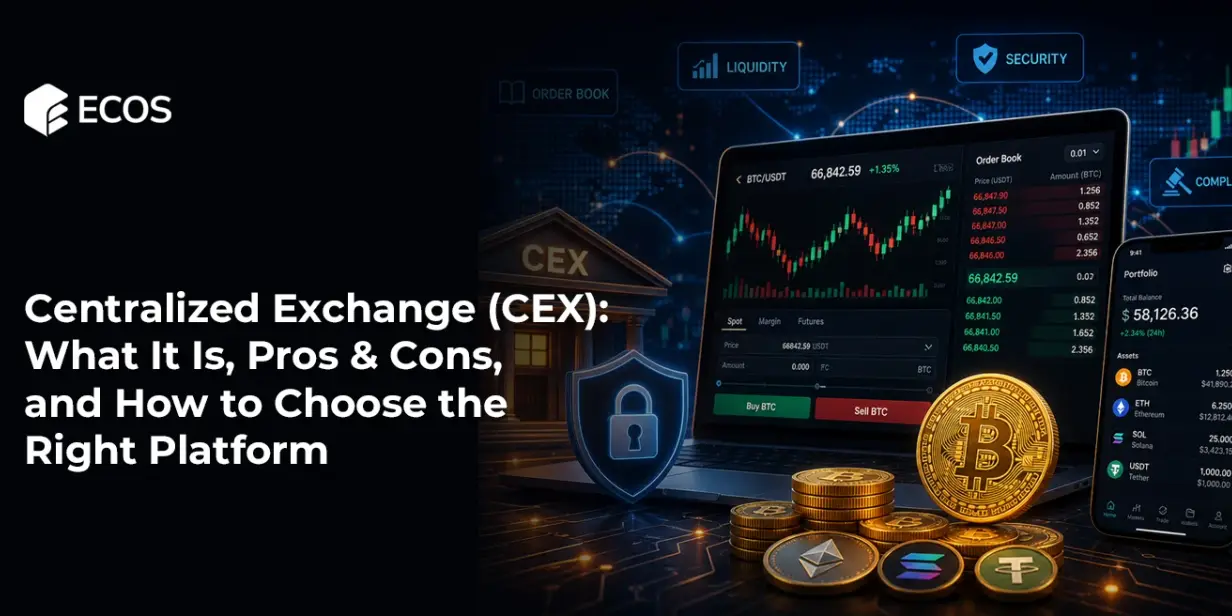
What is a CEX in crypto? A centralized exchange (CEX) is a platform that acts as an intermediary between crypto buyers and sellers. Unlike decentralized exchanges (DEX), where trades happen directly between wallets, a CEX holds user funds, manages their orders, and takes responsibility for executing trades.
Think of it like a traditional stock broker. You transfer money, the broker keeps records, matches your order with the right counterparty, and confirms the trade. The difference is that instead of stocks, you’re dealing with Bitcoin, Ether, and thousands of other tokens.
The definition of a CEX sounds simple, but behind it sits a full infrastructure: order-processing servers, asset custody systems, security teams, legal departments, and customer support. That infrastructure is simultaneously the main advantage of CEX and the main source of its risks.
How Centralized Exchanges Work
The Order Book System
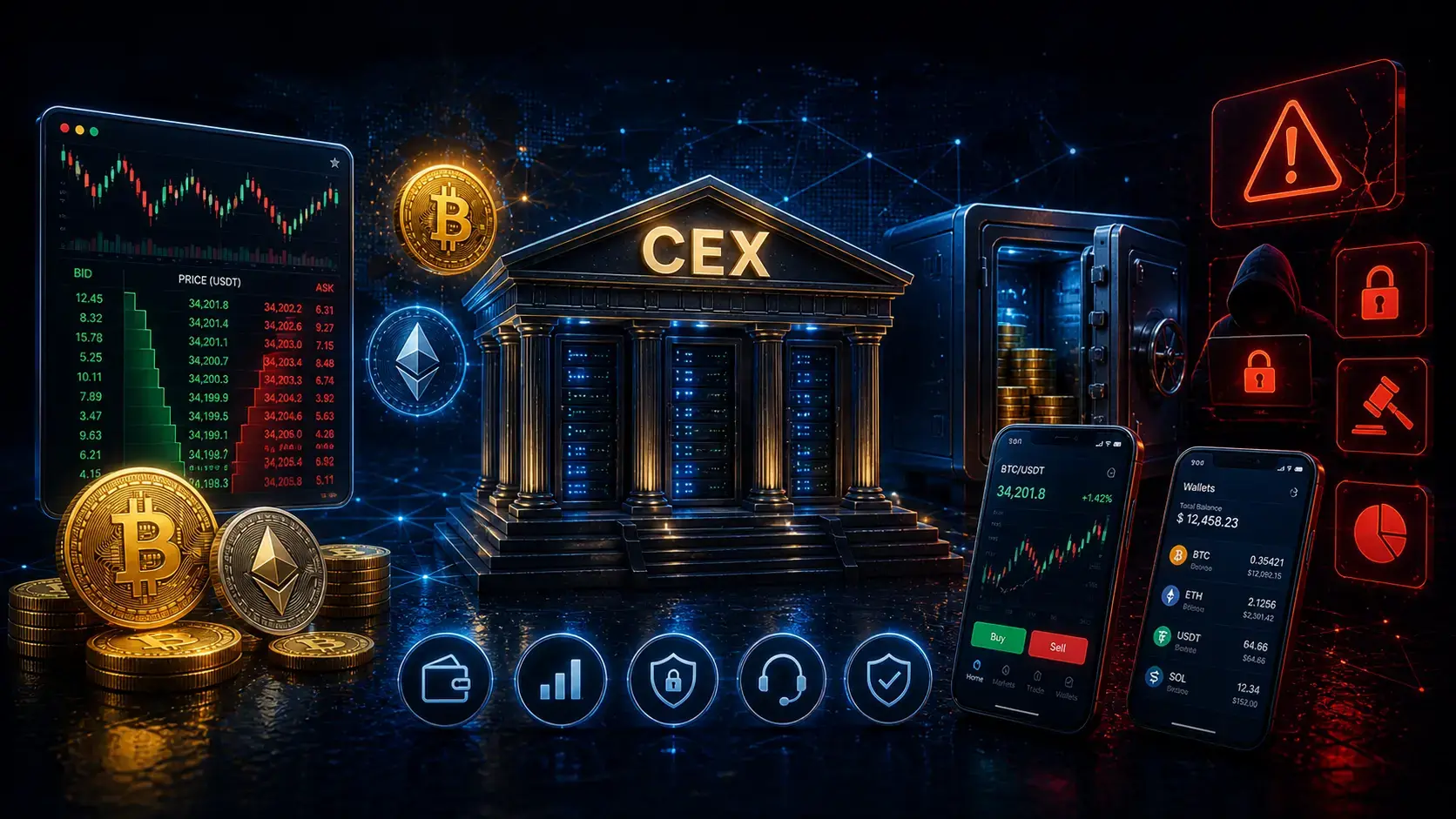
At the core of any CEX is the order book — a list of all active buy and sell orders for a specific asset. One trader wants to buy ETH at $3,200; another is willing to sell at $3,210. Both orders sit in the order book. The system watches for them and waits for prices to match.
The order book updates in real time — thousands of changes per second. You can read the market from it: a large volume of buy orders signals strong demand; sellers stacking above the current price likely indicates resistance.
Matching Buyers and Sellers
When buyer and seller prices meet, the exchange engine executes the trade — automatically, in fractions of a second. The user never sees who they traded with; they simply receive the desired asset at the stated price.
The exchange earns on the spread and fees. The spread is the difference between the best buy price and the best sell price. The fee is a fixed or percentage charge per trade. On high-volume exchanges with deep liquidity, spreads are minimal — sometimes within 0.01%.
Asset Custody
The key difference between CEX and DEX: when you transfer funds to a centralized exchange, you hand control of those funds to the platform. The private keys to your assets are held by the exchange, not by you. In the crypto community, this is captured in the phrase: “not your keys, not your coins.”
Major exchanges store most assets in cold wallets — offline storage with no internet connection. Hot wallets (online) are used only to cover current withdrawal liquidity. This separation reduces hack risk but doesn’t eliminate it, as the history of several major incidents confirms.
CEX Platform Examples
Hundreds of centralized exchanges exist, but the market is effectively split among a handful of major players.
Binance is the world’s largest exchange by trading volume. It lists more than 350 tokens and offers spot and futures trading, staking, and a launchpad for new projects. Spot trading fees are 0.1%, with discounts available through BNB.
Coinbase is the most popular exchange in the US — a publicly traded company listed on NASDAQ. It targets beginners: a straightforward interface, card-based purchases, and tax reports. Fees run above market average, but the platform’s reputation for reliability ranks among the best.
Kraken has been operating since 2011 and is one of the oldest in the industry. It’s known for strict security standards and a wide selection of fiat currencies for deposits and withdrawals. The platform is particularly popular in Europe.
OKX and Bybit are major Asian platforms focused on derivatives and high-frequency trading. Both offer a broad toolkit for advanced traders.
ECOS Exchange is a platform within the ECOS ecosystem, built for users who mine and trade simultaneously. Integration with a mining account lets you move mined coins directly to your trading balance without extra steps.
What Is Listing on a CEX?
Explaining the Concept of Listing
Listing on an exchange is the official addition of a token to the platform’s tradeable assets. Before listing, a token exists only within its own ecosystem or on decentralized platforms. After listing, it can be bought and sold through the exchange’s interface like any other asset.
A CEX listing is a significant event for any project. It means the exchange has reviewed the project, verified the legitimacy of the team and technology, and agreed to take responsibility for trading that token. Not every project passes that review.
Why Listing Affects Price
An announcement of listing on a major CEX almost always drives the token’s price up — sometimes by tens of percent in a matter of hours. The reasons are straightforward: listing expands the audience, increases liquidity, and adds a layer of validation from a reputable platform.
After the listing goes live, the price often corrects — traders who bought on the rumor take profits. This pattern is common enough that crypto trading has a fixed phrase for it: buy the rumor, sell the news. A CEX listing is a textbook example of that dynamic.
Listing Requirements
Each exchange sets its own criteria, but common patterns emerge. A project needs a working product or a clear roadmap, a transparent team, a smart contract audit, sufficient market capitalization, and — on major exchanges — initial liquidity.
Getting listed on Binance or Coinbase is the hardest: selection is strict, the process is opaque, and it often takes months. Mid-tier exchanges sometimes charge a listing fee. Smaller platforms list tokens far more easily, but their audience is correspondingly smaller.
Advantages of Centralized Exchanges
Why do most users choose CEX over DEX? Convenience.
- Easy entry. Buying crypto on a CEX is possible with a bank card or wire transfer — in minutes. On a DEX, you first need a crypto wallet and an understanding of how it works.
- High liquidity. Major exchanges process billions of dollars in trades daily. That means tight spreads and the ability to buy or sell a large position quickly without significant slippage.
- Execution speed. CEX order engines handle thousands of transactions per second. For active traders, execution speed is critical.
- Customer support. If something goes wrong, there’s someone to contact. A DEX has no support — the smart contract doesn’t take complaints.
- Wide range of instruments. Spot, futures, options, margin trading, staking, launchpads — all under one roof.
- Regulatory protection. Major CEXs operate within a legal framework, undergo audits, and comply with AML/KYC requirements. For institutional participants, this is a prerequisite.
CEX Platform Risks
Every advantage of a CEX has a downside worth understanding before moving funds there.
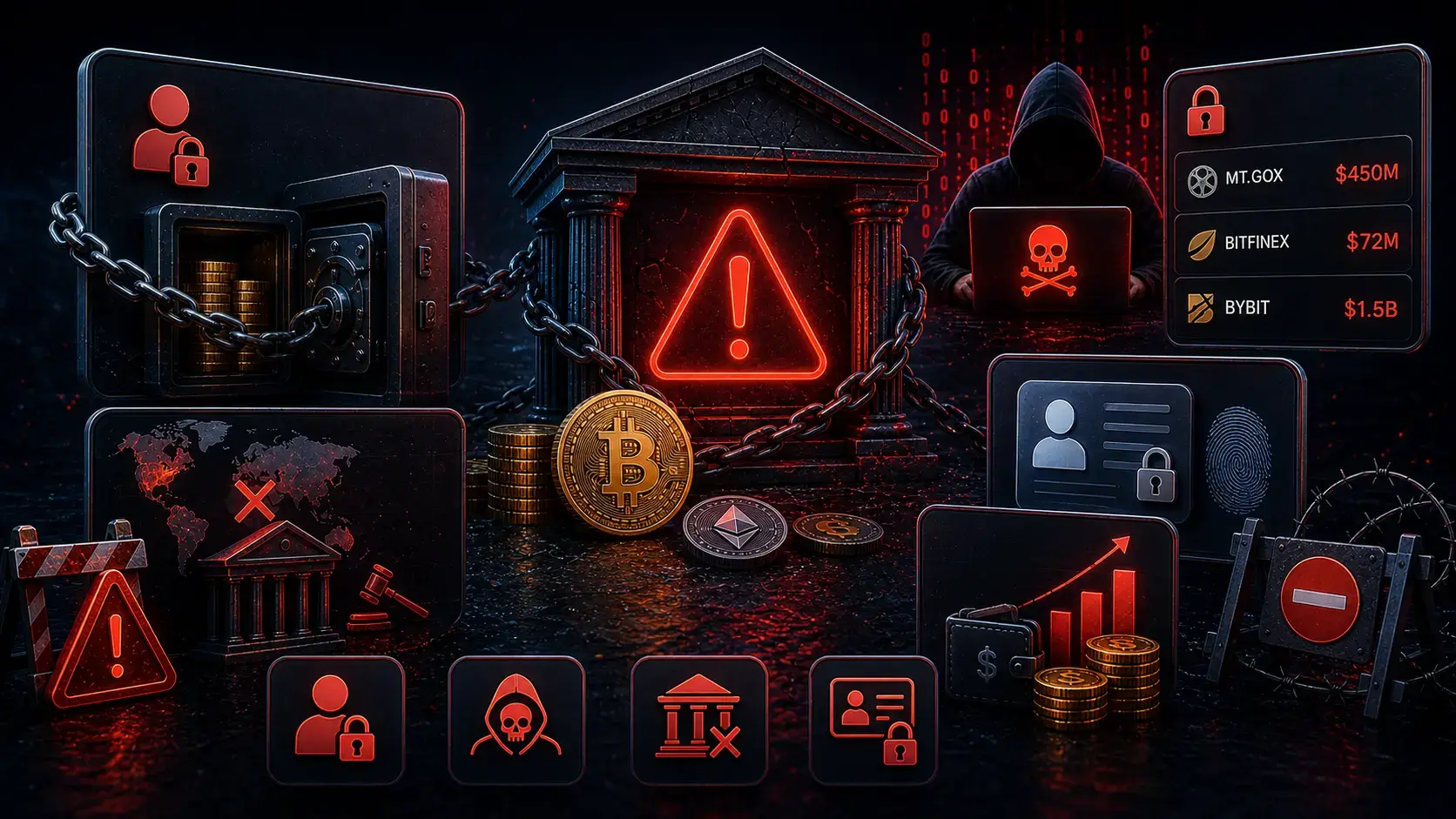
Third-party custody. You don’t control the keys — which means, technically, you don’t control the funds either. If the exchange freezes withdrawals (as happened with Celsius and FTX in 2022), access to assets can be blocked indefinitely or disappear entirely.
Hack risk. The history of major CEX breaches is well documented: Mt. Gox (2014, $450M), Bitfinex (2016, $72M), Bybit (2025, $1.5B). Major exchanges invest heavily in security, but absolute protection doesn’t exist.
Regulatory risk. An exchange can suspend operations in a given country due to regulatory requirements. Users in that jurisdiction lose access to their assets — sometimes without warning.
KYC requirements. Identity verification is standard on most CEXs. That means sharing personal data with the platform, which not every user is comfortable with.
Fees. CEXs earn on every trade. For active traders, accumulated fees over a year can add up to a substantial sum.
When to Use a CEX
A CEX is the right choice in several scenarios.
If you’re new to crypto and want to buy your first coins with fiat — a CEX will be the simplest path. The interface is familiar, support is available, and the purchase process takes minutes.
If you need high liquidity for large trades. On a DEX, a large order can move the price against you. On a CEX with a deep order book, that risk is significantly lower.
If you trade derivatives — futures, options, perpetual contracts. These instruments are available almost exclusively on CEXs.
If having access to support matters when something goes wrong with a transaction or account.
A DEX is preferable when you need full custody of your funds, access to tokens not yet listed on major platforms, or to avoid KYC procedures.
The Future of Centralized Exchanges
The industry’s paradox: crypto was built as a tool for decentralization, but most trading volume still runs through centralized platforms. The reason is simple — for most users, convenience matters more than ideology.
Regulatory pressure is increasing. Binance, Coinbase, and other major exchanges already operate under tightening requirements from the SEC, the EU, and Asian regulators. This will drive up compliance costs, but it will also bring greater user protection and institutional trust.
Hybrid models are gaining traction. Exchanges are exploring ways to combine CEX convenience with elements of self-custody. Proof-of-Reserves — a mechanism that publicly confirms a platform actually holds the assets it claims — has become a standard for many exchanges since the FTX collapse.
DEXs keep growing but haven’t displaced CEXs. Uniswap, dYdX, and other decentralized platforms attract experienced users. For fiat on-ramps, derivatives, and deep liquidity, however, CEX remains the preferred option. Both formats will likely coexist for a long time.
Key Takeaways
- A CEX (centralized exchange) is an intermediary platform that holds user funds, maintains an order book, and matches buyers with sellers.
- The main difference from DEX: on a CEX, you don’t control the private keys. Funds are held in exchange accounts.
- A CEX listing is the official addition of a token to the platform after a project review. Listing announcements typically push the token’s price up.
- CEX advantages: simple fiat entry, high liquidity, broad instrument selection, customer support.
- Main risks: third-party custody, hack exposure, regulatory restrictions.
- CEX is the optimal choice for beginners, large trades, and derivatives trading. DEX is preferable when full control of funds is the priority.
Expert Commentary
According to Cryptopedia by Gemini: “Centralized exchanges are online platforms used for buying and selling cryptocurrencies. They are the most common way to trade crypto and act as intermediaries between buyers and sellers. Centralized exchanges perform functions similar to traditional stock exchanges.”
The description is accurate, but it leaves out one important detail — the question of trust. When you store funds on a CEX, you’re trusting a company not to go bankrupt, not to get hacked, and not to block withdrawals. After the 2022 events with FTX and Celsius, that’s no longer an abstract risk — it’s a documented scenario. This is why experienced market participants recommend keeping on exchanges only the amount you can afford to lose in the worst case.
Conclusion
CEXs are mature infrastructure providing essential liquidity and market access. However, balancing their advantages with risk management is key: use 2FA, choose platforms with Proof-of-Reserves, and only keep active trading funds on-exchange.
Rather than competitors, CEX and DEX are complementary tools. When selecting a CEX, evaluate security history, fees, and regulatory status. Coinbase or Kraken are excellent for beginners, while Binance or OKX favor active traders with lower fees.
More Questions
A CEX is a centralized intermediary that manages user funds, order books, and trades. Unlike a DEX, the exchange controls the private keys rather than the user. Examples include Binance, Coinbase, and OKX.
CEXs hold your assets and keys, prioritizing convenience and liquidity. DEXs use smart contracts for direct wallet-to-wallet trading, ensuring full user control. Choose CEX for ease or DEX for self-custody.
CEX listing adds a token to an exchange’s tradable assets, moving it beyond DEXs. This official inclusion usually boosts the token’s price by increasing liquidity and reaching a wider audience.
Major exchanges use cold wallets and 2FA, yet hacks and bankruptcies remain a threat. To stay safe, trade only what’s necessary on-platform and move the rest to a private cold wallet.
Choose an exchange based on security, liquidity, fees, and regulation. Evaluate available tools like spot or staking. Coinbase/Kraken are best for beginners, while Binance/OKX offer active traders more features and lower costs.
Published Articles

Crypto On-Ramps and Off-Ramps Explained: How Fiat and Crypto Move In and Out
Entering the world of digital assets often feels like trying to cross...
 Popular
What is the Omniverse? Exploring the Ultimate Multiversal Concept
Introduction Do you know what the omniverse is? Is this concept real?...
 Popular
Bitcoin Pizza Guy: The Story Behind the First Real Bitcoin Purchase
Introduction The history of Bitcoin is full of dramatic ups and downs,...

Crypto Basics Explained: A Beginner’s Guide to Cryptocurrency and Trading
Introduction The world of finance is changing right before our eyes. Just...
 Popular
Uniswap Explained: What It Is, How It Works, and How to Use the UNI DEX
Introduction Decentralization and decentralized platforms that have emerged in recent years have...
 Popular
Bitcoin Lightning Network Explained: What It Is and How Bitcoin Lightning Works
Introduction In the world of cryptocurrency, transaction speed and costs have always...