
Crypto Leverage Trading Explained: How to Trade With Leverage Safely

Introduction
I’ve seen those screenshots on Twitter—the ones where someone turns a few hundred dollars into a small fortune overnight using 100x leverage. It looks like a magic trick, but in reality, it’s more like juggling chainsaws. If you’ve ever felt that itch to grow your portfolio faster than spot trading allows, you’re looking at leverage trading crypto, a method where you borrow funds from an exchange to open larger positions than your actual balance would permit.
The appeal is obvious: you can control $10,000 worth of Bitcoin with just $1,000 in your pocket. This multiplier effect is what we call leverage, and while it can make your gains explode, it does exactly the same to your losses. I’ve talked to plenty of traders who treated this like a casino, only to see their entire account vanish in a single market wick. It isn’t just about “betting” on price direction; it’s about understanding the mechanics of debt, collateral, and the ever-present threat of liquidation.
In this guide, I want to strip away the hype and the complex jargon. We’ll look at how this stuff actually works under the hood, from initial margin requirements to risk management strategies that might actually keep your capital alive. Whether you’re aiming for a modest 3x or eyeing the high-stakes world of perpetual futures, the goal is the same: stay in the game long enough to actually profit.
What Is Leverage in Crypto?
If I had to explain what is leverage in crypto to someone who has never touched a trading terminal, I would describe it as a way to trade with money you do not actually own. In the simplest terms, leverage trading crypto is the act of borrowing capital from an exchange to amplify your buying or selling power. You are not limited to the $100 in your wallet; instead, you use that $100 as collateral to control a much larger amount of an asset.
The multiplier you choose—be it 2x, 10x, or even 100x—determines how much your position is boosted. For example, if you use 5x leverage, every 1% move in the price of the coin results in a 5% change in your profit or loss. While this sounds like a fast track to wealth when the market moves in your favor, it is a sharp, double-edged sword. I have seen many people ignore the fact that the same multiplier applies to their losses, often leading to a total wipeout of their deposit.
How Crypto Leverage Trading Works
When you open a leveraged position, you are not actually buying the full amount of crypto with your own cash. Instead, the exchange lends you the bulk of the position. To get this loan, you provide initial margin, which is essentially a security deposit. Think of it like a house deposit—you pay a small percentage upfront, and the bank covers the rest. В crypto, the exchange keeps your collateral in a separate sub-account, and it stays locked as long as your trade is active.
The mechanics are tied to your equity. If you enter a 10x long position on Ethereum and the price goes up by 5%, your equity increases by 50%. The exchange is happy because your collateral is more than enough to cover the borrowed funds. But if the price drops by 10%, your entire initial margin is gone. This is where the concept of a liquidation price comes in. It is the specific price point where the exchange automatically closes your position to prevent them from losing their own money.
I have noticed that many beginners ignore the maintenance margin. This is the minimum amount of equity you must keep in your account to keep the trade alive. If the market gets volatile and your balance dips below this level, you get a margin call or face immediate liquidation. It is a cold, automated system that does not care about your “long-term vision” for the coin. If the numbers do not add up, the position is closed instantly.

Bitcoin Leverage Trading Explained
When we talk about bitcoin leverage trading, we are looking at the heavyweight champion of the market. Bitcoin is not just another coin; its massive liquidity and volume make it the primary choice for anyone wanting to use borrowed funds. I remember watching a 5% price swing in BTC that happened in under ten minutes. For a spot trader, that is a bad afternoon, but for someone on 20x leverage, it is a total liquidation of their position.
The mechanics here are fairly straightforward. Most exchanges allow you to trade Bitcoin with leverage ranging from 2x up to 125x. However, just because you can use 100x does not mean you should. I often compare high-leverage Bitcoin trades to trying to catch a falling knife while wearing oven mitts. You might get lucky, but the odds are heavily against you. Bitcoin price discovery is often driven by huge institutional moves and retail panic, creating “wicks” that can hunt your stop losses before the price even starts trending in your direction.
If you are serious about this, you need to understand that Bitcoin is often the “gold standard” for collateral. Many platforms use BTC as the base for their margin accounts. This means your buying power actually fluctuates with the price of Bitcoin itself. It is a layer of risk that many people miss: if your collateral is losing value while your trade is also underwater, you are essentially burning the candle at both ends.
How to Trade Crypto With Leverage (Step-by-Step)
If you are ready to move from theory to action, the process is actually quite mechanical. I remember the first time I tried this; I was terrified of clicking the wrong button and losing everything in a second. But once you strip away the flashy interfaces, every platform follows a similar flow. Here is how you actually get a trade off the ground without losing your mind.
First, you need to pick a platform and move your funds into a specific wallet. Most exchanges have a separate “Futures” or “Margin” account. You transfer your stablecoins or BTC there, and this becomes your collateral. This is the “skin in the game” that allows you to borrow the rest. I always suggest starting with a tiny amount—something you are genuinely okay with losing—just to see how the platform handles orders.
Next, you have to decide on the size of your leverage. Most sliders go up to 100x, but for the love of your bank account, stay away from those. I usually stick to 2x or 3x when I am testing a new strategy. Once the leverage is set, you choose between a “Limit” or “Market” order. A limit order is better if you have a specific price in mind and want to avoid high fees.
Finally, you open the position and—this is the part most people skip—you set your stop-loss. I cannot emphasize this enough: a trade without a stop-loss is just a countdown to liquidation. You are telling the system exactly where to cut your losses if the market proves you wrong. Once that is in place, you can actually step away from the screen without having a heart attack every time the price moves a dollar.
Types of Leverage in Crypto
When you actually sit down to open a trade, you have to decide how the exchange should handle your collateral. Most platforms offer two main settings: isolated margin and cross margin. I remember ignoring this choice when I first started, which was a massive mistake. Each setting changes your risk profile completely, and picking the wrong one is a fast way to lose more money than you intended.
With isolated margin, the risk is confined to a single trade. If you put $100 into a Bitcoin long, that $100 is the absolute most you can lose. It is like a firewall; even if that specific trade hits its liquidation price and vanishes, the rest of your account balance stays safe. I find this much easier for managing my stress levels, especially when I am trading volatile altcoins that can swing 20% in an hour.
On the flip side, cross margin uses your entire account balance to back up all your open positions. The idea is to give your trades more room to breathe. If one trade is losing money, it can “borrow” strength from the rest of your wallet to avoid liquidation. While this sounds helpful, it is incredibly dangerous. If the market crashes across the board, one bad position can act like a vacuum and suck your entire account dry. It is a tool for experienced pros who are juggling multiple hedges, not for someone just trying to catch a trend.
Advantages of Leverage Trading
I have always found that the biggest draw of this style of trading is how it lets you do more with less. Instead of waiting years to build a massive stack, you can use capital efficiency to control larger positions today. It is about opportunity cost. If I have $5,000, I could put it all into one spot trade. Or, I could use 2x leverage on $2,500 and keep the other half in stablecoins, ready to buy a dip or pay for an unexpected expense. It gives you a level of flexibility that simply does not exist in the spot market.
Then there is the obvious part: the profit. When the market is moving, leverage turns a boring 2% move into a 20% gain. For many, this is the only way to turn a small account into something significant. But beyond the greed, there is also the benefit of hedging. I sometimes use leverage to open a short position when I think my main portfolio might take a hit. It acts like an insurance policy; if the market crashes, the profit from my leveraged short helps cover the losses on my long-term holdings. You can see how platforms like Coinbase explain these strategic benefits for advanced users.
Risks of Crypto Leverage Trading
I have to be blunt here: if you use leverage, you are playing a game where the house is waiting for you to blink. The primary danger of leverage trading crypto is something called liquidation. This is the moment the exchange decides the trade is too risky for them to keep open. They close your position and take your collateral to cover the debt. It is not a polite request; it is an automated, cold process that happens in a millisecond. I have watched accounts vanish during a “flash crash” before the owner could even log in to their app.
Then there is the sheer speed of the market. Crypto is famous for its extreme volatility, where a single whale sell-order or a cryptic tweet can move the price by 10% in a heartbeat. When you are on 20x leverage, a tiny 5% move against you means your entire investment is gone. I often tell people that leverage does not just multiply your money; it multiplies your stress. You stop looking at charts for trends and start staring at them out of pure fear.
Finally, there is the funding fee. People forget that borrowing money is never free. On many platforms, you pay a small fee every eight hours just to keep your position open. If the market goes sideways and stays there, these fees slowly eat away at your capital. It is a slow bleed that many beginners do not account for until they see their balance shrinking for no apparent reason.
Leverage Trading vs Spot Trading
The easiest way to think about the difference between these two is ownership. When you engage in spot trading, you are buying the actual coins. If you buy one Bitcoin today, you own that Bitcoin. You can move it to a cold wallet, let it sit for ten years, or use it to buy a coffee. The only way you lose money is if the price drops, but even then, you still have the same amount of BTC. It is the classic “buy and hold” strategy that most long-term investors prefer because it is relatively low-stress.
Leverage trading crypto, on the other hand, is not about ownership at all. You are essentially betting on price movements using borrowed money. You never actually “hold” the asset in the traditional sense; you just hold a contract that says you will profit or lose based on the price. I like to say that spot trading is like buying a car, while leverage is like betting on a drag race using a car you rented with a high-interest loan. In spot, you can survive a 50% market crash if you have the patience. In a leveraged position, that same crash would have wiped you out long before the bottom.
Risk Management Strategies
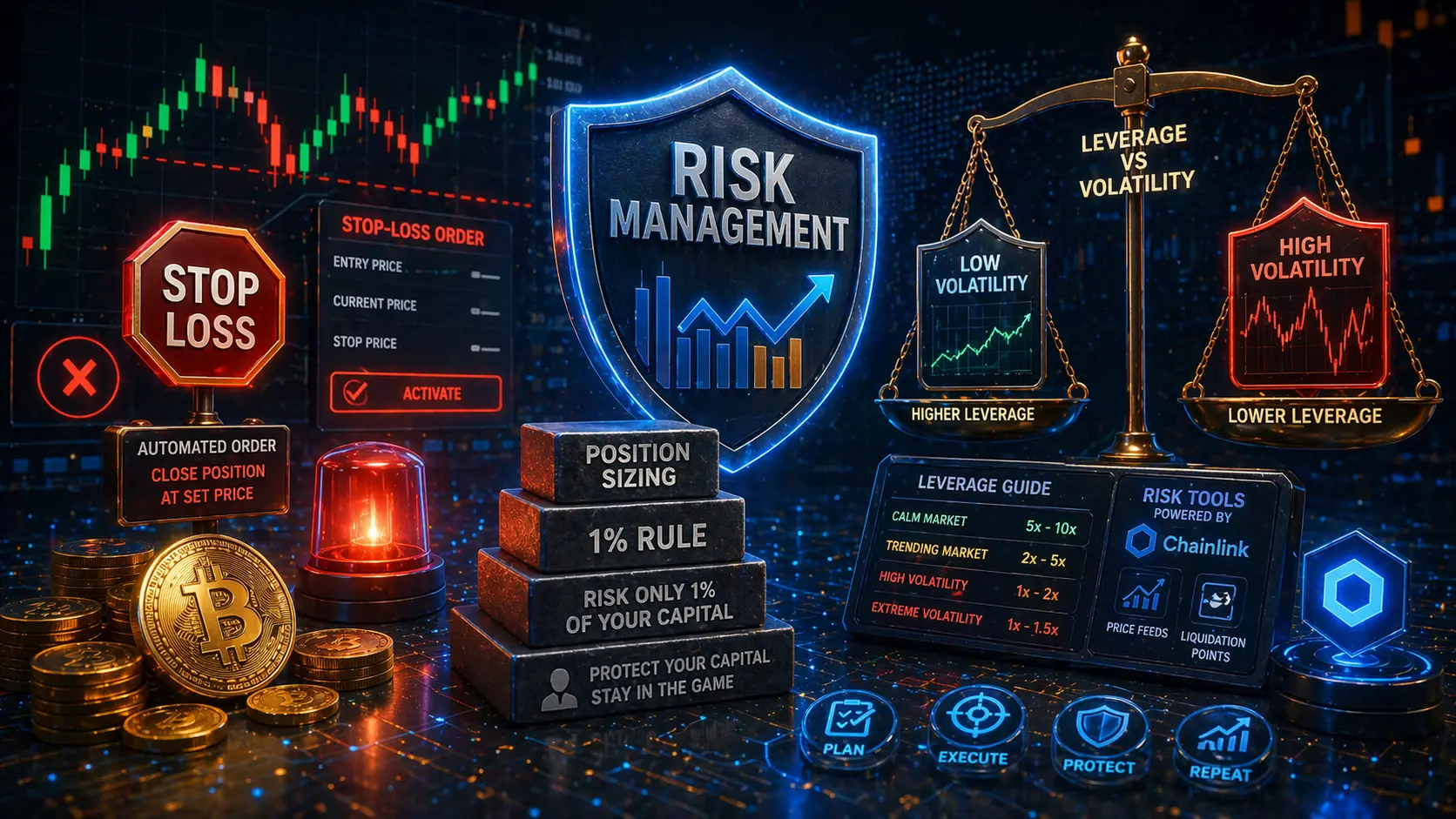
If you want to survive more than a week in this market, you have to accept that you will be wrong. A lot. The difference between a professional and a gambler is how they handle being wrong. I’ve found that the most effective tool in any trader’s kit is the stop-loss. This is an automated order that closes your position once it hits a certain price, preventing a bad trade from turning into a total catastrophe. I never open a position without one. If I’m not willing to define where I’m wrong before I enter, I shouldn’t be in the trade at all.
Another rule I live by is position sizing. You should never put your entire account into a single leveraged trade. Most experienced traders follow the “1% rule,” meaning they never risk more than 1% of their total capital on any single setup. For example, if you have $10,000, you only allow yourself to lose $100 on a trade. This way, even a string of ten losses won’t blow your account. It keeps your head clear and prevents the panic that leads to revenge trading, which is when you try to “win back” losses by taking even bigger risks.
Finally, you need to understand that your leverage should be inverse to the market’s volatility. When market volatility increases, it’s wise to lower your leverage. There is no shame in using 2x or even 1.5x when things get wild. High leverage is for calm markets with clear trends, not for the chaos of a major breakout or crash.
Best Practices for Beginners
If you are just starting your journey with leverage trading crypto, my first piece of advice is simple: stay humble. The market has a way of punishing overconfidence very quickly. I often see people jumping straight into 50x trades because they had a lucky streak on the spot market. That is a recipe for disaster. Instead, start with the smallest possible amount—money you would literally be okay with losing. This lets you learn the mechanics of the interface without your hands shaking every time a candle turns red.
Another practice I swear by is sticking to major assets like Bitcoin or Ethereum. These coins have high liquidity, meaning they are less likely to experience the extreme price gaps that can result in significant losses for altcoin traders in seconds. Also, keep a journal. Write down why you entered a trade and where you plan to exit. It sounds tedious, but it is the only way to stop making the same expensive mistakes over and over. If you find yourself checking your phone every two minutes, your position is too big. Scale back until you can actually sleep at night.
Regulation of Leverage Trading
The rules for leverage trading crypto are a mess of different laws that change every time you cross a border. I have noticed that regulators are becoming increasingly nervous about how easy it is for retail investors to access high leverage. In the United States, for instance, the CFTC keeps a very tight leash on things. Most US-based traders are restricted to much lower leverage compared to what you might find on offshore platforms. It is their way of trying to prevent mass liquidations that could rattle the broader financial system.
If you look at the UK, the FCA took an even harder stance a few years ago by banning the sale of crypto derivatives to retail users entirely. They argued that these products are too complex and volatile for the average person to handle. On the other hand, regions like Southeast Asia or certain Caribbean islands are far more relaxed, which is why many of the biggest exchanges are registered there. I always tell people to check their local laws before they start. Trading on a platform that is banned in your country might seem fine until you try to withdraw your money and find your account frozen.
Key Takeaways
- Leverage is a mechanism that lets you control a large position using a small amount of your own capital as collateral.
- The primary risk is liquidation, which happens when the market moves against you and the exchange closes your position to cover the debt.
- Using a stop-loss is the only way to ensure a single bad trade does not wipe out your entire account balance.
- Isolated margin is generally safer for beginners because it limits the risk to a specific trade rather than your whole wallet.
- Successful trading is more about risk management and keeping a level head than it is about finding a “perfect” entry or exit.
Conclusion
I will be honest—leverage trading is not for everyone. It is a high-stakes environment where the line between a brilliant strategy and a total loss is razor-thin. I have spent years watching these markets, and the traders who actually last are the ones who treat leverage as a surgical tool, not a lottery ticket. It is about understanding that you do not need 100x gains today if you want to be in this game ten years from now. Keeping your ego in check is just as important as knowing how to read a candle chart.
If you decide to dive in, start slow and stay disciplined. Focus on capital preservation above everything else. Use the tools available, like stop-losses and isolated margin, to keep the odds from stacking too heavily against you. The crypto world moves fast, and it is easy to get swept up in the noise of people posting massive gains on social media. Но at the end of the day, the only profit that matters is the one you actually get to keep in your wallet. Treat the exchange like a partner that requires constant supervision, and you might just find a way to make the numbers work in your favor.
FAQ
Is leverage trading crypto legal?
Yes, it is legal in many parts of the world, but the rules are not the same everywhere. For instance, the UK’s FCA has completely banned these products for retail investors because they consider them too risky. You should always check your local regulations before signing up for a platform. Trading on an exchange that is not authorized in your region is a fast way to get your account frozen or lose access to your funds.
Can I lose more money than I deposited?
On most modern exchanges, the answer is no. They have a built-in safety net called a liquidation system. If a trade goes against you, the exchange will close your position before your balance hits zero to make sure they get their borrowed money back. However, you need to be careful with cross margin. In that mode, one bad trade can suck the money out of your entire account balance to keep itself alive, potentially leaving you with nothing.
What is the best leverage for a beginner?
If you are just starting, my honest advice is to stay at 1x or 2x. There is no reason to go higher until you have a proven strategy and can control your emotions. High leverage is not a shortcut to wealth; it is a shortcut to an empty wallet. I have seen too many people try 10x or 20x right away, only to be wiped out by a tiny market wobble that would not have even bothered a spot trader.
Published Articles

Crypto On-Ramps and Off-Ramps Explained: How Fiat and Crypto Move In and Out
Entering the world of digital assets often feels like trying to cross...
 Popular
Bitcoin Pizza Guy: The Story Behind the First Real Bitcoin Purchase
Introduction The history of Bitcoin is full of dramatic ups and downs,...

Crypto Basics Explained: A Beginner’s Guide to Cryptocurrency and Trading
Introduction The world of finance is changing right before our eyes. Just...
 Popular
Uniswap Explained: What It Is, How It Works, and How to Use the UNI DEX
Introduction Decentralization and decentralized platforms that have emerged in recent years have...
 Popular
Bitcoin Lightning Network Explained: What It Is and How Bitcoin Lightning Works
Introduction In the world of cryptocurrency, transaction speed and costs have always...

How Bitcoin ATMs Work: A Complete Guide to Using Crypto ATMs
Introduction Millions of people around the world use cryptocurrencies today – at...