
Dogecoin Mining: How to Start, Best Hardware, and Profitability Tips
How Does Dogecoin Mining Work?
Dogecoin uses a proof-of-work consensus mechanism based on the Scrypt hashing algorithm — the same algorithm as Litecoin. This matters practically: a dogecoin miner can simultaneously mine both DOGE and LTC through merge mining, a feature introduced in 2014 that lets miners earn rewards on two chains without splitting their computational work.
When a doge coin miner submits a valid proof-of-work, they get to add the next block to the Dogecoin blockchain and collect the block reward — currently 10,000 DOGE per block, unchanged since Dogecoin removed its halving schedule in 2015. Blocks are produced approximately every minute, which means the network distributes around 14.4 million DOGE daily in block rewards.
Because Dogecoin has no supply cap, the issuance continues indefinitely. This contrasts sharply with Bitcoin, where the fixed 21 million cap and halving schedule create deflationary pressure. For miners, the steady emission means block rewards don’t shrink over time — but it also means inflation is a structural feature, not a bug, of the Dogecoin economic model.
Dogecoin Mining Methods
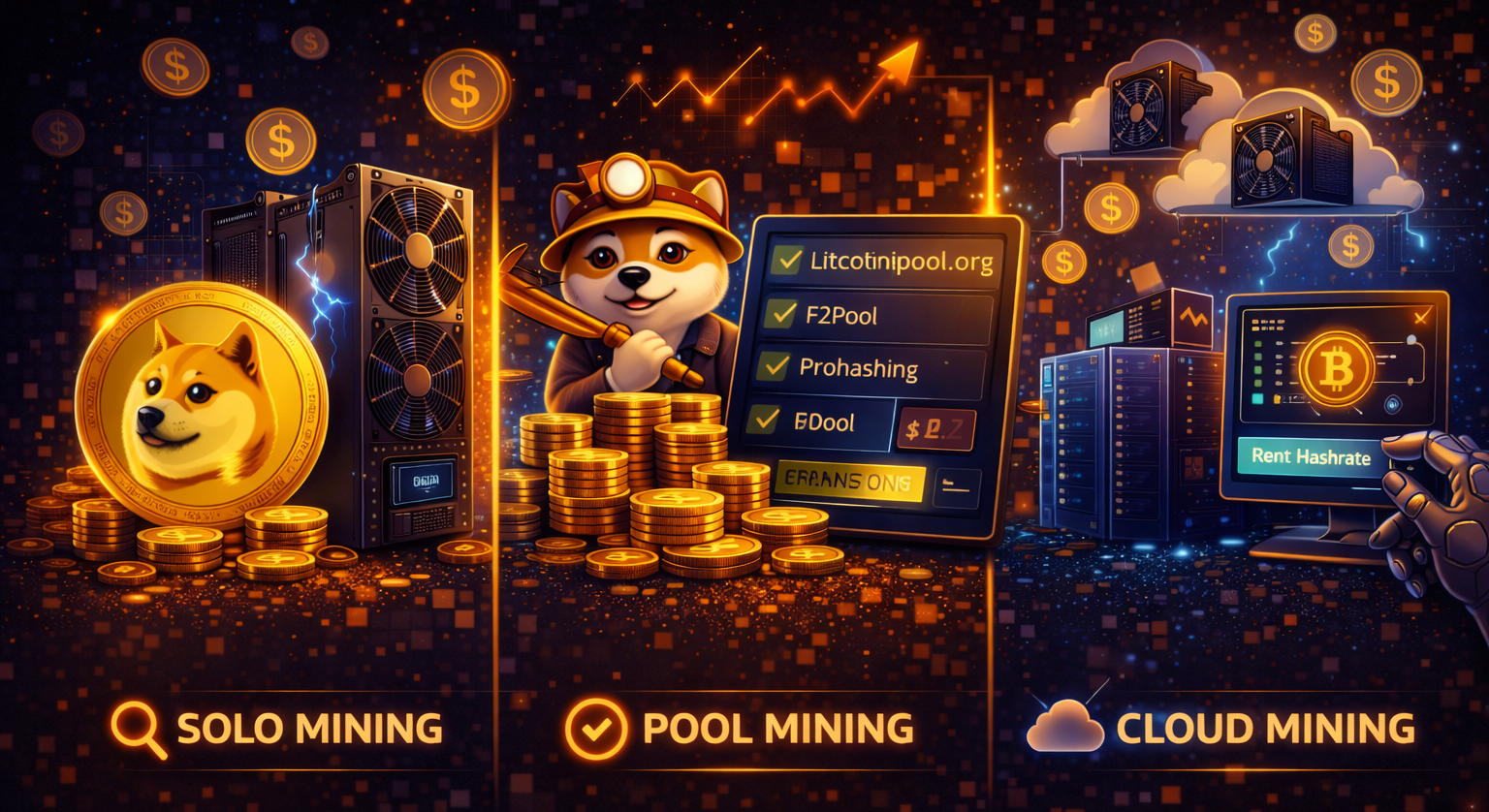
Solo Mining
Solo mining means your dogecoin mining rig competes directly with the entire network for each block. When you find a block, you collect the full 10,000 DOGE reward. The problem: with network hashrate measured in hundreds of terahashes per second, a single miner’s probability of finding a block is statistically negligible. Solo mining is viable only if you operate a significant ASIC fleet, and even then, variance means weeks or months can pass between rewards.
Pool Mining
Pool mining combines the hashrate of many miners, dramatically increasing how often the pool finds blocks. Rewards are split proportionally to each miner’s contribution. The best dogecoin mining pool options in 2026 include Litecoinpool.org (which handles merge mining automatically, paying out in both DOGE and LTC), F2Pool, AntPool, ViaBTC, and Prohashing. Each uses slightly different payout structures — PPS (pay per share) gives predictable payouts regardless of luck; PPLNS (pay per last N shares) ties your earnings more closely to pool performance.
For most dogecoin miners operating one to a few ASICs, pool mining is the default choice. The variance reduction is worth the pool’s fee, typically 0.5–2% of earnings.
Cloud Mining
Cloud mining lets you rent hashrate from a remote facility without owning physical hardware. You pay a contract fee and receive mining payouts without managing equipment, electricity, or cooling. The appeal is clear; the catch is equally clear: cloud mining contracts often perform poorly compared to owning hardware outright, and the space has a documented history of fraudulent operators. If cloud mining interests you, stick to established providers with transparent hashrate tracking and avoid any contract promising guaranteed returns.
What You Need to Start Mining Dogecoin
Hardware Requirements
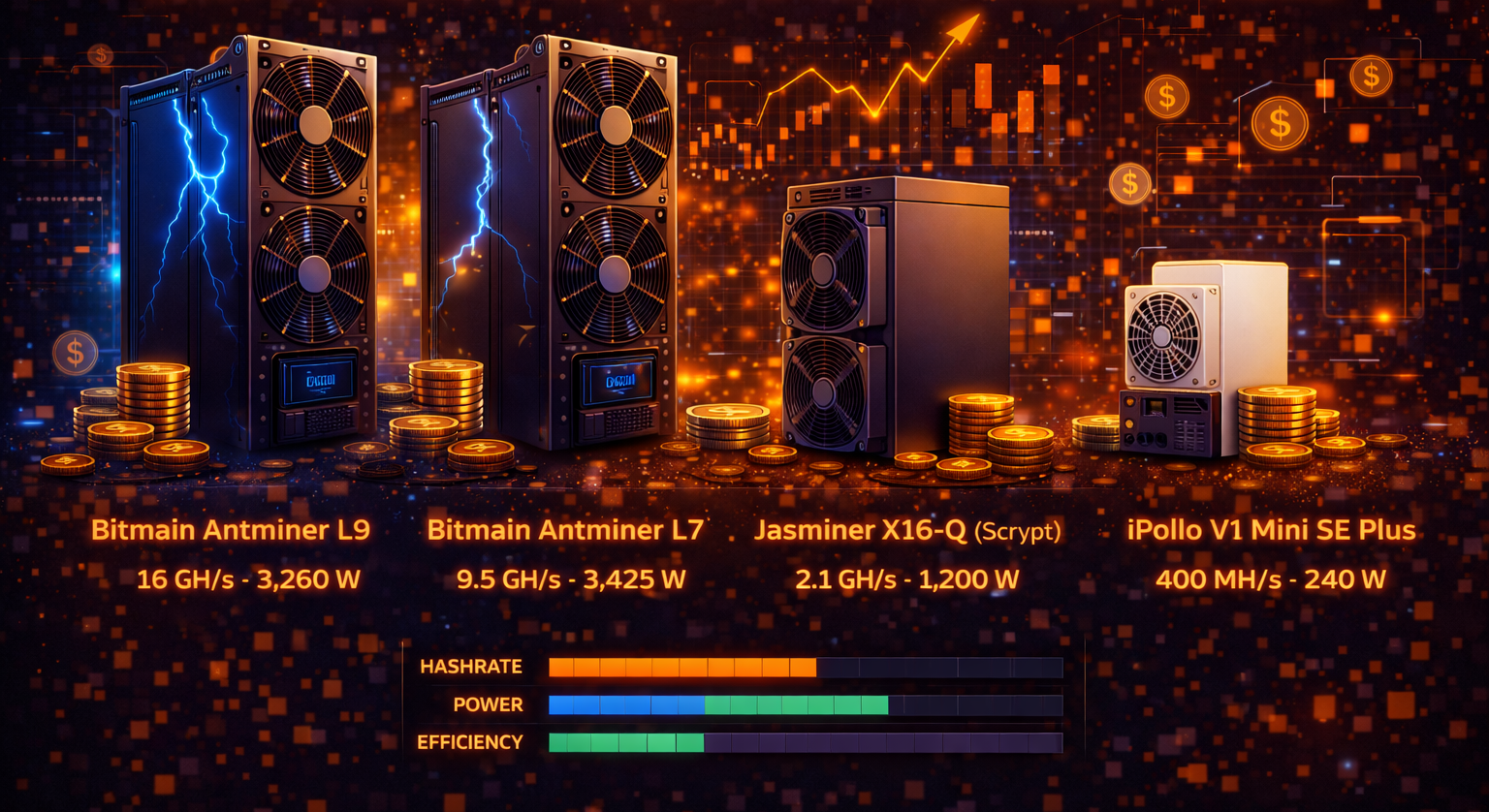
Dogecoin mining in 2026 is exclusively ASIC territory. GPU mining was competitive during Dogecoin’s early years, but ASIC efficiency has since made GPU mining economically unviable — the hash rates simply don’t compete. A dogecoin mining rig today means at minimum one Scrypt ASIC miner. Entry-level options like the iPollo V1 Mini SE Plus produce around 400 MH/s at 240W; top-tier machines like the Antminer L9 push 16 GH/s at 3,260W.
Beyond the ASIC unit itself, you need proper power supply units (PSUs) rated for the miner’s wattage, Ethernet connectivity (most modern ASICs don’t support WiFi), and mounting infrastructure. Many professional dogecoin mining rigs use custom shelving or rack systems to stack multiple units efficiently.
Software Requirements
Dogecoin miner software handles communication between your hardware and the mining pool. For ASIC miners, pool configuration typically happens through a web interface built into the miner’s firmware — you input the pool’s stratum URL, your wallet address, and a worker name. You don’t need to install separate dogecoin mining software for most ASICs.
For monitoring and management, tools like Awesome Miner and mining pool dashboards let you track hashrate, temperature, and earnings across multiple machines. If you’re running a fleet, remote management software becomes essential for identifying hardware issues without physical inspection.
Electricity Needs
Electricity is the dominant variable in dogecoin mining profitability. An Antminer L9 draws 3,260W continuously. Running one unit 24/7 consumes about 78 kWh per day, or roughly 2,350 kWh per month. At $0.10/kWh that’s $235/month in electricity per machine; at $0.05/kWh it drops to $117. The difference between these rates can be the difference between profitable and unprofitable mining at any given DOGE price.
Miners with access to cheap electricity — industrial rates, renewable energy credits, stranded natural gas — have a structural cost advantage that no hardware upgrade can compensate for. Before purchasing any dogecoin ASIC miner, calculate your all-in electricity cost, including any demand charges or power factor penalties.
Cooling Needs
ASIC miners generate substantial heat. A single L9 exhausts roughly 3,260W of heat into its environment — equivalent to running 32 standard 100W incandescent bulbs. Industrial ASIC deployments use forced air cooling (dedicated intake and exhaust fans creating a hot/cold aisle system), evaporative cooling in dry climates, or immersion cooling where miners are submerged in dielectric fluid for maximum thermal efficiency.
Home miners running one or two units typically route exhaust air outside during winter or use portable air conditioning units during summer. Ambient operating temperature matters: most ASIC miners are rated for 5–40°C inlet air. Exceeding this range reduces efficiency, triggers thermal throttling, and shortens hardware lifespan.
Best Dogecoin Mining Hardware in 2026
Top ASIC Miners for Dogecoin
The dogecoin ASIC miner market is dominated by Bitmain’s Antminer L-series, with competition from Goldshell and Jasminer. Below is the current landscape of viable hardware for mining doge.
Key Features
When evaluating a dogecoin miner, three numbers matter most: hashrate (measured in MH/s or GH/s), power consumption (watts), and efficiency (joules per gigahash, J/GH). Lower J/GH is better — it means more hash per watt. Price per GH is also useful for comparing acquisition cost efficiency across machines at different price points.
ASIC Miners for Dogecoin
The Bitmain Antminer L9 leads the pack in 2026. Launched in late 2023 and available in volume through 2024–2026, it delivers 16 GH/s at 3,260W, making it the highest-hashrate Scrypt ASIC currently produced. The Antminer L7, its predecessor, remains widely deployed at 9.5 GH/s and 3,425W — less efficient but cheaper on the secondary market. The Goldshell LT6 at 3.35 GH/s represents mid-tier efficiency. For home miners with limited power capacity, the iPollo V1 Mini SE Plus at 400 MH/s and 240W is among the few options that fit within a standard 15A circuit.
Comparison of Top ASIC Miners
| Miner | Hashrate | Power | Efficiency | Approx. Price (2026) |
| Bitmain Antminer L9 | 16 GH/s | 3,260 W | ~204 J/GH | $3,800–$5,200 |
| Bitmain Antminer L7 | 9.5 GH/s | 3,425 W | ~360 J/GH | $1,800–$2,800 |
| Goldshell LT6 | 3.35 GH/s | 3,200 W | ~955 J/GH | $600–$900 |
| iPollo V1 Mini SE Plus | 400 MH/s | 240 W | ~600 J/GH | $180–$280 |
| Jasminer X16-Q (Scrypt) | 2.1 GH/s | 1,200 W | ~571 J/GH | $1,100–$1,500 |
Note: Prices fluctuate with DOGE market conditions and hardware availability. Secondary market prices for older machines like the L7 can dip significantly during bear markets. The L9 commands a premium reflecting its efficiency advantage.
Dogecoin Mining Profitability in 2026
Key Factors Impacting Profitability
Is mining dogecoin profitable? The answer depends on four variables moving simultaneously: DOGE price, network difficulty (which reflects total hashrate), your electricity cost, and hardware efficiency. No single factor determines the outcome — all four interact.
Network difficulty adjusts based on total mining activity. When more hashrate enters the network (new ASICs, miners switching from other Scrypt coins), difficulty rises and each miner’s proportional share of rewards falls. When hashrate exits, difficulty drops. In 2024–2025, Scrypt hashrate grew significantly as the L9 ramped up production and DOGE price appreciation attracted new miners. Difficulty increases since 2024 have squeezed margins for less efficient hardware.
DOGE price is the wildcard. Dogecoin reached an all-time high of $0.74 in May 2021 and traded in the $0.10–$0.20 range through much of 2024–2025. At $0.15/DOGE, the 10,000 DOGE block reward is worth $1,500. At $0.30/DOGE, the same block is worth $3,000. Price movements of this magnitude dwarf electricity cost differences between miners.
Calculating Profitability
Use a mining calculator (WhatToMine, CoinWarz, or NiceHash) with your specific hardware’s hashrate and power consumption, your electricity rate, and current network difficulty and DOGE price. The output shows estimated daily earnings before and after electricity costs.
A rough calculation for an Antminer L9 at current 2026 difficulty levels: at $0.08/kWh electricity and DOGE at $0.20, an L9 generating approximately 16 GH/s earns roughly $8–$12/day in DOGE before electricity costs of about $6.27/day, yielding a margin of $1.73–$5.73/day. These numbers shift substantially with DOGE price — at $0.10/DOGE the same machine may operate near breakeven or at a small loss.
Profitability at Different Electricity Rates
- $0.04/kWh — Highly profitable even for older hardware like the L7. Mining at this rate is competitive in most market conditions and represents the electricity cost available to large industrial operators, subsidized energy zones, and some renewable energy setups.
- $0.06–$0.08/kWh — The L9 operates profitably at current DOGE prices; older machines like the L7 approach breakeven. Most commercial mining operations in low-cost regions fall here.
- $0.10–$0.12/kWh — Marginal profitability for efficient hardware at current DOGE prices. Breakeven or slight losses for less efficient machines. This is the typical range for residential electricity in many US states and European countries.
- Above $0.15/kWh — Unprofitable for most dogecoin mining rigs at current prices. Mining at these rates only makes sense if DOGE price appreciates significantly, which cannot be predicted reliably.
Is Dogecoin Mining Worth It?
Pros of Dogecoin Mining
- Merge mining with Litecoin — every major dogecoin mining pool supports merge mining. Your L9 or L7 earns both DOGE and LTC simultaneously at no extra power cost. This dual revenue stream meaningfully improves the economics compared to single-coin mining.
- Fixed block reward — the 10,000 DOGE reward doesn’t halve. Bitcoin miners face reward cuts every four years; Dogecoin miners don’t. This makes Dogecoin mining revenue more predictable in nominal terms.
- Active development and community — Dogecoin has maintained relevance well beyond its meme origins. Elon Musk’s continued public support, X integration experiments, and active developer community keep DOGE in circulation and trading at meaningful volumes.
- Established infrastructure — Dogecoin is a mature chain with years of mining pool history, reliable node infrastructure, and wide exchange support. Operational risk from protocol or network failure is low.
Cons of Dogecoin Mining
- Unlimited supply creates structural inflation — 14.4 million new DOGE per day is issued indefinitely. Unlike Bitcoin, there’s no supply cap. This means DOGE price appreciation requires continuous demand growth to offset inflation.
- Hardware capital costs are high — a single L9 costs $4,000–$5,000 new. At thin margins, payback periods extend to 12–24+ months, during which price, difficulty, and hardware condition all create uncertainty.
- Electricity dominates margins — small changes in electricity rate flip profitability. Users without access to below-market electricity face consistent pressure on returns.
- ASIC market concentration — Bitmain dominates Scrypt ASIC production. Supply constraints, price manipulation, and long lead times for new hardware are recurring issues that individual miners can’t control.
Tips for Maximizing Dogecoin Mining Efficiency
Practical Tips for Enhanced Efficiency
- Enable merge mining from day one — configure your dogecoin mining pool to pay out both DOGE and LTC. Litecoinpool.org handles this automatically. Don’t leave LTC revenue on the table.
- Monitor hashrate and chip health continuously — dead or underperforming chips reduce your effective hashrate without reducing your power draw. Tools like Awesome Miner or your ASIC’s built-in dashboard show per-chip performance. Replace or RMA faulty hardware promptly.
- Optimize pool fee vs payout structure — PPS pools (like F2Pool) charge higher fees but guarantee steady payouts regardless of pool luck. PPLNS pools (like Litecoinpool) have lower fees but tie your earnings to the pool’s block-finding rate. For small miners, PPS reduces variance at a modest cost.
- Time major purchases around difficulty drops — when DOGE price falls and less efficient miners exit, network difficulty drops, improving margins for remaining miners. Buying hardware during these periods means lower hardware prices and better initial profitability ratios.
- Overclock carefully or underclock for efficiency — many ASIC miners can be underclocked to run at lower hashrate and lower power draw, improving J/GH efficiency. At high electricity costs, underclocking can improve profitability by reducing the power bill faster than it reduces income.
- Use time-of-use electricity rates strategically — if your utility offers off-peak pricing, scheduling maximum load during cheaper hours improves margins. Some miners run additional hardware only during off-peak windows.
- Factor in resale value — ASIC miners retain some value even when unprofitable to operate. The L9 has shown strong secondary market demand. If you exit mining during a downturn, hardware resale partially offsets losses.
Conclusion: Future of Dogecoin Mining
Dogecoin mining in 2026 is a mature, ASIC-dominated activity where efficiency and electricity cost determine outcomes more than any other variable. The hardware landscape has consolidated around Bitmain’s L-series, with the Antminer L9 setting the efficiency benchmark. Merge mining with Litecoin remains the most important profitability enhancer available to any dogecoin miner.
The outlook is shaped by DOGE price uncertainty, continued difficulty growth as efficient ASICs proliferate, and the potential for new Scrypt hardware releases that could shift the efficiency frontier. Dogecoin’s position in the broader crypto ecosystem — kept relevant by strong community support, mainstream recognition, and ongoing development — means the network isn’t going away. But whether mining it profitably is accessible to any individual miner depends almost entirely on that miner’s electricity cost.
For anyone evaluating entry in 2026: run the numbers honestly with your actual electricity rate, current DOGE price, and realistic hardware cost. If the margin is there, the infrastructure is mature enough to support it. If it isn’t, cloud mining or simply buying DOGE carries less operational overhead.
Published Articles
Crypto On-Ramps and Off-Ramps Explained: How Fiat and Crypto Move In and Out
Entering the world of digital assets often feels like trying to cross...
 Popular
Bitcoin Pizza Guy: The Story Behind the First Real Bitcoin Purchase
Introduction The history of Bitcoin is full of dramatic ups and downs,...

Crypto Basics Explained: A Beginner’s Guide to Cryptocurrency and Trading
Introduction The world of finance is changing right before our eyes. Just...
 Popular
Uniswap Explained: What It Is, How It Works, and How to Use the UNI DEX
Introduction Decentralization and decentralized platforms that have emerged in recent years have...
 Popular
Bitcoin Lightning Network Explained: What It Is and How Bitcoin Lightning Works
Introduction In the world of cryptocurrency, transaction speed and costs have always...
How Bitcoin ATMs Work: A Complete Guide to Using Crypto ATMs
Introduction Millions of people around the world use cryptocurrencies today – at...