
EVM Explained: What the Ethereum Virtual Machine Is and Why It Matters in Crypto
Introduction
When we talk about cryptocurrencies, most people immediately think of price charts or Bitcoin. But if you look under Ethereum’s hood, you’ll find something much more complex than just a digital ledger for sending coins. At the center of this ecosystem lies the Ethereum Virtual Machine (EVM) — a global virtual computer that literally breathes life into smart contracts and decentralized applications.
I often hear newcomers confuse the blockchain with the virtual machine. Let’s clear this up: if the blockchain is a hard drive storing transaction history, then the EVM is the processor that handles those transactions. Without it, Ethereum would be just another payment system. It’s because of this technology that we have DeFi, NFTs, and the ability to program money however we like.
What Is the Ethereum Virtual Machine (EVM)?
EVM Definition and Meaning
At its core, the ethereum virtual machine is a software environment running on thousands of computers (nodes) worldwide. Every node in the Ethereum network runs an instance of the EVM to maintain consensus on what is happening in the network at any given moment.
This is what developers call a “state machine.” At any point in time, Ethereum exists in a specific “state”: someone owns tokens, a contract code is running somewhere. When a transaction occurs, the EVM changes that state. Crucially, this process is entirely deterministic: if you run the same code on two different computers in the network, the result will be identical.

What Is EVM in Crypto Context
In the context of evm crypto, we are talking about a universal standard. Think of it as an operating system, like Windows or Android, but for the decentralized internet. It allows developers to write code once and be certain it will work everywhere that supports this standard.
When we discuss an evm blockchain, we mean a network that speaks Ethereum’s language. This opened the doors for hundreds of other projects that chose to use this ready-made and battle-tested architecture for their own needs instead of reinventing the wheel.
Why the Ethereum Virtual Machine Exists
Before Ethereum, creating a new blockchain with unique features required writing code from scratch. It was slow, expensive, and often unsafe. The EVM was created to solve this problem once and for all.
The EVM exists to:
- Ensure code isolation. If there’s a bug in one smart contract, it won’t crash the rest of the network.
- Unify development. Programmers don’t need to worry about what hardware a node is running; they write code for the virtual environment.
- Make the network programmable. This turned the blockchain from a simple wallet into a full-fledged application platform.
How the EVM Works
To understand how the ethereum virtual machine explained actually functions, think of it as a massive, distributed calculator. Unlike a traditional computer that stores data locally, this machine is spread across thousands of nodes.
I often compare this to playing chess by mail. Every player has an identical board and set of pieces at home. When one person makes a move, everyone else must replicate that move on their own board to ensure the game state remains the same for everyone. In the evm crypto world, miners or validators handle this constant synchronization.
Smart Contract Execution Explained
When a developer builds an app, they write code in a high-level language, usually Solidity. However, the ethereum virtual machine doesn’t understand human words or complex Solidity commands directly.
The workflow is straightforward:
- A programmer writes the code.
- A compiler translates it into a simplified format.
- This simplified code is uploaded to the blockchain.
- The EVM reads these instructions and executes them one by one.
This setup ensures that the rules of the game don’t change mid-way. If a contract says “send 10 coins,” the machine simply does it without second-guessing or allowing for disputes.
Bytecode, Opcodes, and Gas
This is where we get into the technical “kitchen.” What the machine ultimately understands is called bytecode — a long string of numbers and letters. Tucked inside this code are opcodes — basic commands like “add,” “store,” or “subtract.”
There is a catch, though: computer resources aren’t free. To prevent someone from running an infinite loop and crashing the entire network, Ethereum introduced the concept of gas.
- Every operation (opcode) has a specific price in gas.
- Adding numbers is cheap; storing data in memory is expensive.
- The user pays for this gas to get their transaction processed.
I find this to be a brilliant defense mechanism. It’s not just a service fee; it’s a way to make spam or network attacks economically unfeasible.
Deterministic Execution Across Nodes
You might wonder how thousands of nodes across the globe arrive at the exact same result. This is due to deterministic execution.
On a regular PC, a program’s outcome can be affected by random factors like system time, available RAM, or even background tasks. In what is the ethereum virtual machine, things are different. It has no direct access to the “outside world.” It only sees data within the blockchain. This ensures that the calculation results are always identical, regardless of where the computer is located.
EVM and Ethereum
Many people think Ethereum is just about the Ether cryptocurrency, but that’s only the tip of the iceberg. In reality, Ethereum is a massive, distributed operating system, and the ethereum virtual machine is its “brain.” If you took the EVM away, the network would turn into a simple list of transactions, much like the early days of Bitcoin.
I see it this way: Ethereum provides the infrastructure, but the virtual machine decides what to do with it. When you swap tokens on Uniswap or buy an NFT, you aren’t interacting with the blockchain directly; you are interacting with code that the EVM executes. It is the environment where all smart contracts live. This makes evm ethereum the gold standard for decentralized computing that almost every new project looks up to today.
What is an EVM-compatible blockchain?
Over the last few years, plenty of other networks have popped up — Polygon, BNB Chain, and Avalanche, to name a few. These are called evm blockchain or EVM-compatible networks. What does that mean in plain English? Think of a USB-C charger. It fits any phone with that port, regardless of the brand.
So, what is an evm chain? It’s a blockchain that uses the same rules and data formats as Ethereum. For users, this is a huge win: you can use the same wallet (like MetaMask) and the same address across different networks. For developers, it’s even more vital — they can just copy their code from Ethereum and launch it on another chain in minutes.
Why EVM matters in crypto and Web3
The EVM has become something like the English language of the tech world: almost everyone speaks it. Its importance is hard to overstate, and here is why I believe it’s the foundation of the modern web.
Interoperability and developer adoption
Programmers are efficiently lazy. No one wants to learn a complicated new programming language for every single network. Since most tools are built for evm crypto, developers find it easier to stay within this ecosystem. If the code works on Ethereum, it will work elsewhere. This creates a massive library of ready-made solutions that anyone can pick up and use.
EVM in DeFi, NFTs, and DAOs
The entire explosion of decentralized finance and NFTs happened because of this virtual machine. It allowed for the creation of complex financial tools that run automatically. Without the evm meaning as a standard, we’d still be swapping tokens only through centralized exchanges. Almost every major DeFi protocol — from Aave to Curve — relies on the EVM architecture.
Network effects and ecosystem growth
The more people use the EVM standard, the stronger it gets. It’s a self-sustaining cycle. New networks strive to be EVM-compatible just to get immediate access to the army of users and developers. Ultimately, what is evm today is more than just technology; it’s an entire economic zone where capital and ideas move freely between blockchains.
EVM vs Non-EVM Blockchains
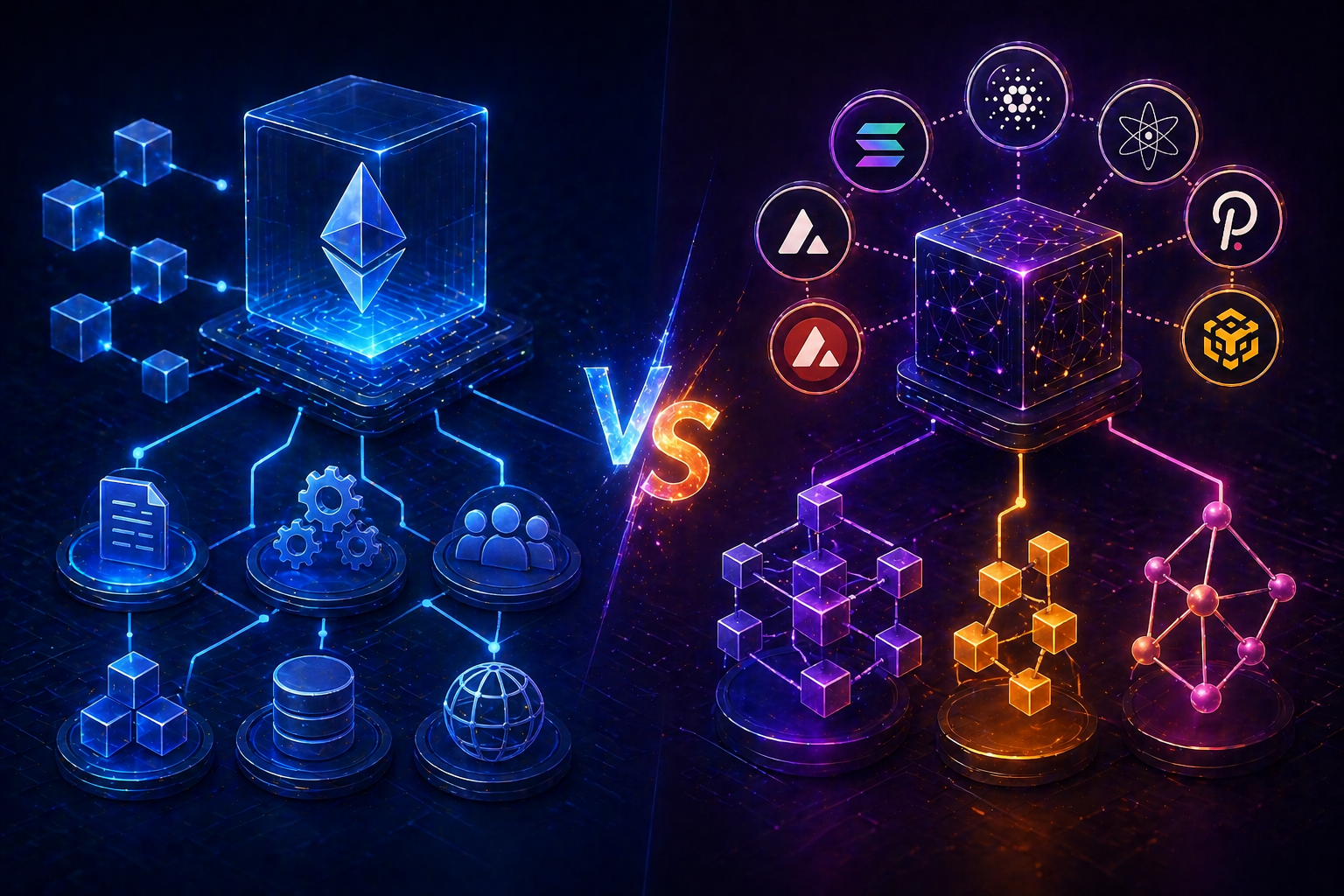
The crypto world isn’t limited to Ethereum alone. Giants like Solana, Near, and Aptos have intentionally moved away from using the ethereum virtual machine. It’s like the classic debate between Windows and macOS: each has its own philosophy and loyal fanbase.
Non-EVM blockchains usually chase raw speed. They use their own programming languages, such as Rust or Move, which can handle thousands of transactions per second. But there’s a trade-off: developers have to learn from scratch, and users need to download new wallets. I believe an evm blockchain wins because of its accessibility. It’s like a familiar TV remote: you pick it up and instantly know which buttons to press, even if you’ve just bought a brand-new model.
Future of the Ethereum Virtual Machine
Despite its age, this technology is constantly evolving. Developers realize the old architecture can sometimes be slow and pricey. Right now, the community is working on an update called EOF (EVM Object Format). To put it simply, it’s like a major engine overhaul that makes it more powerful and fuel-efficient without changing how you drive the car.
I’m curious to see how what is evm transforms from an experiment into a truly global standard. In the future, we will likely see even deeper integration with L2 solutions (layer 2 scaling), where transactions cost fractions of a cent while maintaining the same security as the main network.
Conclusion
In the end, what is the ethereum virtual machine is far more than just a boring piece of code. It’s the foundation of the entire modern token economy. It gave us the chance to trust code more than we trust people’s promises.
Yes, it has its flaws and strong competitors. But today, the EVM is where the most money, ideas, and talent are concentrated. If you want to understand where the future of the internet is headed, knowing how this machine works is your best guide.
Published Articles
Crypto On-Ramps and Off-Ramps Explained: How Fiat and Crypto Move In and Out
Entering the world of digital assets often feels like trying to cross...
 Popular
Bitcoin Pizza Guy: The Story Behind the First Real Bitcoin Purchase
Introduction The history of Bitcoin is full of dramatic ups and downs,...
Crypto Basics Explained: A Beginner’s Guide to Cryptocurrency and Trading
Introduction The world of finance is changing right before our eyes. Just...
 Popular
Uniswap Explained: What It Is, How It Works, and How to Use the UNI DEX
Introduction Decentralization and decentralized platforms that have emerged in recent years have...
 Popular
Bitcoin Lightning Network Explained: What It Is and How Bitcoin Lightning Works
Introduction In the world of cryptocurrency, transaction speed and costs have always...

How Bitcoin ATMs Work: A Complete Guide to Using Crypto ATMs
Introduction Millions of people around the world use cryptocurrencies today – at...