
How Bitcoin Transactions Work: A Comprehensive Guide to Bitcoin Transfers, Security, and Verification
Introduction
Here is the paragraph with the key phrase bitcoin transactions integrated naturally. I also adjusted the structure to maintain a smooth flow and avoid passive constructions as in the previous tasks.
Every time someone sends Bitcoin, a chain of events unfolds across the network — invisible to the user, but technically intricate. No bank verifies a balance or authorizes a transfer. No central server keeps the ledger. Instead, thousands of computers around the world reach agreement in seconds that the transaction is valid.
This is what makes bitcoin transactions fundamentally different. A BTC transfer is not simply moving money. It is a cryptographically signed message that a decentralized network verifies, propagates, and permanently records. Understanding how a Bitcoin transaction works means understanding why this system operates without intermediaries — and why it is so difficult to compromise.
What Is a Bitcoin Transaction?
A Bitcoin transaction is a digital record of BTC being transferred from one address to another, signed with a cryptographic key and recorded in the blockchain. That is the core definition, but several important nuances sit beneath it.
First, a BTC transaction is not the movement of “coins” in the conventional sense. Wallets do not store Bitcoin like a file. Instead, the blockchain maintains the complete history of all transactions. A wallet’s balance represents the sum of all unspent outputs (UTXOs) linked to its address. When you send BTC, you are essentially “spending” those outputs and creating new ones.
Second, what is a Bitcoin transaction from a structural perspective? It is a data package: inputs (where the BTC comes from), outputs (where the BTC goes), a digital signature, and metadata. Each transaction references previous ones — forming a continuous chain that cannot be falsified without recalculating the entire history.
Third, a Bitcoin transaction only reaches finality once a block includes it. Until that point, it sits in the mempool — a queue of pending transactions — where a miner can technically replace it or leave it out.

How Does a Bitcoin Transactions Work?
Creating a Transaction
Everything begins in the wallet. The user specifies the recipient’s address, the amount, and optionally the fee size. The wallet automatically selects which UTXOs to use as inputs — much like choosing banknotes when paying with cash.
If the total input amount exceeds the transfer amount plus the fee, the wallet creates “change” — an additional output directed back to the sender’s address. This is standard mechanics: a Bitcoin transaction must fully “spend” all selected inputs.
At this stage the transaction has not been sent yet — it is constructed locally and awaits a signature.
Signing With a Private Key
Before broadcasting, the transaction is signed with the wallet’s private key. This is a cryptographic operation based on the ECDSA algorithm (Elliptic Curve Digital Signature Algorithm): the private key generates a unique signature for this transaction, which any network participant can verify using the corresponding public key.
The signature serves two functions simultaneously. It confirms that the sender controls the private key to the specified address — meaning they have the right to spend those funds. And it is bound to the specific transaction data: changing even a single byte invalidates the signature. This protects the transaction from modification in transit.
Importantly, the private key is never exposed and never leaves the device. The network receives only the signature and the public key — sufficient for verification.
Broadcasting to the Network
The wallet broadcasts the signed transaction to the Bitcoin network, starting with the nearest known nodes. Each node checks the transaction against a set of rules: it validates the signature, ensures no one has spent these UTXOs, and confirms the format meets network standards.
If the transaction passes these checks, the node forwards it to neighboring nodes. The network uses the gossip protocol: information spreads through the network in a cascade, and within seconds thousands of nodes worldwide see the transaction.
Once in the mempool, the transaction waits for a miner to include it in a block. Fee size determines priority: a higher fee rate (satoshis per byte) ensures miners process the transaction faster.
What Supports Bitcoin Transactions?
Bitcoin Nodes
Nodes form the foundation of Bitcoin’s infrastructure. A full node stores a complete copy of the blockchain and independently verifies bitcoin transactions and blocks against protocol rules — trusting no one, including miners and other nodes.
Tens of thousands of nodes operate on the network to make decentralization a reality. Changing protocol rules requires convincing the majority of them to accept the update. This structure makes attacks on the protocol extremely costly and politically difficult.
Light clients (SPV wallets) do not store the full blockchain; instead, they delegate the verification of bitcoin transactions to full nodes. This offers convenience for mobile applications but results in a lower level of self-verification.
Miners and Proof of Work
Miners collect transactions from the mempool and assemble blocks. To add a block to the blockchain, a miner must solve a computational puzzle: find a number (nonce) such that the hash of the block header falls below a target value. This is Proof of Work.
The puzzle is deliberately constructed so that it can only be solved by brute force — requiring enormous computing power. But verifying the solution takes a fraction of a second. The miner who finds the solution receives the block reward plus all fees from the included transactions.
The difficulty adjusts automatically every 2,016 blocks, keeping the average block time around 10 minutes — regardless of total network hashrate.
Blockchain Consensus
When a miner finds a block, it broadcasts the block to the network. Nodes verify it: is the Proof of Work valid, are all transactions inside valid, does the block comply with all protocol rules. If everything checks out, the block is accepted and added to the chain.
The “longest chain” rule — more precisely, the chain with the greatest accumulated difficulty — determines which version of the blockchain is canonical. This mechanism makes retroactive alteration of transaction history practically impossible: rewriting a block from the past would require recalculating all the Proof of Work built on top of it, while the network continues moving forward.
Main Parts of a BTC Transactions
Every Bitcoin transaction consists of several required components. Understanding their structure clarifies why transactions behave the way they do.
Inputs — references to unspent outputs from previous transactions (UTXOs). Each input contains: txid (the identifier of the previous transaction), vout (the output index in that transaction), and scriptSig or witness (data to unlock the funds, including the signature).
Outputs — specify where and how much BTC goes. Each output contains an amount and a scriptPubKey — the condition a future recipient must satisfy to spend those funds.
Fee — not explicitly stated in the transaction structure. It is the difference between the total of all inputs and the total of all outputs. The miner collects it as a reward for including the transaction in the block.
Version and locktime — technical fields that define the transaction format and set the minimum time or block height required for a miner to include the transaction.
Transaction identifier (txid) — the SHA256d hash of the transaction data. This is how a transaction is found in a block explorer.
Bitcoin Transaction Validation
Validation is a multi-level process occurring at individual nodes. It also happens across the entire network when a transaction enters a block.
First, a node checks the syntax and structure. It verifies if the transaction size is valid or if it is a duplicate.
Second, the network verifies the logic of the referenced UTXOs. It ensures they are unspent and that the signature matches the public key.
Third, when including the transaction in a block, the miner and all nodes verify it in context: checking Proof of Work validity, reward limits, and the absence of conflicting transactions.
After a transaction is included in a block, each subsequent block on top adds one “confirmation.” Standard practice: 1 confirmation is sufficient for small amounts, 6 confirmations for large transfers. Six confirmations mean that to reverse the transaction, an attacker would have to recalculate six blocks faster than the rest of the network adds the next one — which is practically impossible at current hashrates.
Why Bitcoin Transactions Can Be Slow
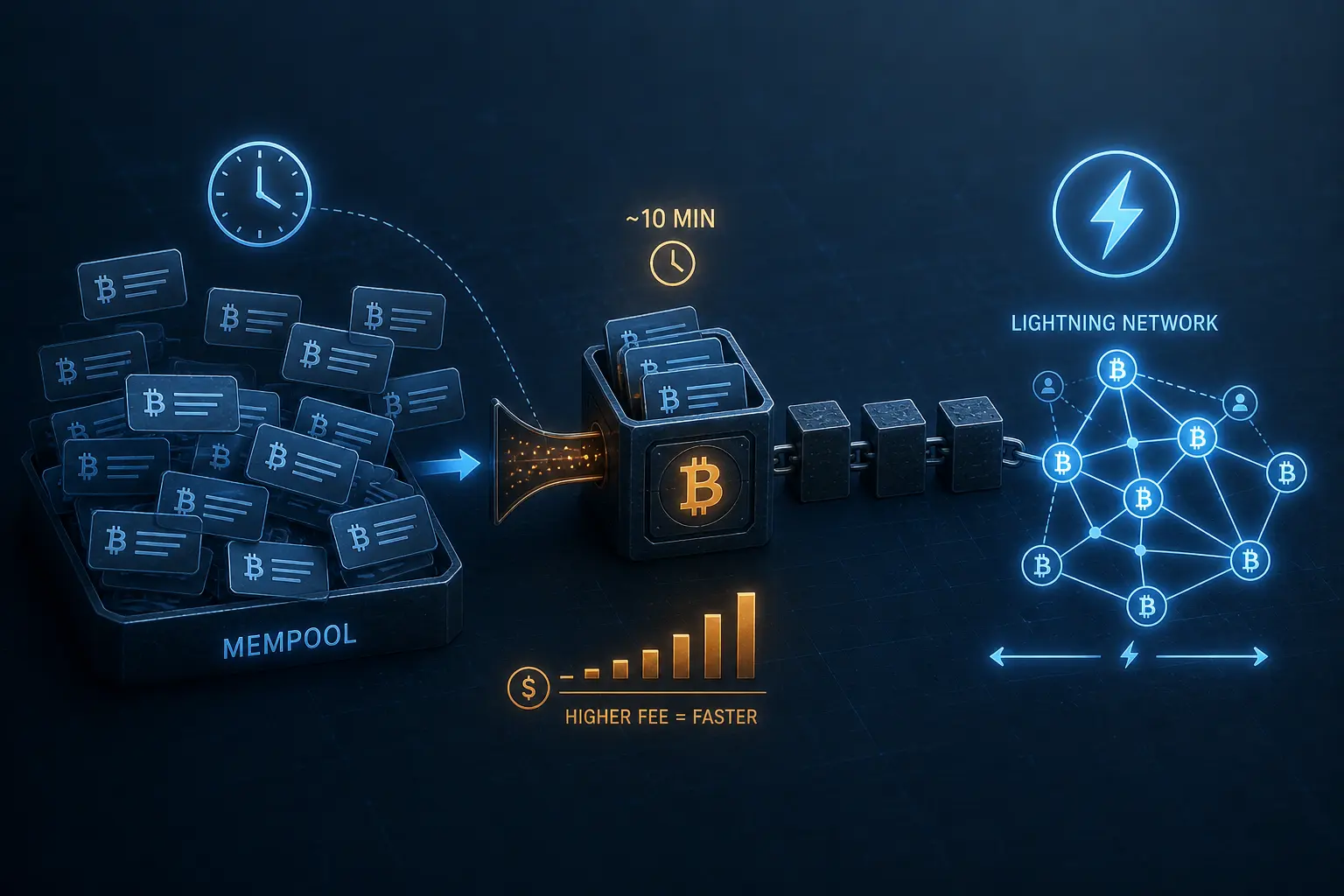
The average block time in Bitcoin is around 10 minutes. This is an architectural choice, not a technical limitation: that interval balances confirmation speed against consensus stability.
But block time is not the only source of delay. The primary variable is mempool congestion. Each Bitcoin block has a limited size (roughly 1–4 MB accounting for SegWit). When there are more transactions in the mempool than fit in the next few blocks, a queue forms — and low-fee transactions may wait hours or even days.
During high-activity periods — major market moves, hype around new protocols — fees spike sharply. In May 2023, during the Ordinals inscription boom, the average transaction fee exceeded $30. A month later it was back to $1–2. Bitcoin’s fee market works like an auction: whoever pays more gets into the next block faster.
Layer 2 technologies — above all the Lightning Network — address this by moving most payments off the main blockchain. Lightning enables near-instant transactions with minimal fees, while the on-chain ledger only records the opening and closing of a payment channel.
Common Bitcoin Transactions Problems
Stuck transaction. User sends a transaction, but it remains unconfirmed for hours or days. The cause stays almost always the same: the fee fell below the minimum level miners currently accept during network congestion. Solutions: Replace-By-Fee (RBF) — if the wallet supports it, the user sends a new version of the same transaction with a higher fee. Child-Pays-For-Parent (CPFP) — the user creates a new transaction spending the output of the stuck one. This new transaction includes a fee high enough to pull both through.
Wrong recipient address. Bitcoin transactions are irreversible. Users lose funds they send to a non-existent address. Only the owner of an address can return funds that a sender accidentally transferred to them. Address formats (base58check, bech32) include a checksum that protects against most typos, but not against a full address substitution.
Double spend. An attempt to use the same UTXOs in two transactions simultaneously. Nodes reject the second of two conflicting transactions upon receipt. However, both versions may end up in the mempool — and the miner will include only one in a block. This is a risk when accepting unconfirmed transactions as payment.
Dust attacks. Sending minimum amounts (dust) to many addresses for de-anonymization: if the recipient combines these UTXOs with others in a single transaction, the attacker may establish links between addresses. Modern wallets can flag and ignore dust UTXOs.
Key Takeaways
- A Bitcoin transaction represents a cryptographically signed record of a BTC transfer. The decentralized network of nodes and miners verifies this record before the blockchain permanently stores it.
- The UTXO model proves that wallets do not “store” Bitcoin. Instead, the wallet manages the right to spend unspent outputs from previous transactions.
- A private key signature confirms the right to spend funds. It protects the transaction from modification without ever revealing the key itself.
- Mempool congestion and fee size determine confirmation speed. A higher fee rate ensures the transaction enters a block faster.
- The community considers six confirmations sufficient finality for large amounts. By that point, a retroactive attack becomes practically impossible.
- Users resolve stuck transactions through RBF or CPFP. Unfortunately, the network cannot recover funds sent to a wrong address.
Expert Insight
The Bitcoin Core documentation describes the transaction verification process as deliberately conservative: each node independently verifies every transaction and every block against the complete set of protocol rules, relying on trust in no other network participant.
This architectural decision is a feature, not a bug. In a system with no central arbiter, the only way to establish trust is to make verification cheap for everyone and expensive to cheat. This is why a Bitcoin node running on an ordinary computer can independently confirm the validity of every transaction in the network’s entire history — going all the way back to the Genesis block.
Conclusion
A Bitcoin transaction is an elegant engineering solution to a problem long considered unsolvable: how to transfer value between strangers without a trusted intermediary. Cryptographic signatures, the UTXO model, Proof of Work, and network consensus work together as a single system in which each element reinforces the reliability of the others.
Understanding how a BTC transaction works means understanding why Bitcoin resists censorship, forgery, and centralized control. This resistance stems from mechanics, not marketing: thousands of independent participants verify every transfer, and no single actor can alter the outcome.
More Questions
A Bitcoin transaction digitally records BTC moving between addresses. The sender signs it with a private key, while the network verifies the transfer. Using the UTXO mechanism, transactions reference previous ones before the blockchain permanently stores the confirmed data.
The wallet creates and signs a transaction before broadcasting it. Nodes verify the data and update the mempool. Miners include the transaction by solving Proof of Work. Each new block adds confirmations, making the transfer increasingly irreversible for the network.
The average time for one confirmation is around 10 minutes. However, with high mempool congestion, low-fee transactions may wait significantly longer. For small amounts, 1–3 confirmations are typically sufficient; for large transfers, 6 or more.
UTXO represents an unspent output from a previous transfer. A wallet’s balance equals the sum of all UTXOs linked to its addresses. When sending funds, the wallet spends selected UTXOs entirely, creating new outputs for the recipient and itself.
Three key elements: nodes verify transactions and store the blockchain; miners add transactions to blocks via Proof of Work; and the consensus mechanism uses the accumulated difficulty rule to select the network’s canonical chain version.
RBF lets users replace pending transactions marked as replaceable. Once a block includes the transfer, it becomes irreversible. Only a majority hashrate attack could technically cancel confirmed data.
Published Articles

Crypto On-Ramps and Off-Ramps Explained: How Fiat and Crypto Move In and Out
Entering the world of digital assets often feels like trying to cross...
 Popular
Bitcoin Pizza Guy: The Story Behind the First Real Bitcoin Purchase
Introduction The history of Bitcoin is full of dramatic ups and downs,...

Crypto Basics Explained: A Beginner’s Guide to Cryptocurrency and Trading
Introduction The world of finance is changing right before our eyes. Just...
 Popular
Uniswap Explained: What It Is, How It Works, and How to Use the UNI DEX
Introduction Decentralization and decentralized platforms that have emerged in recent years have...
 Popular
Bitcoin Lightning Network Explained: What It Is and How Bitcoin Lightning Works
Introduction In the world of cryptocurrency, transaction speed and costs have always...
How Bitcoin ATMs Work: A Complete Guide to Using Crypto ATMs
Introduction Millions of people around the world use cryptocurrencies today – at...