
How to Mine Vertcoin (VTC): A Complete Beginner’s Guide
Introduction to Vertcoin Mining
Vertcoin exists because of a specific philosophical position: cryptocurrency mining should remain accessible to ordinary people with regular computer hardware. Most proof-of-work coins have seen their mining networks gradually captured by specialized ASIC machines — expensive, purpose-built hardware that small operators can’t afford. Vertcoin’s developers made a deliberate choice to fight this trend through algorithm design.
Mining Vertcoin means participating in a network that prioritizes decentralization. It has repeatedly updated its core hashing algorithm specifically to prevent ASIC dominance. This isn’t a passive policy. Vertcoin forked to Lyra2REv3 in 2018 and then to Verthash in 2020 to target ASIC threats. The result is a network where a gaming GPU remains competitive in 2026. Such accessibility is genuinely rare in today’s proof-of-work mining landscape.
This guide covers what Vertcoin is and how to mine it step by step. We examine the hardware and software you need, profitability calculations, and the future of the network. The process is more approachable than most mining guides suggest. This remains true whether you are an experienced GPU miner or new to the field entirely.
How Vertcoin Differs from Bitcoin and Other Cryptocurrencies
Vertcoin launched in 2014 as a direct response to the ASIC problem that was already visible in Bitcoin mining at the time. David Muller and a small team designed it with one hard constraint: the mining algorithm would always be changed if ASICs were ever developed that could efficiently run it. That constraint separates Vertcoin from virtually every other major proof-of-work coin.
The differences go beyond the mining algorithm. Vertcoin has a maximum supply of 84 million coins — four times Bitcoin’s 21 million cap. Its block time targets 2.5 minutes rather than Bitcoin’s 10-minute average, which means transactions receive their first confirmation faster. The halving interval is also different: Vertcoin halves every 840,000 blocks compared to Bitcoin’s 210,000-block cycle.
Perhaps more significant than any technical parameter is the community governance model. Vertcoin has no corporate backing, no pre-mine, and no founder allocation. Decisions about the protocol — including algorithm changes — are made through community consensus rather than by any controlling entity. This open governance is precisely what allowed the network to fork twice to defend against ASICs.
Comparison of Vertcoin vs. Bitcoin:
| Feature | Vertcoin (VTC) | Bitcoin (BTC) |
| Algorithm | Verthash | SHA-256 |
| Block time | ~2.5 minutes | ~10 minutes |
| ASIC resistance | Yes — by design | No — dominated by ASICs |
| Mining hardware | GPU (consumer cards) | Specialized ASIC machines |
| Block reward | 25 VTC (as of 2026) | 3.125 BTC (post-2024 halving) |
| Max supply | 84 million | 21 million |
| Halving interval | Every 840,000 blocks | Every 210,000 blocks |
Understanding Vertcoin’s Mining Algorithm
What Is the Lyra2REv3 Algorithm?
Lyra2REv3 was Vertcoin’s intermediate algorithm, introduced in 2018 as a response to ASICs that had been developed for the previous Lyra2RE algorithm. Lyra2REv3 used a password-based key derivation framework that made parallel processing expensive, specifically targeting the ASIC design principle of running thousands of simplified operations simultaneously.
The algorithm required memory bandwidth in a way that GPU architecture handles naturally but ASIC design struggles with. Memory-hardness is the technical term for this property — the algorithm’s memory access patterns were unpredictable enough that brute-force parallelization didn’t provide the efficiency gains ASICs normally achieve over GPUs.
Lyra2REv3 worked for about two years before credible ASIC development threats emerged. Rather than watching the network slowly centralize as happened with Bitcoin and Litecoin, the Vertcoin community voted to move again — this time to Verthash, which is the current algorithm as of 2026.
How Lyra2REv3 Makes Vertcoin ASIC-Resistant
The ASIC-resistance mechanism in both Lyra2REv3 and the current Verthash algorithm comes from deliberately imposing costs that favor general-purpose hardware. Specifically, the algorithm accesses a large, slowly-built memory structure called the DAG-like scratchpad. Creating this structure takes time proportional to memory bandwidth, and reading from it efficiently requires the kind of cache architecture that gaming GPUs have and ASICs typically don’t.
Verthash, which replaced Lyra2REv3 in 2020, intensified this approach. The algorithm reads from a 1.2 GB data file that must be stored in GPU VRAM during mining. This file is too large to fit in the on-chip memory that an ASIC would typically use, forcing any hardware trying to run the algorithm to have substantial DRAM — which significantly increases ASIC manufacturing cost and erodes the efficiency advantage that makes ASICs economically attractive.
The practical effect is measurable: a mid-range gaming GPU running Verthash in 2026 competes meaningfully with any specialized hardware that might be developed, because the algorithm’s memory requirements impose costs that can’t be engineered away through chip design alone. This is the engineering foundation of Vertcoin’s decentralization philosophy.
GPU Mining vs. CPU Mining for Vertcoin
CPU mining for Vertcoin is theoretically possible but practically pointless in 2026. Modern CPUs can run the Verthash algorithm, but they produce hashrates in the range of 100–500 H/s — orders of magnitude below what a mid-range GPU achieves. Even an integrated graphics chip outperforms a CPU for Verthash due to the memory bandwidth differences between CPU and GPU architecture.
GPU mining is the correct approach. An NVIDIA RTX 3070 produces approximately 350-400 KH/s on Verthash. An RTX 4070 reaches around 450-500 KH/s with good efficiency settings. AMD cards perform similarly, with the RX 6700 XT and RX 7700 XT both showing competitive numbers. The key metric for Verthash is memory bandwidth, not raw compute — which means high-memory-bandwidth GPUs outperform raw compute champions.
VRAM matters for a different reason too: the Verthash algorithm requires loading the 1.2 GB data file into GPU memory. Cards with less than 2 GB VRAM cannot run Verthash at all. Practically speaking, any modern gaming GPU with 4 GB or more VRAM is fully capable, and 8 GB+ cards have enough headroom to mine without memory pressure affecting performance.
Getting Started with Vertcoin Mining
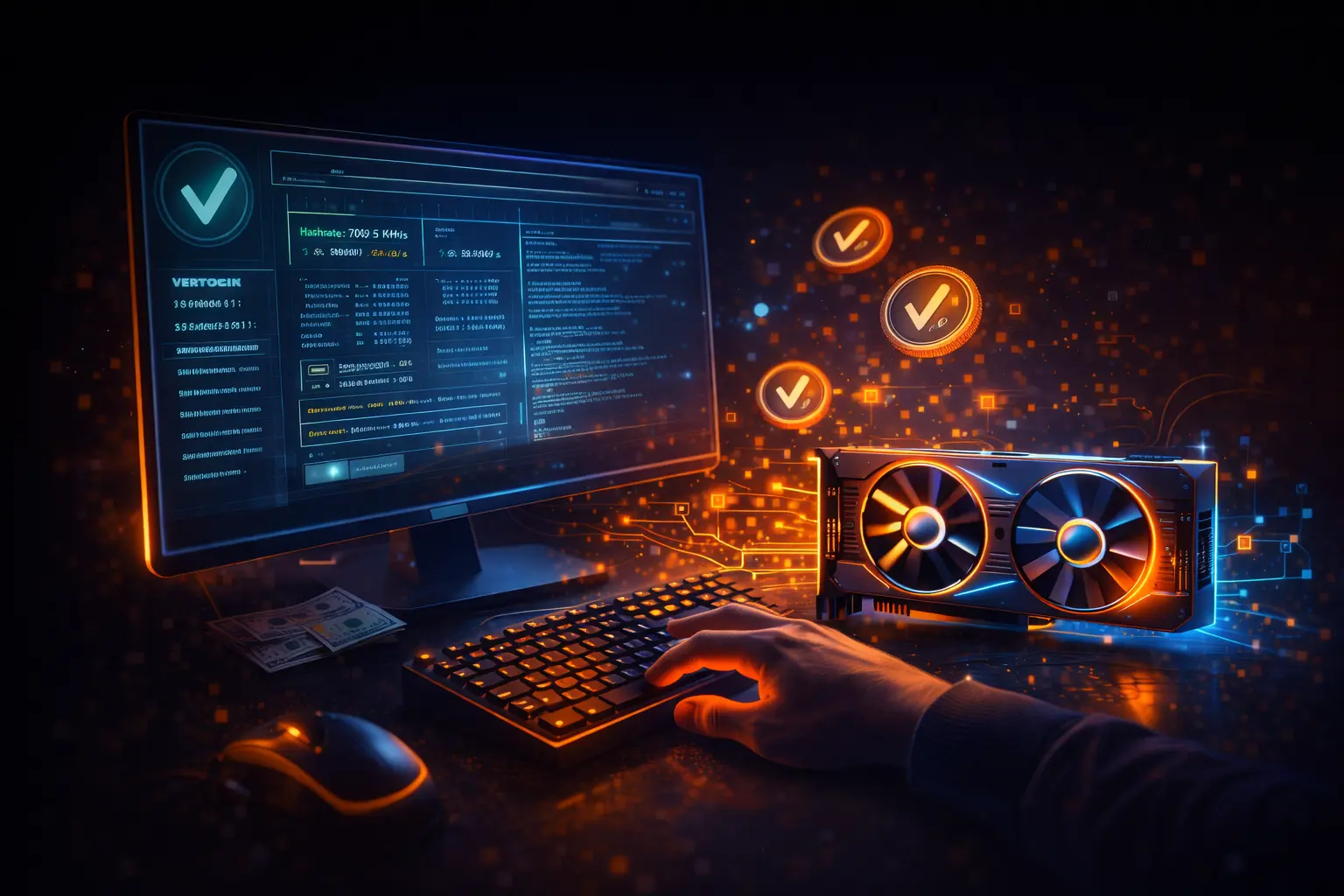
Before the first hash runs, three things need to be in place: a Vertcoin wallet to receive rewards, the right miner software, and a pool or solo mining setup. Each step takes less time than most guides imply.
Download the official Vertcoin Core wallet from vertcoin.org, or use Electrum-VTC for a lightweight option that doesn’t require downloading the full blockchain. After installation, generate a receiving address and back up your wallet file or seed phrase immediately — this is non-negotiable and not something to do later. The address you’ll use looks like a standard cryptocurrency address starting with V.
Pool selection comes next. VTC.community pool, Suprnova’s VTC pool, and Hash Auger are among the consistently maintained options in 2026. The pool’s fee structure (typically 0.5–1%), its minimum payout threshold, and its current connected hashrate all matter for your mining economics. Joining a larger pool reduces variance in payout timing; smaller pools pay less frequently but each payout is larger when it comes.
Setting Up Your Vertcoin Mining Rig
Installing GPU drivers is the foundation. Use the most recent stable drivers from NVIDIA or AMD’s official site — avoid beta drivers for mining, as stability matters more than cutting-edge features. After driver installation, download one of the compatible Verthash miners: Vertcoin One-Click Miner (OCM) handles configuration automatically and is the recommended starting point for beginners. Alternatively, experienced miners use Teamredminer (for AMD) or NBMiner/T-Rex (for NVIDIA) for more granular control.
Configure the miner by entering your pool’s stratum URL, your wallet address, and a worker name. The worker name is arbitrary — most miners use a descriptive label like their hostname or GPU type. The pool’s getting-started page will provide the exact stratum address and port number to use. Double-check the wallet address before starting; a single character error sends rewards to an unrecoverable address.
Overclocking and power tuning make a significant difference to mining economics. Verthash is memory-bandwidth-limited, so memory overclocking typically yields more hashrate improvement than core clock increases. Power limits reduced to 60–70% of TDP while maintaining memory clocks often produce the optimal efficiency ratio — more hashes per watt, which directly improves profitability. MSI Afterburner (for both NVIDIA and AMD) is the standard tool for these adjustments.
Monitor temperatures closely during the first hours of operation. GPU junction temperatures should stay below 90°C; VRAM temperatures below 95°C. Fans should be set to a custom curve rather than left on auto — adequate cooling extends GPU lifespan substantially. If temperatures are borderline, improving case airflow or reapplying thermal paste yields better results than reducing clocks.
How to Calculate Vertcoin Mining Profitability
Three variables dominate Vertcoin mining profitability: your GPU’s hashrate on Verthash, your electricity cost per kWh, and the current VTC price. Secondary variables include pool fee, network difficulty, and whether you’re using the mined VTC immediately or holding it.
CoinWarz and WhatToMine both support Verthash calculations with real-time network difficulty data. Enter your GPU’s hashrate (in KH/s), your power draw (from your monitoring software), and your electricity rate. The calculator returns estimated daily and monthly VTC earnings before and after electricity costs. At $0.10/kWh and an RTX 3070 with a 100W power draw after tuning, most calculators in 2026 show the operation either marginally profitable or marginally unprofitable depending on VTC’s daily price — typical for small proof-of-work coins.
The VTC price volatility matters enormously. Vertcoin has historically traded between $0.05 and $3.00+ across different market conditions, and hashrate profitability swings dramatically across this range. Miners who treat VTC as a speculative asset — mining and holding during bear markets, selling during peaks — have fared better than those who immediately sold all rewards at spot price. This isn’t financial advice, it’s an observation from the network’s 10-year history.
Hardware ROI is the other side of the equation. Mining with hardware you already own for gaming or other purposes carries zero additional hardware cost, making electricity the only incremental expense. Purchasing a GPU specifically for Vertcoin mining is harder to justify: even at favorable electricity rates, VTC’s market cap and liquidity make payback period projections highly speculative. Purpose-built mining rigs make more economic sense if running multiple revenue streams across different algorithms.
Common Issues and Troubleshooting Tips
Why Is My Miner Running Slow?
Low hashrate relative to expected performance usually has one of three causes: incorrect software configuration, thermal throttling, or driver issues. First, verify that the miner is actually using the GPU and not falling back to CPU mode — this shows up in the miner’s output as the device name and should show your GPU model, not CPU. Second, check whether the Verthash data file has been fully generated — partial generation produces errors or reduced throughput. Third, confirm your memory overclock is stable; unstable memory clocks cause hardware errors that reduce effective hashrate even if the reported hashrate looks normal.
Why Is My GPU Overheating?
Overheating during Vertcoin mining almost always traces to one of three sources: inadequate airflow in the mining environment, a fan curve not set aggressively enough, or dried-out thermal paste on an older GPU. Check ambient temperature first — mining in an environment above 30°C significantly limits how much heat the GPU can shed. Fan curves should be custom-set to run at 70–80% speed during mining loads rather than using the default auto curve that ramps slowly. For GPUs more than three years old, replacing thermal paste and thermal pads often recovers 15–20°C of junction temperature, which directly enables higher stable clocks.
Why Am I Not Getting Rewards?
Pool mining rewards require patience proportional to your share of the pool’s hashrate. If your GPU represents 0.1% of the pool’s total hashrate and the pool finds a block every 10 minutes, your expected payout interval is over 160 hours — but this is an average, not a guarantee. Short-term variance is normal. Check the pool’s dashboard to confirm your worker is showing online and submitting shares. Shares accepted by the pool are the immediate indicator of correct operation; rewards follow from the pool’s block finds and your share contribution.
Rejected shares usually indicate a stratum configuration error or a miner software issue. Verify that your pool address, port, and wallet address are all entered correctly. Some pools require password fields even when set to arbitrary values — check the pool’s documentation. Stale shares indicate network latency between your miner and the pool; switching to a geographically closer pool server reduces stale share rate.
Future of Vertcoin Mining
Vertcoin’s future as a mining coin hinges on a tension that’s been present since its founding: maintaining ASIC resistance requires ongoing developer effort and community coordination, while the coin’s market cap and developer activity have both declined from their 2018 peaks. The fundamentals of the argument for Vertcoin haven’t changed, but the competitive landscape has.
The Verthash algorithm has remained secure through 2026 without credible ASIC threats materializing. This is partly because Vertcoin’s market cap doesn’t justify the multi-million dollar investment that ASIC development requires — a perverse protection that comes from being a smaller coin. Bitcoin’s market cap makes ASIC development extremely profitable; Vertcoin’s market cap makes it marginal at best.
Development activity on the Vertcoin GitHub remained positive through 2025, with protocol improvements and wallet updates. The community maintains the infrastructure needed for mining: pool software, explorer, and wallet clients. Whether this constitutes enough developer momentum for long-term viability is genuinely uncertain — honest assessment requires acknowledging that Vertcoin competes in a crowded altcoin space without the liquidity advantages of major coins.

Key Factors to Watch in Vertcoin’s Future:
- Algorithm security — whether Verthash remains ASIC-resistant or faces a credible hardware threat that forces another fork. Historical precedent says Vertcoin will fork if needed, but each fork carries coordination risk.
- Network hashrate trends — rising hashrate indicates growing miner participation and network security; sustained decline suggests economic or technical problems discouraging participation.
- Development activity — GitHub commits, pull requests, and community forum activity on Reddit (r/vertcoin) and Discord indicate whether the project has active maintenance.
- Exchange listings and liquidity — Vertcoin’s tradability on major and mid-tier exchanges determines whether mining rewards can be converted efficiently. Delisting from exchanges would significantly affect miner economics.
- Layer-2 and DeFi integration — whether Vertcoin develops additional use cases beyond simple peer-to-peer transactions will influence long-term demand and price stability.
Key Takeaways
- Vertcoin uses Verthash, a memory-hard algorithm specifically designed to prevent ASIC mining and keep GPU miners competitive. Any GPU with 2+ GB VRAM can participate.
- The block time is 2.5 minutes with a 25 VTC block reward as of 2026, and the network has a maximum supply of 84 million coins — four times Bitcoin’s cap.
- Profitability depends heavily on electricity cost and VTC price. At current difficulty levels, profitable mining typically requires electricity below $0.10/kWh or VTC prices above recent averages.
- Pool mining is strongly recommended for consistent rewards. Solo mining with a single GPU produces extremely infrequent block finds given network difficulty.
- Verthash requires 1.2 GB of GPU VRAM for the mining data file, meaning cards with less than 2 GB VRAM cannot participate at all.
- Vertcoin’s community maintains a commitment to re-forking if ASICs threaten the network — the defining feature that separates it from most proof-of-work coins.
Expert Insight
According to CoinWarz’s mining analytics team: Vertcoin consistently shows one of the most geographically distributed hashrate patterns among proof-of-work coins they track — a direct result of its ASIC-resistance preventing the hashrate concentration that occurs when industrial mining farms dominate networks. This distribution means the network is genuinely resistant to the geographic and regulatory risks that affect Bitcoin and other ASIC-dominated coins.
This observation aligns with Vertcoin’s founding goals. A network where mining is distributed across thousands of individual GPU miners in dozens of countries is meaningfully harder to regulate, ban, or capture than one where the majority of hashrate sits in a handful of industrial facilities. Whether that property is worth the tradeoffs in liquidity and developer activity is the central question for anyone considering mining vertcoin in 2026.
Conclusion
Vertcoin occupies a specific niche: a proof-of-work coin that has actively maintained GPU-accessible mining through deliberate algorithm choices for over a decade. Mining vertcoin with a modern GPU is genuinely possible in 2026, which is more than can be said for most major proof-of-work coins where GPU mining was effectively obsoleted years ago.
The economics are challenging. Profitability depends on electricity cost, VTC price, and network conditions that change continuously. Hardware you already own makes the calculation much more favorable than purchasing equipment specifically for this purpose. Pool mining with careful power tuning represents the rational approach for most participants.
Vertcoin’s future depends on continued developer engagement and whether the ASIC-resistance philosophy attracts enough network participants to keep the project viable long-term. For miners who believe in that philosophy — or who simply want a GPU mining outlet for hardware they already have — the technical setup is straightforward and the community documentation is better than average.
FAQ
How to mine Vertcoin?
Mining Vertcoin requires a GPU with at least 2 GB VRAM, a Vertcoin wallet address, and compatible mining software. Download a VTC wallet from vertcoin.org, register on a mining pool like VTC.community or Suprnova, then install a Verthash-compatible miner such as Vertcoin One-Click Miner, Teamredminer, or T-Rex. Configure the software with your pool’s stratum address and your wallet address, then start mining. The Verthash algorithm will generate a 1.2 GB data file on first run; subsequent starts are faster.
Is mining Vertcoin profitable?
Profitability depends on your electricity cost and the current VTC price. Use CoinWarz or WhatToMine to enter your GPU’s Verthash hashrate, power consumption, and electricity rate for a current estimate. At $0.10/kWh, most mid-range GPUs in 2026 sit near breakeven on Vertcoin mining. Lower electricity costs or higher VTC prices shift the calculation toward profitable; higher electricity rates make it unprofitable regardless of hardware.
What algorithm does Vertcoin use?
Vertcoin currently uses Verthash, a memory-hard proof-of-work algorithm introduced in 2020 that replaced Lyra2REv3. Verthash requires accessing a 1.2 GB data file from GPU VRAM during mining, making it impractical for ASIC hardware and keeping GPU mining competitive. The algorithm was specifically designed so that Vertcoin developers can update it again if ASIC development ever threatens GPU miners’ competitive position.
What VTC wallet should I use?
Vertcoin Core (available at vertcoin.org) is the full-node wallet and the most secure option — it downloads the complete blockchain, which takes time and disk space but provides maximum verification. Electrum-VTC is a lightweight alternative that connects to existing nodes without requiring a full blockchain download, which is more convenient for most users. Either wallet generates a standard VTC receiving address that works with any mining pool.
Pool vs. solo mining Vertcoin — which is better?
Pool mining is strongly recommended for anyone with a single GPU or small number of GPUs. Solo mining requires finding an entire block yourself, which at typical single-GPU hashrates would take many months on average at current network difficulty. Pool mining earns proportional rewards from every block the pool finds, producing much more consistent income. The pool fee of 0.5–1% is a small cost compared to the dramatically reduced payout variance.
Published Articles
Crypto On-Ramps and Off-Ramps Explained: How Fiat and Crypto Move In and Out
Entering the world of digital assets often feels like trying to cross...
 Popular
Bitcoin Pizza Guy: The Story Behind the First Real Bitcoin Purchase
Introduction The history of Bitcoin is full of dramatic ups and downs,...
Crypto Basics Explained: A Beginner’s Guide to Cryptocurrency and Trading
Introduction The world of finance is changing right before our eyes. Just...
 Popular
Uniswap Explained: What It Is, How It Works, and How to Use the UNI DEX
Introduction Decentralization and decentralized platforms that have emerged in recent years have...
 Popular
Bitcoin Lightning Network Explained: What It Is and How Bitcoin Lightning Works
Introduction In the world of cryptocurrency, transaction speed and costs have always...
How Bitcoin ATMs Work: A Complete Guide to Using Crypto ATMs
Introduction Millions of people around the world use cryptocurrencies today – at...