
Impermanent Loss in DeFi: What It Is and How Liquidity Providers Can Manage It
Introduction
In DeFi, participating in liquidity pools has long been one of the most popular ways to generate passive income. However, alongside trading fees and rewards, liquidity providers also face a risk that many discover too late. Most call this risk impermanent loss—a factor that often disappoints DeFi newcomers.
At first glance, the question what is impermanent loss may seem abstract and complex, but in reality it is a basic economic effect that nearly every liquidity pool participant encounters on a regular basis. The term itself is misleading, as the word “impermanent” suggests a temporary inconvenience that should resolve on its own. Because of this, explanations of impermanent loss are often taken at face value, without a clear understanding of the real impact on capital.
In this article, we will take a detailed look at what impermanent loss is, how it occurs, why it can become permanent, how impermanent loss works in liquidity pools, and which strategies help liquidity providers manage this risk rather than ignore it.
What Is Impermanent Loss
In DeFi, returns depend not only on fees and rewards, but also on how asset prices move within a pool. Unlike simple token holding, providing liquidity changes the structure of asset ownership, which is what creates this effect.

Definition of Impermanent Loss
Impermanent loss measures the difference between the value of assets if they were simply held in a wallet and the value of those same assets after withdrawing from a liquidity pool. This difference arises due to the automatic rebalancing of assets within the pool as prices change. In other words, impermanent loss crypto shows how much profit a liquidity provider misses out on compared to passive holding, even if the nominal number of tokens in the pool has increased.
The Meaning of “Impermanent” in the DeFi Context
The term “impermanent” literally means “temporary,” but in DeFi it carries a specific nuance. The meaning of “impermanent” refers to the fact that losses are not realized until liquidity is withdrawn from the pool.
As long as liquidity remains in the pool, the effect can increase or decrease depending on price movements. However, it is important to understand that this temporary nature refers only to the mechanism itself, not to any guarantee of recovery. This is precisely where beginners often underestimate explanations of impermanent loss and approach the risk too optimistically.
Why the Term “Impermanent” Is Misleading
The main issue is that the term creates a false sense of security, suggesting that such “losses” will somehow disappear on their own. In practice, impermanent losses become permanent the moment a liquidity provider exits the pool.
Moreover, if the price of one asset declines significantly and for a prolonged period, losses can become substantial and may not be offset by fees. As a result, many investors face situations where impermanent loss in a liquidity pool fully outweighs the income earned.
How Impermanent Loss Works
To understand why impermanent loss occurs, it is necessary to examine the mechanics of automated market makers and how liquidity pools respond to price changes. Unlike order books, AMMs continuously rebalance assets within the pool to maintain a predefined ratio.
Price Changes and Pool Rebalancing
When the price of one asset rises or falls relative to the other, the pool automatically sells the appreciating asset and buys the depreciating one. This process is exactly what creates impermanent loss crypto.
For example, if one token rises sharply in price, the liquidity provider effectively realizes part of the profit too early, missing out on the full upside. As a result, the explanation of impermanent loss boils down to the fact that the pool always aims to maintain balance, not to maximize LP returns.
AMMs and Liquidity Pool Mechanics
Most major DeFi protocols use the constant product model, where the product of the quantities of two assets remains constant. This formula sits at the core of impermanent loss in liquidity pools.
In practice, the greater the deviation of an asset’s price from its initial level, the more aggressively the pool rebalances and the higher the potential loss compared to simply holding the tokens.
When Impermanent Loss Becomes Permanent
Impermanent losses remain “impermanent” only as long as liquidity stays in the pool. At the moment of withdrawal, the difference between the pool value and the value under passive holding is locked in. If the price has not returned to its original ratio, the loss becomes permanent. This is why impermanent loss in a liquidity pool is particularly dangerous for those who ignore long-term price trends and exit at unfavorable moments.
Impermanent Loss in Liquidity Pools
The effect of impermanent loss is most clearly visible in liquidity pools, where assets are constantly rebalanced in response to market movements. For liquidity providers, it is important to recognize that impermanent loss in a liquidity pool is not a rare exception, but a built-in feature of the AMM model.
Explaining Impermanent Loss in a Liquidity Pool
impermanent loss in a liquidity pool occurs every time the price of one asset in a pair changes relative to the other. The pool automatically adjusts balances, selling the appreciating asset and increasing exposure to the underperforming one. As a result, the liquidity provider ends up holding less of the asset that gained value and more of the asset that performed worse. This is how impermanent loss manifests in practice.
Examples Using ETH/USDC and Other Pairs
One of the clearest examples is the ETH/USDC pair. If the price of ETH doubles, the pool sells part of the ETH and increases the USDC balance. The liquidity provider ends up with less ETH than if they had simply held it, even though the total position value may have increased.
The same effect appears in other pairs. In highly volatile pairs, impermanent loss crypto can quickly exceed fee income, especially when price movements are sharp and one-directional.
Volatility and Its Impact on LPs
Volatility is the key factor that amplifies impermanent loss. The stronger and faster the price movement, the more aggressively the pool rebalances and the larger the gap between pool performance and holding.
For liquidity providers, this means that high-volatility pairs require either higher fees or additional incentives. Without them, impermanent loss can make participation economically unattractive.
Impermanent Loss Formula
Although impermanent loss is often explained intuitively, it has a clear mathematical foundation. The impermanent loss formula allows LPs to quantify how much less profitable providing liquidity was compared to simply holding assets.
The classic formula for impermanent loss in a constant product AMM (x·y = k) is:
Impermanent loss = 2 × √P / (1 + P) − 1
- Where:
P is the price change of the asset relative to the initial level - √P is the square root of the price change.
The formula expresses the percentage difference between the LP’s outcome and simple holding.
- In practice, this means:
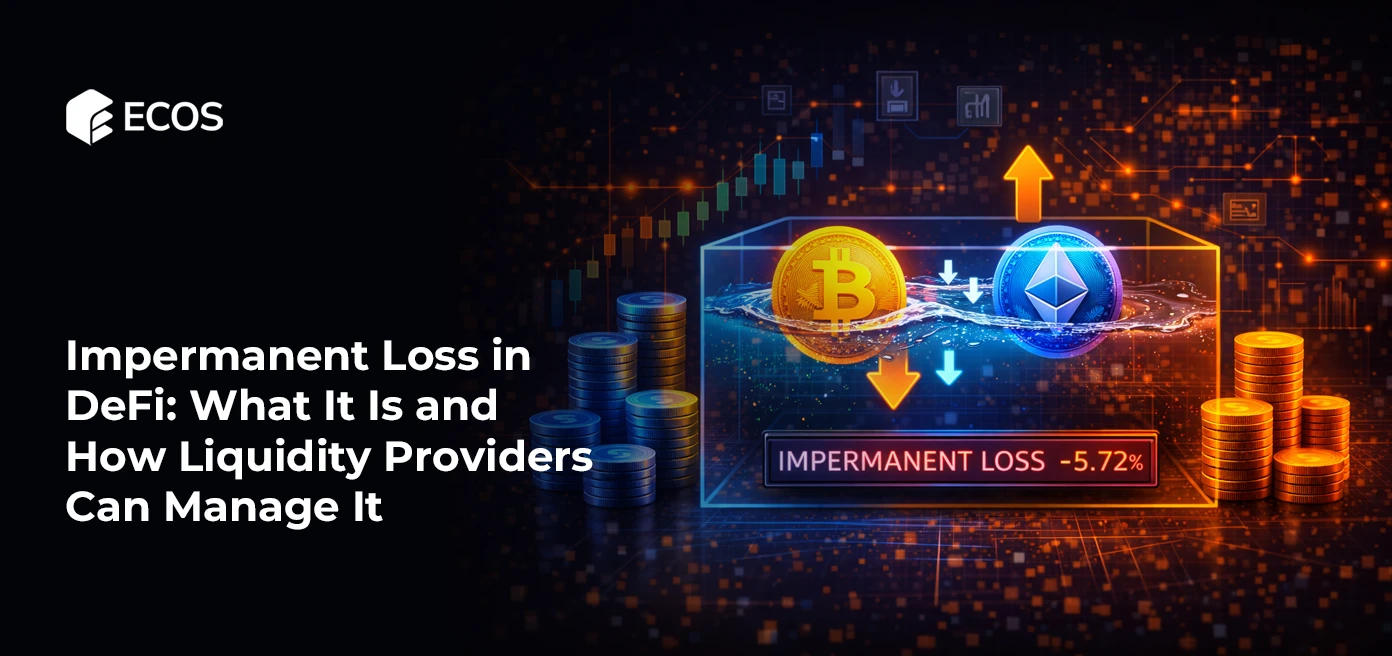
If the price does not change (P = 1), the result is zero – impermanent loss does not occur. - If the price doubles (P = 2), impermanent loss is approximately −5.72%.
- If the price increases fivefold, losses exceed −25% compared to holding.
It is important to emphasize that the formula reflects a relative loss, not an absolute one. Even if the total position value increases, impermanent loss crypto shows how much worse the LP’s result is compared to passive holding.
Factors That Increase Impermanent Loss
The size of impermanent loss is neither random nor equal across pools. It depends directly on several factors that liquidity providers often underestimate when entering DeFi. Understanding these variables helps assess risk in advance and avoid scenarios where impermanent loss crypto fully offsets potential income.
One key factor is asymmetric price movement. When one asset in a pair rises or falls sharply relative to the other, impermanent loss in a liquidity pool increases exponentially. Pairs consisting of a stablecoin and a volatile asset are especially vulnerable.
Another major factor is prolonged deviation from the initial price level. Even if price movement is gradual but sustained, the pool continues rebalancing and accumulating losses. A return to the original price range is the only scenario in which the effect can diminish.
Other contributing factors include:
- high intraday volatility;
- low trading fees in the pool;
- lack of additional LP incentives;
- participation in pools with new or illiquid tokens.
Taken together, these factors make impermanent loss a practical consideration rather than a theoretical risk.
How to Reduce or Manage Impermanent Loss
It is impossible to completely avoid impermanent loss when working with AMMs, but liquidity providers can significantly reduce its impact by choosing the right pools and strategies. Managing this risk is a core skill for anyone treating liquidity provision as a long-term activity.
One basic approach is selecting low-volatility pairs. Pools with stablecoins or assets that historically move in sync generate lower impermanent loss in liquidity pools than pairs with sharp price swings.
The time horizon also matters. Short-term liquidity provision during periods of high volatility often amplifies impermanent loss crypto. Longer participation allows more time for fees to accumulate and potentially offset losses.
Using Concentrated Liquidity
Concentrated liquidity refers to liquidity deployed within a specific price range rather than across all possible prices. This model allows liquidity providers to define price intervals in which their assets are active.
Concentrated liquidity mechanisms enable LPs to limit the price range in which rebalancing occurs, reducing activity outside the chosen range and lowering impermanent loss.
However, this approach requires active position management. If the price moves outside the selected range, liquidity stops earning fees. As a result, concentrated liquidity reduces impermanent loss risk but increases monitoring and strategic demands.
Impermanent Loss, Trading Fees, and Rewards
For liquidity providers, the key question is whether fees and rewards can offset impermanent loss. In many cases they can – otherwise liquidity provision would not be viable. However, the outcome depends heavily on pool structure, asset volatility, and participation strategy.
This is where explanations of impermanent loss move from theory to practical calculation.
When Fees Offset Impermanent Loss
In pools with high trading volume, fees can partially or fully compensate for impermanent loss in a liquidity pool. The more frequently trades occur, the more fees are distributed to LPs.
This works only if:
- volatility remains within reasonable bounds;
- the pool’s fee level matches the risk;
- liquidity is not overly diluted among too many LPs.
Otherwise, even active trading may not prevent impermanent loss crypto from exceeding earned income.
Incentives, Farming, and Token Rewards
Many DeFi protocols offer additional token rewards to attract liquidity. These incentives often mask impermanent loss and create the illusion of high profitability.
However, farming rewards are often temporary and depend on token emissions. They are also prone to sharp price declines. For this reason, impermanent loss in a liquidity pool should be evaluated independently of bonus rewards, not treated as guaranteed compensation.
Long-Term Liquidity Provider Strategies
For long-term LPs, the focus shifts from maximizing short-term yield to building a sustainable strategy. This includes regularly reviewing pools, exiting positions when market dynamics change, and recognizing when impermanent loss is no longer justified.
Over time, success is defined not by the absence of impermanent loss, but by the ability to manage it alongside fees and rewards.
Common Myths and Mistakes
A number of myths surround impermanent loss, distorting risk assessment for liquidity provision. These misconceptions are especially common among newcomers to AMMs and DeFi protocols.
One frequent myth is the belief that impermanent loss in a liquidity pool is “always temporary” and resolves on its own. In reality, this only happens if prices return to their original ratio; otherwise, you realize losses when you exit the position.
Another common mistake is ignoring comparison with holding. Many evaluate LP results solely based on total position value, forgetting that impermanent loss is defined relative to the alternative of passive holding.
Newcomers also often choose highly volatile pools without adequate fees and participate in farming without assessing reward sustainability. Avoiding these mistakes requires a systematic approach to risk and return analysis rather than searching for a “perfect” pool.

Is Impermanent Loss an Acceptable Risk?
Whether impermanent loss is justified has no universal answer. Strategy, investment horizon, and the specific application of liquidity pools determine the outcome. For some, impermanent loss is an unpleasant surprise; for others, it is a deliberate component of yield calculation.
In the short term, participating in high-volatility pools can be unprofitable if fees and rewards fail to offset impermanent loss. Simple holding often performs better under these circumstances. When considering long-term strategies, pools with consistent volume and moderate volatility can effectively neutralize losses through fee accumulation. For experienced LPs, impermanent loss is a managed parameter rather than an unexpected drawback.
The key is awareness and experience. When a liquidity provider understands AMM mechanics, evaluates explanations of impermanent loss, and regularly reviews positions, the risk becomes manageable. Without this, users often perceive impermanent loss as a hidden downside of DeFi, when in fact it represents the cost of accessing decentralized liquidity.
Conclusion
Impermanent loss is not a protocol flaw or a hidden fee, but a natural economic effect embedded in automated market makers. Understanding what is impermanent loss allows liquidity providers to make informed decisions rather than reacting after the fact.
It is important to remember that impermanent loss crypto always exists relative to an alternative – simple asset holding. It does not represent a direct loss, but shows the price LPs pay for participating in liquidity pools and earning fees. This is why explanations of impermanent loss must be considered alongside trading fees, farming rewards, and exit strategies.
For some users, impermanent loss is justified by steady fee income; for others, it signals the need to rethink their DeFi approach. Ultimately, successful liquidity provision is not about avoiding these costs entirely, but about managing them with a clear understanding of mechanics, risks, and limitations.
Published Articles

Crypto On-Ramps and Off-Ramps Explained: How Fiat and Crypto Move In and Out
Entering the world of digital assets often feels like trying to cross...
 Popular
Bitcoin Pizza Guy: The Story Behind the First Real Bitcoin Purchase
Introduction The history of Bitcoin is full of dramatic ups and downs,...

Crypto Basics Explained: A Beginner’s Guide to Cryptocurrency and Trading
Introduction The world of finance is changing right before our eyes. Just...
 Popular
Uniswap Explained: What It Is, How It Works, and How to Use the UNI DEX
Introduction Decentralization and decentralized platforms that have emerged in recent years have...
 Popular
Bitcoin Lightning Network Explained: What It Is and How Bitcoin Lightning Works
Introduction In the world of cryptocurrency, transaction speed and costs have always...

How Bitcoin ATMs Work: A Complete Guide to Using Crypto ATMs
Introduction Millions of people around the world use cryptocurrencies today – at...